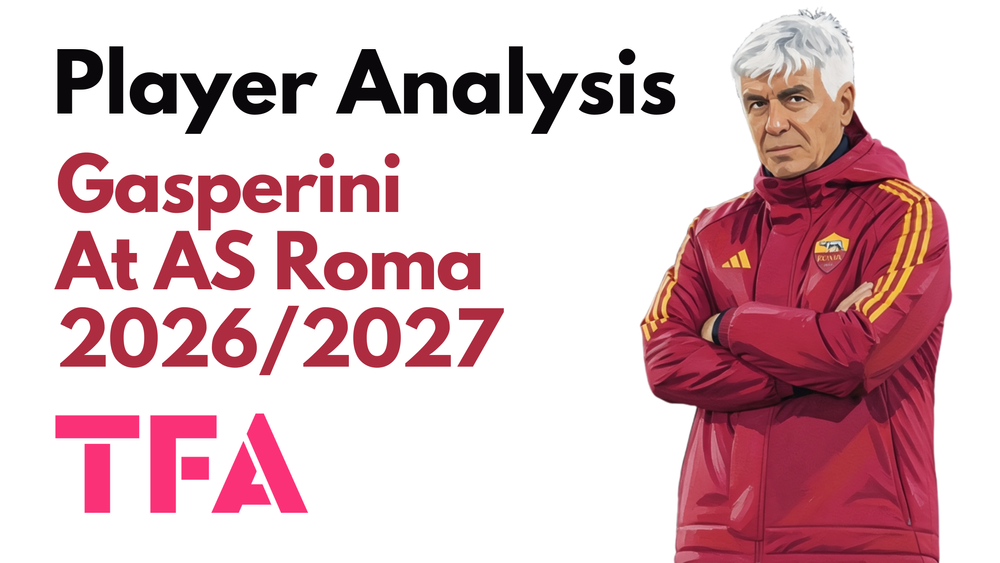
Gian Piero Gasperini Tactics At AS Roma 2026/2027: How The 68-Year-Old Tactician Is Building A Serie A Powerhouse - Tactical Analysis

The arrival of Gian Piero Gasperini at AS Roma represented a fundamental, uncompromising tactical pivot for a club that had spent years searching for a cohesive sporting identity.
Following his historic nine-year tenure at Atalanta, where he engineered a modern blueprint for mid-budget European excellence, Gasperini was tasked with dismantling a risk-averse, reactive culture in the capital.
The initial phase of his campaign has delivered an immediate, transformative impact, propelling Roma to the summit of the Serie A standings and restoring I Giallorossi to the UEFA Champions League.
Rather than attempting to gradually integrate his ideas into the existing setup, Gasperini immediately enforced his rigid, high-intensity positional and pressing framework upon the squad.
Reuniting with former Atalanta pupils such as Gianluca Mancini and Bryan Cristante provided an essential tactical foundation, giving the squad immediate focal points who understood the cognitive and physical demands of his system.
Furthermore, strategic summer transfer activity tailored specifically to his requirements, highlighted by the additions of dynamic forward Santiago Castro and aggressive central defender Konstantinos Koulierakis, supplied the raw physical profiles necessary to sustain his physical mechanics.
This AS Roma tactical analysis evaluates the structural mechanisms behind Roma’s successful start, examining their revamped build-up patterns, their aggressive man-oriented defensive pressing traps, and the spatial dynamics governing their current system.
Third-Man Rotations & Wing-Back Overloads
The primary architectural shift in Roma's game model under Gasperini appears in their first and second phase build-up mechanics, operating nominally from a fluid 3-4-2-1 base alignment.
In previous seasons, Roma suffered from sterile possession phases characterised by slow lateral circulation between the three central defenders and a static double pivot.
Gasperini has systematically dismantled this predictability by introducing dynamic, vertical passing triangles that rely heavily on third-man combinations and aggressive wide overloads.
During early build-up, the three central defenders, typically featuring Gianluca Mancini, Konstantinos Koulierakis, and Evan Ndicka, split across the full width of the penalty area.
Instead of remaining anchored deep, the wide centre-backs are explicitly instructed to make progressive forward overlaps into the half-spaces whenever space opens up ahead of them.
This creates an immediate numerical overload against opposition mid-blocks, as opposing wingers are forced to decide whether to track the advancing centre-back or maintain their wide positional responsibilities.