Mauricio Pochettino Tactics At USMNT 2026: Can Poch Turn Team USA Into World Cup Contenders? – Tactical Analysis

Team USA have a strong recent history of progressing from the FIFA World Cup group stage.
The United States Men's National Team (USMNT) have qualified for eight of the last nine World Cups (1990-2022), and they progressed from their group in five of those competitions.
USMNT finished 3rd in the inaugural 1930 FIFA World Cup in Uruguay. Since then, their best showing in the modern World Cup came in 2002, when they reached the quarter-finals, where they were eliminated by Germany.
They enter the 2026 World Cup tournament as joint hosts alongside Canada and Mexico under the tutelage of ex-Espanyol, Southampton, Tottenham Hotspur, Paris Saint-Germain and Chelsea boss, Mauricio Pochettino.
Poch has repeatedly expressed his desire to see his team and their supporters believe in their ability to properly compete with any team in the world this summer.
The Argentinian took charge of Team USA in September 2024 and currently has a 55.55% win percentage in the post.
He took his side to the Gold Cup Final last summer, where they lost to Mexico 1-0.
However, his appointment was always about extracting the most from this current generation of American talents at their home World Cup.
This USMNT tactical analysis examines how the Argentinian coach will aim to do just that.
We analyse Team USA’s recent performances to explain Mauricio Pochettino USMNT tactics and what to expect from his side at the 2026 FIFA World Cup.
USMNT Formation & Predicted Starting XI Lineup
Team USA Formation
The USMNT lineup has been incredibly flexible in terms of shape recently, having got plenty of experience setting up in both three-centre-back and two-centre-back formations under Mauricio Pochettino.
They set up pretty much exclusively with two centre-backs in last year’s Gold Cup, but used a back three more often in last Autumn’s friendlies.
Their 2026 games have seen a mix thus far.
It’s likely we see variation from the USMNT formation depending on the opponent, but the most likely formations we’ll see them in are the 3-4-2-1, the 4-2-3-1 and the 4-3-3.
USMNT Lineup
New York City stopper Matt Freese has been Pochettino’s first choice between the sticks throughout his time as manager, and he will likely remain the United States’ No. 1 for the World Cup.
Villarreal’s Alex Freeman has a good chance of starting as a right-back in a back four.
Alternatively, we could see him at either right centre-back or right wing-back in a back three.
Pochettino has selected six more potential centre-back options in his 26-man USMNT roster as well, in Chris Richards, Joe Scally, Miles Robinson, Mark McKenzie, Tim Ream and Auston Trusty.
We’ve seen several different combinations of those six in action over the Pochettino era.
Crystal Palace’s Chris Richards should have a place in the starting XI, while the left centre-back spot will likely be between captain Tim Ream and Auston Trusty.
Pochettino has typically favoured the experienced Ream, though there’s a strong argument to be made for the extra agility and pace which Trusty would offer over the 38-year-old on the left side of defence behind the likely left-back, Antonee Robinson.
Fulham's Robinson will be given license to bomb up the touchline, which will leave the left centre-back with a fair amount of space to cover at times.
Should the USA play with a back three, the right wing-back role could go to any of Freeman, Timothy Weah or Sergiño Dest.
Pochettino is fond of Sebastian Berhalter in midfield.
The Vancouver Whitecaps man has been Pochettino’s most frequently used midfielder and represents an excellent option for the ‘6’ role should the Argentinian coach go for a 4-3-3 setup at any point.
In a midfield two, he’s likely to be partnered by AFC Bournemouth’s Tyler Adams.
Pochettino’s best options for an offensive ‘8’ in a 4-3-3 or a ‘10’ in a 4-2-3-1 are Malik Tillman, Brenden Aaronson, Weston McKennie and Giovanni Reyna.
Of the four, I think Tillman would be the best creative midfield option, though he hasn’t earned a lot of international minutes under Pochettino thus far.
The left wing position is where we’re likely to find Christian Pulisic, with the 27-year-old having played here for his country most often under Pochettino.
He also occupied a central role behind the striker more often for AC Milan this season.
Many of the aforementioned options could compete for the right wing spot, but I’d like to see Timothy Weah get the nod to start, though Dest is also a strong contender.
The right wing is an area where I’d expect to see substitutions played every game due to the USA’s depth in that position and their likely reliance on fresh legs and pace in the right-wing role.
Folarin Balogun is the likely starter up front, though Ricardo Pepi will provide strong competition.
USMNT Stats 2025/2026
The statistical profile table below helps establish the USA’s tactical identity under Mauricio Pochettino tactics.
USMNT FIFA World Cup 2026 Statistical Profile
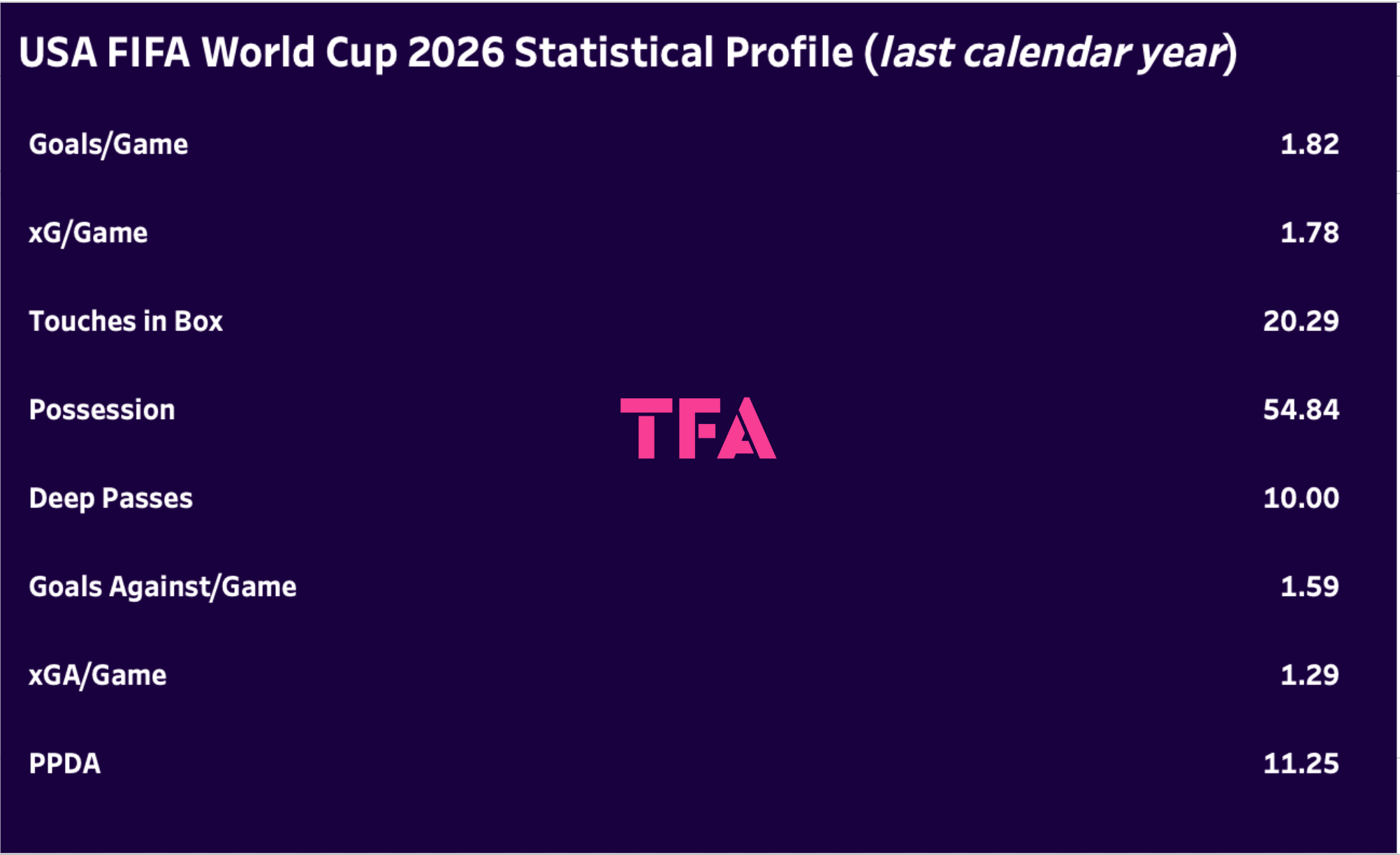
Over the last 12 months, the USMNT squad have averaged just under two goals per game and just under two xG per game.
The near-identical figures suggest that the USA’s attacking output has been driven by sustainable chance creation, as opposed to short-term overperformance, which is encouraging heading into a tournament environment where regression can catch teams that consistently outperform their xG.
The possession figures further reinforce the impression of a proactive side, with an average of 54.8% possession across the 17 fixtures in our dataset, alongside over 20 touches inside the opposition’s penalty area and 10 deep completed passes per match.
Interestingly, the USA have sought to establish territorial control even against relatively strong opposition.
Still, it’s worth noting they were dominated in possession by both Mexico in last summer’s Gold Cup Final loss and a recent friendly loss to Roberto Martínez’s Portugal.
Defensively, the picture is mixed.
Pochettino’s side have conceded goals at a higher rate than the underlying figures would predict.
While the defensive structure generally limited chance quality well, there is evidence that mistakes, goalkeeping variance and/or opposition finishing quality turned manageable situations into goals conceded, which is worrying.
USMNT Performance Profile 2025/2026
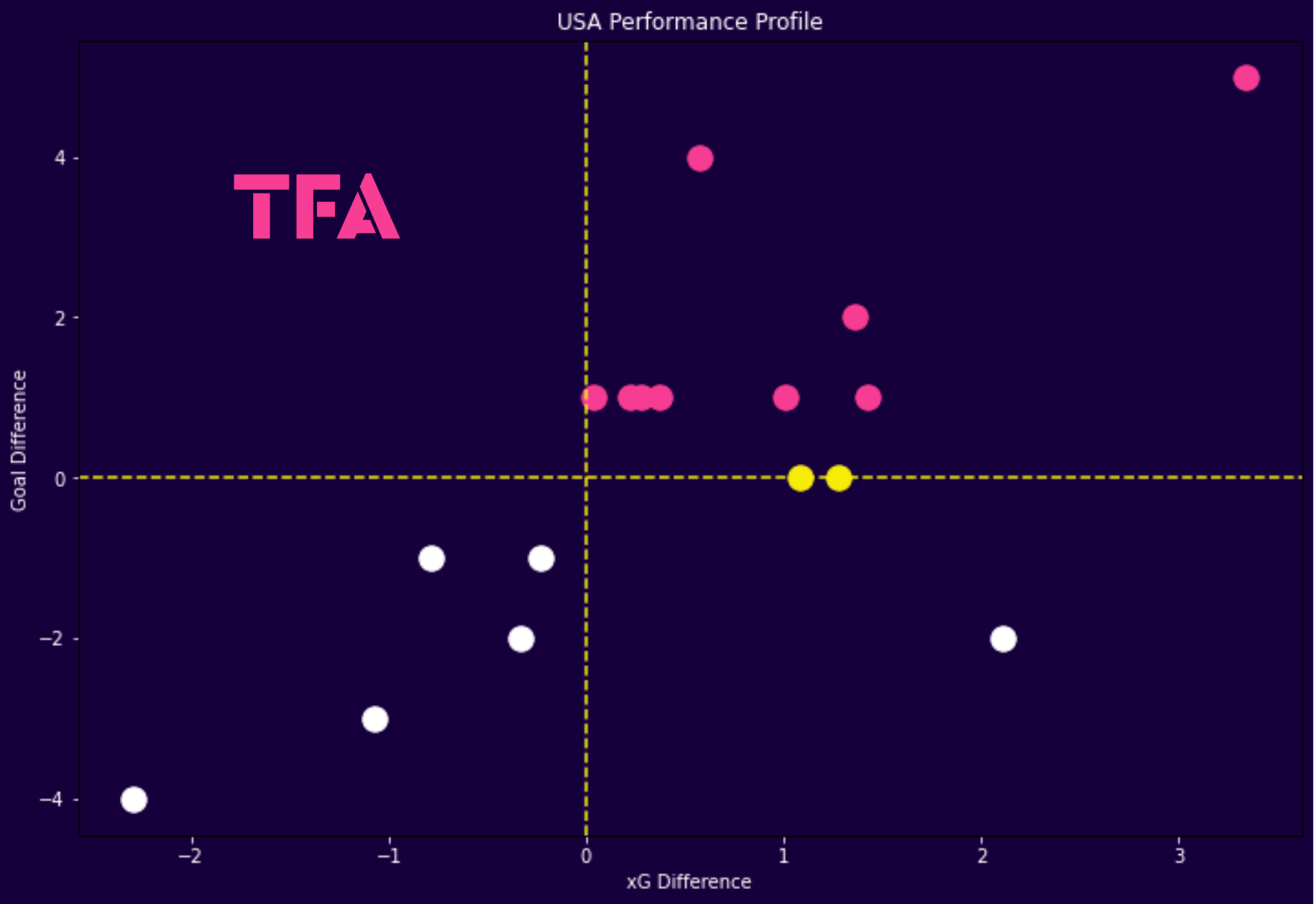
The second graphic shows whether the USA’s results actually reflected performances over the past calendar year.
The top-right quadrant represents matches in which the USA both won the xG battle and won on the scoreboard.
All American victories fall into this area, indicating that positive results were generally supported by superior underlying performance rather than luck.
Similarly, most defeats appear in the bottom-left quadrant, where the USA lost both the chance-quality battle and the result, suggesting losses were largely deserved from a statistical perspective.
The most interesting feature of the chart is the small group of outliers, however.
The defeat to Korea, the only dot in the bottom-right quadrant, stands out as the largest mismatch between performance and result in the sample.
This effectively shows the USA recorded a heavily positive xG differential, yet lost the match by two goals.
They scored fewer and conceded more than expected in this particular contest, which represents their biggest underperformance over the last year.
The two draws (vs Ecuador and Costa Rica) are also noteworthy as the USA recorded a positive xG differential in both games.
Their heaviest defeat, a four-goal loss to Switzerland, came relatively early in Pochettino’s tenure and represents a clear outlier in the sample.
Apart from that game, their xG differentials have generally been fairly encouraging over the last year, with the only other xG differential greater than -1 coming versus Belgium, and a loss to Türkiye falling the next closest to -1.
Overall, looking at the two charts, I’d say that the USA’s attack appears sustainable, supported by strong underlying data.
The defensive profile raises more questions.
Opponents are typically converting chances at a higher rate than expected.
This, combined with the notable xG differentials coming in defeats to Belgium, Turkey and Switzerland, indicates that a combination of general defensive underperformance and defensive resilience against stronger opposition, in particular, represent the team's biggest concern heading into the World Cup.
USMNT Style Of Play In Possession
As mentioned, the USA could set up in several base structures this summer, but a few principles will remain largely consistent regardless of the arrangement of players on paper, and that’ll be more important for the USA and opponents to understand.
Firstly, in possession, the USMNT’s most important players are the wide forwards/wingers.
Assuming Pulisic plays on the left and Weah plays on the right, these two will have distinct roles, with Pulisic acting as the team’s primary creative hub inside and on the edge of the final third, with Weah focusing more on using his pace to get in behind the opponent’s backline.
The team will primarily set up in attack to complement Pulisic as the primary playmaker in the inside-left channel.
The USA will often look to feed the ball into Pulisic in the left half-space, and the AC Milan attacker will focus on trying to find space and make himself available to receive and link up with teammates.
He’ll need movement into space around him to create options and facilitate quick progression through the thirds.
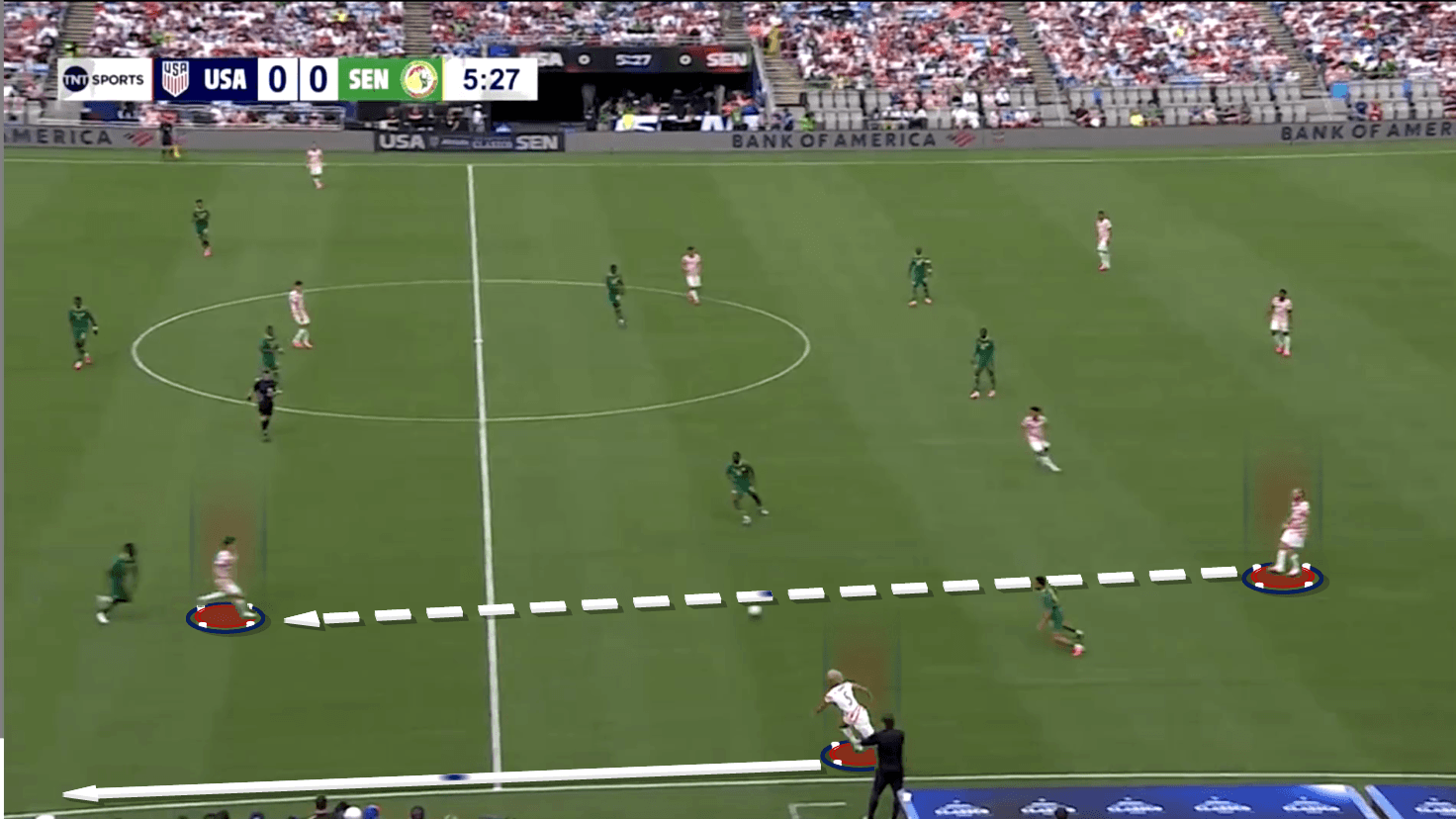
Below, we have an example of Tim Ream playing a progressive pass to Pulisic in the left half-space.
Pulisic looks to drop in behind the opponent’s midfield line and overload the central third, while Antonee Robinson looks to provide an option by overlapping on the left wing to potentially receive a layoff from Pulisic and carry at pace into the final third.
For opponents against whom the USA expect to dominate the ball, I like the idea of setting up in a 4-2-3-1 because it may allow Pulisic to turn inside and link up effectively with a ‘10’ like Tillman, for instance, enabling both men to create space for one another via their off-the-ball movement and enhancing the USA’s chance creation capability when they’ll need it most with a second playmaker.
This setup is conceptualised via the tactics board image in Figure 4.