
Fabio Grosso Tactics At Sassuolo 2025/2026: Building Stability After Promotion – Tactical Analysis

Fabio Grosso's most notable early managerial success came with Frosinone, where he guided the club to Serie A promotion in the 2021/2022 season.
Despite this achievement, he departed before leading the side in the top flight, leaving an element of unfinished business in his tenure there.
In October 2023, Grosso took over at Olympique Lyonnais, succeeding Laurent Blanc.
However, the stint proved short-lived, with his tenure ending the following month amid difficult results and instability at the club.
Grosso returned to Italy with Sassuolo in June 2024 after their relegation from Serie A.
He immediately made an impact, leading Sassuolo to promotion with five matches remaining, a reflection of both consistency and clear tactical structure.
In the current campaign, he has stabilised the side in mid-table, guiding them to tenth place and ensuring they remain clear of relegation concerns.
This tactical analysis provides insight into Fabio Grosso Sassuolo tactics in Serie A 2025/2026 in and out of possession.
Sassuolo Formation & Key Players
Sassuolo tactics predominantly operate in a 4-3-3 structure, offering a balanced framework between defensive stability and attacking width.
The back four is composed of centre-backs Tarik Muharemović and Jay Idzes, with Sebastian Walukiewicz and Woyo Coulibaly occupying the full-back roles, providing both defensive cover and support in wide areas.
In midfield, Nemanja Matić anchors the unit with his positional discipline and experience, while Ismaël Koné and Kristian Thorstvedt operate as the more dynamic interiors, contributing both defensively and in forward transitions.
The front three features Christian Volpato and Domenico Berardi on the wings, flanking central striker Andrea Pinamonti in build-up, forming an attack that combines creativity, movement, and a direct goal threat.
Sassuolo Out-Of-Possession Tactics
Under Fabio Grosso style of play, Sassuolo display clear structural flexibility out of possession, alternating between a 4-3-3 and a 4-4-2 depending on the height of their defensive block.
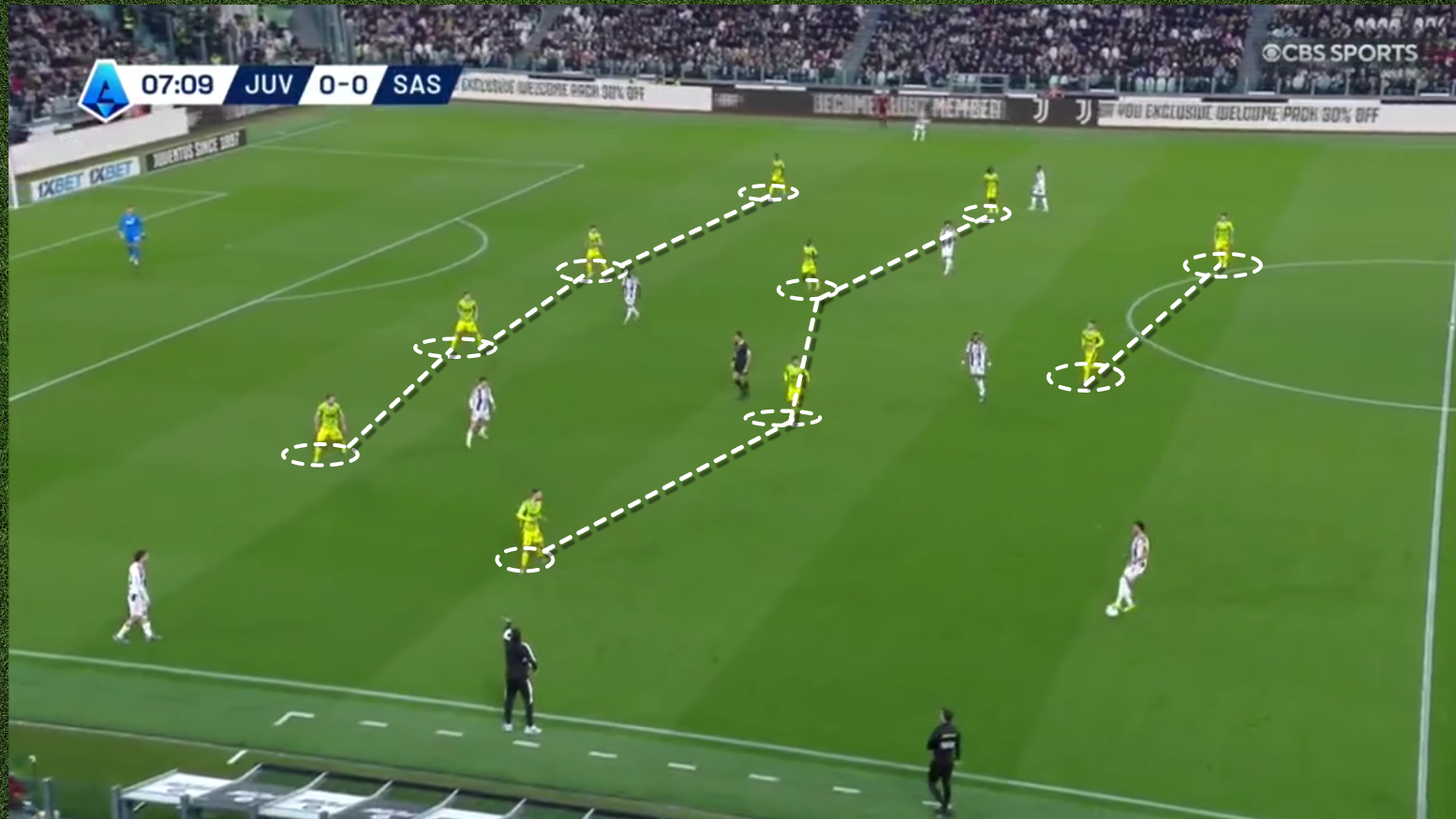
When operating in a mid-block, the team retains a 4-3-3 shape, allowing the front three to screen central passing lanes while maintaining access to wide pressing triggers.
However, when the block drops deeper, the shape shifts into a more compact 4-4-2, prioritising horizontal compactness and reducing spaces between the lines.
Their defensive approach is predominantly zonal, with a strong emphasis on protecting central corridors.
Rather than engaging aggressively high up the pitch, Sassuolo are content to concede space in front of their structure, focusing instead on denying access into dangerous central zones behind the midfield line.
Pressing actions are selective and situational rather than constant.
Players tend to hold their positions within the block and only step out to engage when specific triggers are met, most notably when the opposition circulate possession into wide areas or when they manage to find pockets of space between the lines.
During set-pieces, Sassuolo employ a hybrid defensive scheme that blends man marking with zonal coverage.
The majority of players are assigned direct opponents, ensuring close physical engagement and limiting free movement inside the box.
Complementing this, zonal markers are positioned at the near and far posts, tasked with protecting these critical spaces and dealing with deliveries targeting high-probability scoring zones.
Sassuolo In-Possession Tactics
Sassuolo adopt a distinctly vertical approach in possession, prioritising direct progression through the thirds rather than sustained build-up.
Their attacking structure is centred on Andrea Pinamonti, who functions as a focal point for vertical passes from midfield.
His ability to receive with his back to goal and secure possession under pressure allows teammates to play off him, with the wingers operating in close proximity to exploit second-phase situations.
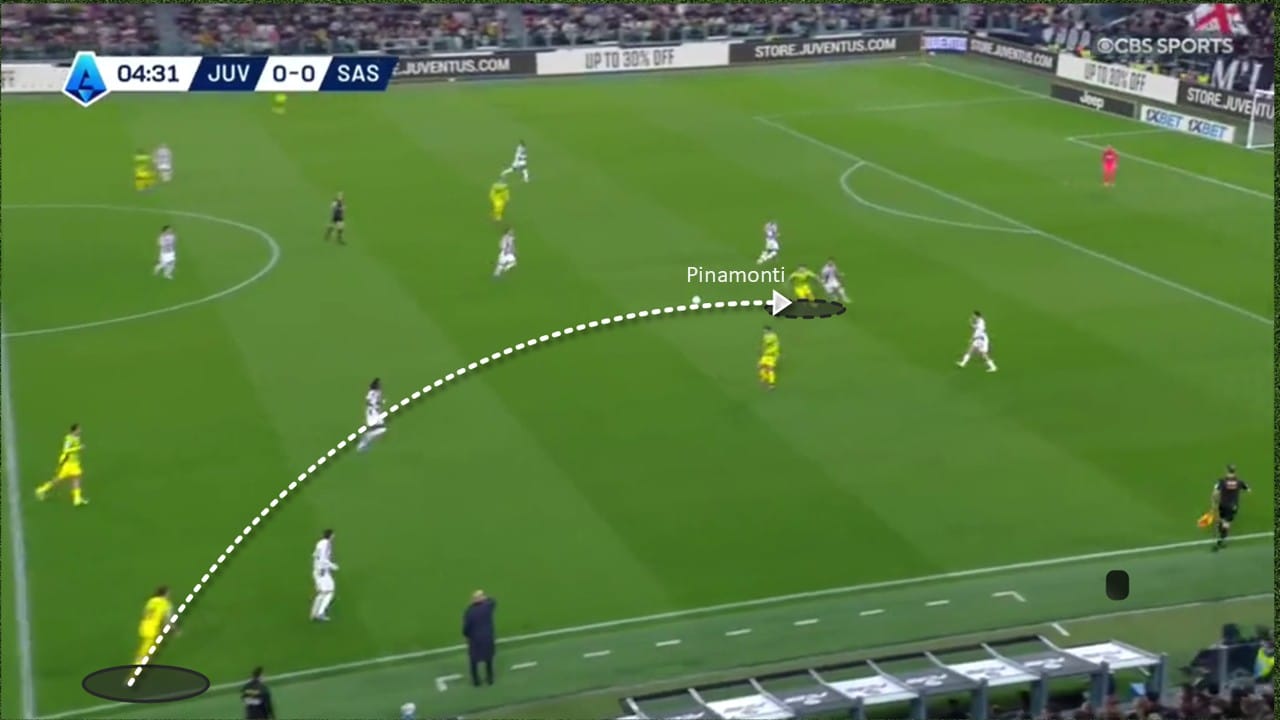
Play often flowed through Matić, who served as the central reference point in midfield and looked to progress possession with incisive vertical passes.
When direct progression was not available, the team adapted by using around-the-corner combinations, enabling them to bypass pressure and maintain forward momentum through quick, angled passing sequences.
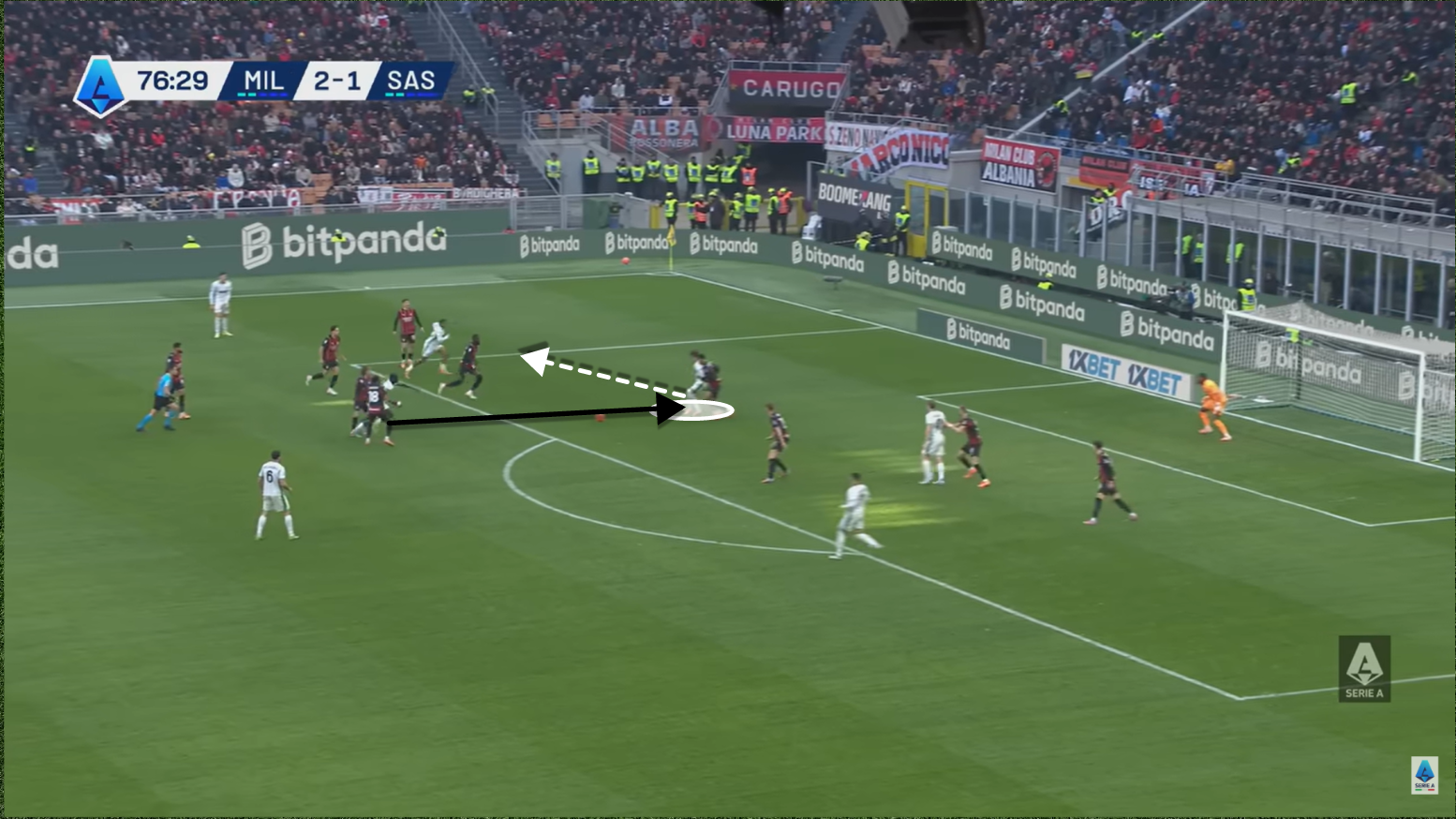
Pinamonti’s role extends beyond simple hold-up play.
By engaging central defenders and drawing them out of position, he creates spaces that Sassuolo consistently attack through coordinated third-man runs.
This pattern has been particularly effective against high-level opposition such as AC Milan and Juventus, where the vacated defensive zones are attacked with well-timed forward runs from midfield and wide areas.
![Real Sociedad Vs Bournemouth [1-2] Europa League 2026/2027: How Do Marco Rose Pressing Tactics Work? - Tactical Analysis](https://cdn.mymidnight.blog/77f959f119f4fb2321e9ce801e2f5163/size/w600/2026/09/Real-Sociedad-Vs-Bournemouth-20262027---Tactical-Analysis-1.png)
![AC Milan Vs Benfica [0-2] Europa League 2026/2027: How Marco Silva Tactics Exposed Rúben Amorim Defensive Problems - Tactical Analysis](https://cdn.mymidnight.blog/77f959f119f4fb2321e9ce801e2f5163/size/w600/2026/09/AC-Milan-Vs-Benfica-20262027---Tactical-Analysis.png)
![Sunderland Vs AZ Alkmaar [1-0] Europa League 2026/2027: Why The Black Cats Make Better Underdogs - Tactical Analysis](https://cdn.mymidnight.blog/77f959f119f4fb2321e9ce801e2f5163/size/w600/2026/09/Sunderland-Vs-AZ-Alkmaar-20262027---Tactical-Analysis.png)
![Leeds United Vs Newcastle United [4-1] Premier League 2026/2027: Why Did Daniel Farke Tactics Dominate The Magpies? - Tactical Analysis](https://cdn.mymidnight.blog/77f959f119f4fb2321e9ce801e2f5163/size/w600/2026/09/Leeds-United-Vs-Newcastle-2026_2027---Tactical-Analysis.png)
![Real Sociedad Vs Atlético Madrid [0-3] La Liga 2026/2027: How Diego Simeone Tactical Precision Rescued A Late Victory - Tactical Analysis](https://cdn.mymidnight.blog/77f959f119f4fb2321e9ce801e2f5163/size/w600/2026/09/Real-Sociedad-Vs-Atl--tico-Madrid-20262027---Tactical-Analysis-1.png)
![Manchester United Vs Manchester City [0-1] Premier League 2026/2027: How Enzo Maresca Tactics Secured Victory With 10 Men - Tactical Analysis](https://cdn.mymidnight.blog/77f959f119f4fb2321e9ce801e2f5163/size/w600/2026/09/Manchester-United-Vs-Manchester-City--20262027---Tactical-Analysis.png)
![Tottenham Hotspur Vs Everton [0-0] Premier League 2026/2027: Why Can't Spurs Score? - Tactical Analysis](https://cdn.mymidnight.blog/77f959f119f4fb2321e9ce801e2f5163/size/w600/2026/09/Tottenham---Vs-Everton-20262027---Tactical-Analysis.png)