
![Spain Vs Argentina [1-0 AET] – FIFA World Cup Final 2026 – Tactical Analysis](https://cdn.mymidnight.blog/77f959f119f4fb2321e9ce801e2f5163/size/w1000/2026/07/FIFA-World-Cup-Final-2026---Analysis.png)
Spain Vs Argentina [1-0 AET] – FIFA World Cup Final 2026 – Tactical Analysis
After 39 days and 104 matches, the 2026 FIFA World Cup came to a close with Luis de la Fuente’s Spain crowned champions, solidifying themselves as the undisputed benchmark of international football once again.

Spain Vs Argentina World Cup Final 2026 Overview
After 39 days and 104 matches, the 2026 FIFA World Cup came to a close with Luis de la Fuente’s Spain crowned champions, solidifying themselves as the undisputed benchmark of international football once again.
This marks La Roja’s second-ever World Cup triumph, the first coming 16 years ago in South Africa after they’d arrived as reigning European champions, a feat they repeated this time around.
For the past month, football fans have been treated to a host of action-packed matches and dramatic narratives, not the least of which was the resurrection of Lionel Messi on the world stage.
Many were uncertain of what to expect from Messi at the top level in 2026, three years on from his transfer from PSG to MLS side Inter Miami.
Finishing as second-highest goalscorer and joint-second-highest assist provider at the tournament, Messi’s performances ensured nobody was left in any doubt over the quality that remains in the Barcelona-bred genius, even at 39 years of age.
However, despite all his achievements throughout the tournament, dragging his side to yet another title proved a step too far, as he ultimately had to settle for second place to deserved winners Spain, the country where Messi’s football development was nurtured from the age of 13 until his 2021 departure from Catalonia.
This World Cup tactical analysis dives into the detail on Spain’s World Cup Final victory.
While the scoreline will forever read 1-0, the match itself was about as one-sided as it gets in a World Cup Final.
This analysis explains why Spain dominated from the opening whistle yet struggled to put the game beyond Argentina sooner.
In particular, Spain’s intelligent midfield movement manipulated the Argentinian shape to create space for ball progression throughout Sunday’s clash, while their intense, well-organised press also helped the new kings to suffocate the reigning World Champions, whose physical and mental fatigue from a gruelling knockout stage became increasingly apparent as the match wore on.
Spain Vs Argentina Lineups & Formations
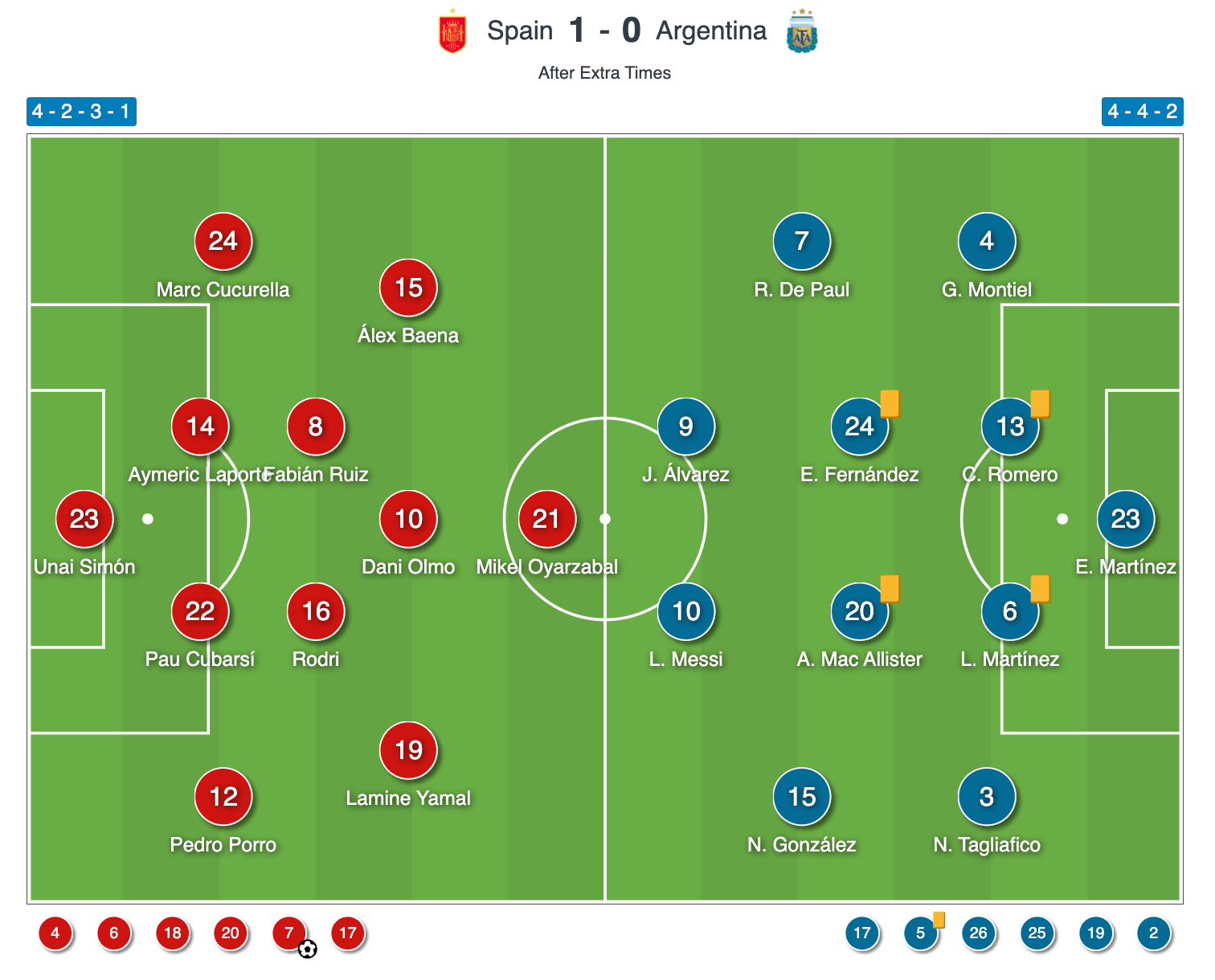
Spain Lineup Vs Argentina
The new World Champions set up in a base 4-2-3-1 formation with Unai Simón in goal behind a back four consisting of Pedro Porro, Pau Cubarsí, Aymeric Laporte and Marc Cucurella, from right to left.
Rodri and Fabián Ruiz played in central midfield, behind Dani Olmo in the No. 10 role with Lamine Yamal and Álex Baena to his right and left, respectively, and Mikel Oyarzabal leading the Spanish attack.
Luis de la Fuente made six substitutions during the match, with the first couple coming just after the hour mark as Ferran Torres and Pedri replaced Oyarzabal and Fabián Ruiz.
Spain made another double substitution about 13 minutes later, as Nico Williams and Mikel Merino came on for Álex Baena and Dani Olmo.
Spain’s final double change came in the first half of extra time, as Martín Zubimendi and Eric García replaced Rodri and Laporte.
Argentina Lineup Vs Spain
As for Argentina, Lionel Scaloni set his side up in a 4-4-2 shape with Emiliano Martínez in goal, Gonzalo Montiel at right-back, Cristian Romero at right centre-back, Lisandro Martínez at left centre-back and Nicolás Tagliafico at left-back.
Enzo Fernández and Alexis Mac Allister started in central midfield, with Rodrigo De Paul on the right of midfield and Nicolás González on the left, while Lionel Messi and Julián Alvarez played up front for La Albiceleste.
Scaloni also made six substitutions during the match.
He was forced into his first change just before half-time when Nicolás Otamendi came on for an injured Lisandro Martínez.
Then, just after the break, Nicolás González made way for Leandro Paredes.
Nahuel Molina replaced Gonzalo Montiel before the hour mark, and Argentina’s final two substitutions of regular time saw Facundo Medina and Giuliano Simeone introduced for Cristian Romero and Rodrigo De Paul.
Argentina’s final change, in the first half of extra time, saw Marcos Senesi come on in place of Julián Alvarez.
Spain Rotations Manipulate Argentina Midfield
One of the main tactical battles in the 2026 FIFA World Cup Final was around Spain’s positional rotations in the middle of the park.
Luis de la Fuente’s shape became a 2-4-3-1 during the build-up phase, with the full-backs providing the width as Spain looked to progress into the opposing half and the double-pivot looking to get on the ball behind Argentina’s forward line.
Spain Build-Up Shape Vs Argentina
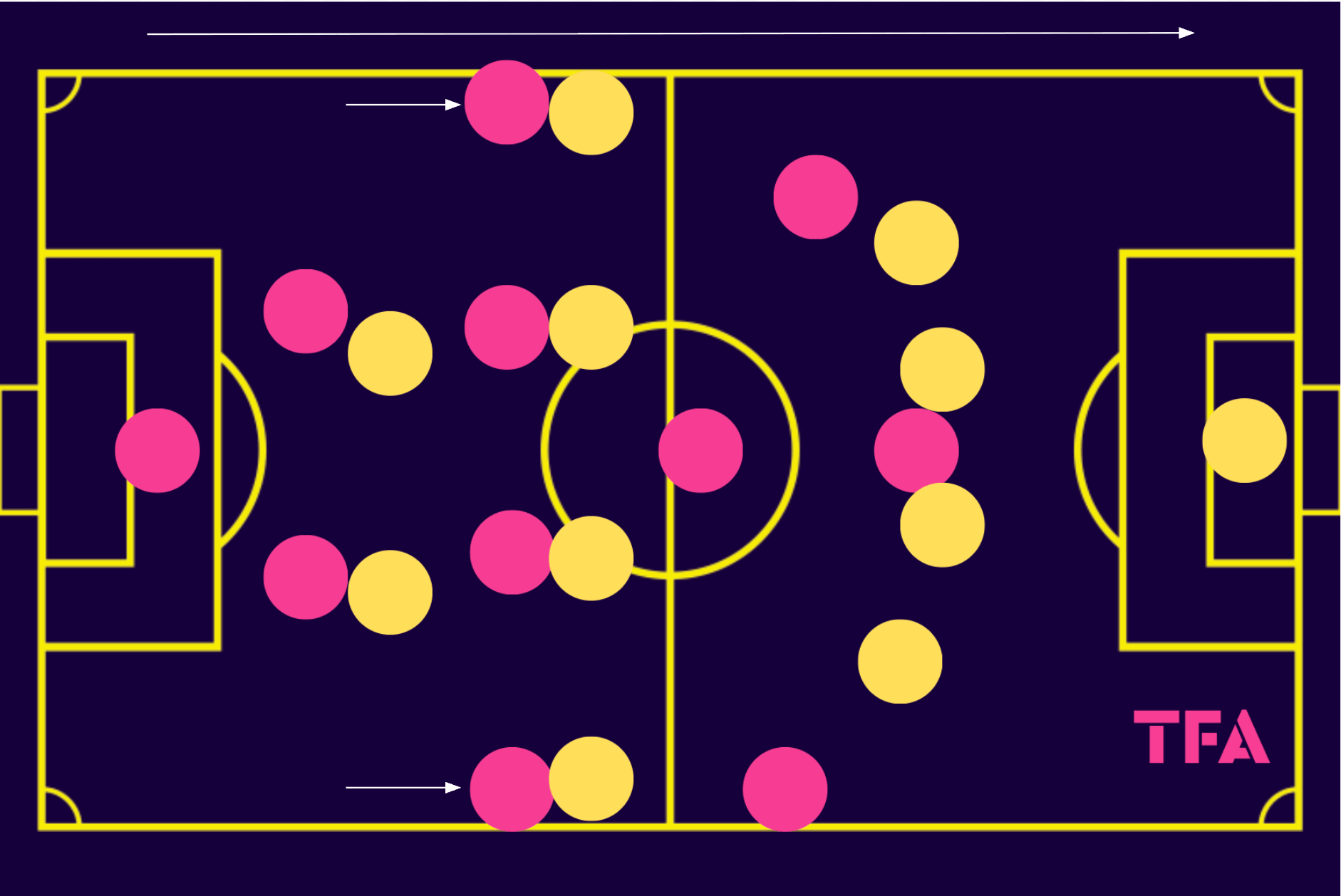
Throughout the match, Spain’s central midfielders dropped even deeper during the build-up, getting far closer to the centre-backs than Dani Olmo in the ‘10’ position.
This served to drag Argentina’s central midfield duo of Mac Allister and Fernández away from the compact block and into higher pressing positions, as they were clearly committed to preventing Spain’s central midfielders from easily getting on the ball.
Rodri was almost always marked during the build-up, either by one of the two central midfielders or Julián Alvarez, who would frequently drop away from the centre-backs to mark Rodri if the Manchester City midfielder was in space.
The knock-on effect of this was the vacated space behind those Argentinian midfielders that could be exploited by progressive passes, usually from the centre-backs or full-backs.
The four attackers further upfield happily occupied that space to receive the progressive passes, aiming to turn and combine with one another to generate opportunities.
Spain’s build-up effectively centred on forcing vertical separation in the Argentinian mid-block, and the intelligent movement from Rodri and Fabián Ruiz helped them to create that separation repeatedly throughout the match, thus creating space to attack between the lines.
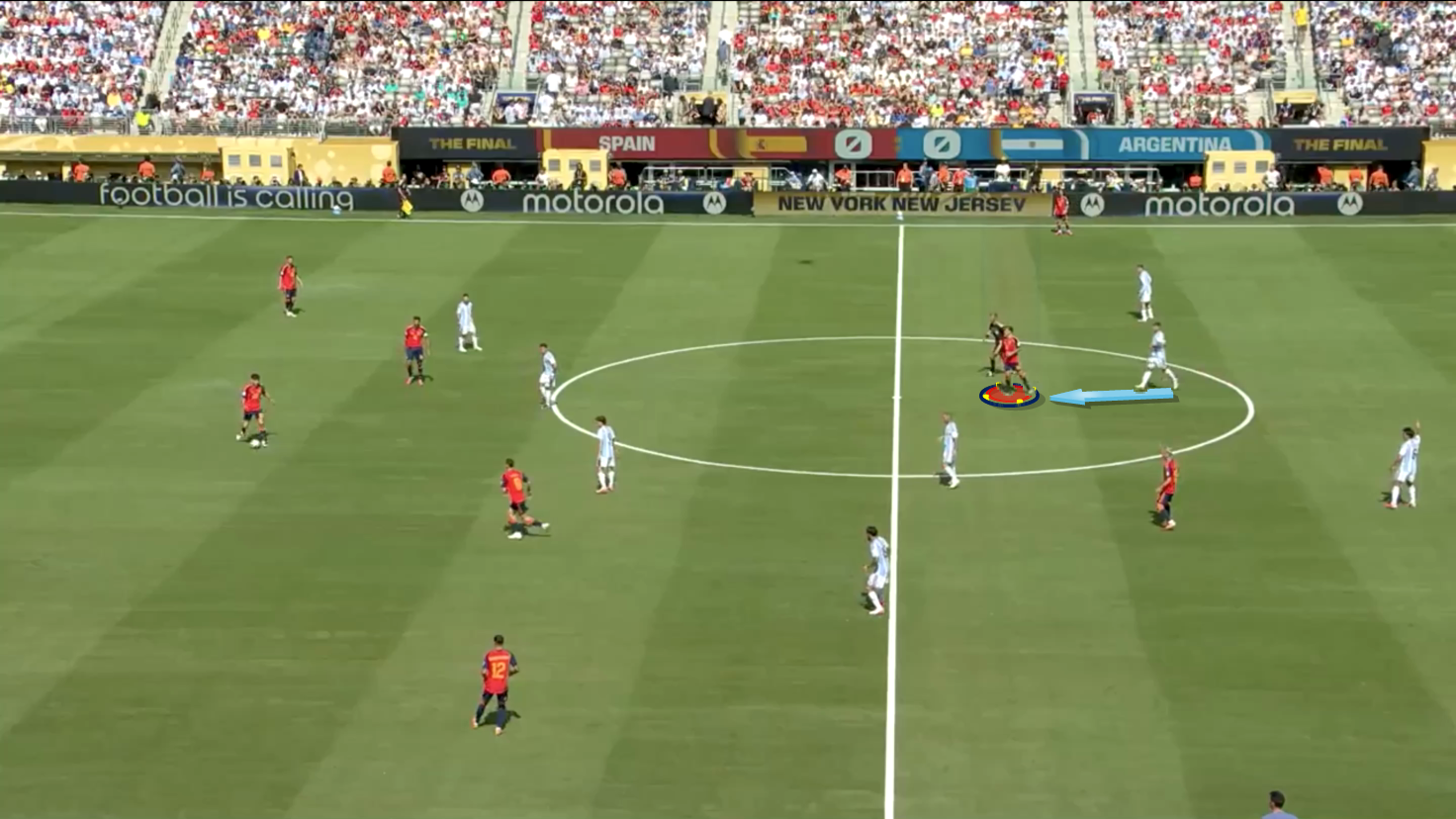
Figure 3 illustrates these tactics in action.
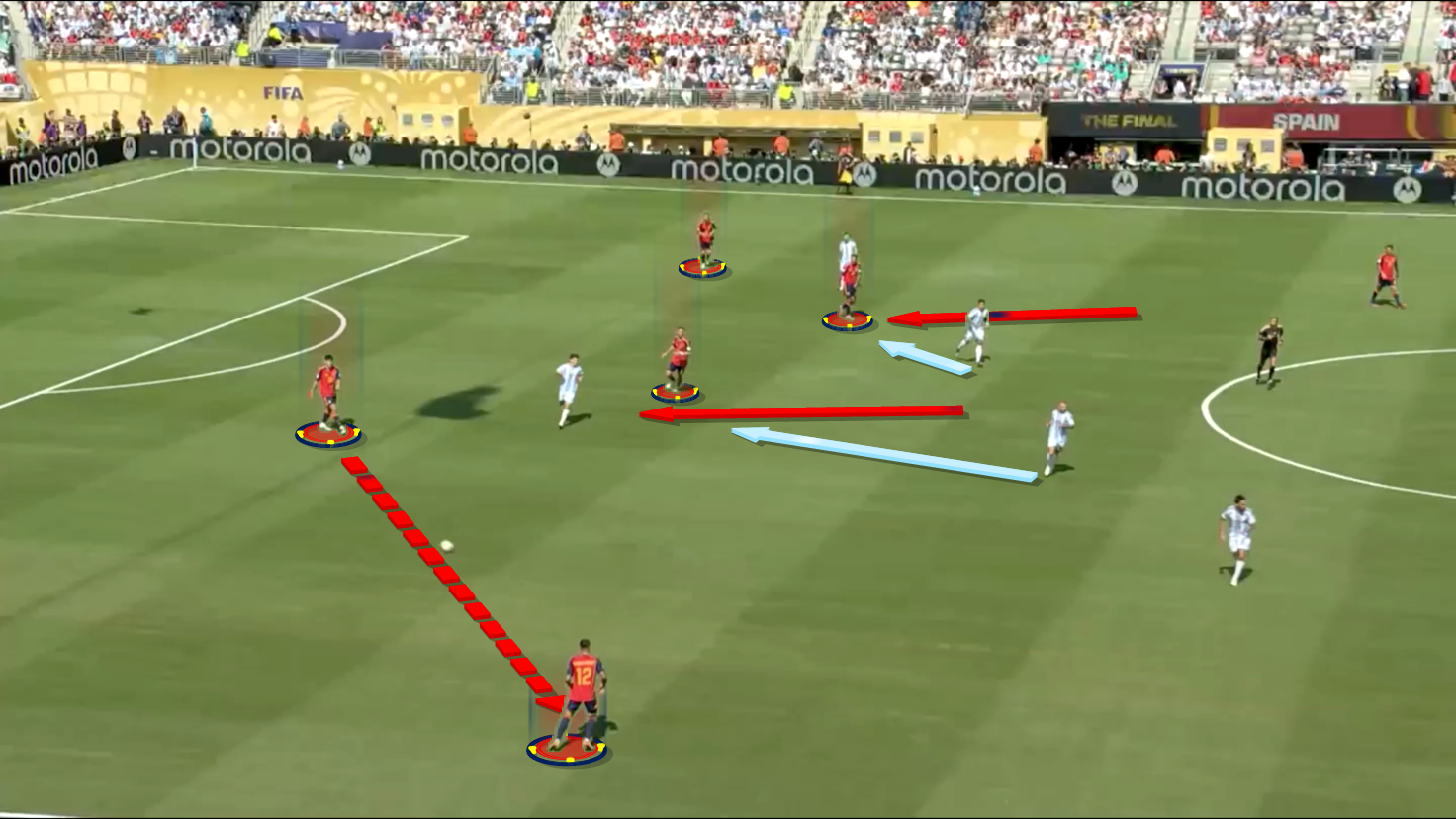
Mac Allister and Enzo Fernández have followed Rodri and Fabián Ruiz deep, while Nicolás González has tucked in centrally.
Right-back Porro is free to receive from Cubarsí, as a result, with space ahead of him to target, which he ultimately opts against, as we progress into Figure 4, due to Lisandro Martínez’s movement behind the would-be receiver.
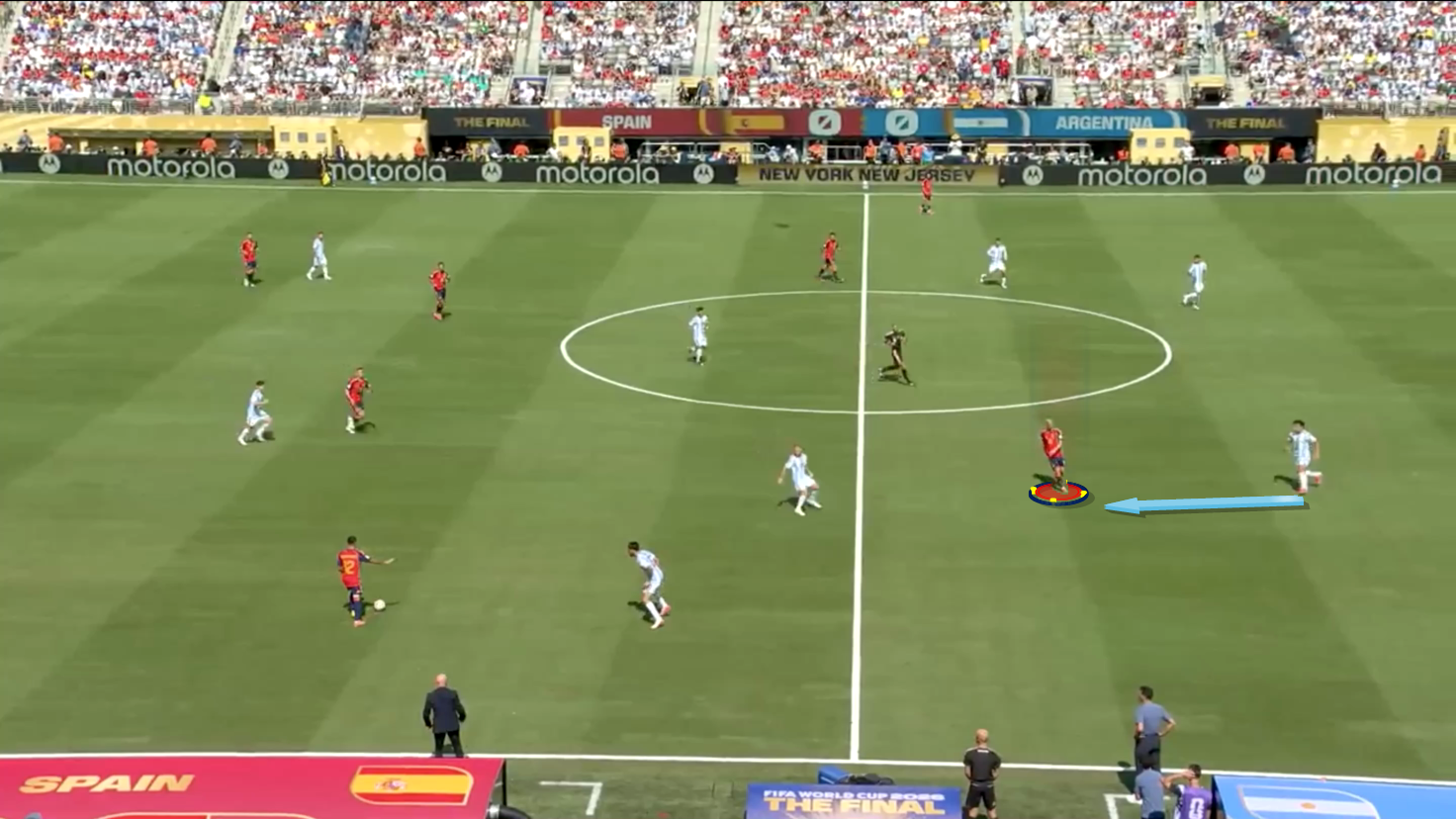
As Argentina’s midfielders were occupied by their Spanish counterparts further upfield, the Argentinian centre-backs were frequently called into action against the Spanish attackers looking to receive in the vacated space.
Lisandro Martínez and Cristian Romero are comfortable engaging in 1v1 duels like this, which made them quite effective at keeping the Spanish attackers at bay or warding off the passes, as Martínez succeeds in doing above in Figure 4 and Romero does in Figure 5, below.
Romero was successful in all three of his defensive duels in this match, while Lisandro Martínez succeeded in one of his two ground duels, with the unsuccessful duel coming when Martínez committed a foul to quell a Spanish counterattack on the edge of Spain’s own third.
Medina, who replaced Romero in the second half, is also a solid defender when he has to proactively engage in ground duels, but Nicolás Otamendi, who replaced Lisandro Martínez in the first half, is not as comfortable in such situations, and this was something Spain acutely exploited with their progressive passing on the right side of the pitch.
Below, we see an example of Fabián Ruiz getting onto the ball deep and playing it to Dani Olmo in space behind Argentina’s central midfielders.
Otamendi opts not to come out and close him down, thus providing Olmo with space to turn and play forward, looking to enter the final third.
![Brighton & Hove Albion Vs Crystal Palace [5-0] Premier League 2026/2027: How Fabian Hürzeler Combined Pressing & Positional Rotations To Dominate The M23 Derby - Tactical Analysis](https://cdn.mymidnight.blog/77f959f119f4fb2321e9ce801e2f5163/size/w600/2026/10/Brighton---Hove-Albion-Vs-Crystal-Palace-2026_2027----Tactical-Analysis.png)
![Newcastle United Vs Aston Villa [0-1] Premier League 2026/2027: How Unai Emery Tactics Punished Wasteful Magpies - Tactical Analysis](https://cdn.mymidnight.blog/77f959f119f4fb2321e9ce801e2f5163/size/w600/2026/10/Newcastle-United-Vs-Aston-Villa--0-1--Premier-League-2026_2027_-How-Unai-Emery-Tactics-Punished-Wasteful-Magpies---Tactical-Analysis.png)
![Celta Vigo Vs Juventus [1-2] Europa League 2026/2027: How The Old Lady Escaped With A Late Comeback Despite Predictable Attacking Play - Tactical Analysis](https://cdn.mymidnight.blog/77f959f119f4fb2321e9ce801e2f5163/size/w600/2026/10/Celta-Vigo-Vs-Juventus---Tactical-Analysis.png)
![Villarreal Vs Napoli [3-1] Champions League 2026/2027: How Iñigo Pérez Tactics Exploited Massimiliano Allegri Mistakes - Tactical Analysis](https://cdn.mymidnight.blog/77f959f119f4fb2321e9ce801e2f5163/size/w600/2026/10/Villarreal-Vs-Napoli---Tactical-Analysis.png)
![Manchester City Vs PSG [2-4] Champions League 2026/2027: How Luis Enrique Tactics Controlled The Key Moments - Tactical Analysis](https://cdn.mymidnight.blog/77f959f119f4fb2321e9ce801e2f5163/size/w600/2026/10/Manchester-City-Vs-PSG---Tactical-Analysis.png)
![Borussia Dortmund Vs Werder Bremen [2-2] Bundesliga 2026/2027: How Daniel Thioune Tactics Earned A Late Comeback With 29% Possession - Tactical Analysis](https://cdn.mymidnight.blog/77f959f119f4fb2321e9ce801e2f5163/size/w600/2026/10/Borussia-Dortmund-vs-Werder-Bremen---Tactical-Analysis.png)
![Croatia Vs Spain [1-2] UEFA Nations League 2026/2027: How Slaven Bilić High Pressing Tactics Troubled Spain - Tactical Analysis](https://cdn.mymidnight.blog/77f959f119f4fb2321e9ce801e2f5163/size/w600/2026/10/Croatia-Vs-Spain--1-2--UEFA-Nations-League-20262027---Tactical-Analysis.png)