
Marcelo Bielsa Tactics At Uruguay 2026: High Risk, High Reward On The World Cup Stage – Tactical Analysis

Two-time FIFA World Cup winners Uruguay enter the 2026 tournament with renewed optimism under Marcelo Bielsa tactics.
Known for his intense, high-risk, high-reward style, Bielsa has transformed La Celeste into one of international football's most exciting teams.
With legends Luis Suárez and Edinson Cavani retired, a new generation now carries Uruguay's hopes.
This tactical analysis article examines Marcelo Bielsa's tactical approach and the key players who could help Uruguay win the World Cup.
Uruguay Formation & Key Players
Bielsa has predominantly utilised a 4-3-3 formation during his tenure with Uruguay.
A key figure in Bielsa's system has been Federico Valverde, who has made the most appearances under the Argentine manager.
As one of Uruguay's captains alongside José María Giménez, Valverde's leadership, work rate and tactical versatility make him indispensable to the national team.
Several of Bielsa's trusted players have also earned places in Uruguay's 2026 World Cup squad, including Facundo Pellistri, Maximiliano Araújo, Manuel Ugarte, Darwin Núñez and goalkeeper Sergio Rochet, all of whom have played important roles in Uruguay's recent resurgence.
Uruguay Style Of Play In Possession
When building from the back, Uruguay typically employ a 2+1 structure that serves as the foundation of Bielsa's possession system.
The two central defenders form the first line of construction, while the holding midfielder, usually Rodrigo Bentancur, operates ahead of them as the connecting player.
At the same time, the full-backs maintain wide positions to stretch the opposition's pressing shape across the width of the pitch.
This positioning forces opponents to cover larger spaces and creates clearer passing lanes for the defenders.
A particularly important aspect of this build-up phase is the movement of Rodrigo Bentancur.
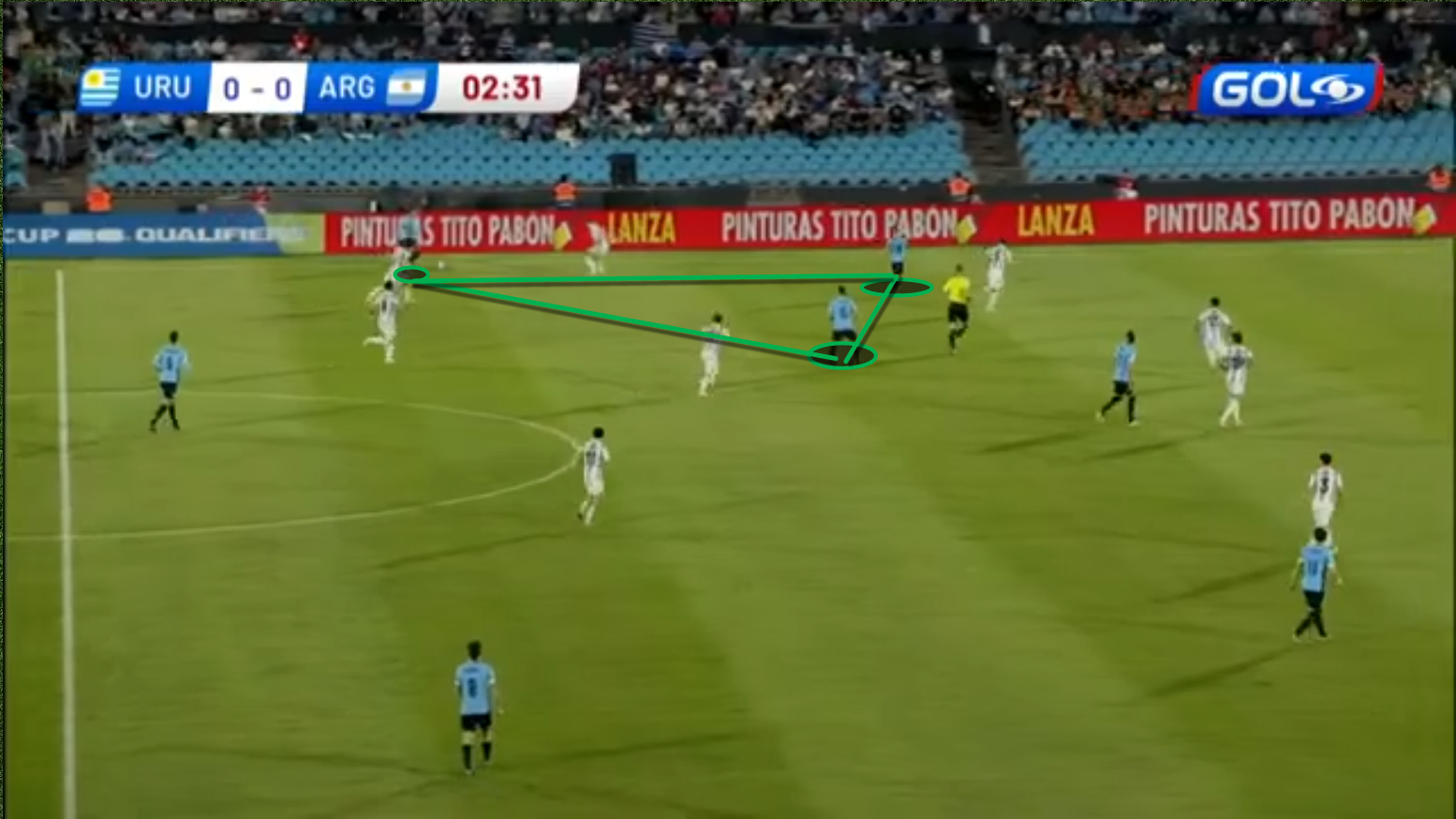
Rather than remaining fixed in front of the defence, he often advances into midfield, attracting the attention of an opposing midfielder, as seen in Figure 1.
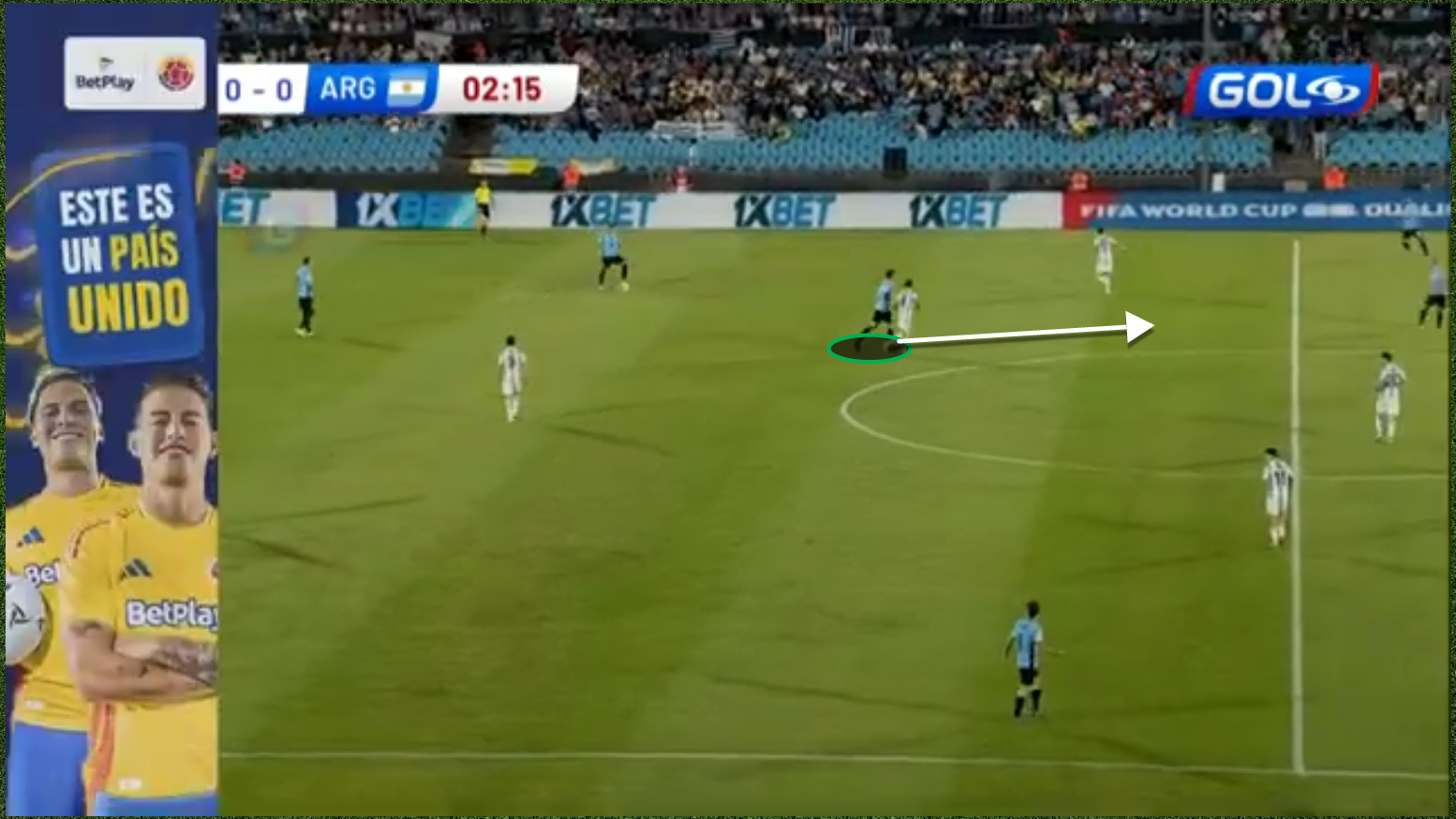
This movement creates a vacant space that can be exploited by one of the central defenders, who is encouraged to carry the ball forward.
By stepping into midfield with possession, the defender can commit opponents before finding a forward pass to a teammate between the lines.
This mechanism allows Uruguay to progress the ball without relying solely on direct passing and makes it more difficult for opponents to maintain a compact defensive block.
Central overloads are another key feature of Bielsa's tactical approach.
Uruguay frequently position multiple players in close proximity within central areas, creating numerical superiority around the ball.
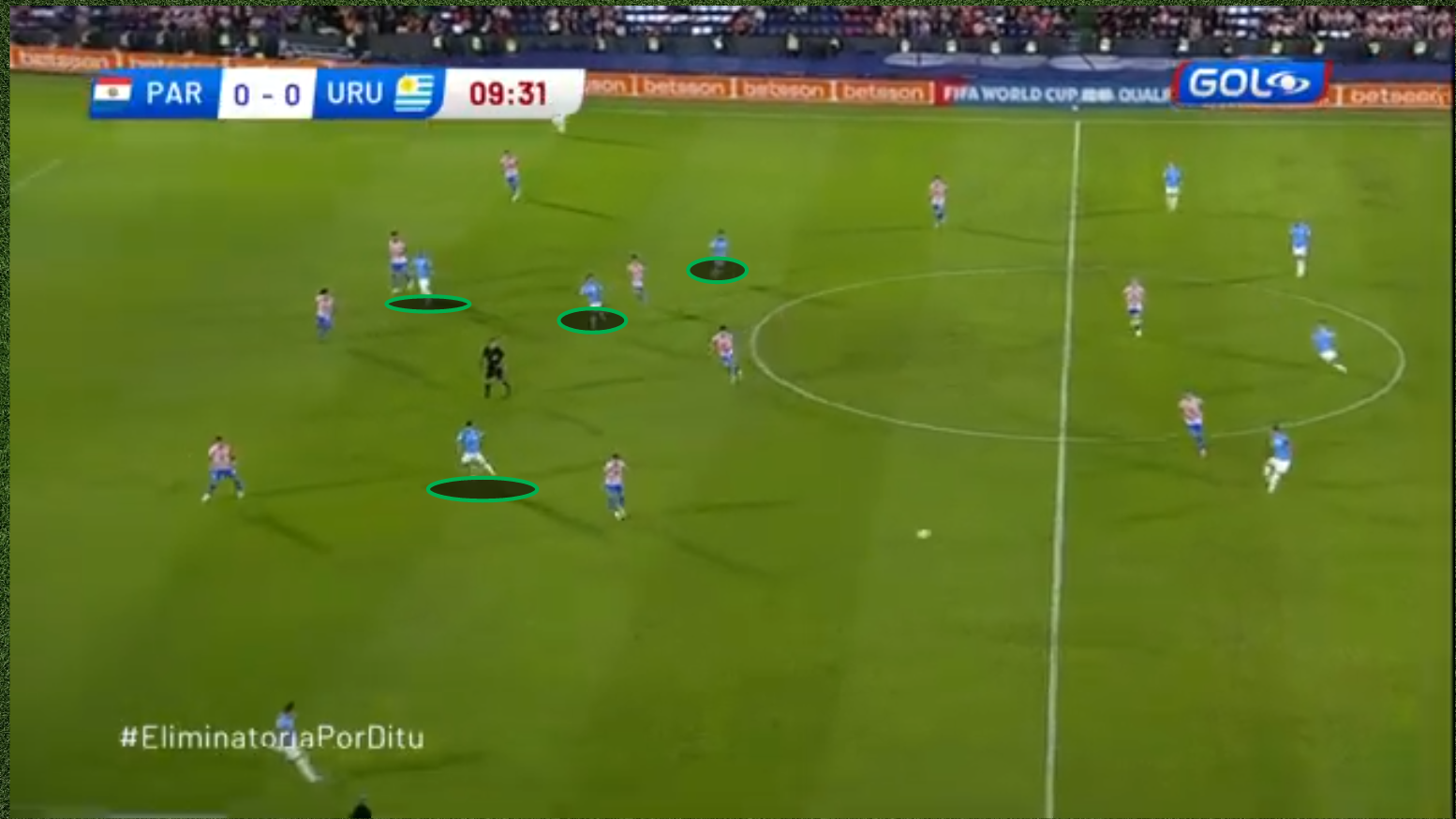
The reduced distance between teammates facilitates quick combinations and one-touch exchanges that can break opposition pressure.
These overloads are especially effective against teams defending in a compact mid-block, as Uruguay can use short passing sequences to create openings and advance into more dangerous areas.
The structure of Uruguay's three-man midfield further enhances their ability to progress the ball.
The two No. 8s are instructed to occupy different vertical lines rather than operating on the same horizontal level.
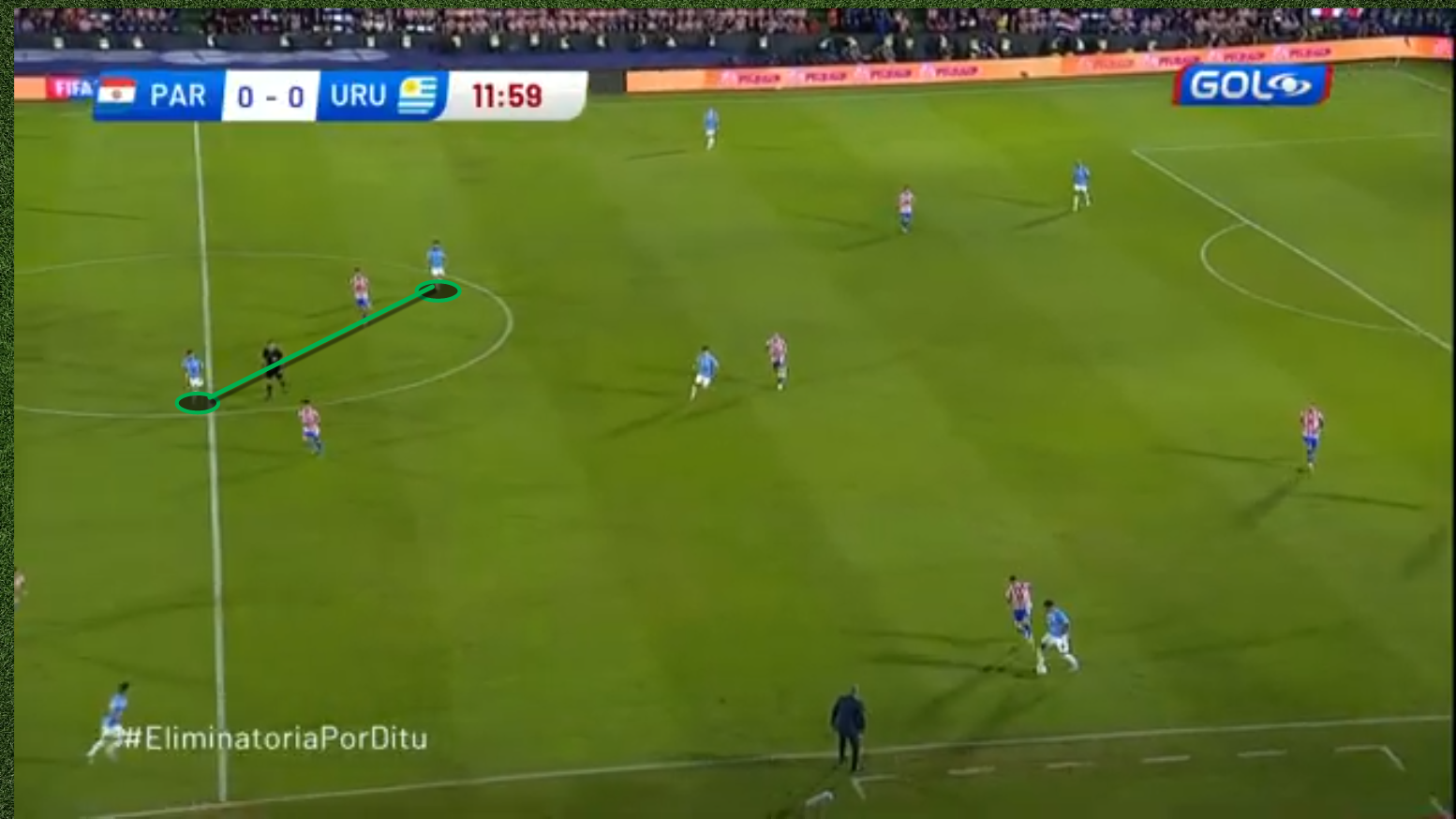
This staggering creates depth within the midfield unit and ensures that multiple passing angles are constantly available.
As a result, Uruguay are able to form numerous passing triangles throughout the centre of the pitch.
These triangles provide security in possession and make it easier to play around or through opposition midfield pressure.
In advanced phases of possession, Uruguay's full-backs are encouraged to invert into central areas.
These movements often drag opposition defenders away from their natural positions, disrupting the defensive shape and creating spaces for teammates to exploit.
Wide players can attack the vacated channels while midfield runners can penetrate the gaps created by the opposition's defensive adjustments.
Such rotations add fluidity and unpredictability to Uruguay's attacking play.
Another defining characteristic of Bielsa's system is the use of diagonal passing lanes, a concept that shares similarities with the Escadinha principle found in relationist football, as seen in Figure 5.
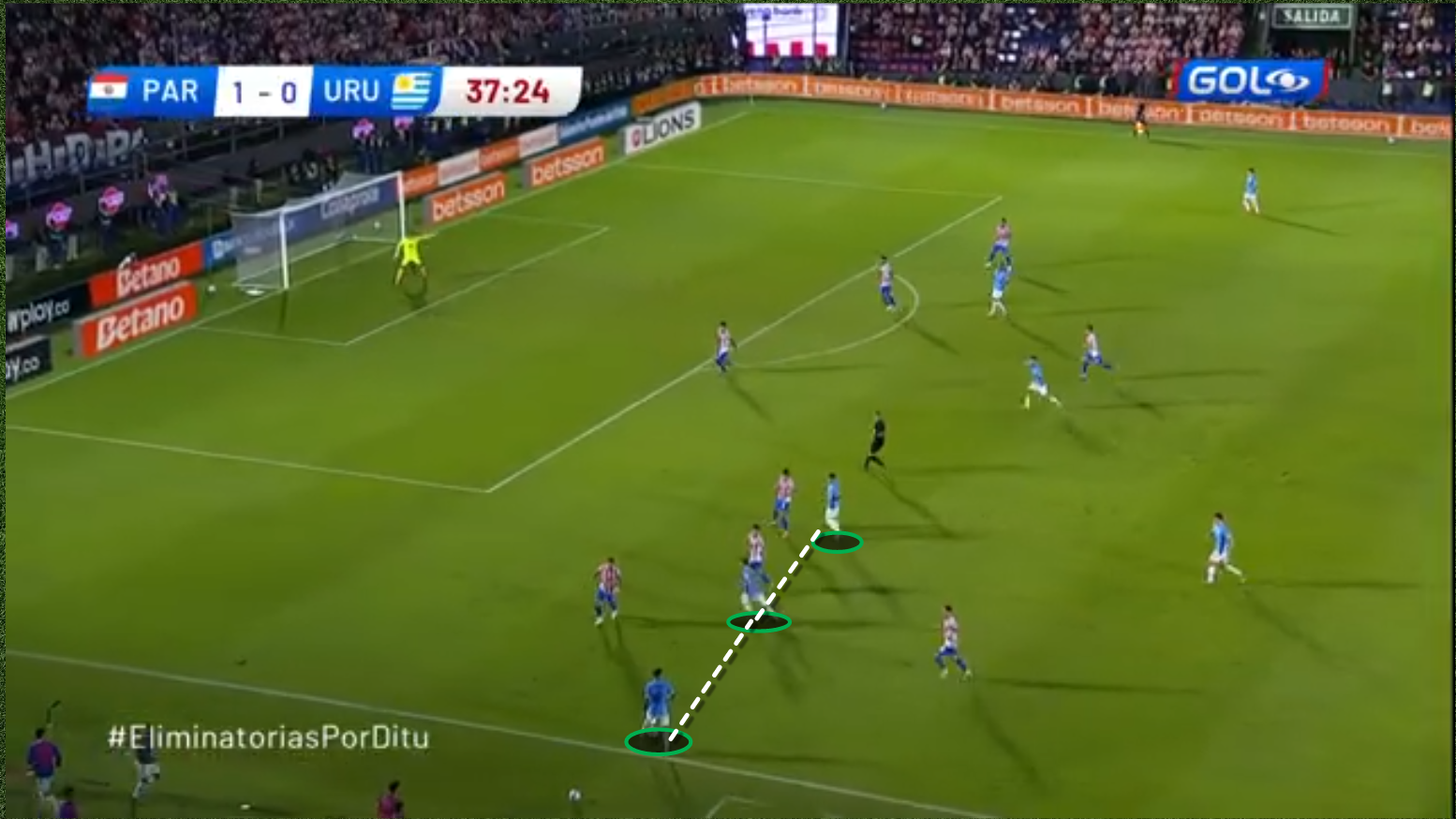
Players position themselves on different heights and angles, ensuring that multiple diagonal connections are available at all times.
The result is a dynamic attacking structure that combines positional organisation with the freedom for players to exploit spaces as they emerge, allowing Uruguay to move the ball quickly and effectively through all phases of play.
Uruguay Style Of Play Out Of Possession
Uruguay's defensive structure under Bielsa is built around relentless intensity and an aggressive commitment to winning the ball back as quickly as possible.
The first line of this press is led by Núñez.
![Tottenham Hotspur Vs Everton [0-0] Premier League 2026/2027: Why Can't Spurs Score? - Tactical Analysis](https://cdn.mymidnight.blog/77f959f119f4fb2321e9ce801e2f5163/size/w600/2026/09/Tottenham---Vs-Everton-20262027---Tactical-Analysis.png)
![West Ham United Vs Wrexham [6-0] EFL Championship 2026/2027: The Cost Of Passive Defending Against Smart Movement - Tactical Analysis](https://cdn.mymidnight.blog/77f959f119f4fb2321e9ce801e2f5163/size/w600/2026/09/West-Ham-United-Vs-Wrexham-2026_2027---Tactical-Analysis.png)
![Fenerbahçe Vs AS Roma [1-1] Champions League 2026/2027: How İsmail Kartal's Compact Defence Limited Gian Piero Gasperini's Attack - Tactical Analysis](https://cdn.mymidnight.blog/77f959f119f4fb2321e9ce801e2f5163/size/w600/2026/09/Fenerbah--e-Vs-Roma-20262027---Tactical-Analysis.png)

![Liverpool Vs Atlético Madrid [2-1] Champions League 2026/2027: How The End-To-End Battle Fell In Andoni Iraola's Favour - Tactical Analysis](https://cdn.mymidnight.blog/77f959f119f4fb2321e9ce801e2f5163/size/w600/2026/09/Liverpool-Vs-Atl--tico-Madrid-2026_2027---Tactical-Analysis.png)

![Real Madrid Vs Inter Milan [2-1] Champions League 2026/2027: Why Cristian Chivu Tactics Struggled Against José Mourinho Defensive Strategy - Tactical Analysis](https://cdn.mymidnight.blog/77f959f119f4fb2321e9ce801e2f5163/size/w600/2026/09/Real-Madrid-Vs-Inter-Milan-2026_2027---Tactical-Analysis.png)