
![Uruguay Vs Spain [0–1] – FIFA World Cup 2026: Luis De La Fuente Rest-Defence Tactics Suffocate La Celeste – Tactical Analysis](https://cdn.mymidnight.blog/77f959f119f4fb2321e9ce801e2f5163/size/w1000/2026/06/Uruguay-Vs-Spain-World--Cup-2026--2-.png)
Uruguay Vs Spain [0–1] – FIFA World Cup 2026: Luis De La Fuente Rest-Defence Tactics Suffocate La Celeste – Tactical Analysis

The modern evolution of international football increasingly resembles a chess match played at hyper-speed, where the primary currency is spatial control and the structural manipulation of the opponent's defensive orientation.
The highly anticipated Group B encounter between Luis de la Fuente's Spain and Marcelo Bielsa’s Uruguay at the Estadio BBVA in Monterrey offered an elite-level exposition of this tactical reality.
Both nations entered the fixture with distinct, deeply ingrained footballing identities: La Roja, the standard-bearers of positional fluid possession play, technical superiority in the half-spaces, and suffocating rest defence; La Celeste, the historic fighters of defensive resilience, vertical explosive transitions, and a modern, aggressive pressing system implemented by Bielsa.
What unfolded in Monterrey, however, was a compelling divergence from the expected open, end-to-end chaotic tactical battle.
Instead, the match developed into a gruelling, highly cerebral game of structural siege.
Bielsa, displaying a pragmatic adaptability rarely seen in his historic body of work, recognised the qualitative technical superiority of the Spanish midfield and structurally altered Uruguay into a remarkably disciplined, low-sitting mid-block.
This defensive wall successfully frustrated Spain for the opening hour, restricting their interior passing lanes and forcing them into low-value wide circulations.
However, Spain’s structural dominance was maintained not just by their patience on the ball, but by a relentless, highly coordinated counterpressing mechanism that permanently recycled possession and systematically suffocated Uruguay within their own defensive territory.
This relentless pressure eventually broke the deadlock via a precise flashing entry into the box, completely shifting the psychological and structural landscape of the match.
In the secondary phase, when forced to chase the game, Uruguay’s tactical blueprint collapsed under the weight of a severe deficit in build-up tempo and a stark absence of vertical off-the-ball movements.
This World Cup tactical analysis deconstructs the core strategic dimensions of the 1-0 Spanish victory, evaluating Uruguay’s defensive block, Spain’s defensive transitions, and the mechanical failures that neutralised the South American side's offensive response.
Uruguay Vs Spain Lineups & Formations
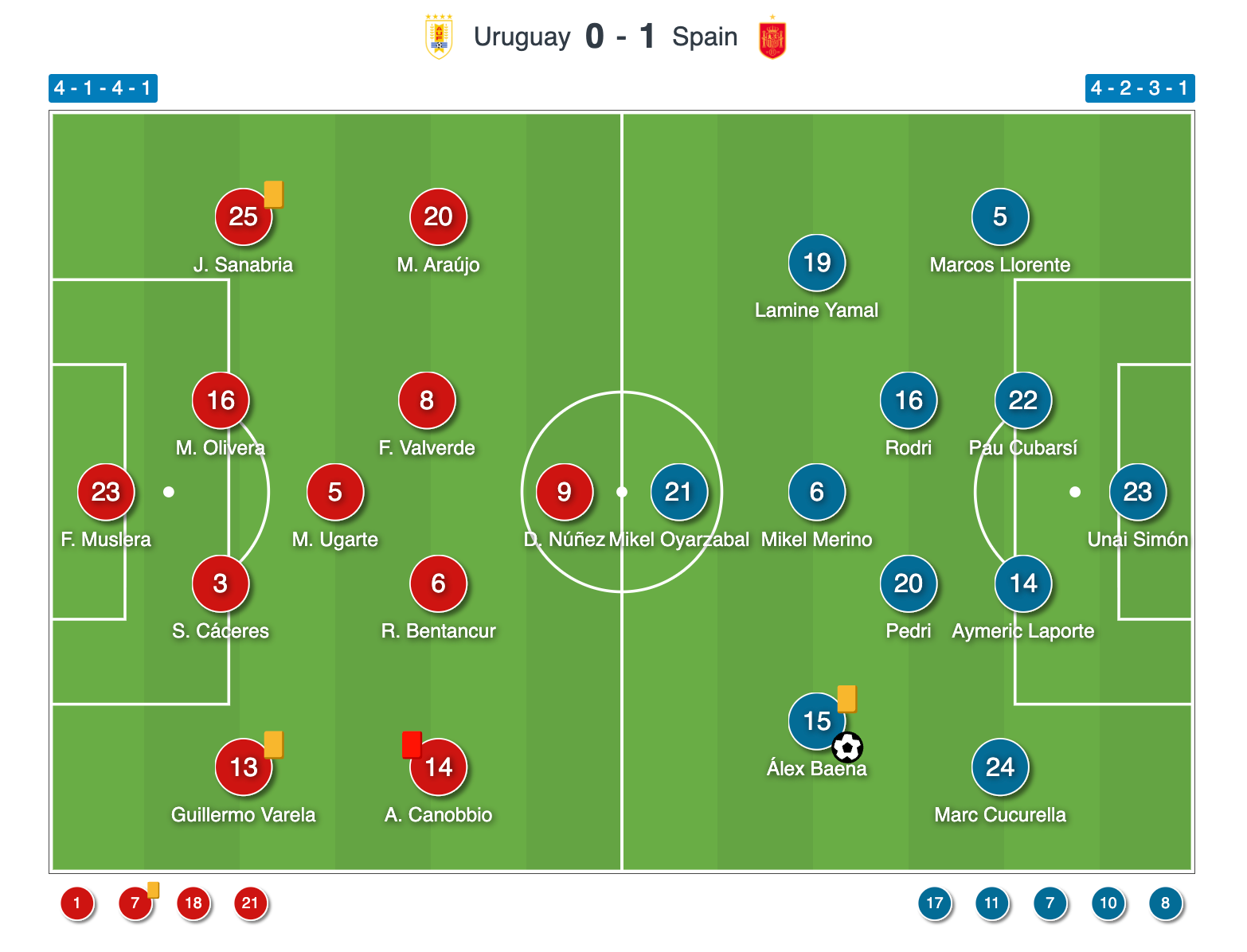
Spain Lineup Vs Uruguay
Luis de la Fuente structured Spain in their contemporary, highly dynamic 4-3-3 base alignment, a system that fundamentally rejects the historical, overly rigid paradigms of tiki-taka in favour of a more vertical, wing-oriented positional model.
Unai Simón occupied his position between the posts, functioning as a vital sweeping anchor during high-line possession phases.
The central defensive partnership comprised the technically elite Aymeric Laporte and the physically dominant Pau Cubarsí, a pairing designed to distribute cleanly under pressure while managing physical aerial duels against direct long-range balls.
Marcos Llorente brought extreme athletic versatility to the right-back position, while Marc Cucurella operated as a highly disciplined, positionally secure left-back.
The midfield engine room was anchored by Rodri, the team's structural focal point, who controlled the horizontal rhythm from his deep-lying single-pivot position.
Ahead of him, Mikel Merino occupied the left interior channel, functioning as a box-to-box facilitator, while Pedri operated as the primary creative playmaker in the right half-space, floating between lines to connect with the frontline.
The attacking trident featured the explosive Lamine Yamal on the right flank and Álex Baena on the left, both tasked with maintaining extreme width to isolate full-backs and to flank the mobile central forward Mikel Oyarzabal, who started up front to stretch centre-backs out of position.
Uruguay Lineup Vs Spain
Marcelo Bielsa countered by structuring Uruguay in a compact 4-1-4-1 defensive block alignment out of possession, which fluidly attempted to transform into an expansive shape during rare attacking transitions.
Fernando Muslera guarded the Uruguayan goal for the first half, protected by a traditional four-man defensive line consisting of Guillermo Varela at right-back, a central defensive partnership of Sebastián Cáceres and Mathías Olivera, and Lucas Sanabria occupying the left-back role.
Manuel Ugarte was deployed as an intense, ball-winning defensive shield at the base of the midfield.
Ahead of him, the midfield line of four featured Agustín Canobbio on the right flank, Federico Valverde and Rodrigo Bentancur operating as the central box-to-box engine room, and Maximiliano Araújo starting on the left midfield flank, dropping deep to form a secondary defensive line that restricted Spanish wide overloads.
Darwin Núñez spearheaded the lineup as the isolated lone striker, a physical profile selected specifically to pin Spain’s centre-backs and offer an immediate vertical outlet for direct, over-the-top clearances.
The Uruguayan Fortress: Low-Block Mechanics & Lateral Shifting
During the first half of the encounter, Uruguay delivered a masterclass in low-block defensive discipline, showcasing structural resilience that completely neutralised Spain’s initial attacking ideas.
Marcelo Bielsa’s decision to abandon his characteristic high-intensity, man-to-man pressing scheme across the entire pitch in favour of a deep 4-1-4-1 setup was a direct tactical concession to Spain’s ability to exploit vertical spaces behind a press.
By dropping the defensive line to the edge of their own 18-yard box, Uruguay completely eliminated the depth required for Álex Baena and Lamine Yamal to launch explosive runs behind the full-backs.
The mechanical foundation of Uruguay’s defensive success relied on flawless horizontal compactness and strict zonal assignments within the half-spaces.
The central defenders, Cáceres and Olivera, maintained a distance of less than eight metres between one another, effectively closing the central corridor.

![Scotland Vs Switzerland [0-3] UEFA Nations League 2026/2027: How Aggressive Pressing Backfired & Murat Yakin Took Advantage - Tactical Analysis](https://cdn.mymidnight.blog/77f959f119f4fb2321e9ce801e2f5163/size/w600/2026/10/Scotland-Vs-Switzerland-20262027---Tactical-Analysis.png)
![Olympique De Marseille Vs PSG [1-2] Ligue 1 2026/2027: How Bruno Génésio Transitions Troubled PSG - Tactical Analysis](https://cdn.mymidnight.blog/77f959f119f4fb2321e9ce801e2f5163/size/w600/2026/09/Marseille-Vs-PSG-2026_2027---Tactical-Analysis.png)
![Fulham Vs Manchester United [1-1] Premier League 2026/2027: How Álvaro Arbeloa Tactics Exposed The Red Devils' Problems - Tactical Analysis](https://cdn.mymidnight.blog/77f959f119f4fb2321e9ce801e2f5163/size/w600/2026/09/Fulham-FC-Vs-Man-United-2026_2027---Tactical-Analysis.png)
![AS Roma Vs Inter Milan [2-2] Serie A 2026/2027: When Undefeated Giallorossi Attack Met Nerazzurri Comeback Resilience - Tactical Analysis](https://cdn.mymidnight.blog/77f959f119f4fb2321e9ce801e2f5163/size/w600/2026/09/AS-Roma-Vs-Inter-Milan-2026_2027---Tactical-Analysis.png)
![Real Sociedad Vs Bournemouth [1-2] Europa League 2026/2027: How Do Marco Rose Pressing Tactics Work? - Tactical Analysis](https://cdn.mymidnight.blog/77f959f119f4fb2321e9ce801e2f5163/size/w600/2026/09/Real-Sociedad-Vs-Bournemouth-20262027---Tactical-Analysis-1.png)
![AC Milan Vs Benfica [0-2] Europa League 2026/2027: How Marco Silva Tactics Exposed Rúben Amorim Defensive Problems - Tactical Analysis](https://cdn.mymidnight.blog/77f959f119f4fb2321e9ce801e2f5163/size/w600/2026/09/AC-Milan-Vs-Benfica-20262027---Tactical-Analysis.png)
![Sunderland Vs AZ Alkmaar [1-0] Europa League 2026/2027: Why The Black Cats Make Better Underdogs - Tactical Analysis](https://cdn.mymidnight.blog/77f959f119f4fb2321e9ce801e2f5163/size/w600/2026/09/Sunderland-Vs-AZ-Alkmaar-20262027---Tactical-Analysis.png)