
Mikel Arteta Tactics At Arsenal 2025/2026: Why Open-Play Problems Could Cost Them Silverware – Tactical Analysis

The Premier League, EFL Cup, and FA Cup have all slipped out of their fingers.
For Arsenal, this season looked like it was full of potential silverware, but now the Gunners, after a bad run of form, could end up with nothing.
Arsenal are coming off a potential title-defining 2-1 loss to Manchester City, which marked their fourth loss in their last six matches.
Mikel Arteta has been criticised both in the past and throughout this season for his conservative approach in possession.
In addition, Arsenal have been very reliant on set-piece opportunities to score a high percentage of their goals.
Arsenal’s struggles from open play are nothing new to Mikel Arteta, and he’s heard all of these criticisms before.
The question now is this: is this simply a bad run of form, or is there a deeper issue that Arsenal need to solve if they are going to lift either the Premier League or Champions League trophy by the end of the season?
In this Arsenal tactical analysis article, we will take a look at some of the tactical issues Arsenal have had in open play during this bad run of form and what they can do to fix them before it’s too late.
Arsenal Tactics From Open Play
Before we dive into Arsenal tactics, I think it’s important to take a quick look at some data on Arsenal’s recent poor run of form and how reliant they are on set-pieces.
Over the course of their last six matches, Arsenal have only averaged 0.75 xG from open play.
That is a pretty significant drop, as before this bad run of form, they were averaging 1.27 xG per 90 minutes from open play.
If you compare their overall open-play xG for the season, 1.19, to their counterpart, Manchester City, a team that isn’t reliant on set-pieces, they are slightly behind their mark of 1.36.
The Gunners have scored 24 of their 84 goals (28.57%) in the Premier League and Champions League from set-pieces.
They have scored 19 goals from set-pieces in the Premier League, but 29.5% of their expected goals created have come from set-plays, which is only the 10th-highest in the Premier League.
So, are Arsenal too reliant on set pieces to create most of their chances?
The answer is both yes and no.
From a tactical perspective, nothing has really changed for Arsenal; it has more to do with how the opposition is defending them.
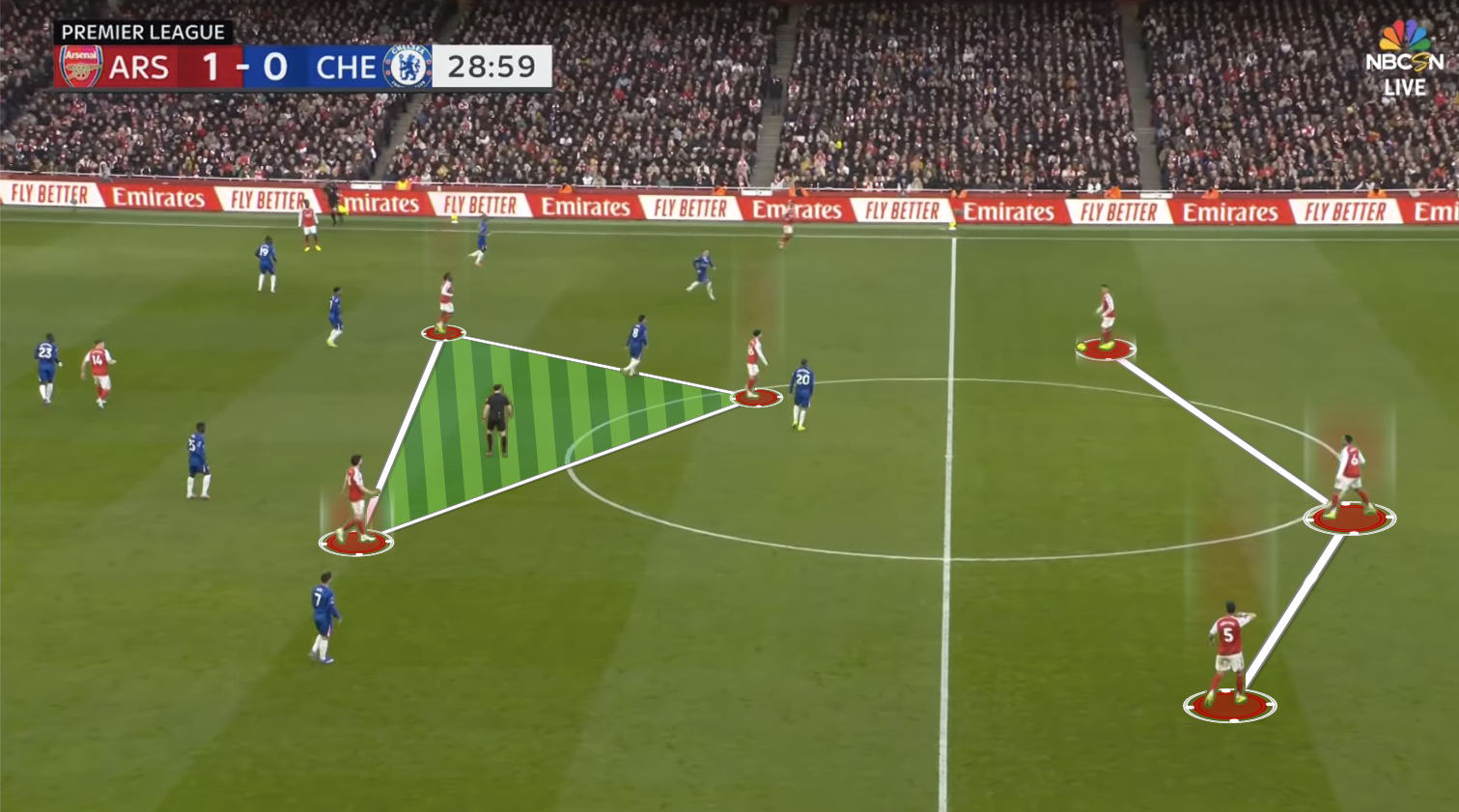
We’ve seen Arsenal many times using either Declan Rice or Martin Zubimendi as a single pivot to create a passing triangle with the opposite number and Eberechi Eze.
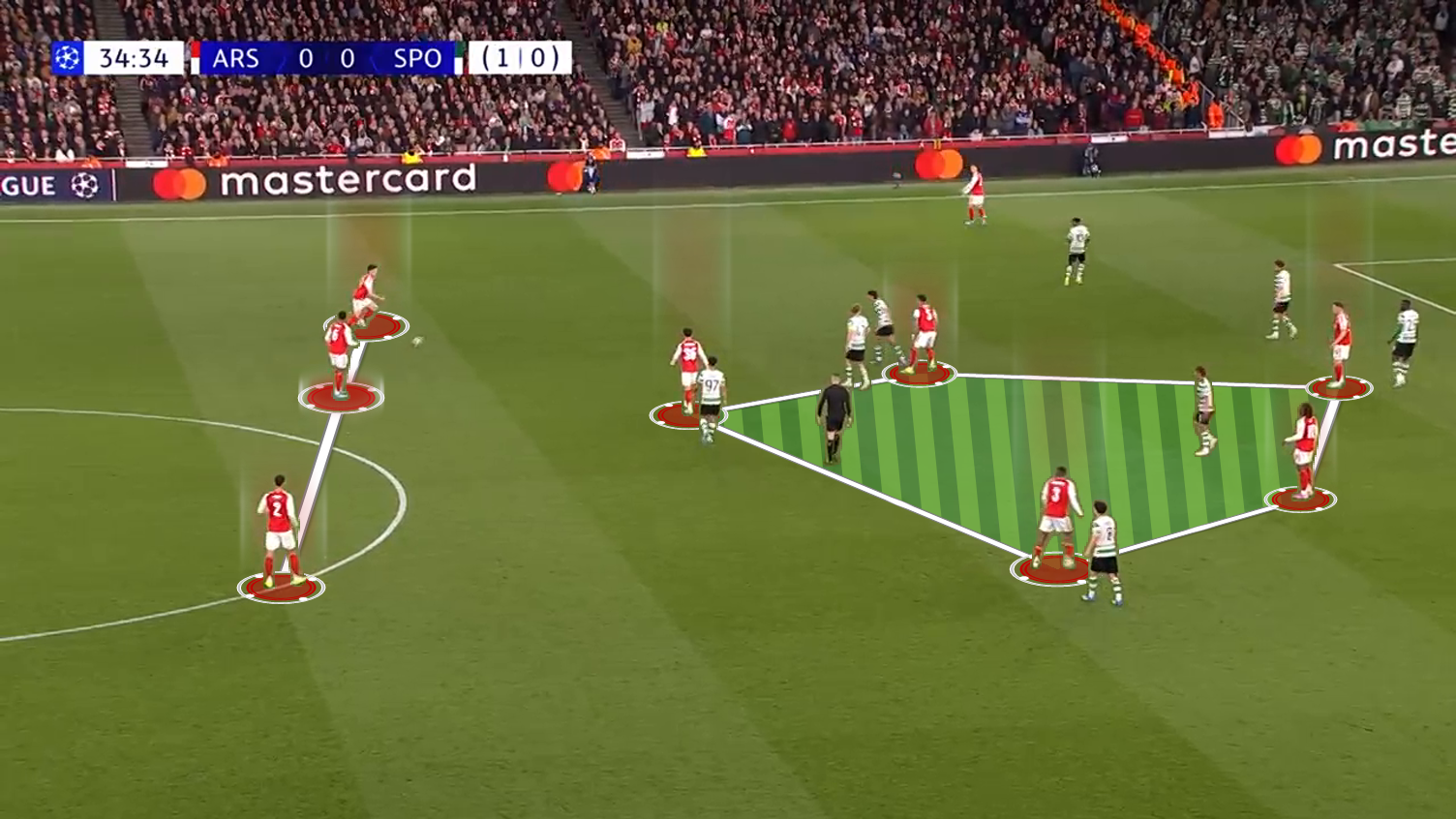
There are even times, like in their recent match against Sporting CP, when they invert both full-backs in the final third to overload the opposition.
During most of the season, Arsenal have been pretty effective at playing through the middle of the opposition.
It’s only recently, as opponents have started to defend them deeper and more compactly, that they’ve struggled.
Therefore, during this bad run of form, we’ve seen Arteta more and more look to overload the wide areas because there is no space for Arsenal to play through the middle.
Let’s take a look at an example from their FA Cup loss to Southampton.
Here, Arsenal are trying to create a five-man overload on the right-hand side of the pitch, but Southampton is playing an extremely low block and commits six players out wide to make sure Arsenal aren’t overloading them.
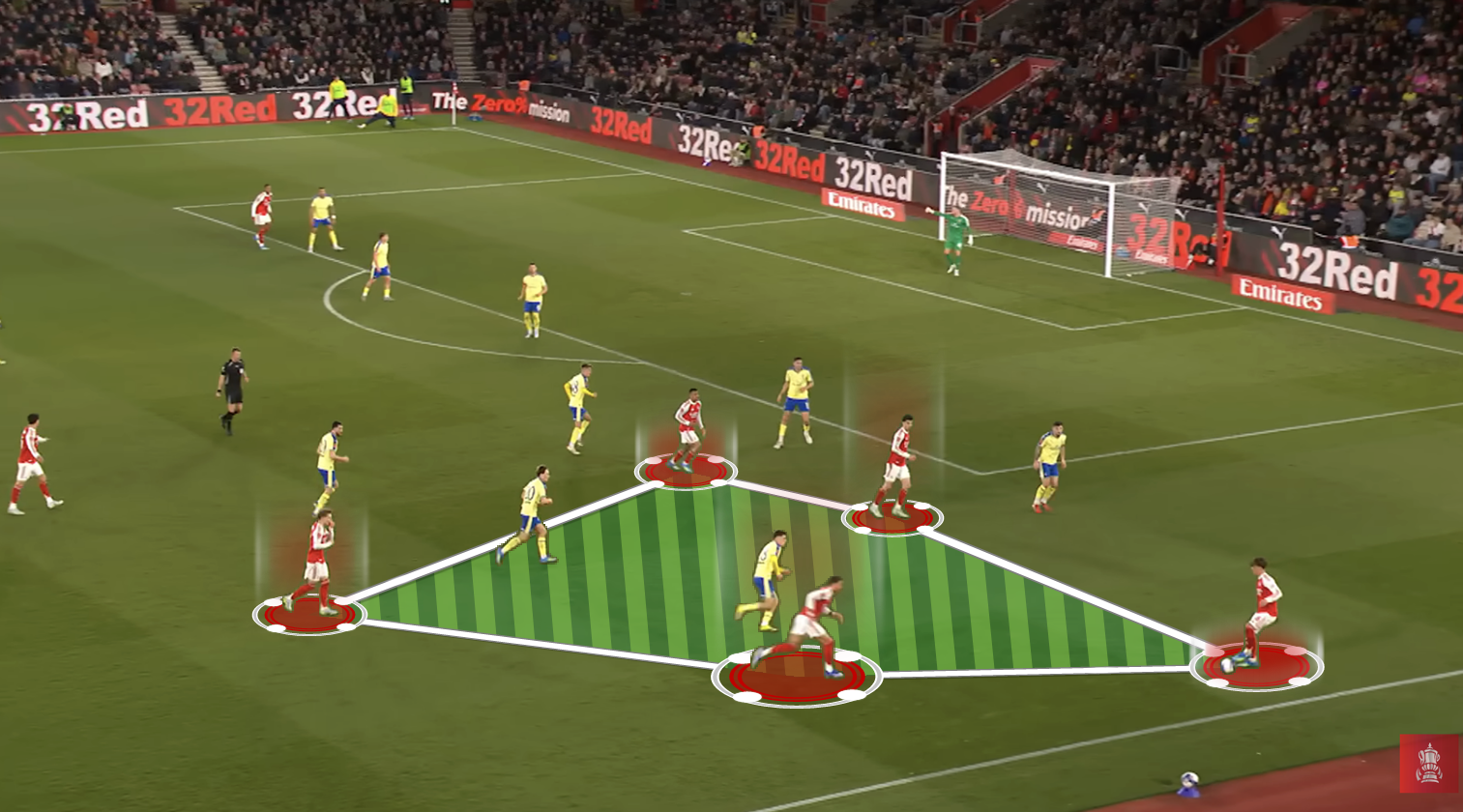
Max Dowman ends up beating his man to the byline, but because Arsenal committed so many players out wide, they have very few in the box to get on the end of his cross.
This is something that Arsenal have had problems with from open play for years now.
It’s one of the reasons Mikel Merino was used as a false nine last season, and why Arsenal spent big money to sign Viktor Gyökeres.
If Arsenal are unable to overload opponents through the middle and have to send in a large number of crosses into the box, who is going to get on the end of them?
Having a big aerial presence in the box when you know you are going to face a low block has become a key in this day and age because of how deep teams defend.
This season, Arsenal are averaging 2.55 successful crosses per 90 minutes, which is 11th in the Premier League.
It is also worth noting that there is a reason Arteta has, in the past and recently, placed a strong emphasis on playing through the wide areas.
The reason behind it gets to the heart of his conservative nature.
Arsenal are widely regarded as the best defensive team in the world, and a big reason for that is their transition defence.
Playing through the wide areas makes it much more difficult for the opposition to counterattack Arsenal quickly and effectively if they lose the ball.
Basically, it comes down to the risk versus the reward.
People often associate Pep Guardiola with being Arteta’s mentor.
However, I think it’s pretty clear that the man who has had the biggest impact on his overall tactical philosophy is David Moyes, who Arteta played under for years at Everton.
The other thing that has to be mentioned is injuries.
Arsenal have been pretty fortunate on that front for most of the season and has a very deep squad thanks to their significant summer investment, which brought in the likes of Noni Madueke, Piero Hincapié, Eze, and Zubimendi, among others.
During this bad run of form, arguably two of Arsenal's most important players, Bukayo Saka and Jurrien Timber, have been unavailable.
Madueke's signing was key for Arsenal in the summer as a contingency plan in case Saka suffered an injury.
However, Arsenal do not have a player who can offer the level of defending and possession versatility that Timber provides.
It’s very rare in modern football to have a player like him at your disposal.
Someone who can invert in any phase of build-up, can be an attacking option in the right half-space, can both overlap and underlap with the right winger, and also operate in a back three in possession.
The real problem, though, is that the Gunners have not been as aggressive as they should be when in the final third.
Their conservative nature has cost them over and over, so below we'll look at a couple of ways they can fix it.
Arsenal Possible Changes From Open Play
I think there are two things that Arsenal can do from open play that don’t necessarily involve a massive structural change.
It’s pretty clear to anyone right now that there is nothing wrong with the positional rotations and structure Arsenal use in build-up, as they allow them to maintain control of a match.
In fact, per MarkStats.club, Arsenal are turning the ball over in dangerous areas at the second-lowest rate in Europe’s top-five leagues, behind only Real Madrid.
The problem for Arsenal isn’t getting the ball into the final third; it’s what they do with it when they are there.
Too many times, they look for overloads instead of attacking the opponent's last line of defence.
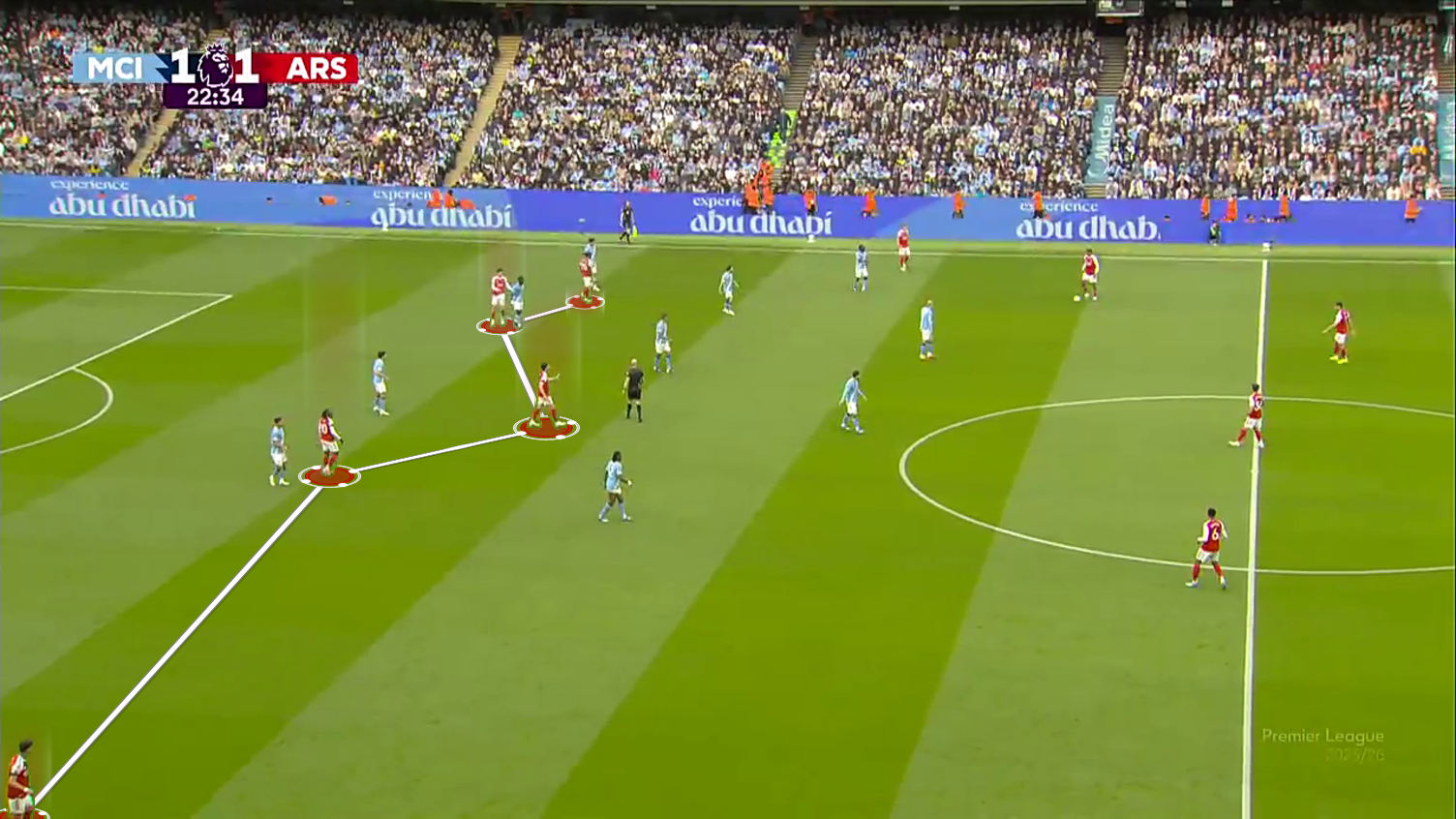
Here is a good example against Man City on Sunday.
Arsenal pushed five players up to the last line of defence, creating a 5v4 against City’s backline.