
Ralf Rangnick Tactics At Austria 2026: The Professor's World Cup Project – Tactical Analysis

Known as "The Professor" for his influence on modern football tactics, Ralf Rangnick has transformed Austria into one of the most organised and intense teams in international football.
Having not reached a FIFA World Cup since 1998, Austria's qualification for the current tournament marks a major achievement.
Under Rangnick, qualification was secured comfortably, highlighting the team's rapid development.
That progress was evident at UEFA Euro 2024, where Austria narrowly lost to France and defeated the Netherlands to top a difficult group.
Their performances earned widespread praise and reinforced their reputation as one of Europe's best-coached sides.
Central to their success is Rangnick's high-pressing philosophy, making Austria energetic, aggressive and difficult opponents.
This Austria tactical analysis takes a look at the tactics surrounding Rangnick’s Austria and why they could be the dark horses of the tournament.
Austria Formation & Key Players
Since taking charge of Austria, Rangnick has consistently relied on a 4-2-3-1 formation, providing the tactical stability that has underpinned the team's recent success.
There were no surprises in the squad selection, particularly with the inclusion of Nicolas Seiwald, Marcel Sabitzer and Konrad Laimer.
Among Rangnick's most trusted players, they have accumulated some of the highest appearance totals under his management.
Their tactical discipline, work rate and familiarity with the pressing system make them vital to Austria's approach.
David Alaba's selection was also expected despite his limited appearances under Rangnick.
As Austria's captain and most experienced player, he brings leadership, versatility and tactical intelligence.
His experience in German football and exposure to similar tactical principles make him a natural fit within Rangnick's framework.
The more notable inclusions were Saša Kalajdžić and Carney Chukwuemeka.
Neither has featured extensively under Rangnick, but strong club performances earned their call-ups, highlighting the coach's willingness to reward form while preserving the core group that has driven Austria's rise.
Austria Style Of Play In Possession
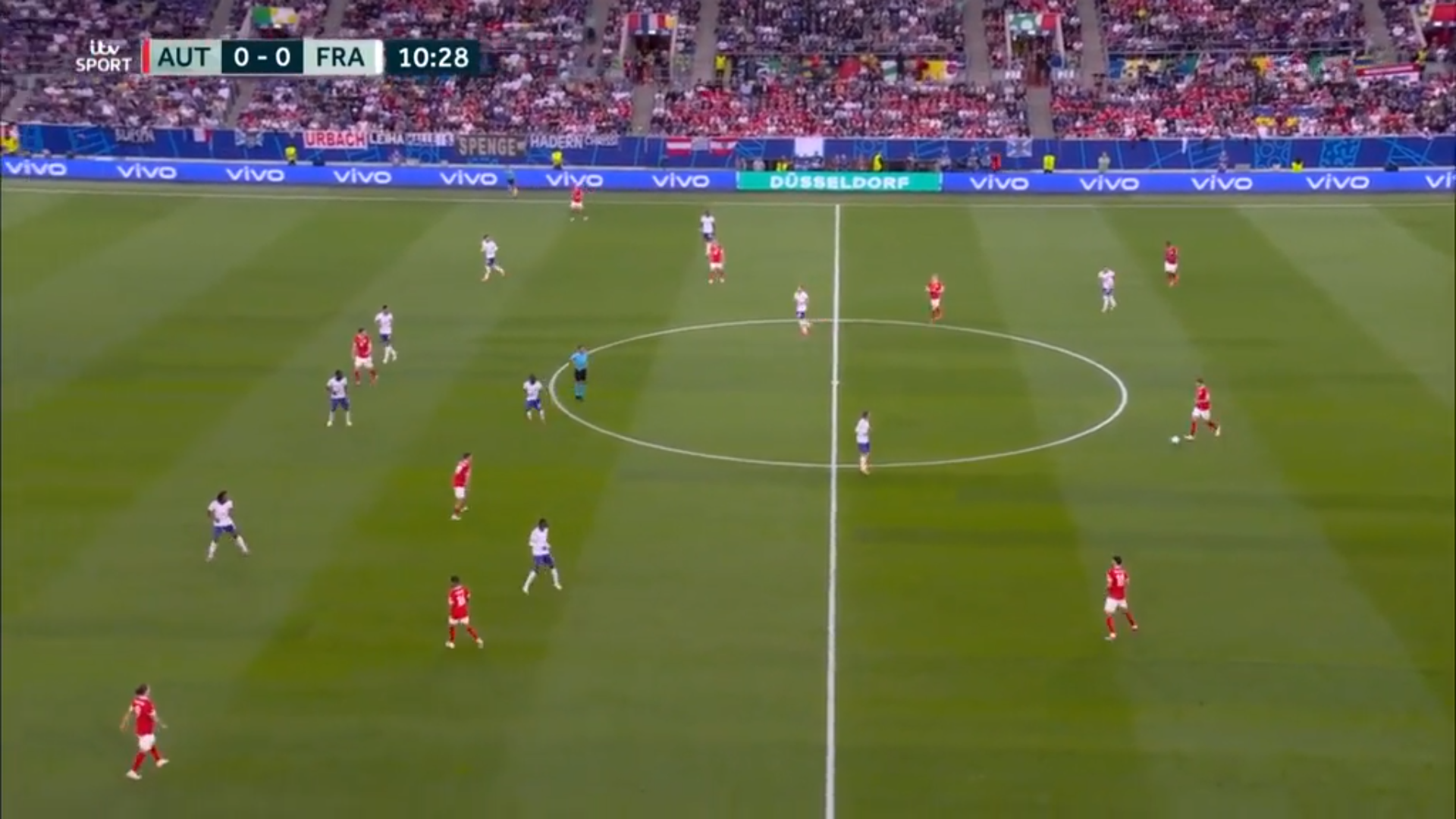
Austria typically begin their build up using a 2+2 structure.
The two central defenders form the first line of circulation, while two deeper midfielders position themselves ahead of them to provide passing options and facilitate progression through the opposition press.
This structure allows Austria to maintain numerical superiority during the initial phase of possession and create stable passing connections across the pitch.
Once Austria successfully progresses the ball beyond the opposition's first line of pressure and establishes sustained possession in the attacking half, their shape evolves significantly.
Florian Grillitsch often drops into the defensive line alongside the centre-backs, transforming the team's rest defence into a back three.
This adjustment provides greater security against counterattacks while enabling more players to occupy advanced positions.
As a result, Austria frequently resembles a 3-1-6 structure in possession, committing numbers forward while maintaining a solid platform behind the ball, as seen in Figure 1.
In advanced areas, Austria seek to create central overloads by instructing their wingers to move inside from wide positions.
This occupation of the central channels forces opposition defenders to narrow their shape, opening space on the flanks for the full-backs to advance, as seen in Figure 2.
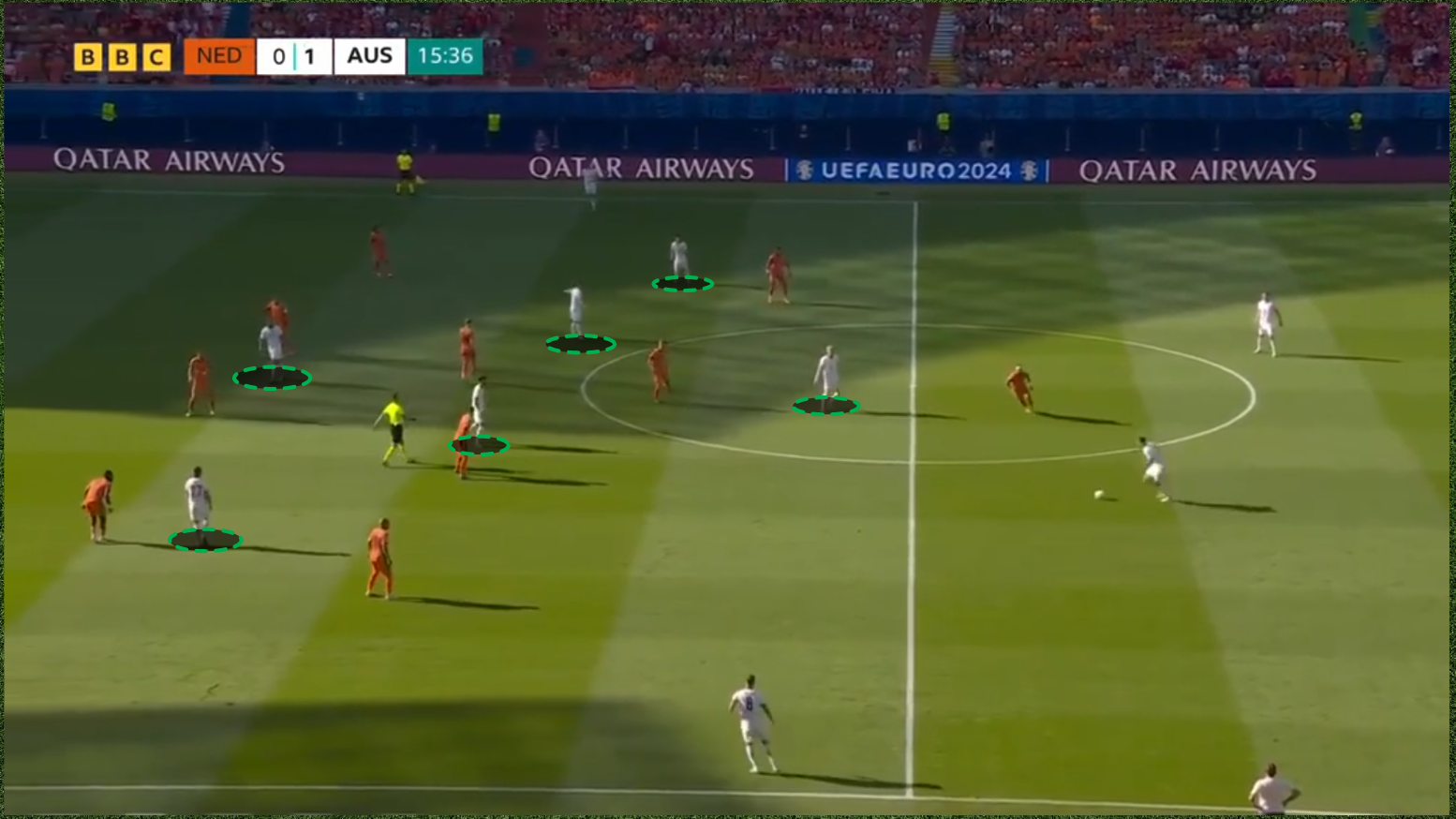
The full-backs then provide width and become key attacking outlets, often receiving the ball in space before delivering crosses or combining with teammates in the final third.
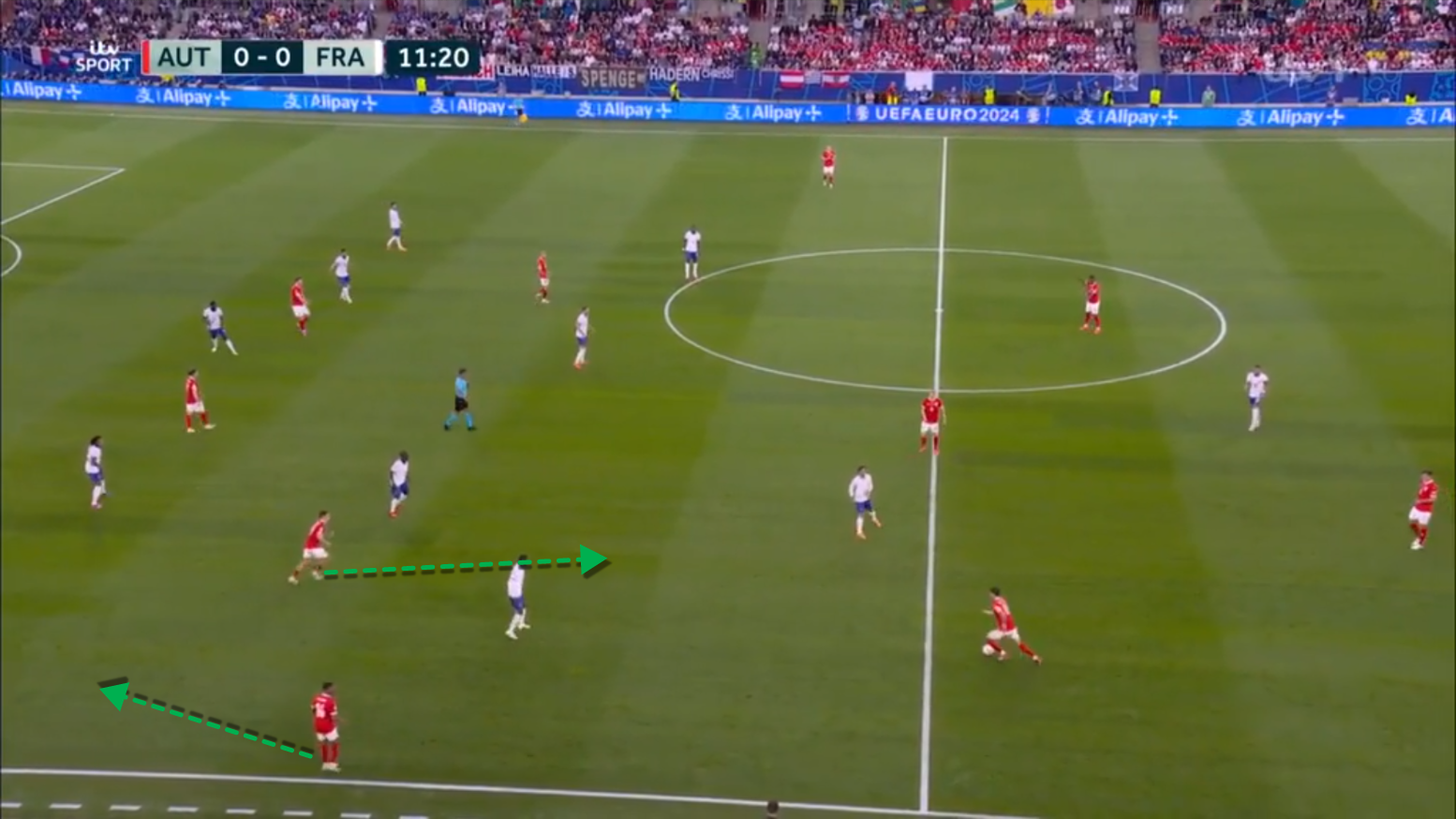
A particularly effective mechanism can be observed on the left side.
The left winger and left-back use coordinated counter movements to manipulate the defensive structure.
When the winger drifts infield, the full-back can surge forward on the overlap, forcing a defender to track the run.
Alternatively, if the defender follows the full-back, the winger gains space between the lines where he can receive possession in dangerous areas and turn towards goal, as seen in Figure 3.