
Lionel Scaloni Tactics At Argentina 2026: Can Messi Retain His World Cup Crown? – Tactical Analysis

Argentina enter the 2026 FIFA World Cup as the defending world champions and the number one team in the FIFA Men's World Ranking.
Led by Lionel Messi and coached by Lionel Scaloni, La Albiceleste have established themselves as one of the strongest national teams in world football.
With a rich World Cup history that includes three titles (1978, 1986, and 2022), Argentina arrive at the tournament aiming to become the first nation since Brazil in 1962 to successfully defend the World Cup.
Their blend of experienced champions and talented younger players makes them one of the favourites to lift the trophy once again.
Argentina kick off their World Cup campaign against Algeria on Wednesday.
In preparation for the tournament, they faced Iceland and Honduras in a pair of friendly matches, recording convincing 3-0 and 2-0 victories, respectively.
Lionel Scaloni's side arrive at the World Cup in outstanding form, having won each of their last seven matches.
During that run, they have conceded just a single goal, which came against Mauritania, underlining the defensive solidity that has become a hallmark of this Argentine team.
In this Argentina tactical analysis, we examine Argentina's style of play, exploring their behaviour both in and out of possession as well as at set-pieces.
We will analyse the key principles that underpin Scaloni's team, exploring how they build attacks, create chances, press opponents, and defend across different phases of the game.
Argentina Starting XI & Preferred Formations
In their final two preparation matches, Argentina used different formations, lining up in a 4-4-2 against Iceland and a 4-2-3-1 against Honduras.
However, despite the structural differences on paper, their principles remained unchanged.
Argentina Lineup Vs Iceland (left), Argentina Lineup Vs Honduras (right)
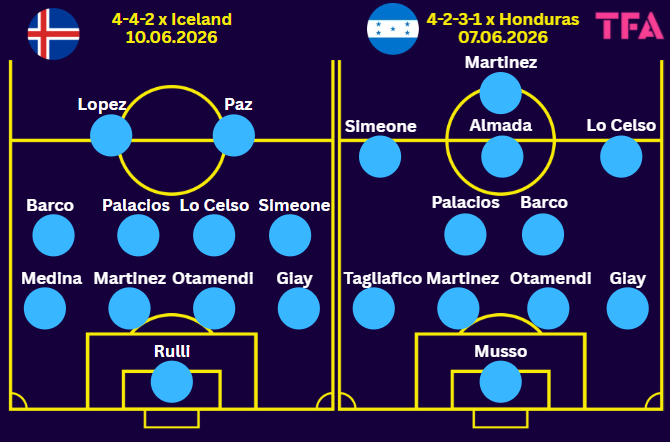
If we look at Argentina's last two starting lineups, we can see that Scaloni rotated several players while maintaining a strong level of performance.
He changed the goalkeeper between matches, with both keeping clean sheets.
Across the defensive line, the only change was at left-back, while captain Nicolás Otamendi, Lisandro Martínez, and Agustín Giay started both games.
In midfield, Scaloni kept Exequiel Palacios, Valentin Barco, and Giovani Lo Celso, highlighting the importance of their roles within the team's structure.
The biggest changes came in attack, where only Giuliano Simeone retained his place in the starting XI across both matches.
This demonstrates the depth and variety of options Argentina possesses in the forward positions.
An interesting fact is that Messi didn't start either of the two preparation matches.
Other key players who were also left out of the starting lineup included Enzo Fernández, Alexis Mac Allister, Rodrigo De Paul, and Julián Álvarez.
The ability to rotate so many influential players without affecting results underlines the remarkable depth of Argentina's squad and the wealth of options available to Scaloni heading into the World Cup.
Argentina Style Of Play In Possession
During the low build-up phase, Argentina frequently use positional rotations to disrupt the opposition's defensive structure.
It's common to see a midfielder moving into the side channel to support the build-up, while a winger drops and moves inside to occupy central spaces.
These rotations create different passing angles and make it more difficult for opponents to apply effective pressure.
When Argentina opt for a more direct approach, they often look to find the striker early with longer passes.
From there, their objective is to attack the space behind the defensive line as quickly as possible.
They frequently switch the point of attack after the initial pass, using quick ball circulation and coordinated movements from the forwards and attacking midfielders.