Hossam Hassan Tactics At Egypt 2026: The Pharaohs' World Cup Strengths & Weaknesses – Tactical Analysis

Egypt’s journey at the 2026 FIFA World Cup has already become one of the tournament’s standout stories.
Entering the competition with high expectations and carrying the hopes of an entire nation, the Pharaohs have worked hard to put themselves in a strong position ahead of the knockout stage.
This campaign has also produced several historic milestones.
Egypt secured their first-ever FIFA World Cup victory with a 3-1 win over New Zealand.
Before that, they opened the tournament with a 1-1 draw against Belgium, before earning another 1-1 draw against Iran.
Those results were enough to see Egypt qualify as runners-up in their group with five points.
Beyond the results, Egypt’s performances have shown a side that has grown in confidence as the tournament has progressed.
Although there are still areas to improve, both in and out of possession, the overall trajectory has been highly encouraging.
With the knockout rounds approaching, the challenge now becomes even greater.
Some tactical details, individual quality, and the ability to manage decisive moments will likely determine how far Egypt can progress.
This World Cup tactical analysis examines the Egyptian National Team’s structure in and out of possession, highlighting the key strengths that have carried them to this stage of the tournament, while also identifying the areas that still require improvement.
Egypt Starting XI & Formation
Hossam Hassan sets Egypt up in a 4-4-2 formation.
Mostafa Shobeir typically starts in goal behind the centre-back pairing of Yasser Ibrahim at right centre-back and Hamdy Fathy at left centre-back.
Ahmed Fatouh starts at left-back, while Mohamed Hany starts at right-back.
Marwan Attia and Mohanad Lasheen start together as the two central midfielders, with Emam Ashour on the left wing, Mohamed Salah as the ‘10’ and Mostafa Ziko on the right wing.
Omar Marmoush takes his usual place up top as the striker.
There are a few changes that could be made to this lineup.
Ramy Rabia could replace either of the centre-backs, while Zizo and Trézéguet are the most likely options to come on in the wide areas.
Up front, we could also see FC Barcelona Atlètic's new centre-forward, Hamza Abdelkarim, get some game time.
Egypt Style Of Play
Egypt Defensive Corners
Having conceded three goals during the tournament so far, including one from a corner against New Zealand and one against Iran, while also surviving a disallowed free-kick goal against Iran, it is worth beginning with Egypt’s defensive set-piece structure.
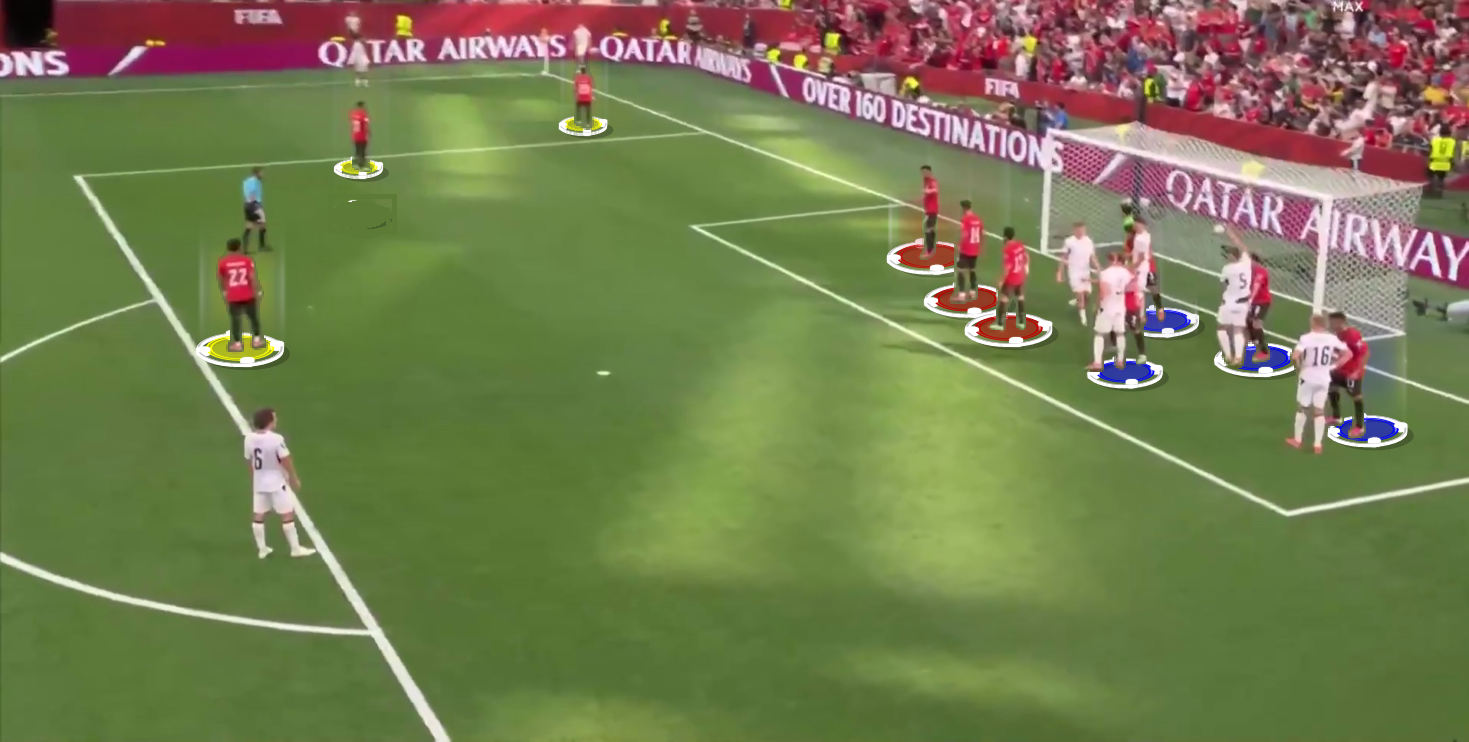
When they conceded to New Zealand, Egypt defended with three zonal markers (red), four man-markers (blue), one player on the edge of the box, and two defenders ready to deal with a short corner from the start.
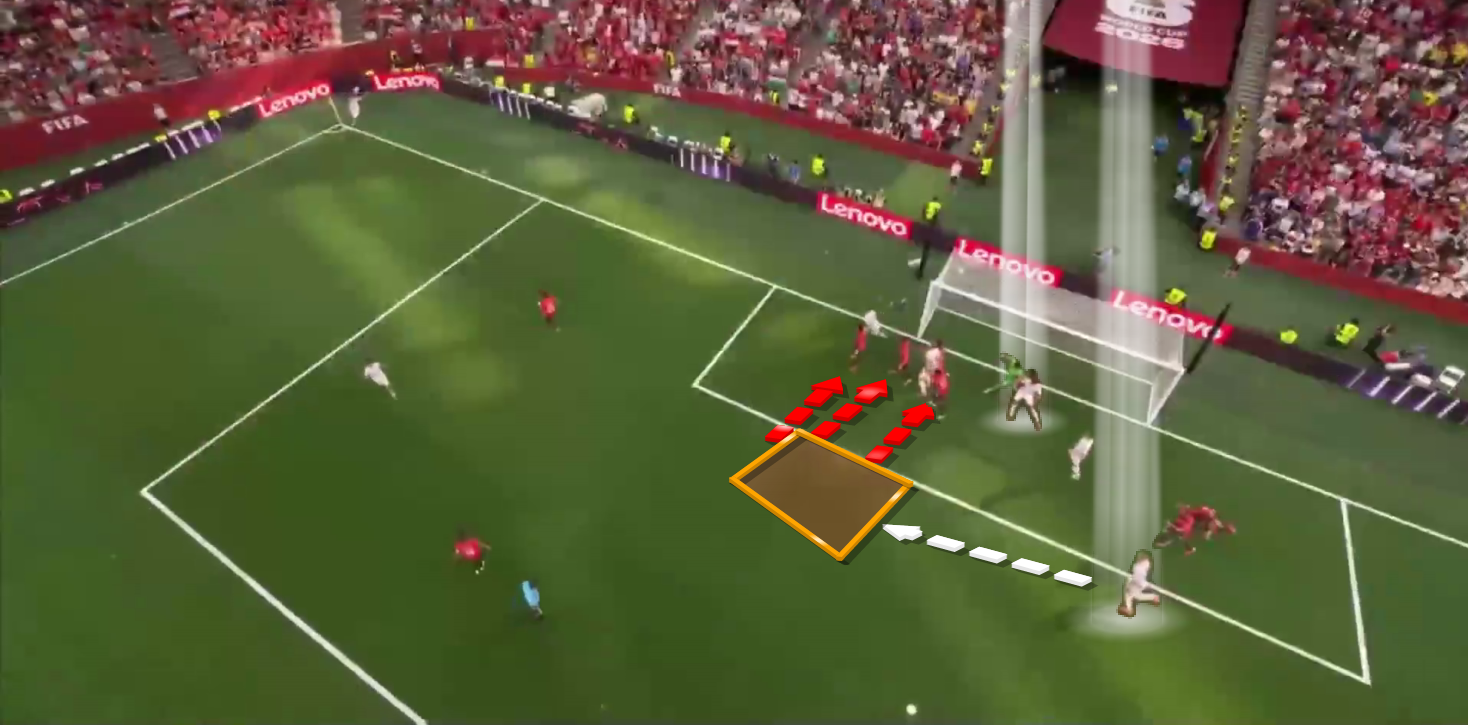
New Zealand attacked with five players positioned deep near the goal line to draw both the man-markers and zonal defenders towards goal, leaving the area around the edge of the six-yard box free.
Their target player started at the far post before separating from his marker and attacking the near-post zone from the blind side of Egypt’s zonal defenders, helped by one of his teammates blocking Egypt's goalkeeper.