
Rúben Amorim Tactics At AC Milan 2026/2027: More Sporting CP Or Man United 2.0? - Tactical Analysis
Rúben Amorim is a strange manager to gauge right now. His reputation as a manager is at its lowest point in years after a disappointing 14 months in charge of Manchester United. Yet the Portuguese coach joined the Red Devils to incredible fanfare.

Who Is Rúben Amorim?
Rúben Amorim is a strange manager to gauge right now.
His reputation as a manager is at its lowest point in years after a disappointing 14 months in charge of Manchester United.
Yet the Portuguese coach joined the Red Devils to incredible fanfare.
He had won Sporting CP their first league title in 19 years in 2020/2021, and brought them another one in 2023/2024.
After it had been announced that he was heading to the Premier League, there was a two-week delay in determining when he would join.
During that time, he beat soon-to-be rivals Man City 4-1 in the UEFA Champions League, and the red side of the city's expectations skyrocketed.
Amorim was known as a manager committed to his three-at-the-back system (reportedly, that commitment cost him a chance to replace Jürgen Klopp at Liverpool).
He, expectedly, immediately implemented this at Old Trafford.
His tenure did have its moments.
There was a 2-1 win away at Manchester City in his first few games in charge, a 2-2 draw and a 2-1 win at Anfield in consecutive seasons, they knocked Arsenal out of the FA Cup and beat them at the Emirates, and there was also the UEFA Europa League run to the final.
The bigger games never seemed to be the issue.
The majority of his time there, though, was at best tepid and featured some incredibly embarrassing moments (the EFL Cup defeat to Grimsby Town, losing to 10-man Everton at home, falling out with fan favourites Marcus Rashford and Kobbie Mainoo).
Yet the man is revered by half of Lisbon.
This Rúben Amorim tactical analysis looks at the good, the bad and the ugly of Rúben Amorim's managerial career so far, and what parallels we can draw with his experience and his upcoming venture into Italian football.
Rúben Amorim Out Of Possession Tactics
While Amorim toyed with the idea of starting with a back four towards the end of his time at Man United, he has (as mentioned) religiously played a back-three system, even mentioning that not even the Pope could convince him to change.
Let's start with what he wants his teams to look like and do off the ball.
His teams attack in the 3-4-2-1/3-4-3 shape we'll get into later, but his teams are a bit more flexible in terms of what they look like out of possession.
There are two common shapes that you will see from an Amorim team when defending: 5-4-1 or 4-4-2.
Below, from a previous Tactical Football Analysis article, we see the 5-4-1 shape in practice during his time at Sporting.
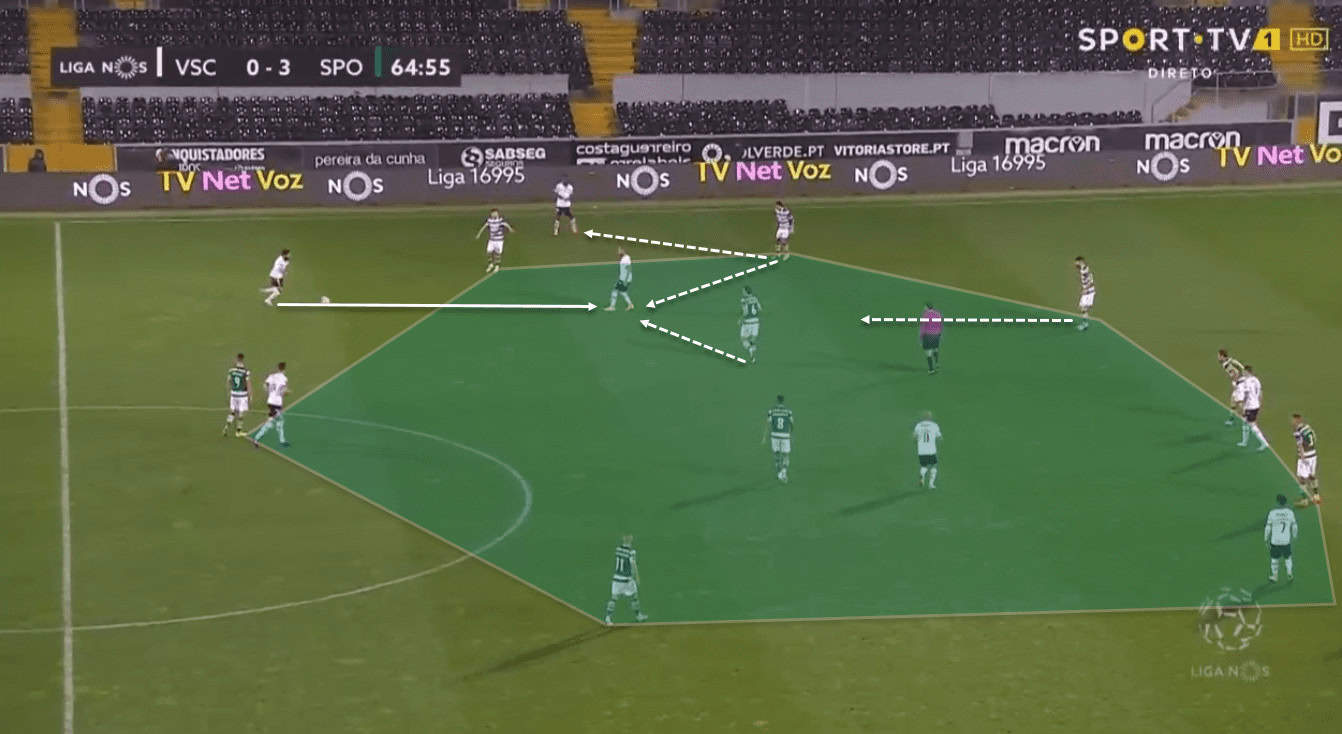
The wing-backs are asked to drop back into the defensive line, keeping a narrow shape and blocking central areas.
The central defenders (think Gonçalo Inácio at Sporting or Lisandro Martínez at Man Utd) were then asked to be 'the aggressors', jumping out to apply pressure and stop any opposition #10's or strikers from having time on the ball in between the lines.
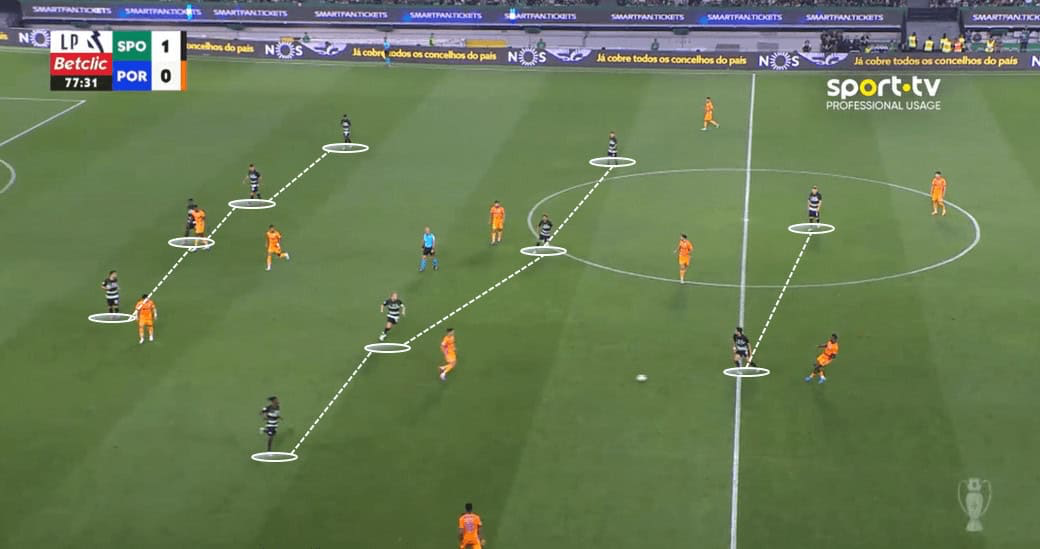
The 4-4-2 shape looks something like the one shown below.
Amorim's teams have several core principles off the ball.
As mentioned, they look to have compactness and protect central areas, often leaving space out wide in the name of blocking the middle of the pitch.
His Sporting team was known for its aggressive counterpressing.
You will often see a high defensive line, and he likes to press teams in certain areas of the pitch (often pushing them over to one side, using opposition full-backs as pressing triggers).
At its best, it's an incredibly fluid system with clearly defined roles for each player.
There was an effectiveness, especially during his time in Portugal and in some big games in Manchester, in the counterpress.
His defensive structure comes with its weaknesses.
One of the biggest things exposed at Man Utd was that the two central midfielders are often asked to cover large spaces, something that players like Casemiro were not able to do.
It meant that opposition teams could easily beat the press, and because Amorim emphasised central areas, they were then exposed out wide, leaving lots of space in behind.
His Manchester United side also struggled to 'get' Amorim's system.
It was often a criticism of him that he was not a good communicator in England, something that was meant to be a strength of his.
The press was disjointed, and they looked like a team without a cohesive plan; players did not press as a unit, and gaps appeared all over the pitch.
Rúben Amorim In-Possession Tactics
So much of Amorim's philosophy revolves around verticality.
It's what his Sporting team excelled at.
Just look at this breakaway in that famous win against Pep Guardiola's Man City.
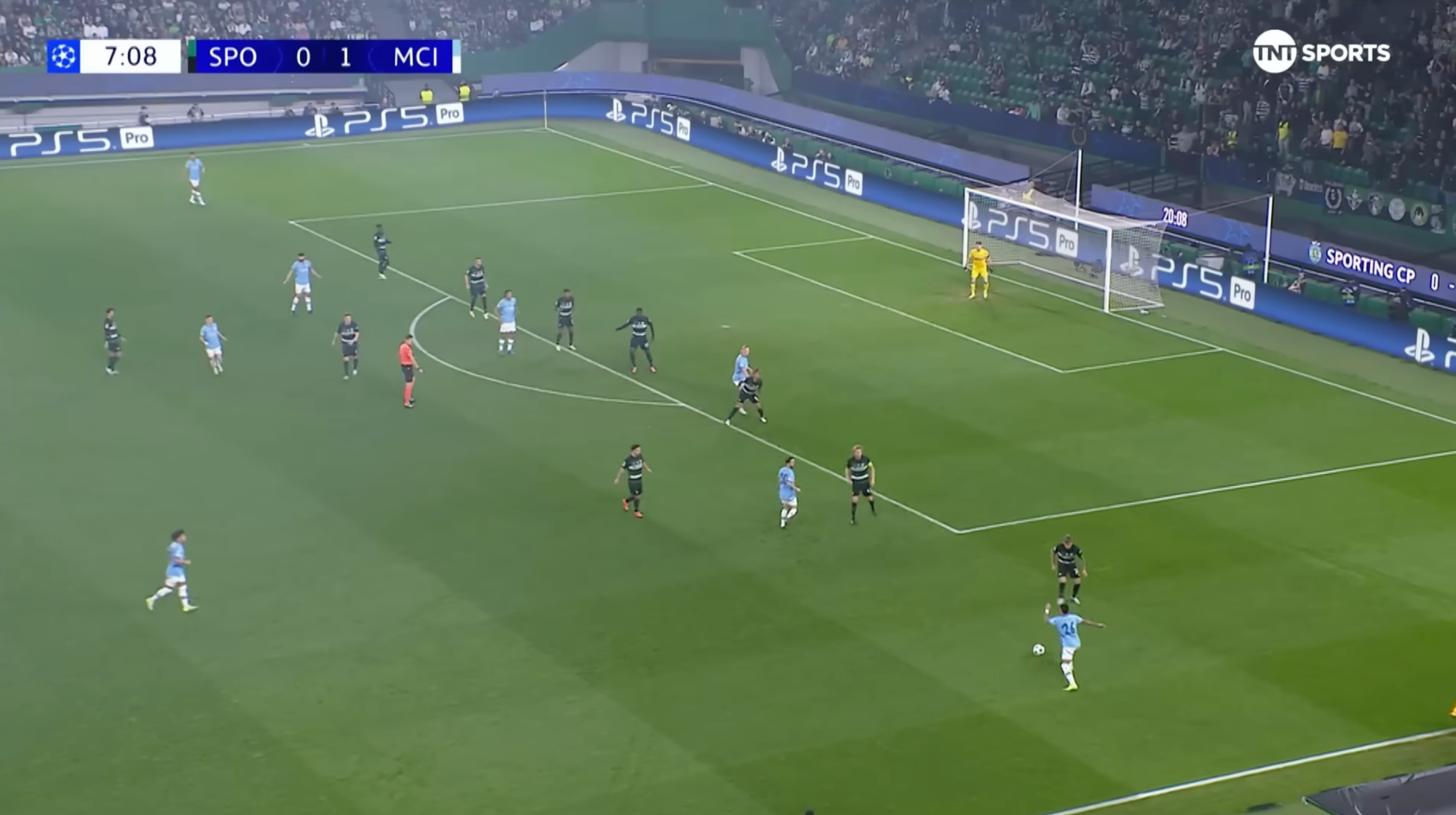
They are set up in their block, more defensive than usual, given the quality of the opponent.
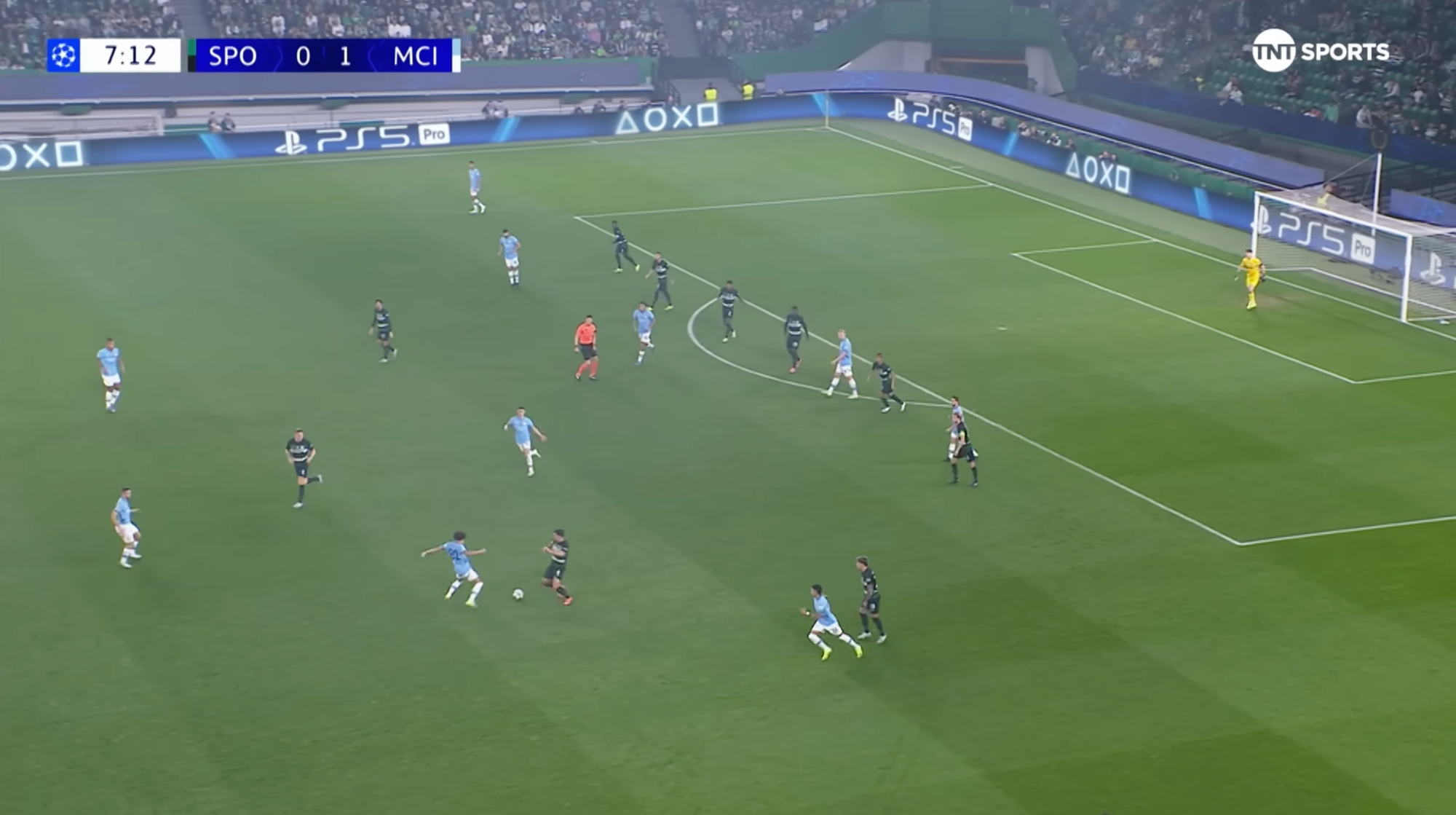
A loose pass from City results in a turnover, and in a flash, Viktor Gyökeres is through on goal.
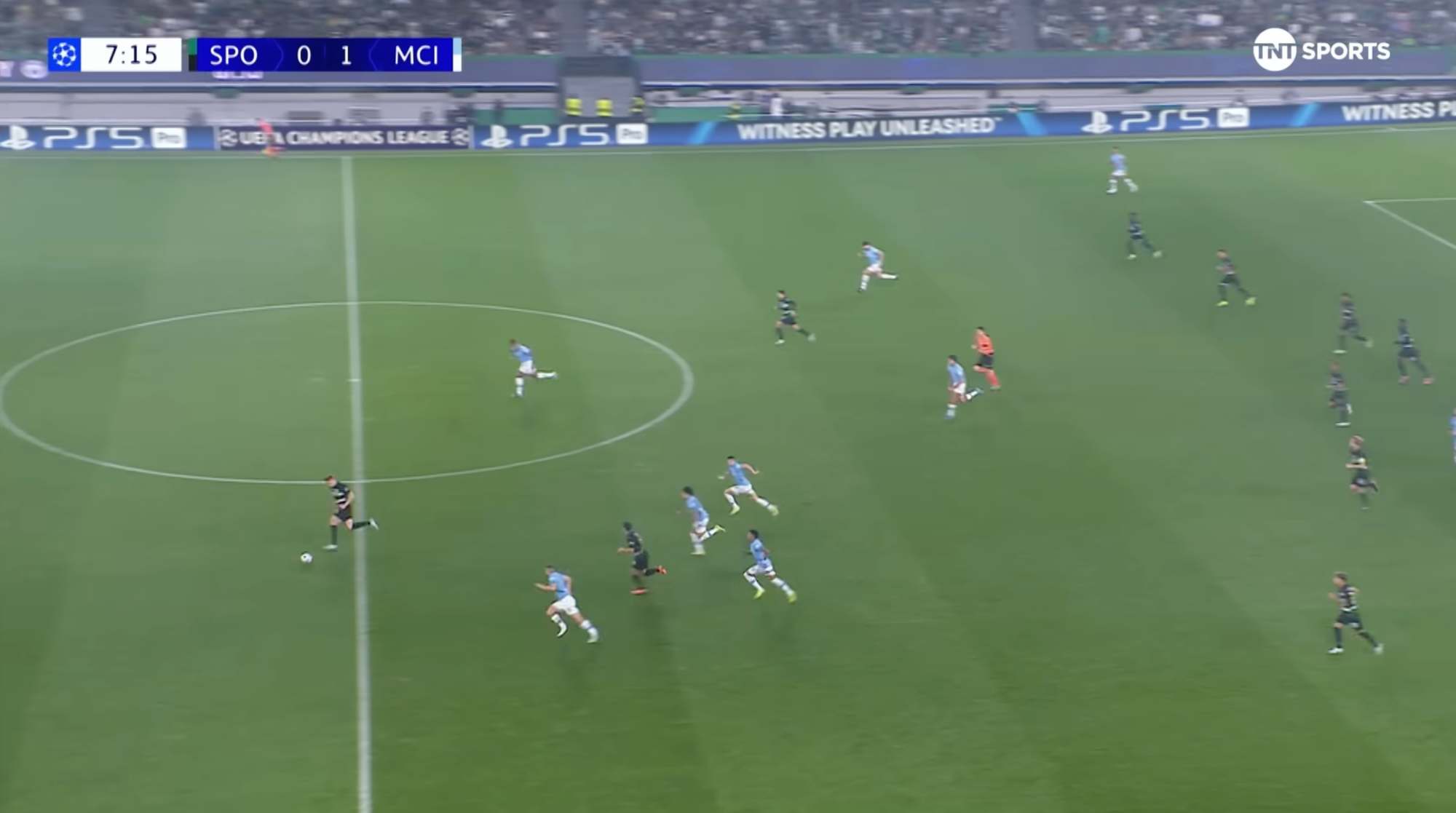
He fluffs his lines on this occasion, but with Gyökeres, he had a genuinely elite transitional striker.
At United, the structure stayed the same.
The 3-4-3 focused on creating a 4-2 structure at the back, giving a numerical advantage against any press.
Amorim relies a lot on wing-backs; they push up high to attempt to create overloads in attack.
The holding midfielders and centre-backs would look to get the ball up the pitch as quickly as possible, and the wing-backs would be asked to either make runs to receive the ball or make runs to generate space for Bruno Fernandes.
United relied heavily on counterattacks whilst Amorim was in charge.
We didn't see the dominance of possession that Man City or Liverpool have looked for in recent years; at times, they'd want their opponents to have the ball so they could create transitional moments.
In some ways, Amorim was unlucky at United.
He often used players he did not want to.
His emphasis on wing-backs is clear, but neither Noussair Mazraoui nor Patrick Dorgu were impressive under him.
His United team also massively underperformed their expected goals.
In his first season (2024/2025), they scored almost 14 goals fewer than they could have expected.
But they also were not good enough.
They could be one-dimensional, particularly against opponents they had 'superiority' over.
They didn't maximise the creativity or talent of Fernandes, who has gone on to have an all-timer season under Michael Carrick, who platformed his individual brilliance.
It was clear that they could look good as the underdog, with teams that would dominate the ball and not sit in against them, but when the opposite occurred, Amorim often came unstuck.
How Do Rúben Amorim Tactics Apply To AC Milan 2026/2027?
The good news for Amorim is that he is joining an AC Milan side that have been utilising a back three.