Roberto Martínez Tactics At Portugal 2026: Can The World Cup Contenders Turn Control Into Goals? – Tactical Analysis

Like other big hitters, Spain and Brazil, Portugal failed to get their 2026 FIFA World Cup off to a winning start, as their opening clash with the Democratic Republic of Congo ended in a 1-1 draw.
This World Cup arrives without a runaway favourite, but Seleção das Quinas undoubtedly sit in the cluster of nations tipped for a deep run.
Off the back of their 2024/2025 UEFA Nations League win, and with what is almost certainly Cristiano Ronaldo's last shot at the trophy, Roberto Martínez has been entrusted with another 'golden generation'.
The Portugal side has generational midfield talent and a defensive unit that has visibly matured over his three-year tenure.
The most talked about unit is the projected midfield three of Vitinha, João Neves, and Bruno Fernandes, a combination that pairs back-to-back Champions League winners with arguably the most influential midfielder in the Premier League.
Around them sit Nuno Mendes, Rafael Leão, Bernardo Silva, and Rúben Dias, names that would walk into virtually any squad in the tournament.
However, there are concerns regarding Portugal's open-play attacking output, the centre-forward position, and the rest-defence structure, which has shown cracks against high-level opposition.
Portugal generated just six shots in their opening game of the World Cup, hitting the target only once.
Despite keeping 73.37% possession, they only managed to generate 0.75 xG against an opposition they should be beating fairly handily if they're to live up to some pre-tournament expectations.
This World Cup tactical analysis details how Portugal will set up throughout the tournament, as well as the in-possession and out-of-possession behaviours that define their model.
It will also examine the individual instructions that hold the Portuguese system together, as well as the structural levers Martínez can pull in-game.
The Three Phases Of Roberto Martínez's Portugal
When Martínez took over in January 2023, he inherited a Portugal squad whose profile demanded a back four.
His Belgium squad had been built around Kevin De Bruyne, Eden Hazard, and Romelu Lukaku in a 3-4-2-1, but Portugal's surplus of pure central midfielders, natural wide forwards, and multifaceted full-backs (João Cancelo, Nuno Mendes, Diogo Dalot) made the 4-3-3 his preferred formation.
Still, he has tinkered with a back three in friendlies and in selected Nations League fixtures.
The first phase, the 2023 qualifying campaign, saw a 4-3-3 with reckless attacking commitment.
Achieving 10 wins from 10 flattered a system in which both full-backs pushed high simultaneously, and the midfield rotated freely.
Phase two, UEFA Euro 2024, exposed the flaws.
Against France, and even Slovenia, Portugal monopolised possession but produced very little in open play.
We saw the same in their opening match of the 2026 FIFA World Cup, which doesn't bode well for them in this tournament.
Bernardo Silva was playing as a right winger, and Martínez was criticised for his loyalty to Ronaldo's pressing inadequacies.
In the 2024/25 Nations League-winning campaign, Bernardo was playing centrally, often as a false nine or advanced midfielder.
João Neves became undroppable alongside Vitinha, and Mendes was granted a licence to invert.
By mid-2025, Portugal looked tactically sharper, less Ronaldo-dependent in the press, and capable of controlling matches against elite opposition.
That may be the blueprint for success if they're to make a success of their World Cup campaign.
Portugal Style Of Play In Possession
Portugal's signature in-possession shape is now a 3-2-5.
As shown, Portugal often progress in a 3-2-5 shape, with the wide players holding extreme width to stretch the pitch.
This creates more room for their half-space threats and ball carriers, while also pinning the opposition's backline.
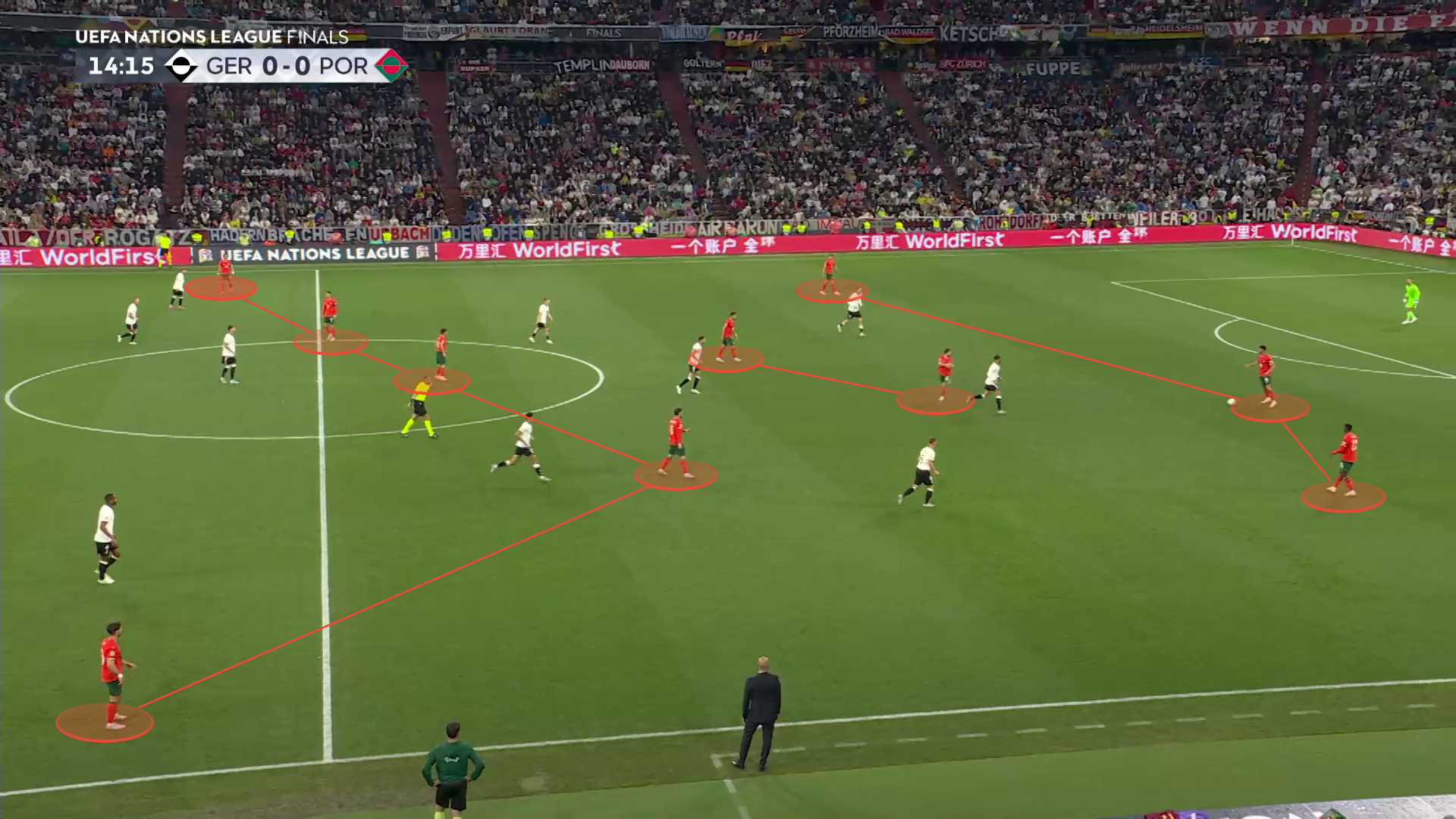
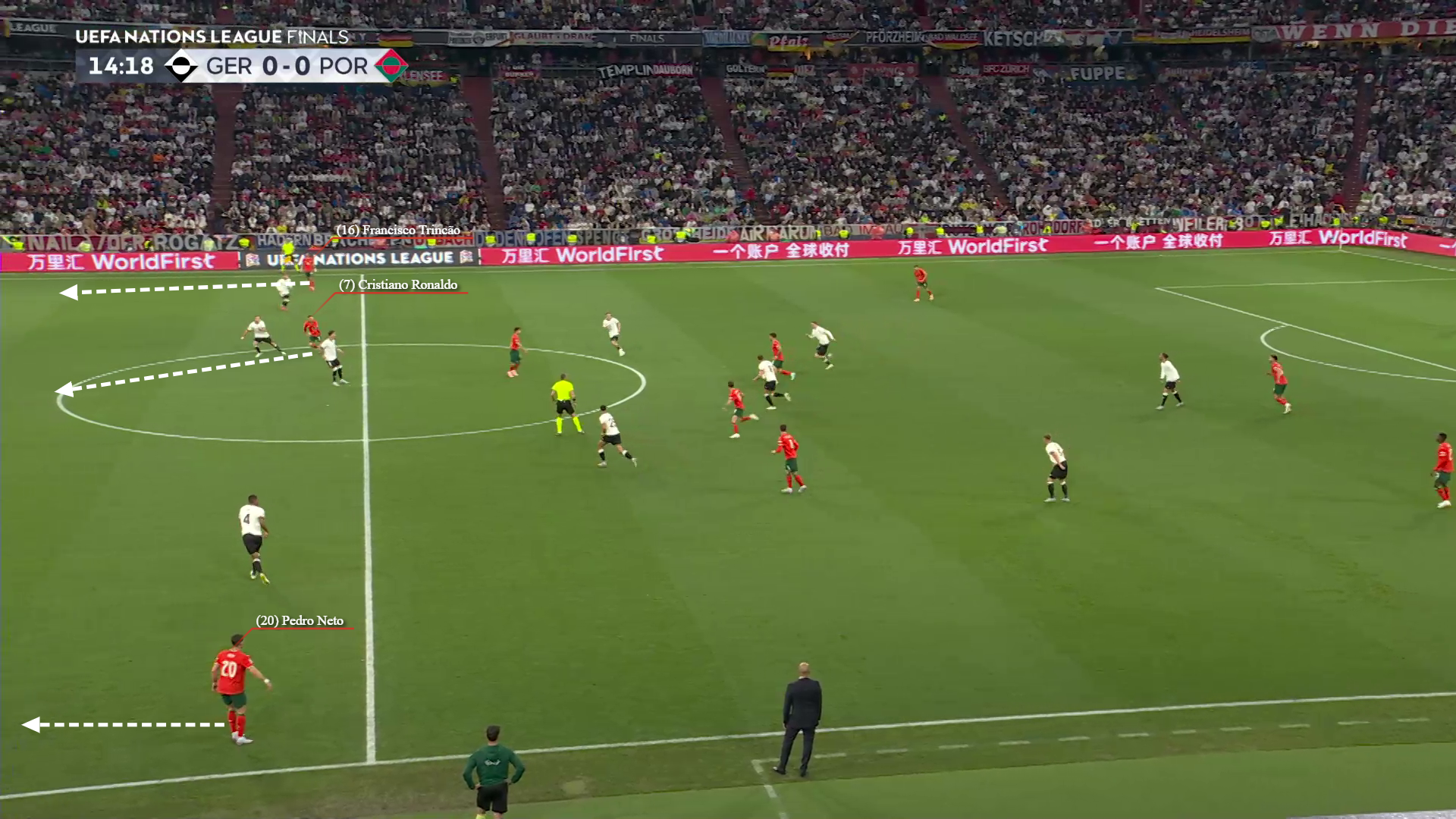
The back three is formed by the two centre-backs (Dias plus António Silva or Gonçalo Inácio), alongside a dropping midfielder or inverted Diogo Dalot.
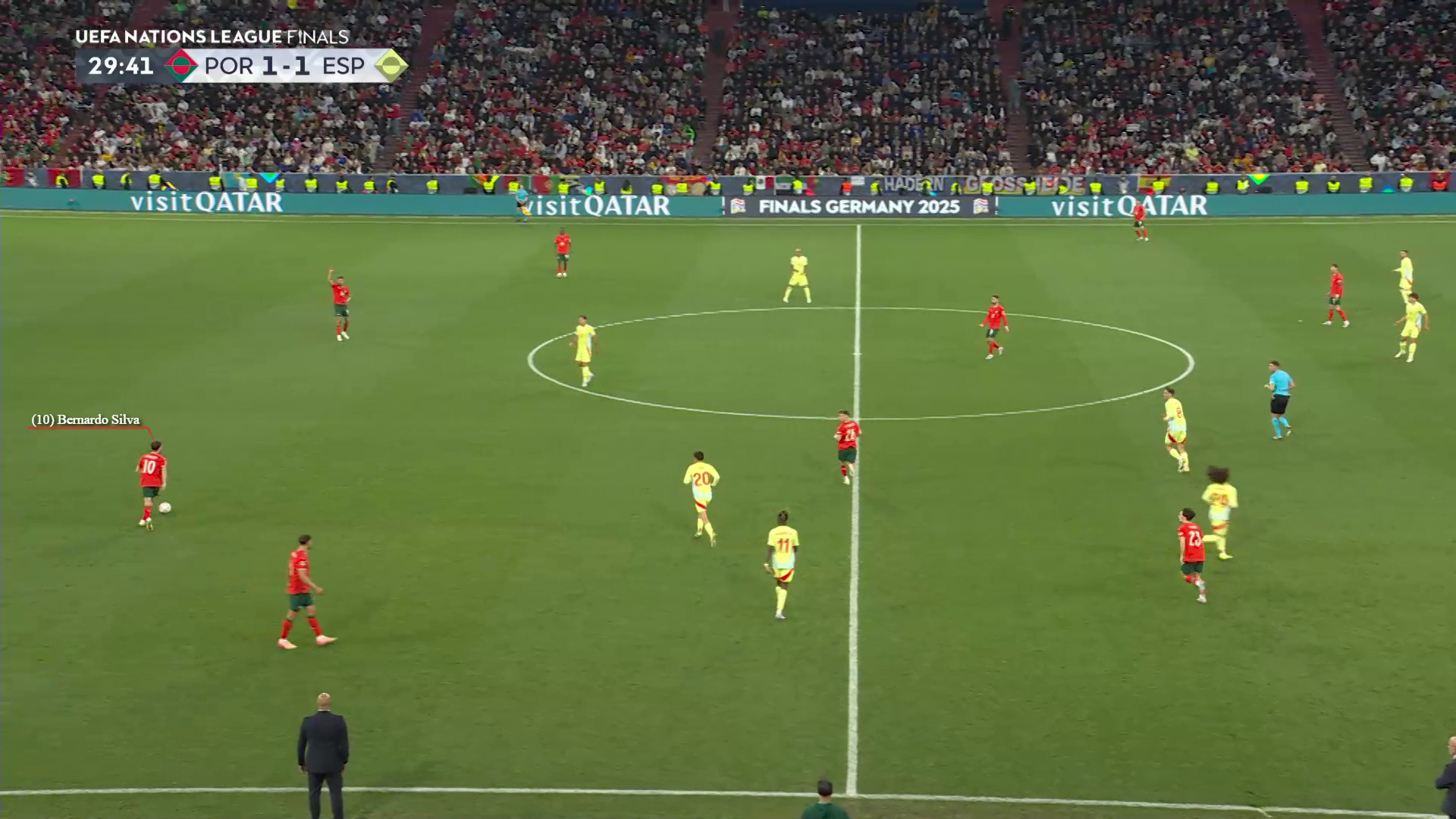
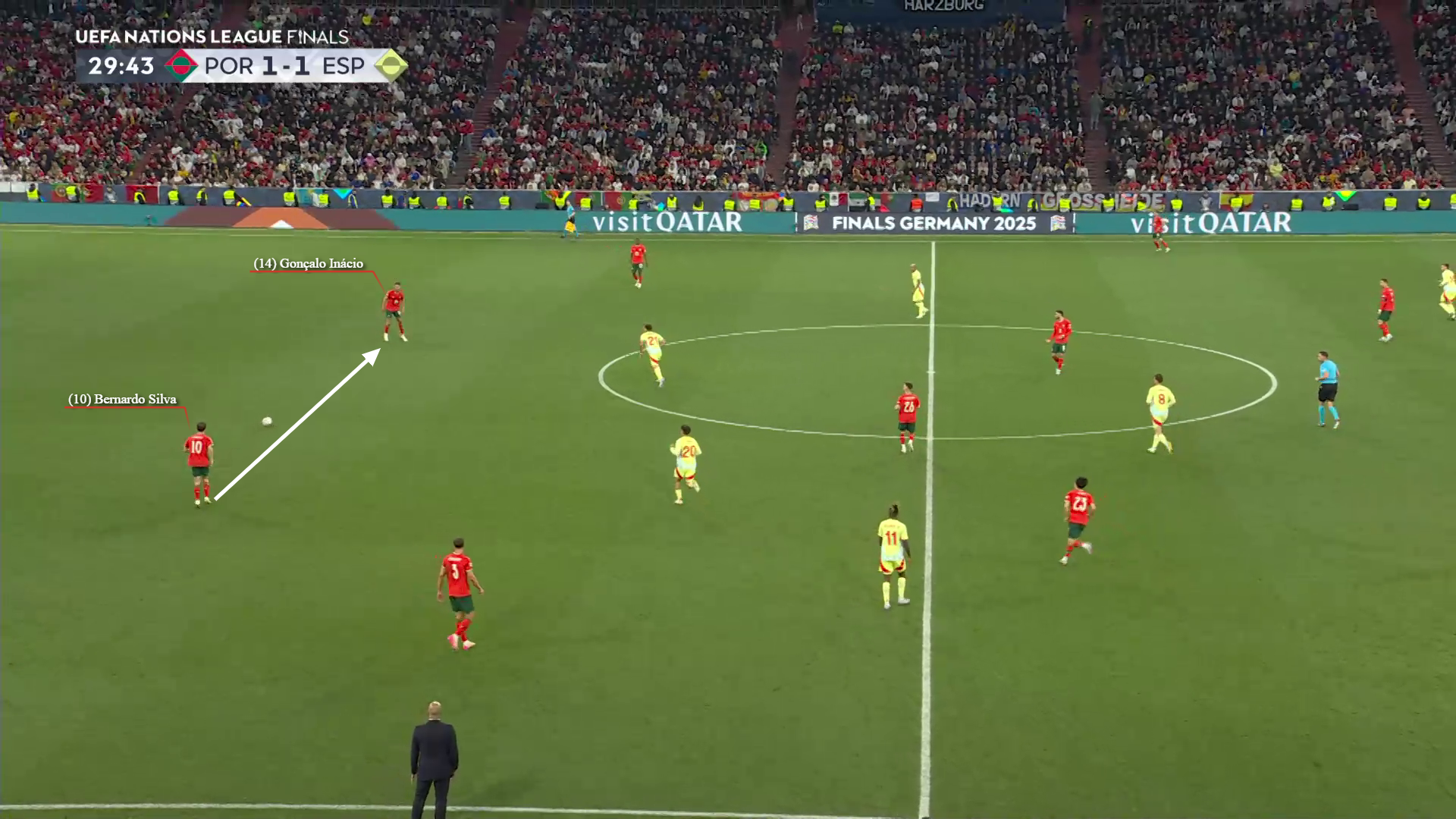
Vitinha drops most often when the press demands his resistance; João Neves tends to push higher as a connector and sometimes drops into the right-back position for buildup, and occasionally Bernardo himself rotates back, creating a Pep-influenced back three.
Neves drops in as Portugal try to build down the right.
He’s excellent in tight areas, but even more effective when he has space, so rotations around him help open the game up and progress the build.
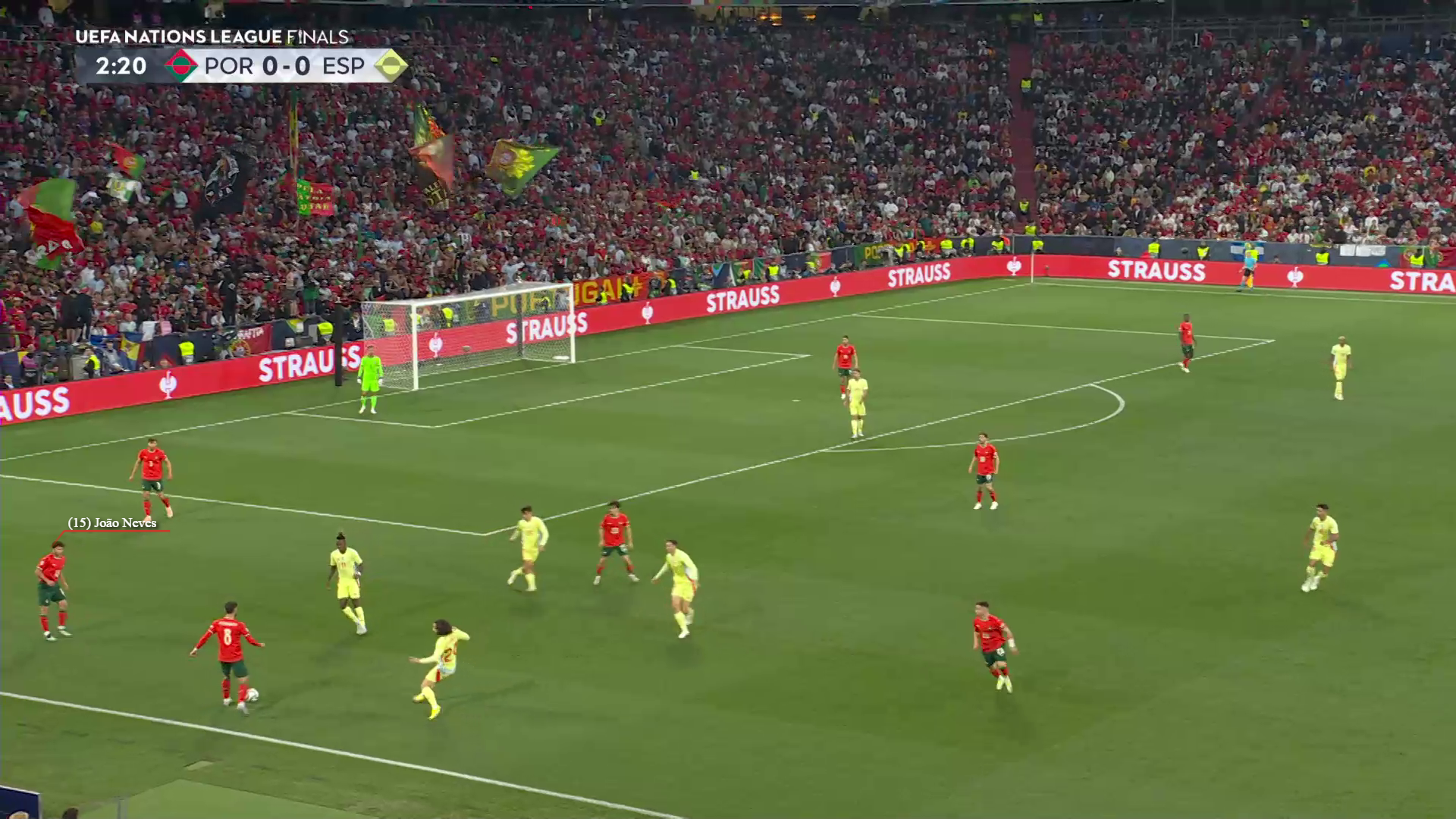
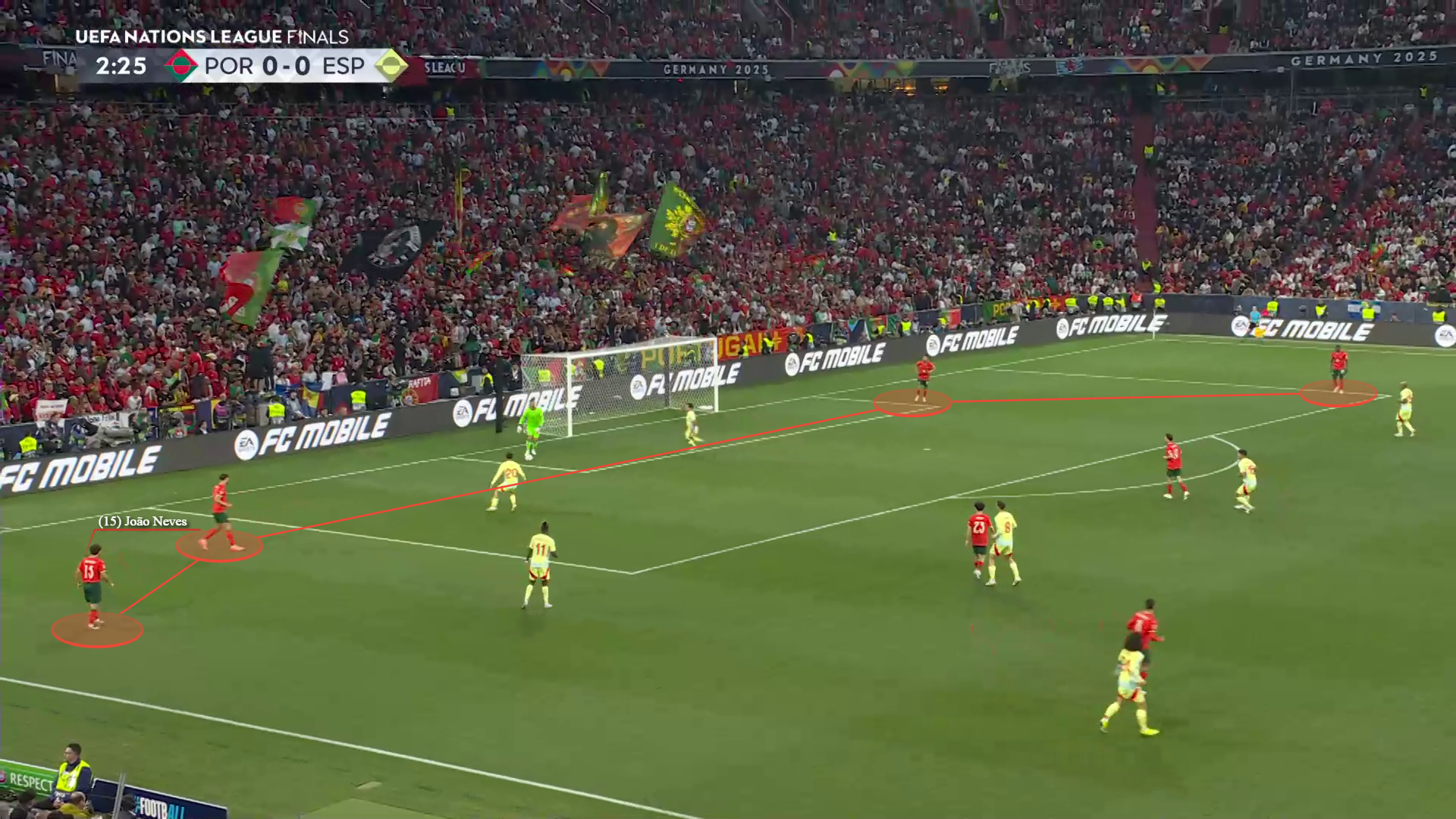
As seen against Spain in the Nations League, Bernardo Silva can drop into the backline to keep the play moving and help pick out openings.
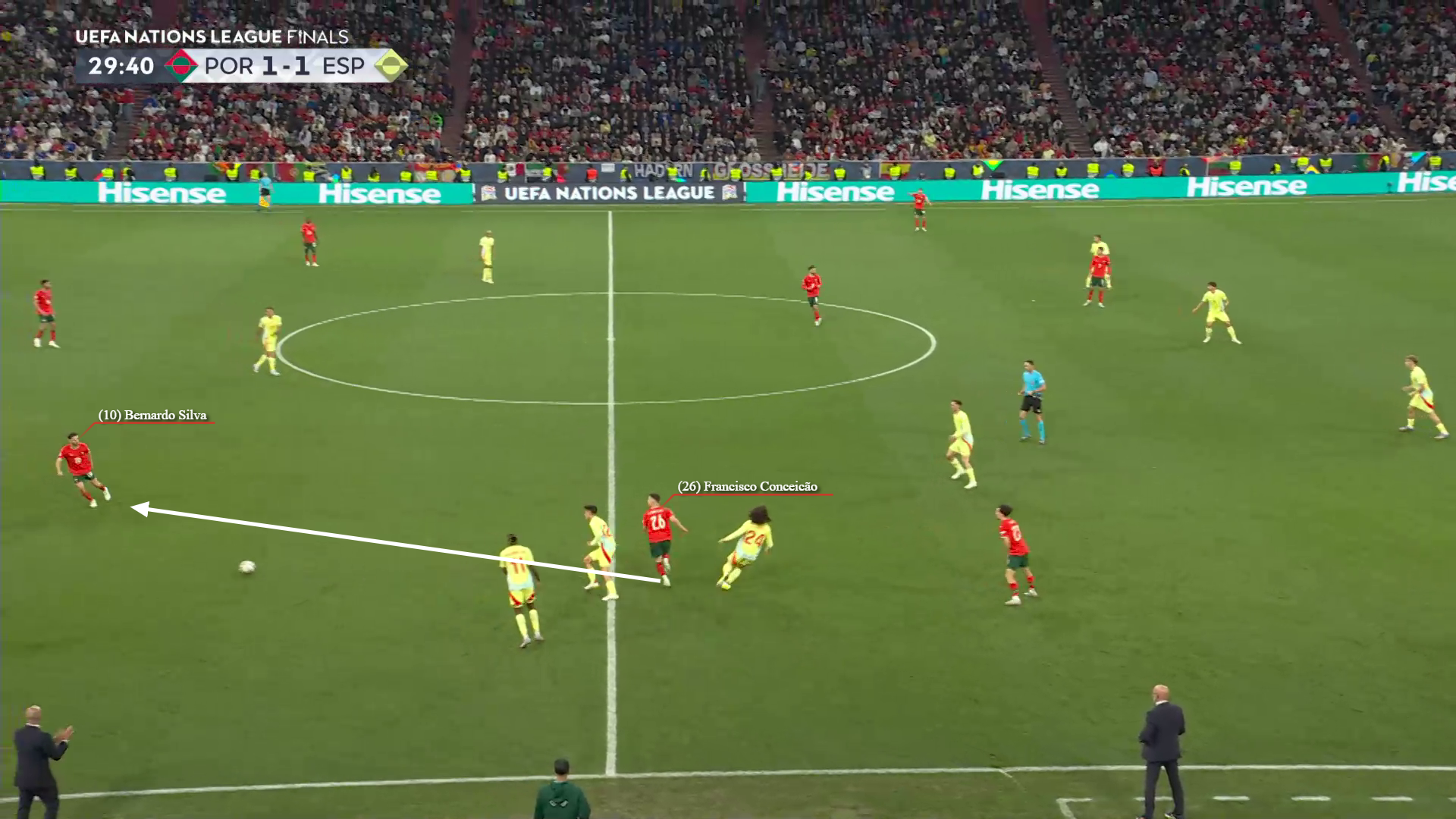
Ahead of that back three sits a double pivot.
The deeper player (usually Vitinha) angles passes laterally and resets tempo, while the higher player (Bruno or Neves) acts as a between-the-lines connector and the immediate pressing trigger when possession is lost.