Coaching Low Block Defending Like Eddie Howe's Newcastle United & Scott Parker's Burnley - Tactical Theory

What Is Low Block Defending?
Low block defending, where a team is set up to defend in their shape with numbers behind the ball in their own defensive third, is seen in almost every game of modern football.
This can be part of a deliberate strategy to sit deep and frustrate the opposition, or just a moment in the match where the opposition has a foothold in their half, and, as is increasingly the case, the defending team has 10 or 11 players behind the ball.
This low block defending tactical theory piece will provide examples of Eddie Howe's tactics at Newcastle and Scot Parker's tactics at Burnley, and how they have defended as a team in recent seasons, and analyse the nuances involved for individual defenders.
This low-block defending tactical theory will also provide examples of training exercises for coaches who wish to improve their teams' low-block defending.
These coaching exercises are designed to help teams play as a cohesive defensive unit and to improve the defence of individual players within that team.
Newcastle United In A Low Block
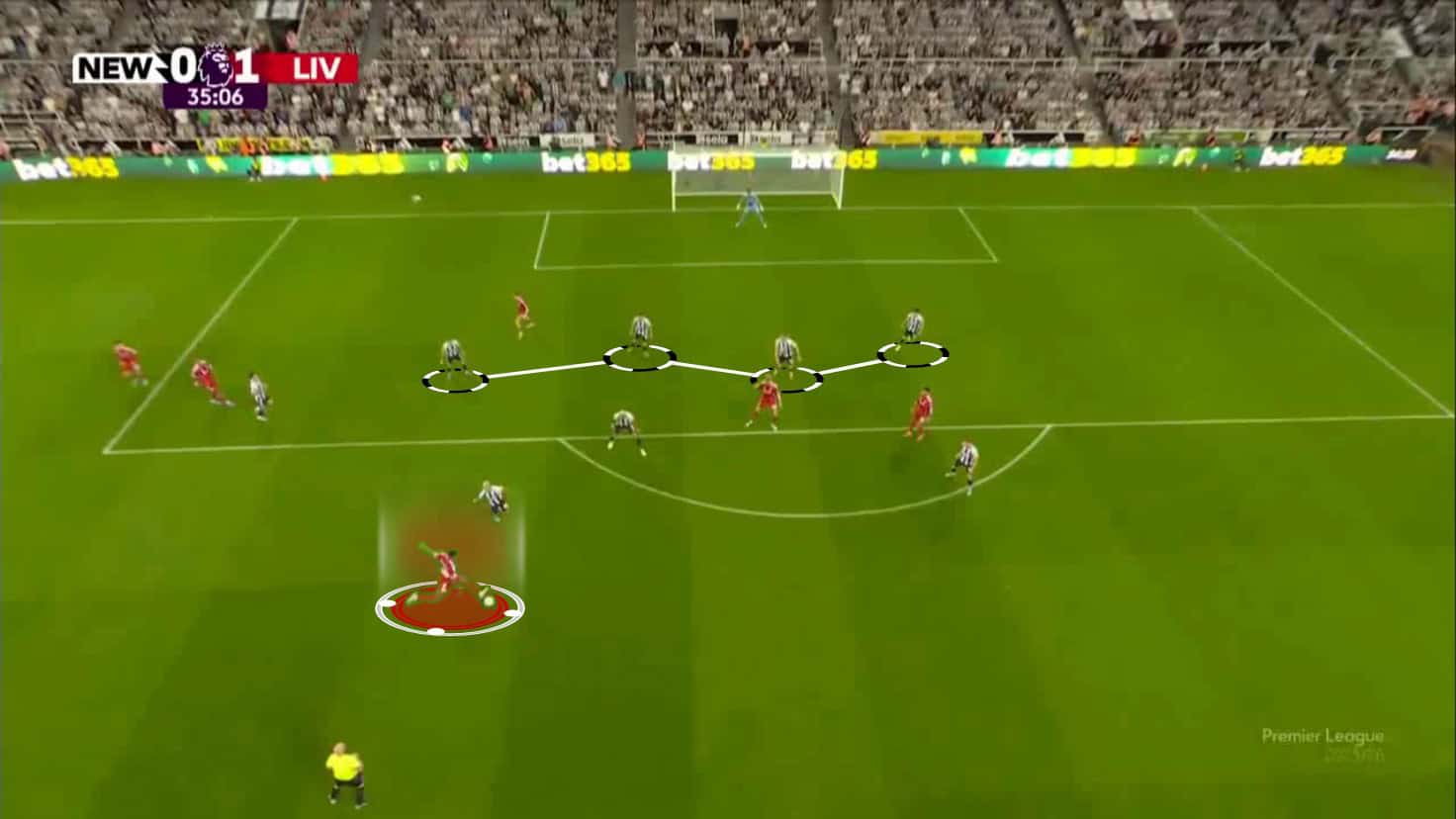
The above image is from the Magpies' Premier League encounter with Liverpool.
Newcastle, playing in a 4-3-3 formation, are pinned in their own defensive third against Liverpool's formidable attack.
Eddie Howe's tactics in these scenarios was to have his backline in line with the penalty spot and his midfielders holding at the edge of the box.
With the backline so close to their own goal, it is extremely difficult for the opposition to play balls behind them.
As the image shows, with the back four covering an area smaller than the width of the six-yard box, every part of the goal from Liverpool striker Hugo Ekitiké’s standpoint is protected.
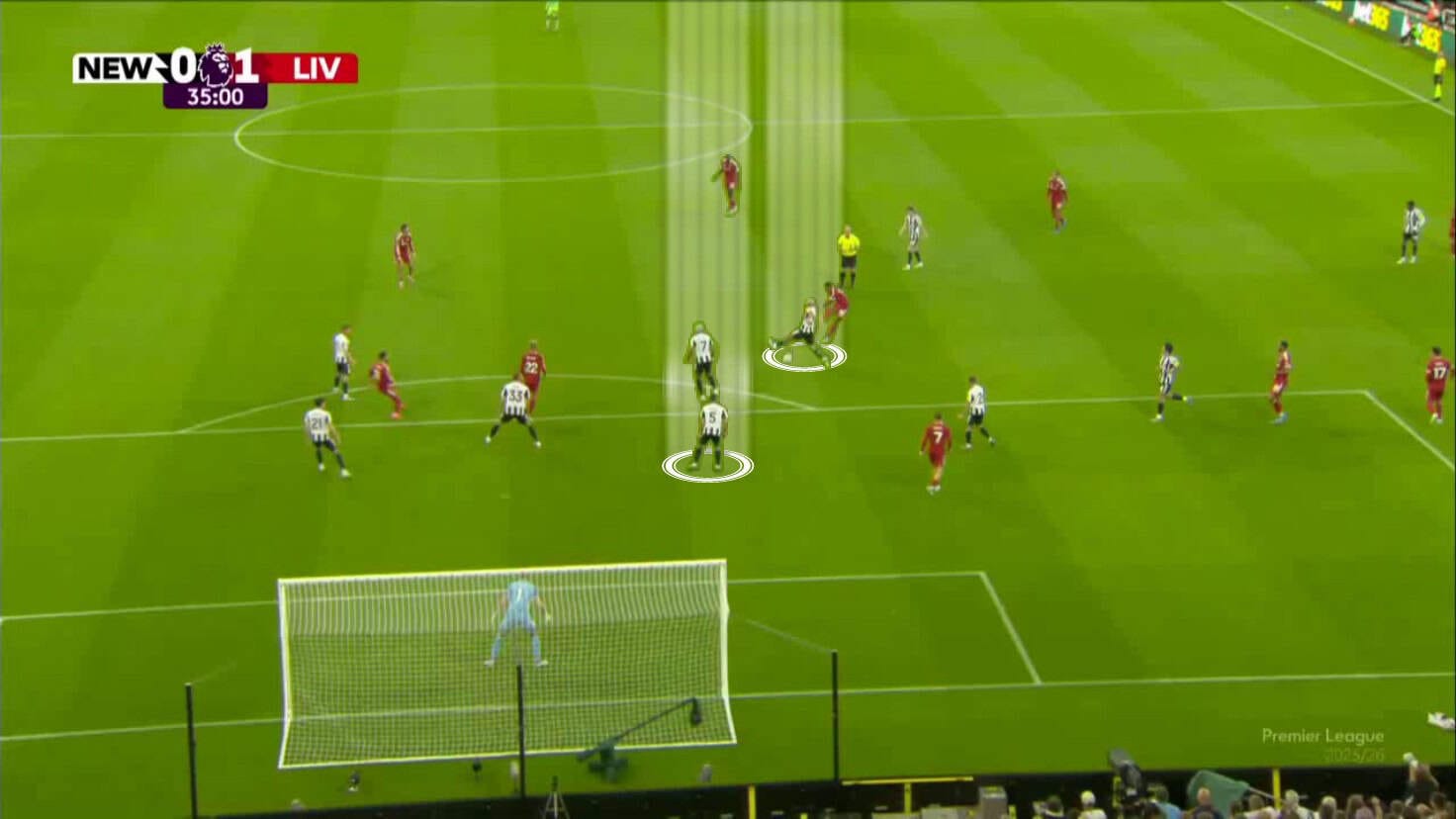
The major mistake made by the onrushing Newcastle defender here is to stick a leg out in an attempt to block Ekitike’s shot.
Ekitike used this outstretched limb to put the ball between the defender's legs at a point where, thanks in large part to the positioning of #5 Fabian Schär, the goal was protected.
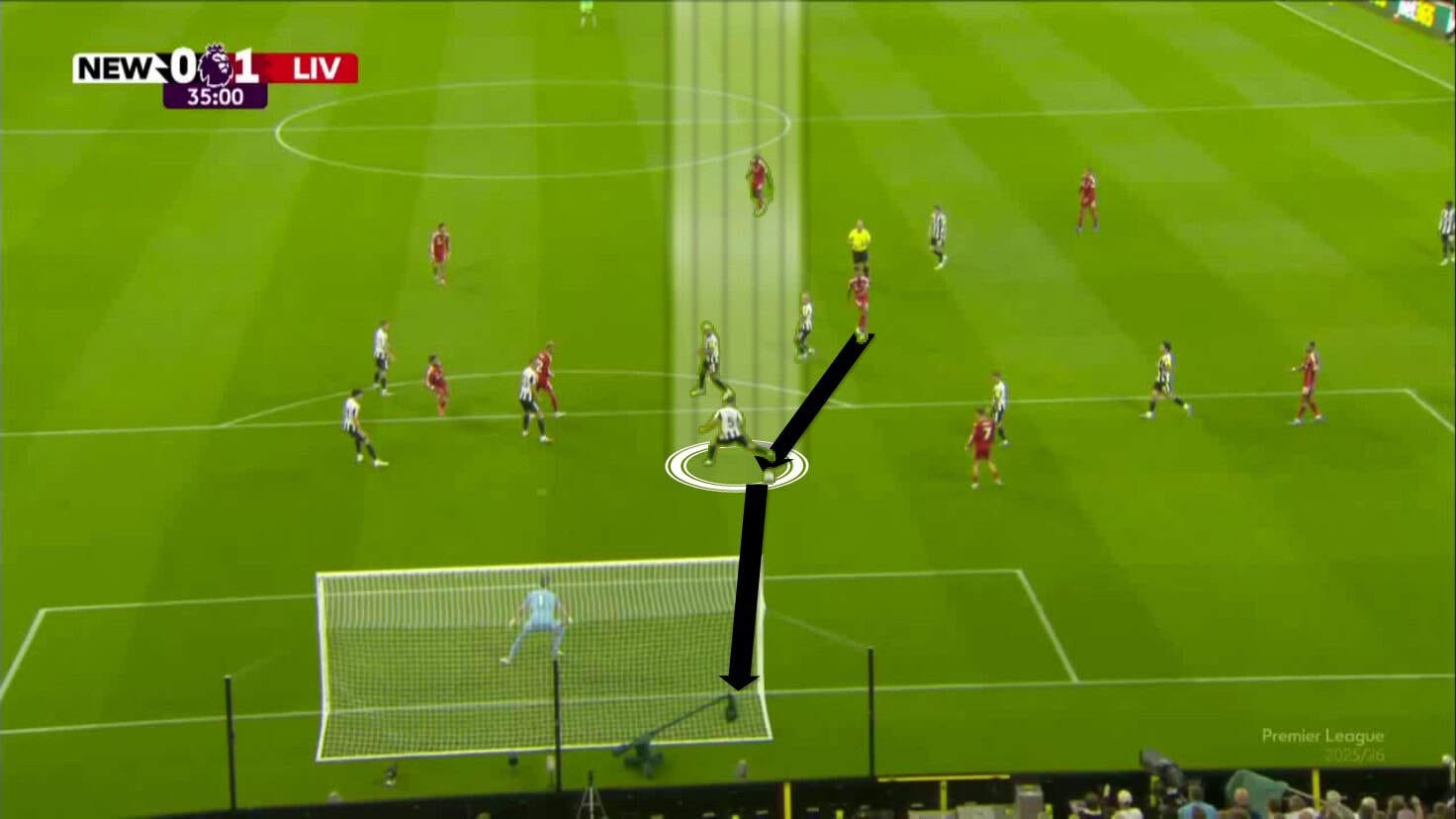
The second mistake, which is very tempting for a defender to make, is to stick a leg out in an attempt to block or deflect a shot wide.
Often, though, and possibly on this occasion, this can deflect an otherwise savable shot beyond the goalkeeper.
Burnley Defending In A Low Block
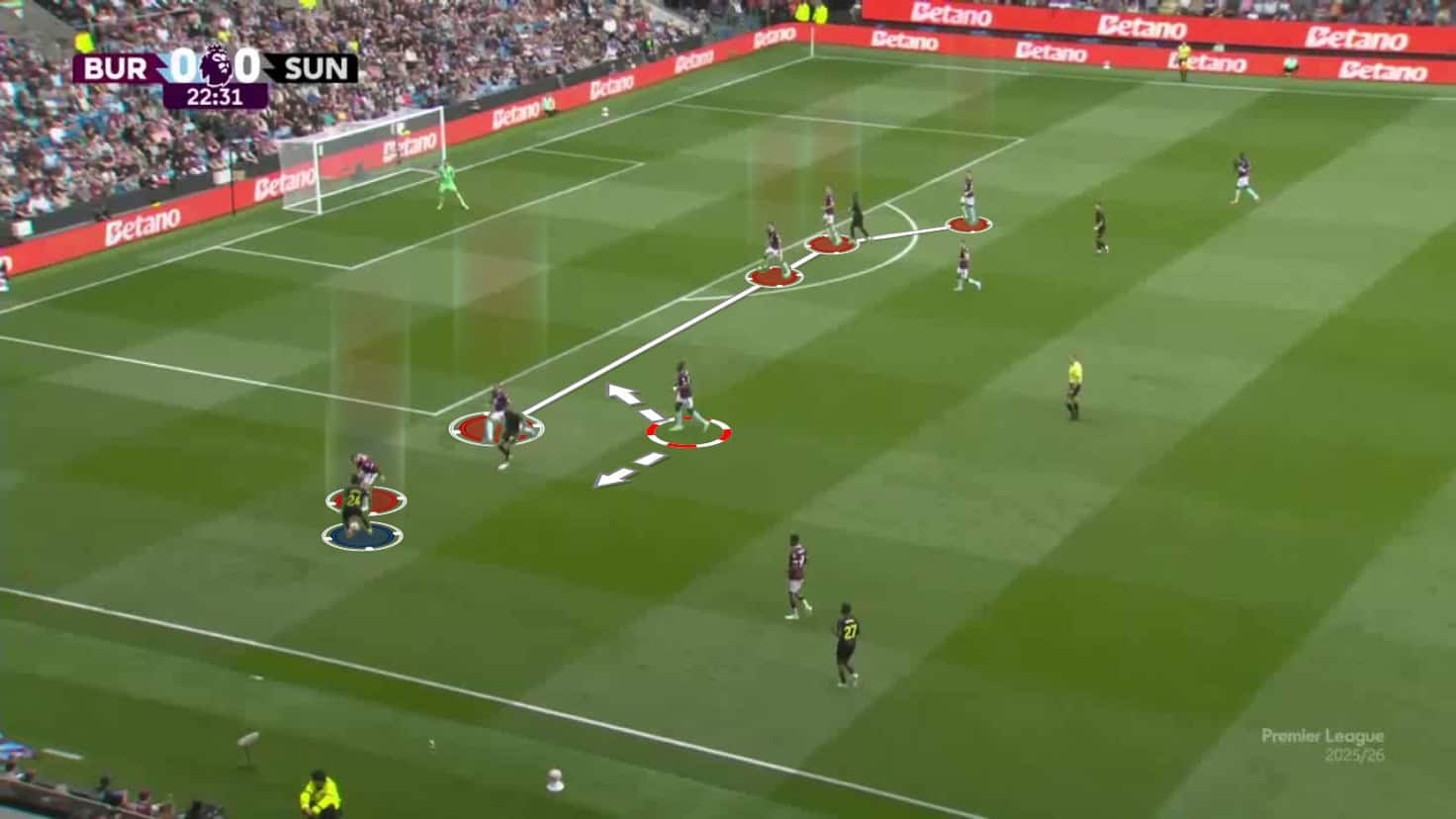
The above image is from Burnley's opening-day victory and clean sheet over last season's EFL Championship Play-Off winners, Sunderland.
The ball has been played into Sunderland's left wide area, with their left-back and left winger (who have interchanged) being covered by Burnley’s right-back and right midfielder.
Commonplace at the top level of the game, and seen here, are the two centre-backs remaining between the posts instead of getting dragged towards the ball.
This has created a gap between full-back and centre-back, making some defenders uncomfortable.
Burnley fills this gap and prevents the need for their centre-backs to shift by having holding midfielder Lesley Ugochukwu cover the half-space just outside their box.
By having Ugochukwu cover this area and double up with his full-backs, the two centre-backs are left to defend the most important part of the pitch.
Here, not only has Ugochukwu protected the space between right-back and centre-back; when the tricky Sunderland winger, Simon Andringra, cuts inside, beating his direct opponent, Ugochukwu is there to halt him.
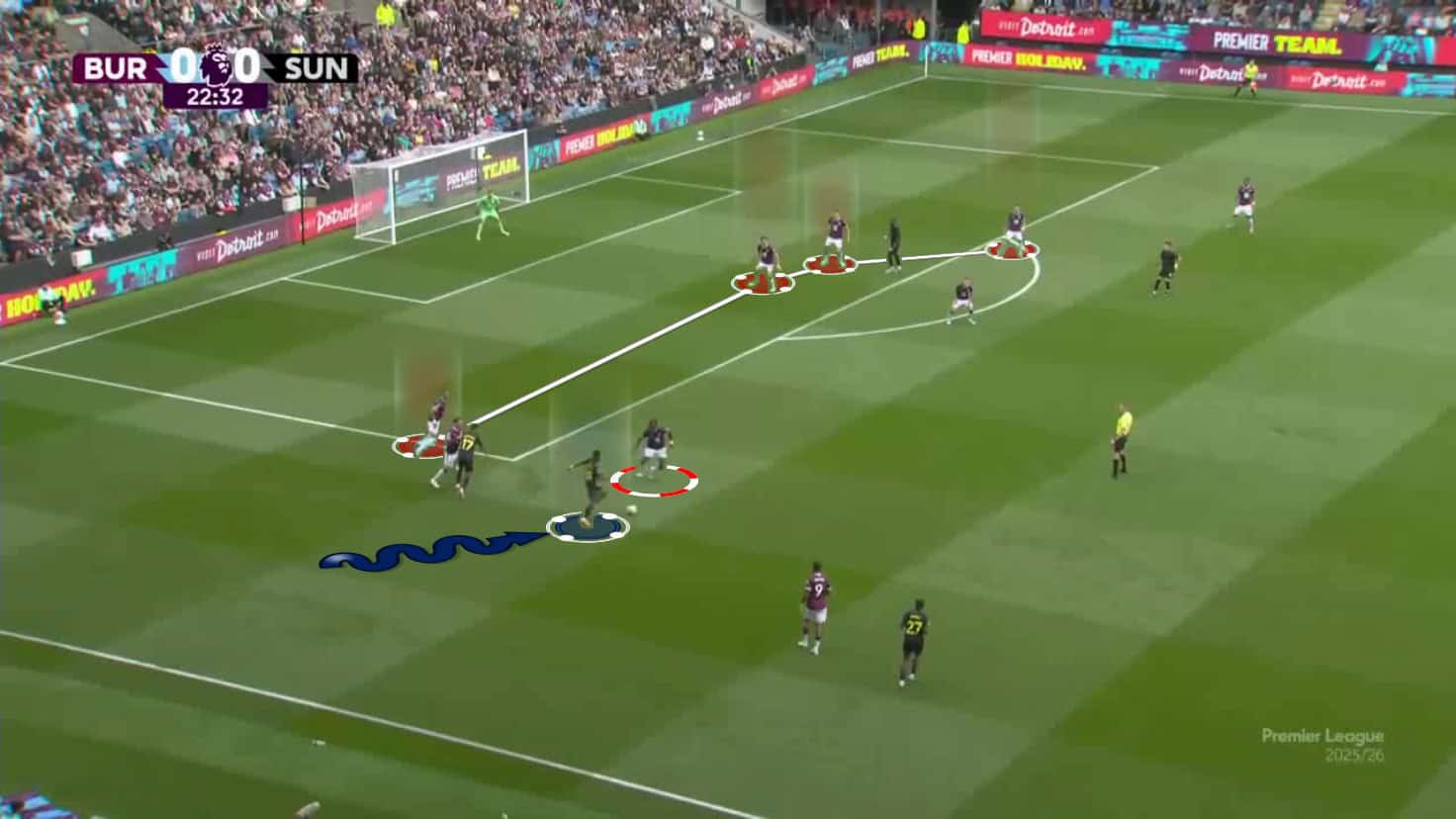
Had the central midfielder not doubled up with his wide teammates, Adingra would have had the opportunity to curl a shot at goal.
If, for instance, the ball-near centre-back had shifted over instead, and then stepped to the winger as he cut inside, the centre-back would have then left space behind himself for a potential slide-through pass into the box.
Coaching Defending Crosses In A Low Block
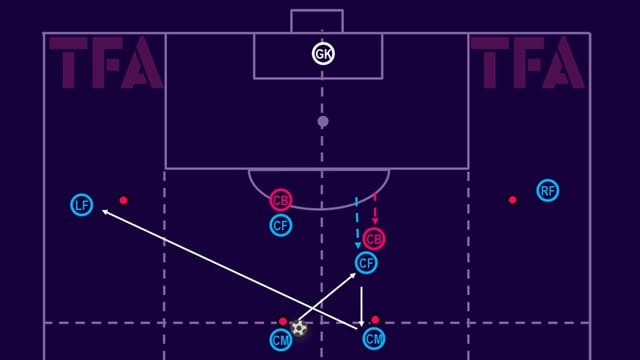
This simple crossing and finishing exercise is designed to work on centre-backs defending various types of crosses when in a low block and replicate the central positioning of the centre-backs as seen in the analysis of Burnley.
The exercise features an attacking team comprising two central midfielders, two forwards, and two wingers who provide crosses.
As shown above, the ball starts centrally and is switched out wide via the forwards.
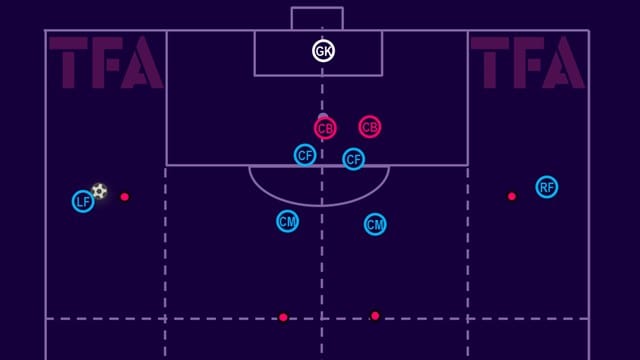
The central midfielders should advance to the edge of the box to replicate typical positioning seen in games.
This gives the defending players a clear target to aim their clearance at and allows the centre-backs to react to any potential second-phase opportunities should the midfielders intercept the ball.
Coaches should encourage the centre-backs to adopt a side-on body orientation, which allows them to see their mark and the ball and facilitates their attack on the cross.
Ideally, their positioning, as shown above, should keep the attacking player ahead of them, allowing them to step forward and not backtrack to attack the cross.
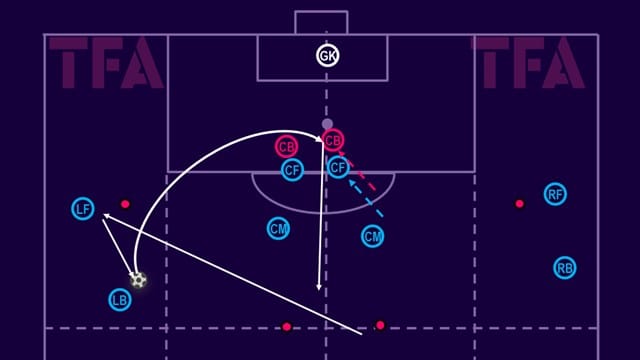
This exercise, as shown in the image above, can be adapted in several ways to provide opportunities to practice defending against various types of crosses.
Back Four Receiving Drill
Knowing what to do with the ball when it is won back is just as important as learning how to defend in these deep areas of the pitch.
Otherwise, teams will find themselves under constant pressure, unable to progress the ball up the pitch.
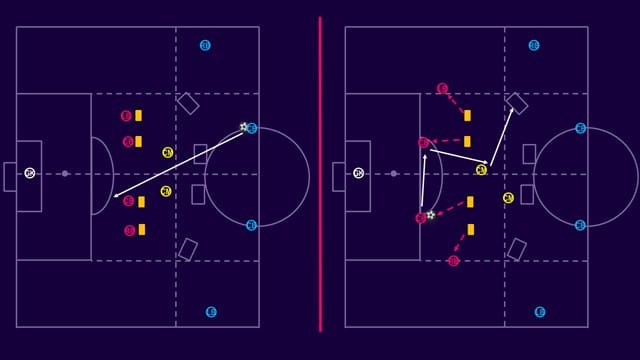
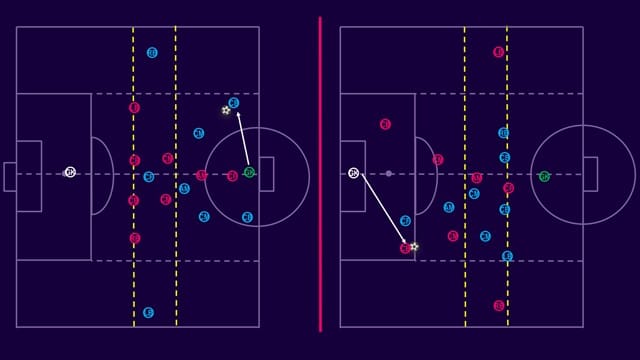
This exercise provides players with the opportunity to practice dealing with a variety of ball styles played towards the box from different angles.
The exercise involves 10 players, although it can be easily adapted to suit the coach's needs and the number of players available.
Four players, representing a back four, are positioned on mannequins 10 yards outside the box and spread across the width of the six-yard box.
Two players, acting as holding midfielders, work between the mannequins and four small-sided goals.
The remaining four players, who will be feeding balls, are arranged in a ‘C’ shape spanning the width of the box.
The defending players aim to control the long ball from the blue team and pass it on the ground to a teammate within a maximum of two touches before passing it into one of the four small-sided goals.
The long-ball can be played by any one of the four blue players.
Allowing the receiving players only two touches encourages them to establish controlled possession as quickly as possible.
If having the ball under control, on the ground, and on the way to a teammate's feet within two touches is not possible, players should exercise their decision-making skills and clear the ball.
Coaches should remind defenders that their priority in this instance is to protect the goal.
The two defensive midfielders should be encouraged to make angles to receive from their back four with a body orientation that allows them to progress the ball forward (into the small-sided goals) as efficiently as possible.
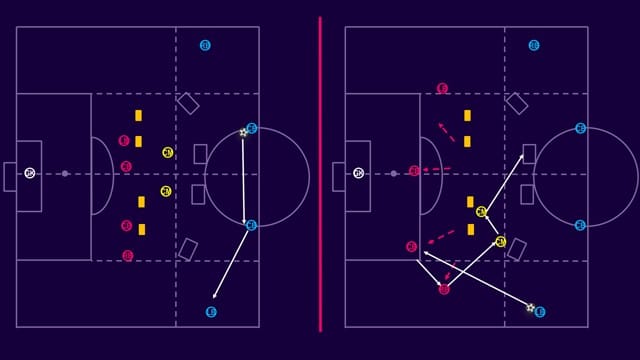
After the defending team has dealt with a certain number of long balls or been working for a set amount of time, the two groups of four switch roles.
A progression for this exercise can be for the ‘attacking’ team to move the ball with two or three passes between themselves before delivering towards the box.
This allows the defending team to work on shifting as a unit and to adjust their positioning depending on where the ball is being delivered from.
Low Block Game: 8-V-8 + GKs
This small-sided game is designed to put players in a position where they are defending in their own defensive third.
The formation of both teams, which can be adapted to suit the tactics of specific teams (and opposition teams), is a 4-2-1-1.
Every restart from both goalkeepers should begin with the out-of-possession team dropping into this formation.
As shown above, the in possession teams' full-backs become attacking wingers, playing high up against the defending side's backline.
During the defensive phase, the role of the attacking midfielder and striker should be to force the ball to one side and prevent it from being switched to the other.
The defending team's goal should be to protect the middle of the pitch and force the ball to one side.
This makes the play predictable and keeps the ball away from the goal area.
When the ball reaches these wider areas, the team should be prepared, initially, to defend crosses from deep areas.
An offside line, positioned 10 yards outside the 18-yard box, provides the defending team with a clear line to hold and gives the opposition forwards a realistically sized area to make runs into.
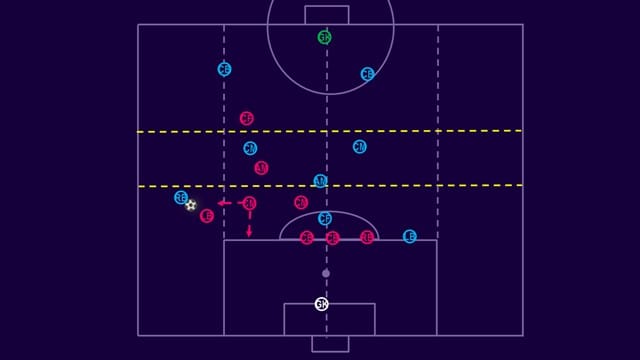
The setup of both sides effectively forces the left and right backs into one-on-one situations, where they are compelled to engage with the opposing winger.
This manufacturer's scenarios, where the back four will become stretched, provide the coach with the opportunity to embed principles on how to deal with situations similar to those faced by Burnley.
As with the crossing and finishing exercise, a very important aspect for individual players to consider is their body orientation.