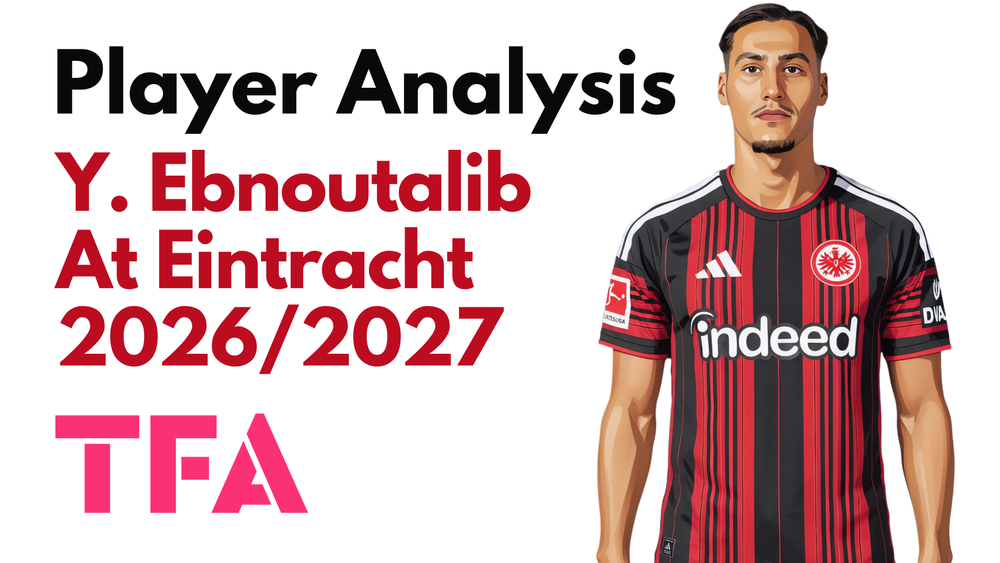
Younes Ebnoutalib Scout Report At Eintracht Frankfurt 2026/2027: From Fourth Division To Jürgen Klopp’s Germany - Player Analysis
Younes Ebnoutalib has risen from Germany’s fourth tier to the national team in remarkable time. This scout report analyses his explosive pace, blind-side runs, finishing and pressing, plus the weaknesses that shape his ideal tactical role.
From fourth division to Bundesliga hat-trick to Jürgen Klopp's Germany squad in 18 months.
Younes Ebnoutalib did not just break through at Eintracht Frankfurt; he announced himself with a hat-trick on the opening day of the season, then earned a surprise call-up to Klopp's squad.
Ebnoutalib joined Eintracht Frankfurt in January 2026, signing a five-year contract and arriving with an €8m price tag.
Six months prior, he sealed a move from fourth-tier Gießen to second-tier Elversberg.
He scored 12 goals in 17 matches for Elversberg in the first half of 2025/2026, a goal rate of 0.71 per 90.
Eintracht Frankfurt took notice, and by January, he was theirs.
On his debut against Borussia Dortmund, he scored.
The impact was immediate.
Then came a knee injury that sidelined him for months.
With a full summer to sharpen, August came, and he opened the new campaign against Union Berlin, scoring a hat-trick in a 3-3 draw; not bad for a season opener.
Six weeks later, Jürgen Klopp called him into his first Germany squad.
This Younes Ebnoutalib scout report and player analysis covers his rise, why Eintracht Frankfurt identified him, and what his profile reveals about the system he needs.
How Do Eintracht Frankfurt Find Elite Strikers?
Eintracht Frankfurt do not build strikers; they find them.
Luka Jović arrived in 2017 as a prospect from Benfica.
Real Madrid paid €63m for him a couple of years later.
Randal Kolo Muani came on a free transfer from Nantes in 2022.
Sébastien Haller, Jesper Lindstrøm, the list goes on.
Over the past decade, Eintracht Frankfurt have extracted hundreds of millions from attackers, not through development, but through identification of undervalued talent.
Die Adler's model is simple.
First, identify elite potential in lower-visibility markets.
Randal Kolo Muani and Omar Marmoush both arrived on free transfers, while Hugo Ekitiké cost €35m but returned a significant profit.
Second, place them in a coherent system.
Didi Hamann notes that "stable structures have been established in Frankfurt, where players can develop and unleash their potential."
Third, sell at peak value before decline.
Younes Ebnoutalib is the latest example.
The system works because Eintracht Frankfurt trust it; they do not chase big names; they manufacture them.
Jürgen Klopp's recognition is the latest indication of how Eintracht Frankfurt's eye for strikers has become a calling card in European football:
"I saw his first game for Eintracht and said to myself, ‘What a player! Where did they find him?’
There was no discussion among the coaching staff.
We all immediately agreed: ‘Yes, we have to include him.'"
Younes Ebnoutalib Style Of Play
Physical Frame & Explosive Pace
Ebnoutalib is 187cm and has been clocked at 32.41 km/h in the Bundesliga this season.
The height reads as target man, and the speed reads as something else, which is the problem he presents to a defence.
A centre-back who steps up to meet him expects to wrestle.
What he gets instead is a turn and a foot race.
By then, Ebnoutalib is into the channel with a two-yard head start.
That combination dictates how Eintracht Frankfurt use him.
Adi Hütter wants the pitch squeezed, the ball won high, and the first pass after a regain going forward rather than sideways.
Ebnoutalib is the outlet that makes the last part possible.
When Eintracht Frankfurt win the ball in the middle third, he is already moving beyond the last defender, which turns a regain into a shooting chance in two passes.
When they have to build more slowly, his job is to pin both centre-backs and hold them deep, which opens the half-spaces for Jonathan Burkardt and the inside-drifting midfielders.
He covered 24.5km across his first three league appearances, an average of 8.17km a game.
That is not a high figure for a Bundesliga forward in raw terms, and it points to how he spends his energy.
He is not a striker who accumulates distance through constant short movement.
He stands, he waits, and he goes at full speed.
Blind-Side Runs
His sharpest habit is positional rather than physical.
He sets up outside a defender's eyeline, level with or just behind the shoulder, and starts his run before the pass is played.
The next sequence is a clear example: Can Uzun carries the ball from distance with the defence dropping in front of him.
Ebnoutalib holds his position at the centre-back's shoulder, behind his eyeline.
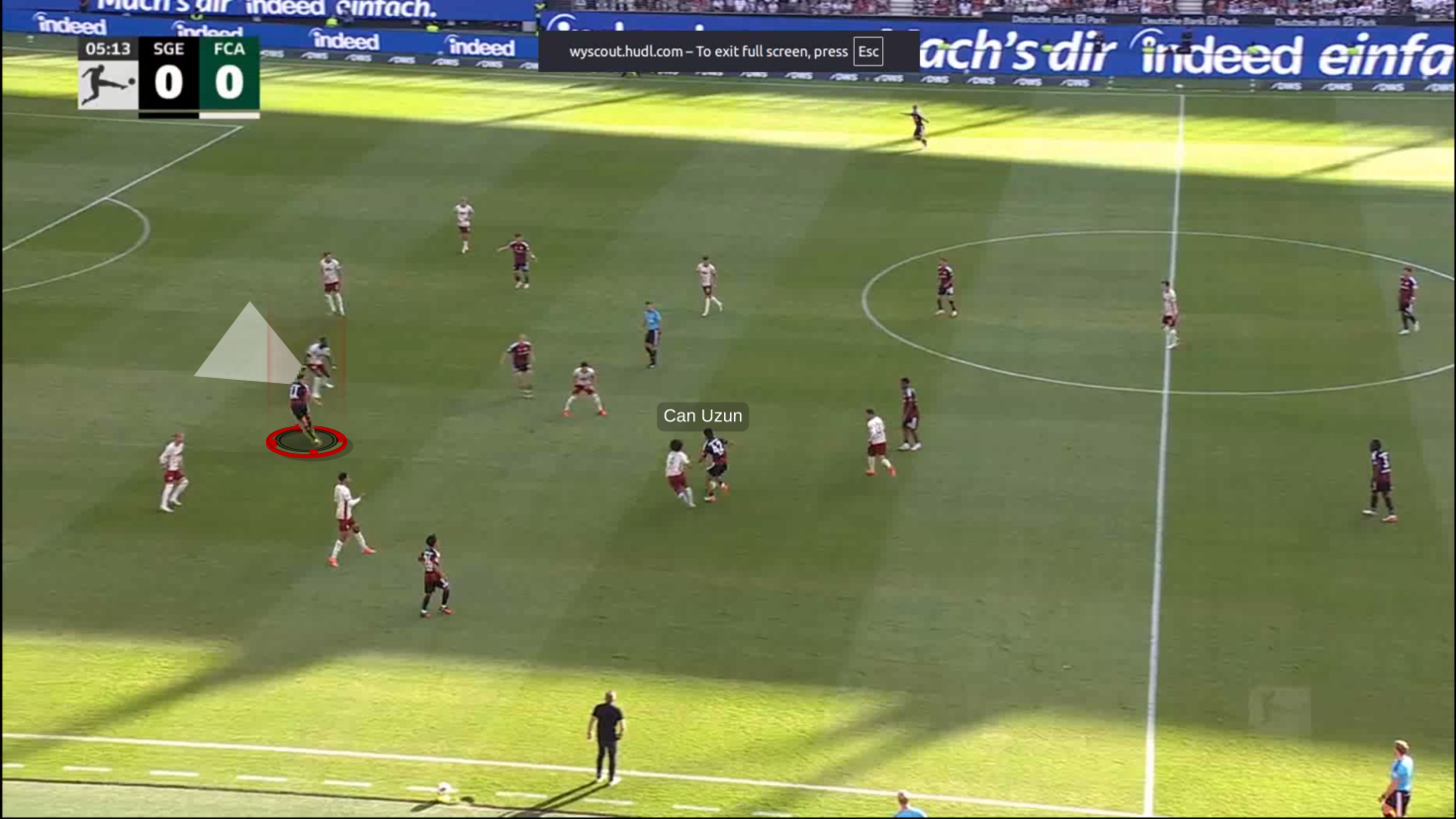
The defender tracks the ball without ever checking his shoulder, and Ebnoutalib is moving before he looks.
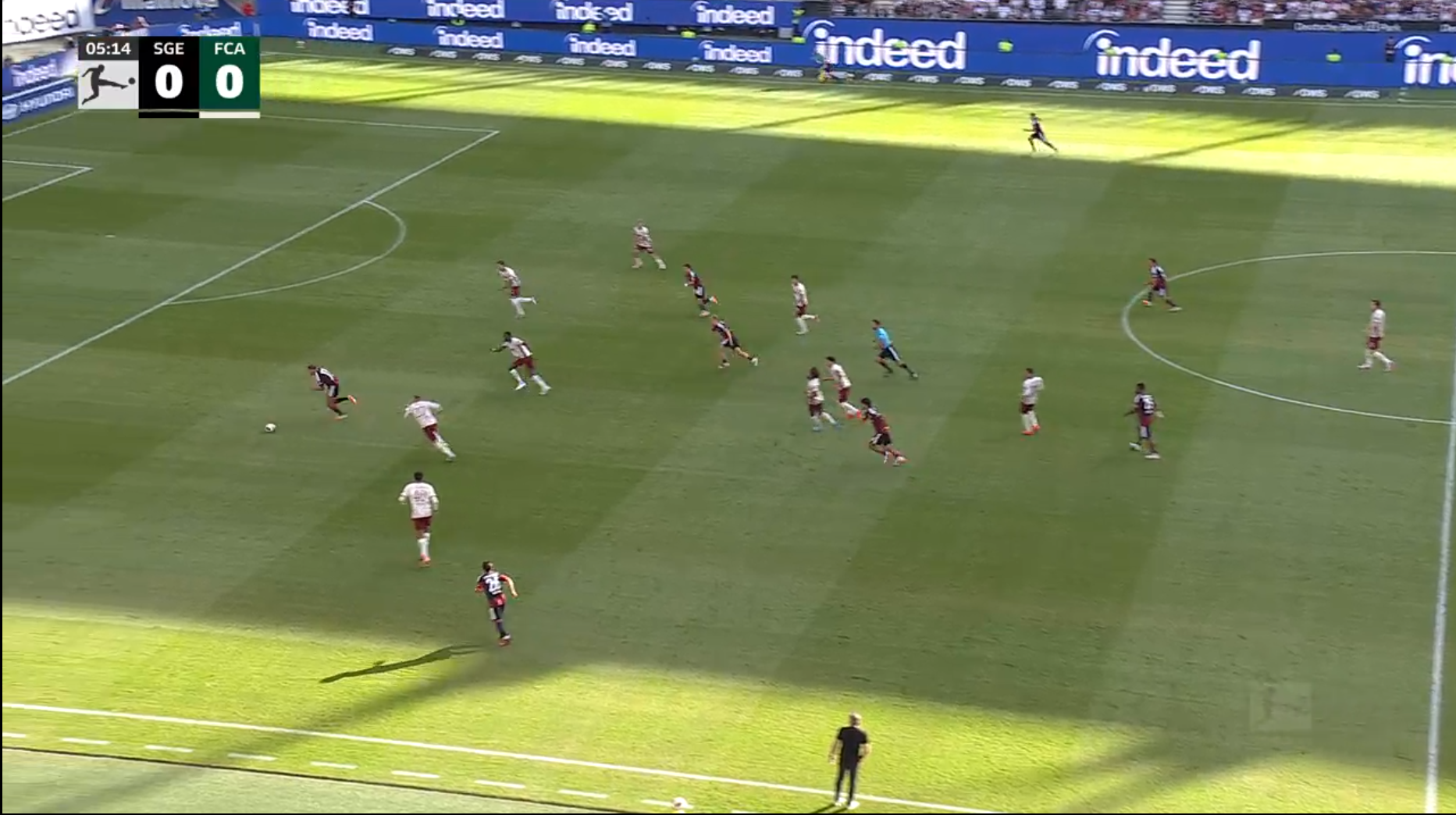
It bought him a yard, and a yard is the difference between a shot and a clearance.
Running In Behind Vs Dropping Deep
His primary job is depth.
He attacks the space beyond the last defender and keeps the opposition backline pinned, which is the more valuable half of a front two in a side built on transition.
His debut goal against Borussia Dortmund demonstrates this.
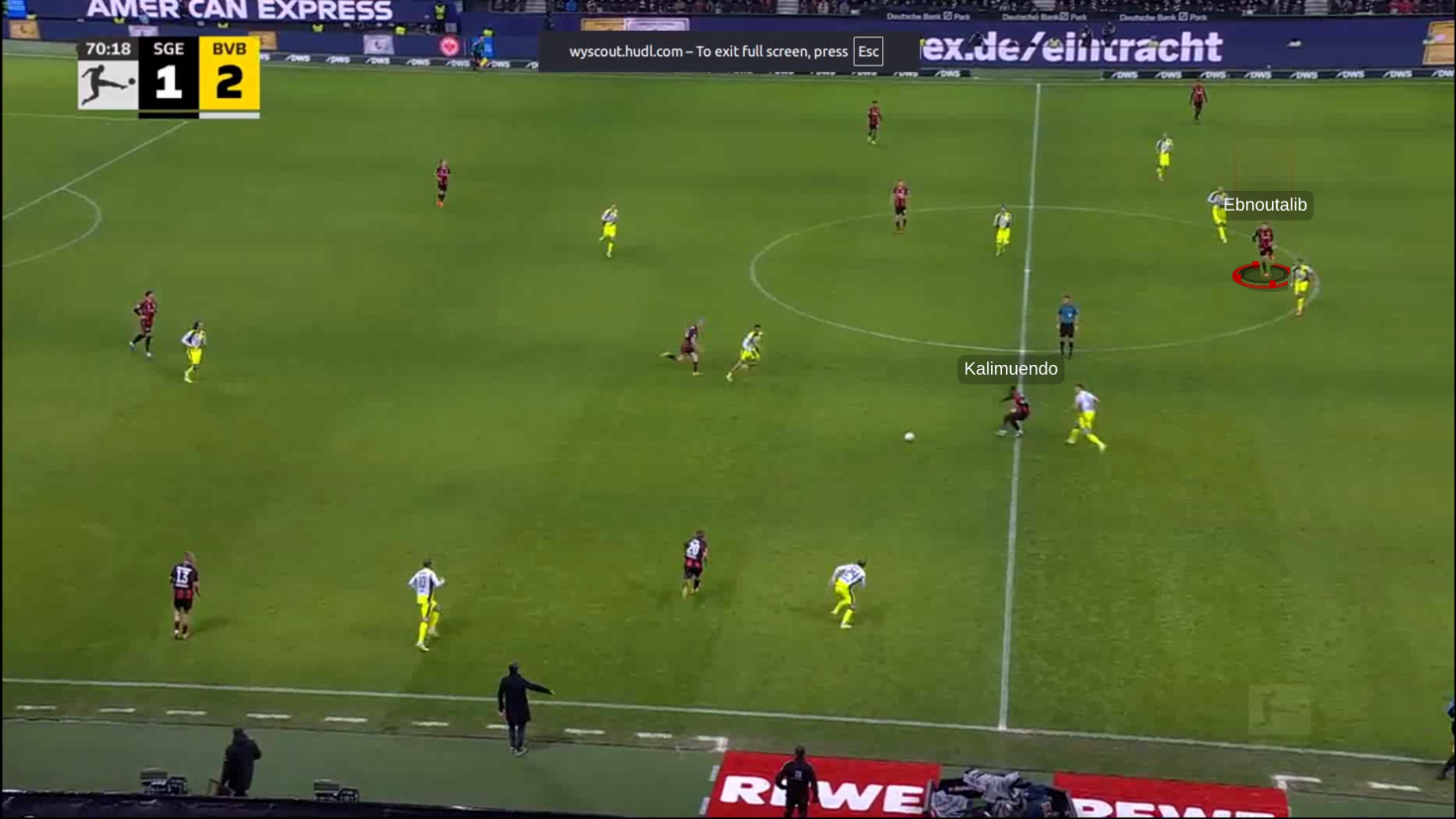
Eintracht Frankfurt broke from their own half with the Dortmund backline up at the centre circle; Ebnoutalib held his position there.
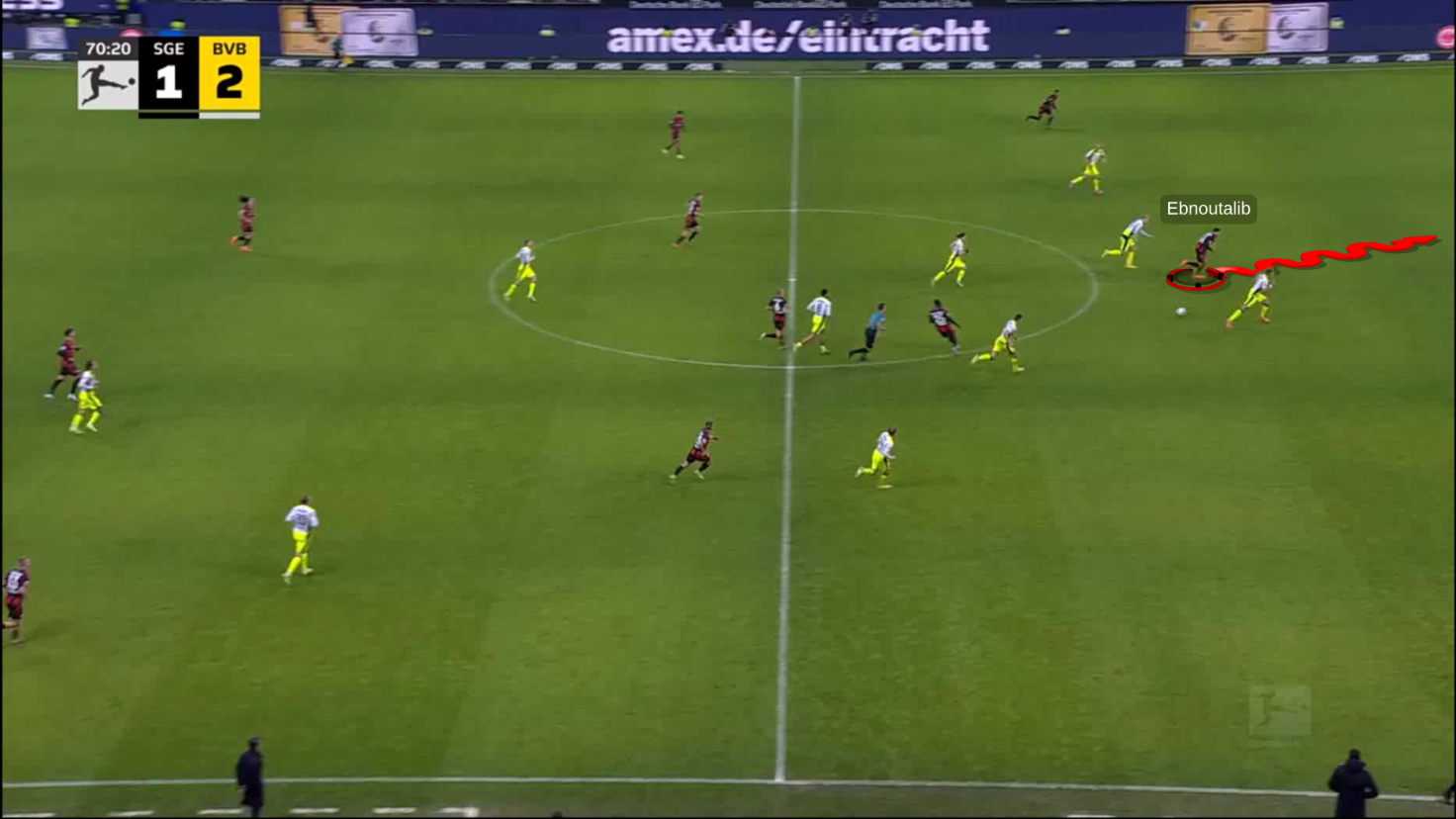
Arnaud Kalimuendo released Ebnoutalib in behind Waldemar Anton.
Four seconds later he was through 1v1 with the keeper.
He finished the chance to level the game.
That is crucial for Eintracht Frankfurt's structure, because the wide midfielders tuck inside and the full-backs push high, leaving nobody to stretch the pitch vertically.
He can also come short.
He receives with his back to goal, shields with his frame, and lays it off to Burkardt or a midfielder arriving behind him.
They use that skill sparingly, and the reason is in the weaknesses below.
The link-up work belongs to Burkardt, who is steadier in possession and drops deeper by design, while Ebnoutalib stays vertical.
Younes Ebnoutalib Strengths
Timing Of Runs
He watches where a defender is looking and puts himself in the gap that leaves.
His runs arrive with the ball rather than ahead of it, which is the harder timing to learn, and it explains why he converts half-chances a quicker but less alert forward would reach a beat too early.
Against Augsburg on six minutes, the ball went to Eintracht Frankfurt's right centre-back, Robin Koch.