Julian Nagelsmann Tactics At Germany 2026: Why Did The World Cup Project Fail & How Can Jürgen Klopp Rebuild? – Tactical Analysis

The premature exit of the German national team from the 2026 FIFA World Cup in North America represents a watershed moment in the structural evolution of the DFB.
When a highly complex structural model collapses under the weight of its own internal systemic contradictions, the immediate consequence within elite football management is almost always an institutional reset.
Julian Nagelsmann's sudden departure from the post of national team head coach following the elimination against Paraguay in the Round of 32 was not merely an emotional reaction to a negative tournament outcome.
Instead, it was the logical culmination of a deeply flawed strategic design that consistently prioritised theoretical, abstract spatial overloads over balanced squad composition, positional flexibility, and fundamental defensive structural stability.
In the intense, highly compressed environment of a major international tournament, managerial decisions regarding personnel and geometric alignment are magnified to an extraordinary degree.
What appeared to be complex, progressive tactical concepts during isolated training phases rapidly transformed into rigid, easily combated obstacles when faced with disciplined, low-sitting mid-blocks and explosive vertical counterattacks.
The structural failure of Die Nationalelf was an engineered reality, born from a sequence of questionable personnel exclusions, highly dysfunctional build-up mechanics, and an offensive crowding of the central channels that completely isolated their key creative outlets.
To understand why this ambitious tactical experiment failed so spectacularly, we thoroughly deconstruct the specific operational breakdowns that occurred across the squad selection, the build-up phase, and the final-third offensive mechanics in this World Cup tactical analysis.
The Personnel Paradox: Abstract Squad Architecture & The Erosion Of Flexibility
The structural vulnerabilities of the Germany campaign were actively generated long before the opening whistle sounded, rooted deeply in the conceptual squad selection finalised by Julian Nagelsmann.
An international tournament requires a manager to assemble a balanced toolkit of diverse profiles capable of adapting to varying tactical scenarios, yet the German squad was assembled with an alarming lack of specialised positional variation.
The most egregious example of this architectural imbalance was Nagelsmann's deliberate, highly controversial decision not to include a single natural, recognised right-back in the final World Cup squad travelling to North America.
By completely omitting traditional full-back profiles who naturally understand the spatial and defensive demands of the touchline channel, the coaching staff anchored their entire tactical plan to a highly rigid, unalterable baseline structure.
Yes, Joshua Kimmich, in theory, is the best option Germany have at right-back, but the skipper has not played in that position at his club for a long time, is better off in midfield, and his move to the defensive line still created problems for Julian Nagelsmann.
This lack of specialised defensive depth was compounded by a series of highly questionable selection dynamics within the goalkeeper and midfield ranks that severely disrupted squad harmony and performance stability.
The choice to deploy the veteran Manuel Neuer as the undisputed starting goalkeeper over Oliver Baumann, who had put together a far superior, highly consistent domestic season, introduced an element of unearned structural hierarchy.
Furthermore, the integration of Leon Goretzka into the travelling party to America was handled with a remarkable deficit in transparent, definitive team communication.
Instead of clearly defining Goretzka's role as either a primary physical asset or a specialised rotational option, the management left his positional status in a state of ambiguous flux, which rapidly translated into structural uncertainty on the training pitch.
Eyebrows were raised across the global scouting community when emerging, elite profiles like central defender Yann Aurel Bisseck and dynamic winger Said El-Mala were entirely excluded from the tournament squad.
Bisseck's immense physical presence and exceptional ability to defend wide channels in isolated 1v1 situations were exactly the defensive tools Germany lacked during high-line transitions, while El-Mala's explosive verticality could have provided a vital plan B from the bench.
Instead of utilising these vibrant, structurally flexible assets, Nagelsmann placed an unwavering, almost dogmatic trust in Leroy Sané, starting the winger in every single match despite him coming off a thoroughly horrid domestic season in Türkiye.
Sané's distinct lack of physical sharpness, combined with a severe deficit in decision-making confidence, rendered him a highly predictable asset on the right flank, yet his structural position within the starting XI remained entirely untouched.
This absolute refusal to alter personnel or integrate diverse profiles systematically slimmed down the tactical options Germany had at their disposal as the tournament progressed.
When opposing managers analysed the German team sheets, they were not forced to prepare for multiple structural permutations or unpredictable tactical transformations.
Germany had rendered themselves completely inflexible, trapped inside a fixed, unyielding selection model that left them structurally incapable of reacting to the dynamic challenges of tournament football.
The Hybrid Back-Three Illusion: Build-Up Asymmetry & Touchline Isolation
When constructing the possession phase from deep, Julian Nagelsmann implemented a highly specific, asymmetric three-man build-up system designed to create a numerical advantage against two-man pressing structures.
In this model, Joshua Kimmich was instructed to tuck inside from his nominal right-back starting slot to form a hybrid right centre-back role alongside Jonathan Tah and Nico Schlotterbeck.
The base Germany shape with indicators of key player movement is outlined below.
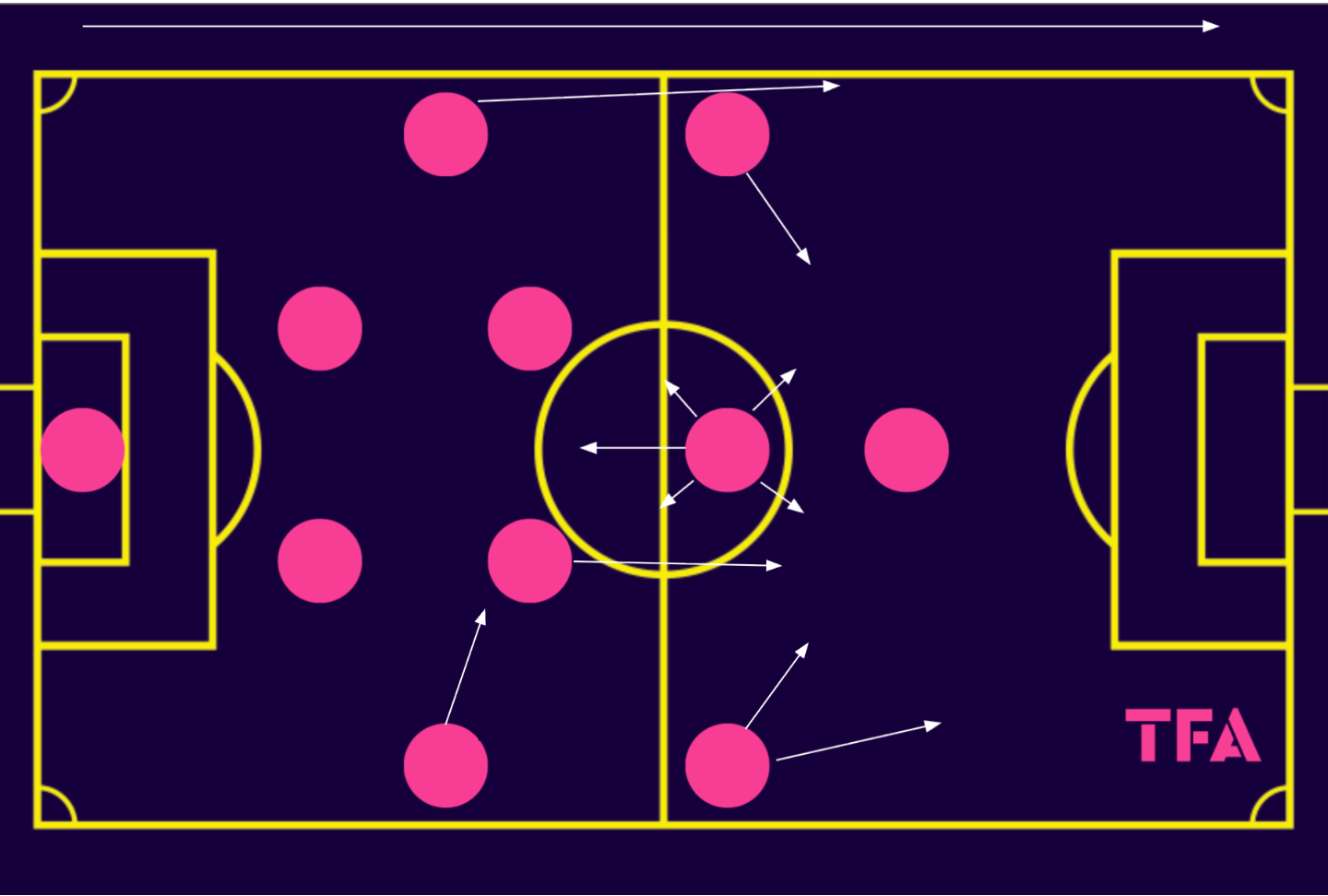
While this mechanism succeeded in allowing Germany to maintain high volume horizontal ball circulation in their own defensive third, its structural impact further up the pitch was devastatingly counter-productive.
During the fatal encounter against a highly disciplined, positionally aggressive Paraguay side, the operational flaws of this asymmetric structure were completely exposed.