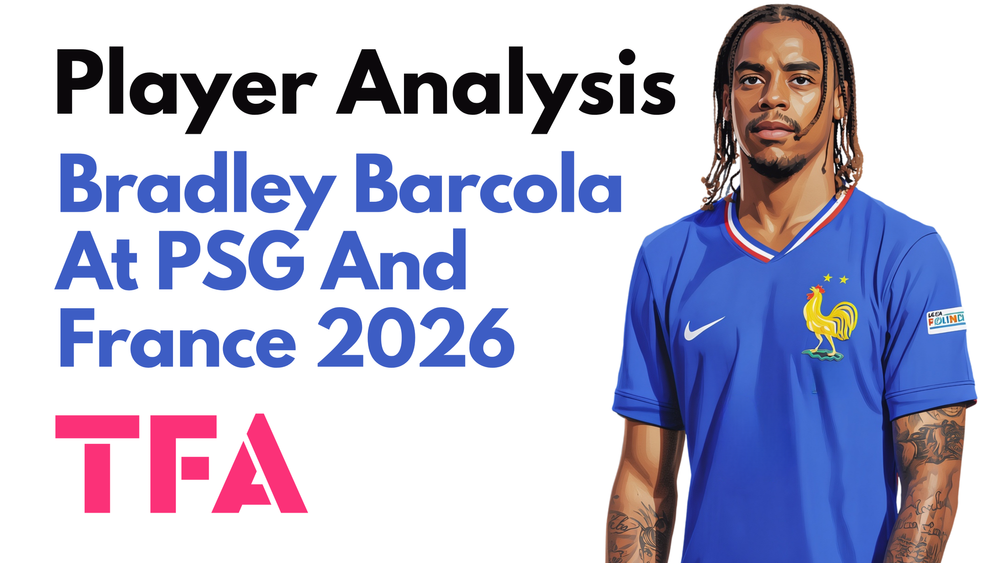
Bradley Barcola Scout Report At PSG & France 2026: Should Arsenal Or Liverpool Sign The €90M Attacker? – Player Analysis
This Bradley Barcola scout report uses data and video to explain his elite pace, movement and final-third impact, how he differs from PSG teammates, and how he could fit Arsenal or Liverpool.

Who Is Bradley Barcola?
The 2026 summer transfer window has not been packed full of dramatic transfer sagas, but there has been some smoke surrounding the future of Paris Saint-Germain and France attacker Bradley Barcola.
PSG have an embarrassment of riches in the forward positions, which looks set to be bolstered yet again by the rumoured transfer of RB Leipzig winger Yan Diomande.
Their 2025/2026 UEFA Champions League Final opponents, Arsenal, and the Gunners’ Premier League rivals Liverpool are also reportedly in the market for a wide attacker, with both Diomande and PSG’s Barcola said to be on their respective shopping lists.
Arsenal have understandably been in the market for an elite left winger, with Leandro Trossard having departed the club this summer and an element of scarcity around their existing left wing options.
The English champions do still have Gabriel Martinelli for now, while Eberechi Eze can play at left wing too, but the Gunners have been after a new first-choice option in that position to reinvigorate their squad for the 2026/2027 campaign.
Yesterday, at the time of writing, Arsenal secured the signing of Christos Tzolis from Club Brugge, a versatile attacker who is mostly used at left wing, so that could be their plan for that part of the attack sorted if they also retain Martinelli, but there's plenty of time for twists in the transfer window yet, and adding Bradley Barcola to their ranks as well could take their attack to a level beyond Tzolis' capabilities.
Liverpool, meanwhile, enter the 2026/2027 season without Mohamed Salah for the first time in almost a decade.
Hugo Ekitiké remains sidelined for perhaps the remainder of 2026, and outside of Alexander Isak, who’s yet to really show the best of himself at Anfield, their forward line does lack the intimidation factor it used to possess.
Both English giants have been heavily linked with Barcola, and though the major moves in the Barcola transfer have all been on the newspaper headlines rather than the paperwork that counts thus far, his potential PSG departure does hold some intrigue as a potential game-changing move for whoever enters the 2026/2027 campaign with the €90m-valued 23-year-old in their ranks.
This Bradley Barcola scout report and player analysis breaks down exactly what kind of player the PSG man is and how he compares stylistically to his Parc des Princes teammates Désiré Doué and Khvicha Kvaratskhelia.
We include Arsenal and LFC comparisons too, with the help of data analysis, to outline exactly what he brings to his current side and what he would bring to a potential new home on the other side of the English Channel.
Bradley Barcola Stats
First, let's compare Bradley Barcola stats with other wingers and attacking midfielders who played at least 800 minutes in Europe’s top-five leagues during the 2025/2026 campaign using custom-built metrics derived from weighted combinations of Wyscout data.
These six metrics combine multiple weighted performance indicators into broader scouting categories, providing a more holistic assessment of each player's attacking profile.
Barcola's radar immediately identifies him as one of the most direct attacking profiles in the dataset.
Bradley Barcola Percentile Ranks 2025/2026
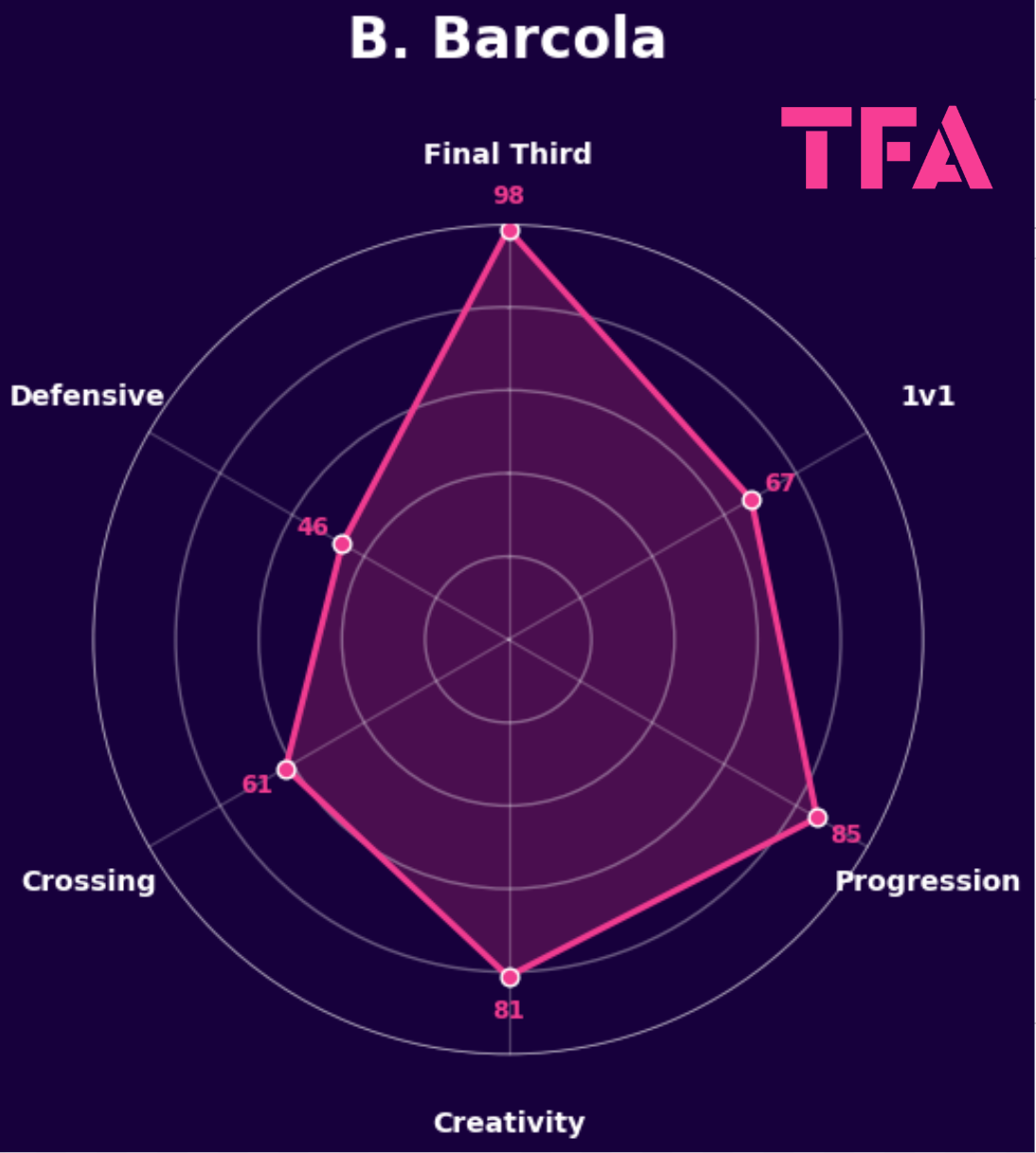
His Final Third Impact Score ranks in the 98th percentile, highlighting his ability to consistently generate high-value attacking actions.
This is where we get a sense of his direct attacking impact and how he threatens the opposing goal.
This aspect of his profile is supported by a strong Progression Score and Creativity Score.
The former demonstrates his effectiveness advancing from deep into dangerous areas.
While this isn’t a core capability in the 23-year-old’s profile, it is still an area in which he performs well relative to his positional peers.
The latter reflects Barcola’s ability to break defensive lines and act as the playmaker for his side.
Again, this isn’t a core part of the Frenchman’s game, but it is another area in which he puts up respectable numbers, though it’s always worth remembering these numbers come as part of a dominant PSG side, which will result in some positive bias.
A comparison with Désiré Doué and Khvicha Kvaratskhelia, therefore, provides useful tactical context in this regard.
All players are strong attackers in a dominant PSG side; they all produce outstanding attacking output, but the profiles of Doué and Kvaratskhelia are noticeably more rounded.
Kvaratskhelia puts up elite numbers in three of our six metrics: Final Third Impact, 1v1 ability and Progression.
He combines this with respectable creative numbers, highlighting his ability to consistently advance possession and eliminate defenders through individual actions while directly generating a high volume of goalscoring opportunities.
Khvicha Kvaratskhelia Percentile Ranks 2025/2026
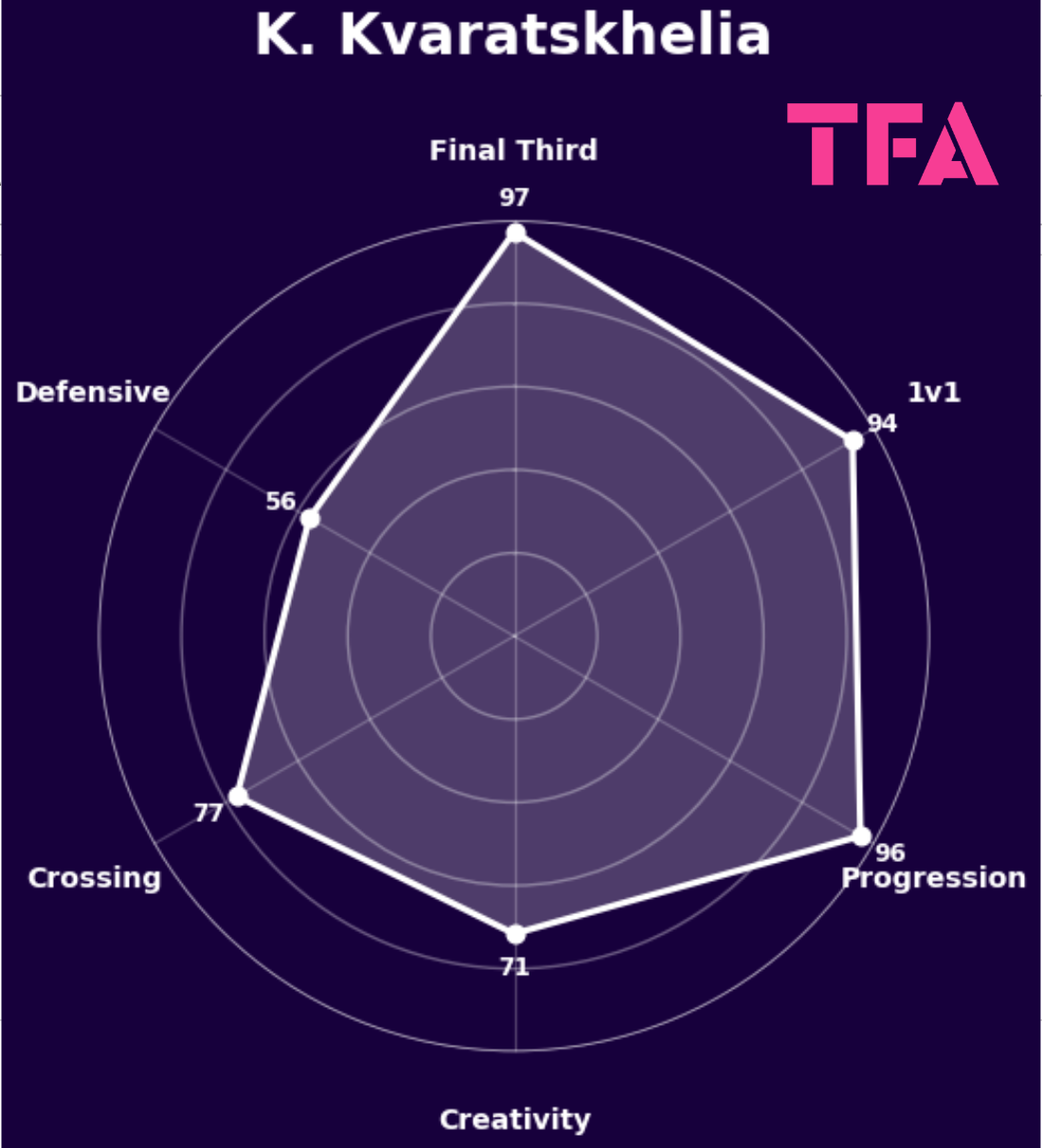
The Georgian winger’s profile is centred on ball carrying and individual attacking actions, making him the player most likely to destabilise defensive structures through his quality.
With a lower Defensive Score, Kvaratskhelia is given a higher degree of freedom to remain high and wide, allowing him to receive possession in advantageous areas where his dribbling and directness can make the biggest impact.
Doué, meanwhile, records exceptional percentile ranks across the board, illustrating a strong influence both in and out of possession by directly targeting the opposing goal, constructing attacks, and pressing.
Désiré Doué Percentile Ranks 2025/2026
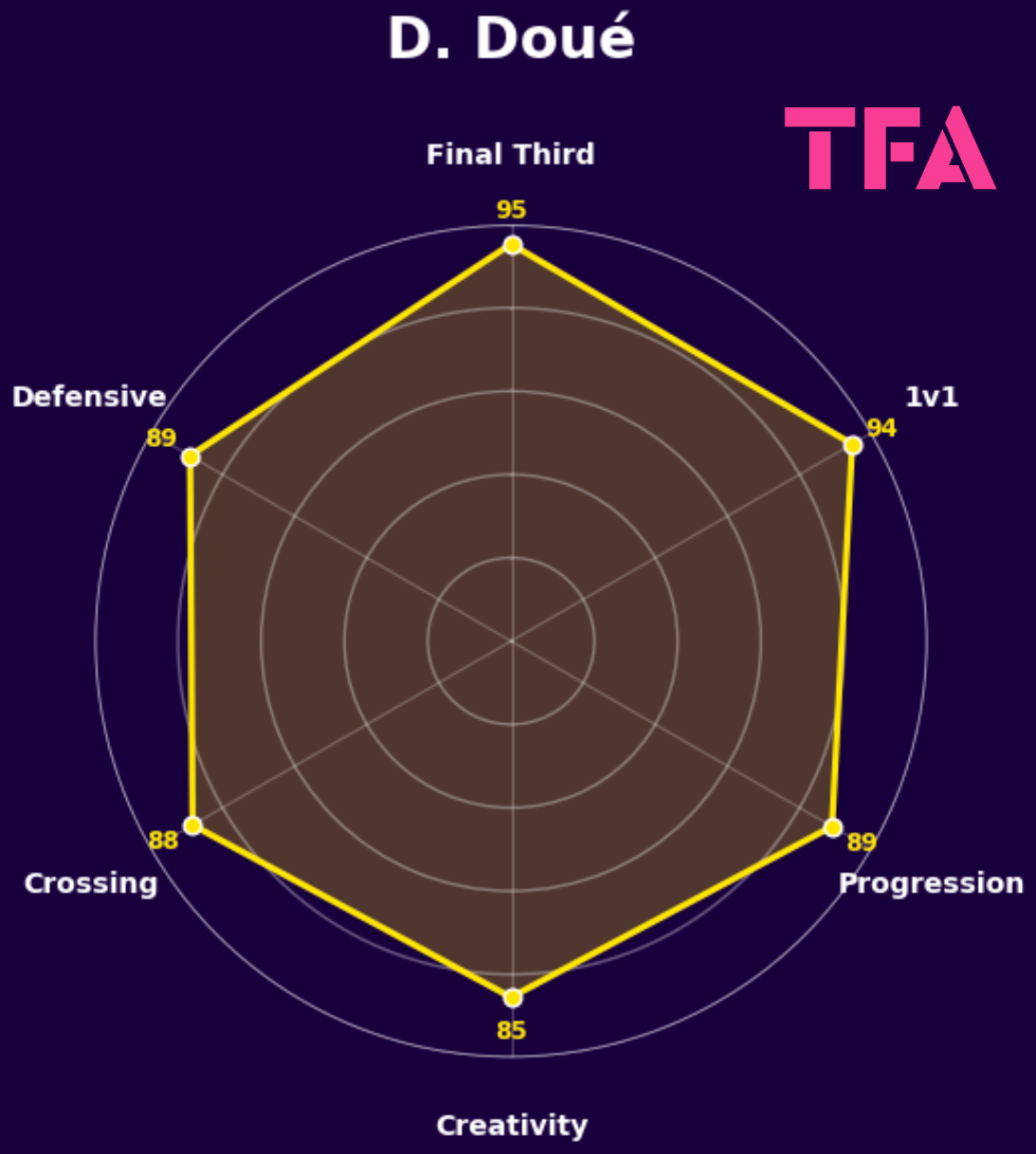
The 21-year-old winger ranks above the 85th percentile in all six categories, while Barcola only manages this in two of the six.
This emphasises Doué’s greater ability to influence every phase of attacking play.
His profile suggests an attacker who contributes well beyond goals and assists.
Outstanding Creativity and Crossing Scores display his ability to construct chances for teammates in a variety of ways, while strong Progression and 1v1 metrics highlight his capacity to advance possession both through carrying and passes, as well as his comfort with taking on defenders out wide and going past them.
His Defensive Score is also the highest of the trio, capping off the profile with an impeccable defensive work rate.
Doué has an advantage over the others because he’s capable of adapting his game to the tactical demands of different situations and presenting a multifaceted threat that always keeps defenders guessing.
Barcola is an elite wide attacker, but he doesn’t have the same capacity to completely change up the problems he’s posing the opposition throughout the game.
Barcola derives the majority of his value from penetration and direct attacking threat.
PSG Winger Percentile Ranks 2025/2026
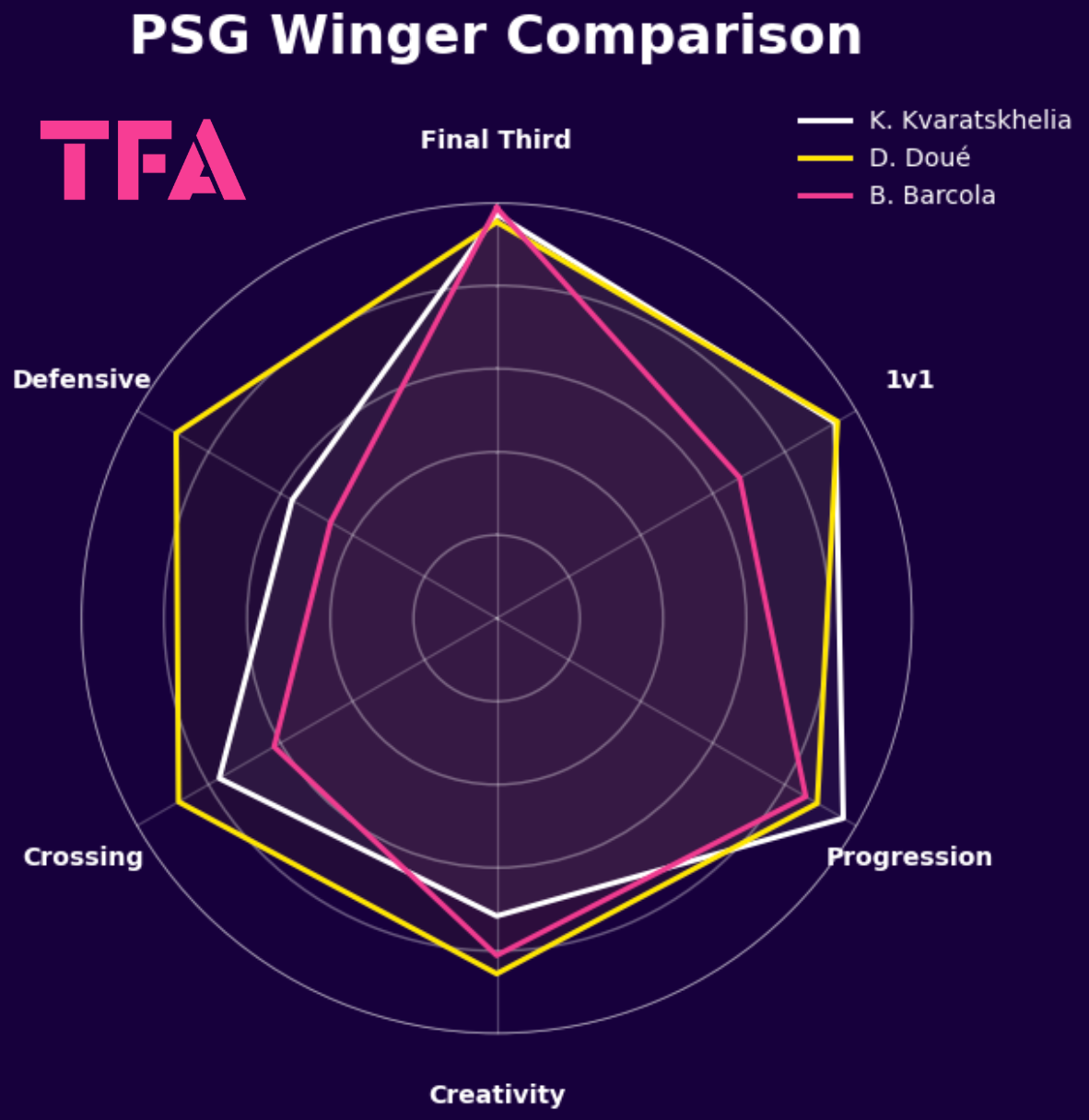
His comparatively lower 1v1 Score is one of the more interesting findings from the model because watching Barcola, you don’t necessarily see that.
He’s widely regarded as an excellent dribbler, but he attempted noticeably fewer dribbles per 90 than both Doué and Kvaratskhelia last season, with a 50% success rate.
Rather than repeatedly isolating defenders, Barcola appears more selective in choosing when to engage in 1v1 situations, preferring to exploit space through his movement and acceleration.
It’s not necessarily a weakness so much as it’s a stylistic difference, in this regard.
Doué engages in a much higher volume of 1v1 duels, with only a slightly worse success rate than Barcola, while Kvaratskhelia exceeds Barcola in both areas, but the Georgian is undoubtedly one of the very best 1v1 threats in world football right now.
This distinction also helps to explain why Barcola’s Progression Score remains elite despite a comparatively weaker 1v1 profile.
A lot of Barcola's ball progression value comes through well-timed runs and explosive carries into open space, rather than consistently beating defenders.
Both Doué and Kvaratskhelia are more ball-dominant attackers who regularly seek to eliminate opponents through repeated dribbling actions.
The comparison with Doué is particularly relevant when considering France's left-wing options at the 2026 FIFA World Cup.
Both are capable of performing the wide attacker role for their country at an elite level, and both got a decent amount of game time at this summer’s tournament.
However, they offer distinctly different tactical solutions which have to be balanced depending on the challenge at hand.
Barcola's pace and penetration make him very well suited to transition-heavy matches, whereas Doué's broader creative profile is better equipped to unlock compact defensive blocks through sustained possession.
Overall, the data portrays Bradley Barcola as a specialised final-third attacker rather than a complete all-rounder on the wing.
His ability to stretch the opposing defence and consistently generate threatening scenarios for his side makes him a strong option for elite teams in need of pace and penetration from the wing.
Figure 5 further reinforces this statistical profile through Barcola's 2025/2026 heat map.
Bradley Barcola Heat Map 2025/2026
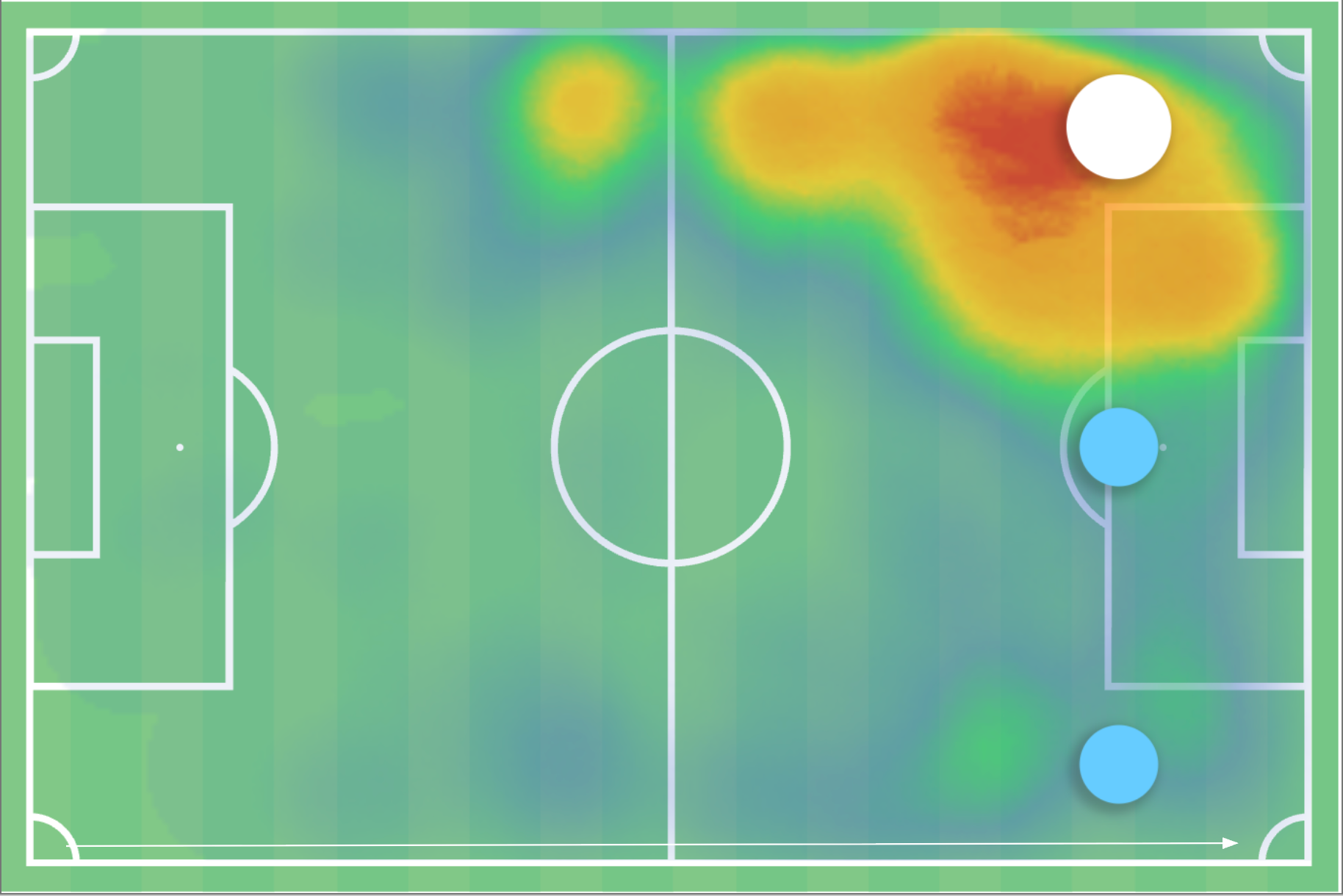
His actions mostly take place in the wide channel just outside the penalty area, with plenty of activity also noticeable in the left half-space and just inside the box.
We frequently see him attack the space behind defensive lines and drive directly towards goal from these positions, while these areas also offer him plenty of opportunity to isolate opposing full-backs in 1v1s.
Unlike more possession-oriented wingers, there’s comparatively little evidence of Barcola consistently occupying central playmaking positions.
His positioning is consistent with that of a wide forward tasked with maintaining width before accelerating into dangerous areas.
This leads to the elite Final Third Impact and Progression scores recorded above.
Although he occasionally drops deeper to support the build-up play, his main influence comes further upfield, where his movement and pace create attacking depth for his side.
Compared with players in our dataset from Arsenal and Liverpool in 2025/2026, Barcola predictably and comfortably boasts a better Final Third Impact Score (98.7th percentile) than Gabriel Martinelli (59.6), Leandro Trossard (79.2), Cody Gakpo (77.6) and Florian Wirtz (70.3).
Barcola would bring an entirely new profile to Arsenal’s left flank.
Though Martinelli is also comfortable with attacking space and driving vertically, Barcola offers a more complete attacking output at the elite level through his Final Third Impact, Progression and Creativity Scores, wrapped up in a similarly aggressive approach.
Trossard, meanwhile, was a more rounded creator than Barcola, with better performance in our Creativity, Crossing and Defensive Contribution metrics.
He also fails to match Barcola's direct goal threat, though.
Compared with Cody Gakpo and Florian Wirtz at Liverpool, Barcola outperforms the former across every metric bar 1v1 Score.
This outlines how receiving to feet and engaging defenders directly is a much bigger part of Gakpo's game.
Barcola would use his movement and pace to attack space behind defensive lines rather than relying on repeated individual duels.
Florian Wirtz, meanwhile, is naturally a different type of attacker, operating mainly in central zones rather than as an orthodox winger, which is reflected in his relatively modest 1v1 and Crossing scores.
The two could link up nicely at Anfield, with Wirtz dictating attacks through combination play and chance creation, and Barcola stretching defensive lines with explosive runs and elite final-third productivity.
Bradley Barcola Pace & Technique
Those two traits in the title of this section, ‘pace and technique’, do a pretty good job of defining what it is that makes Bradley Barcola such an effective wide attacking threat.
Both of these qualities are typically present in what the 23-year-old Frenchman does well in attack.
Barcola’s pace makes him an elite transition threat.