
Coaching Attacking Transition Principles - Tactical Theory

In this tactical theory, we will focus on a training session that aims to create opportunities for players to work on attacking transition principles.
We will encourage them to initially seek to break lines and play forward into players who have support.
However, we will also encourage them to recognise when this isn’t possible and instead have them retain possession and stretch the pitch both horizontally and vertically.
This analysis will also provide examples for coaching attacking transition principles.
It will give examples of three practices and analyse how these practices should be run and what coaching points can be derived from them.
These practices are transferable to a wide range of tactics, as it looks to develop basic principles in this moment.
Attacking Exercise 1
The first part of this session will allow players to experience a high volume of turnovers and experiment with different approaches, whether through dribbles, immediate passes forward, or using a third player to create opportunities to succeed in playing forward.
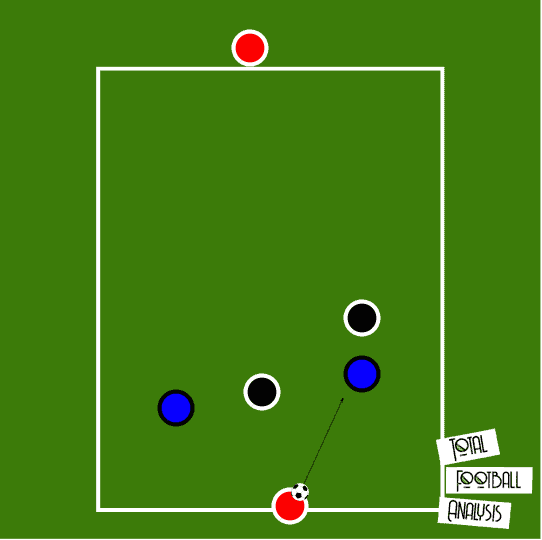
Quite simply, the aim of this game is for the possession team to work the ball from one end to the other.
It works well for rotations if there can be three sets of pairs, with the two pairs in the middle playing against one another, whilst the player on either end acts as the target players/neutrals.
After several sets or a set amount of time, the pairs can rotate, giving a new matchup in the middle and different end players.
The practice should start with the ball being played into the attacking team by one of the end players.
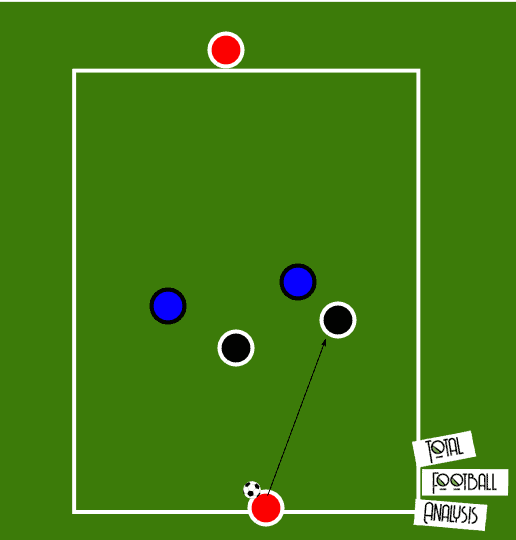
The attacking team should be prevented from using a third player to allow them to play through, with the third player only coming live once the ball has been turned over.
Until that point, this plays out as a 2v2.
It is at this moment that the two can look to combine to play past the defenders, or, of course, the player in possession can look to dribble past the player.
Any passes into the player on the far end result in a goal.
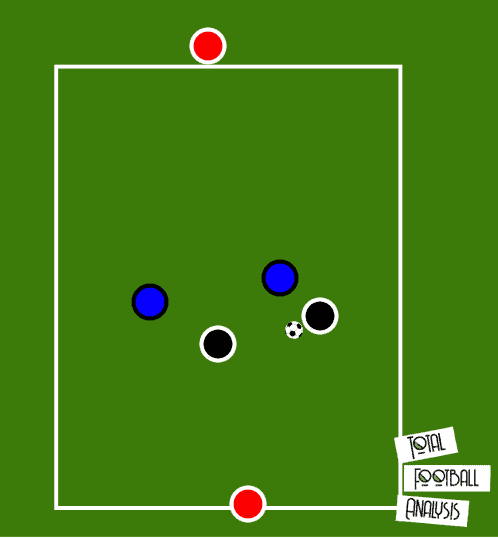
However, once a turnover is forced, the blue team, in this example, can now attack.
If they can score within five seconds of winning possession, their goal is worth two.
We encourage them to look to break lines as early as possible.
We also want to encourage our players to play passes at a quick tempo and play off of limited touches where possible.
The blue team can play straight into the player on the opposite end.
However, should the black team counter-press effectively and prevent them from finding this option, they have the chance to use the closest end player to make a 3v2.
These end players, in such instances, should be put on a touch limit to keep the situation game realistic and the tempo intense.
This player can simply recycle possession, but also has the option to break lines with a forward pass.
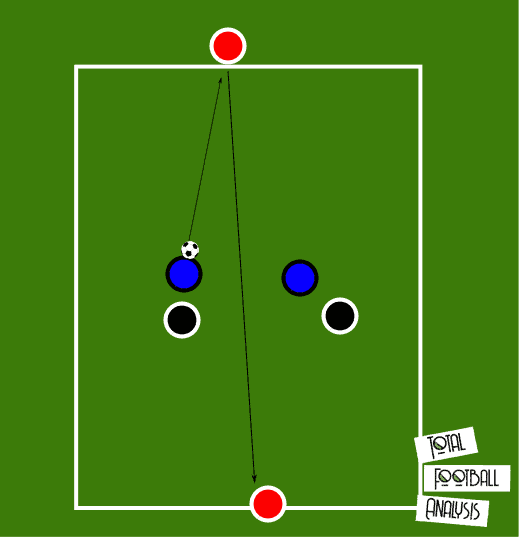
Once the ball is successfully played to the opposite end, the blue team swaps with the black team and becomes the attacking team.
This practice is intense and continuous, so players should work in shorter sets to ensure this match-level intensity.
Attacking Exercise 2
Moving this on to a larger practice, if possible, should be set up in an area of the pitch that provides the context of a midfield battle.
We have a 5v3 with the ball starting in a 3v1 rondo in the middle, with four players on the outside.
For large sets of players, this can be increased by adding more players to the rondo and more players on the outside.
However, this example provides a framework.
There are four goals on the outside behind the players at the end of the outer square.
The 3v1 is ideal because it forces the red team to move after playing a pass and increases the likelihood of a quick turnover.
Once the blue player in the middle wins possession, they are tasked with quickly finding a pass to a teammate on the outside.
The red team can move freely to counter-press, and the central blue player can also move freely, but should be encouraged to stay centrally where possible.
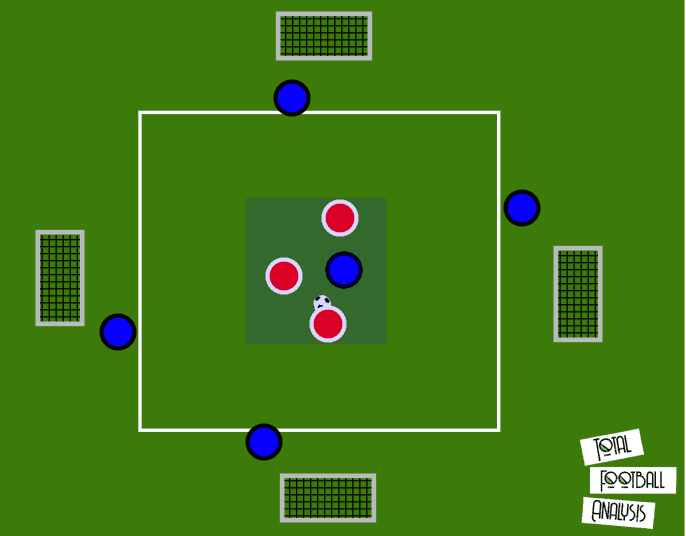
The blue team is tasked with finding 10 passes for a goal.
However, if they can split the defending team, representing an early line-breaking pass in the moment of attacking transition, this can immediately be rewarded as a goal.
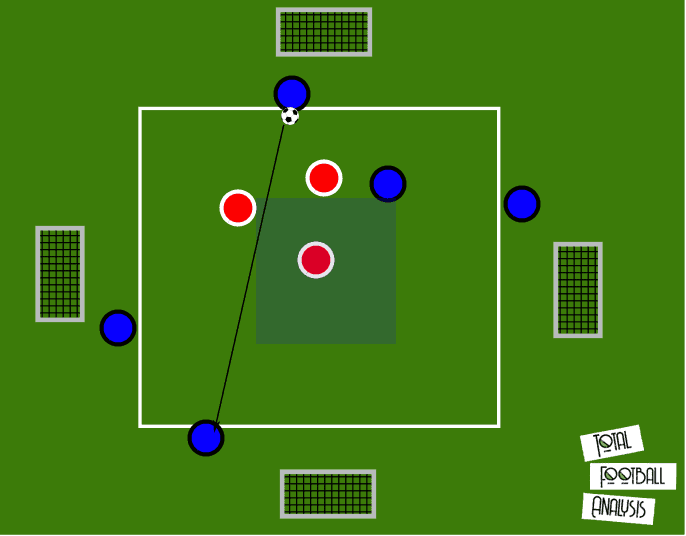
Once they reach either 10 passes or make this split pass, whichever comes first, they are allowed to finish in one of the small goals for an extra point.
Rather than an outside player receiving and finishing on the turn, the blue team should be encouraged to finish facing forwards, making it more game-realistic and prompting them to set their central player to finish.
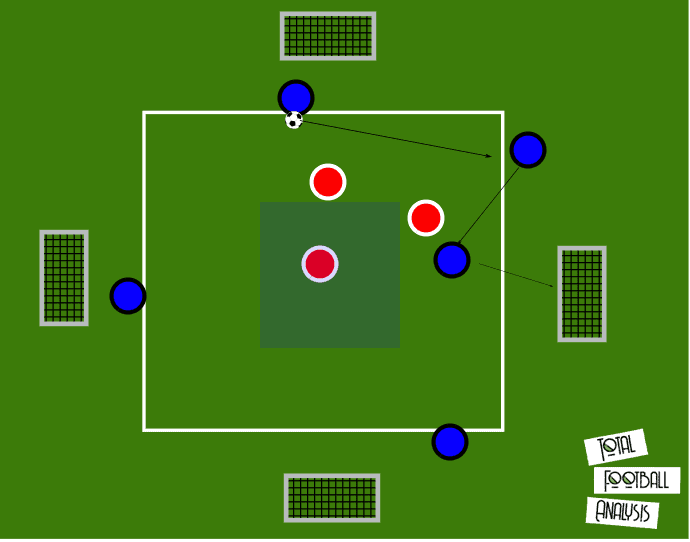
This represents a quick combination of attacking transition and player movement to find space and support forward passes, allowing us to continue playing forward in this moment.
Once more, we are encouraging our possession team in this attacking transition moment to play with pace, off of limited touches, and to understand the benefit of breaking a line in this moment.
When that line-breaking pass is played, we need to ensure the player in possession isn’t isolated and that there is support.
For example, in the following image, let’s say the player in possession has just received the ball through the centre of the pitch.
There is immediate support close to him, and at least on one wing (although preferably on both wings).
The player on the opposite end who has just played the pass should be looking to move across their line and offer a pass option once more, continuously moving the opposition defence around.
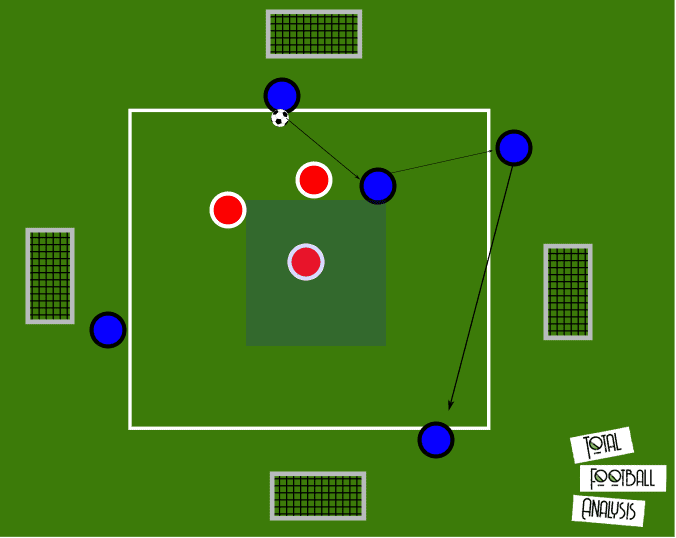
If the red team is able to force an interception when counter-pressing, they are able to score themselves in one of the mini goals.
If they force the turnover and score within six seconds, this goal can be worth double.
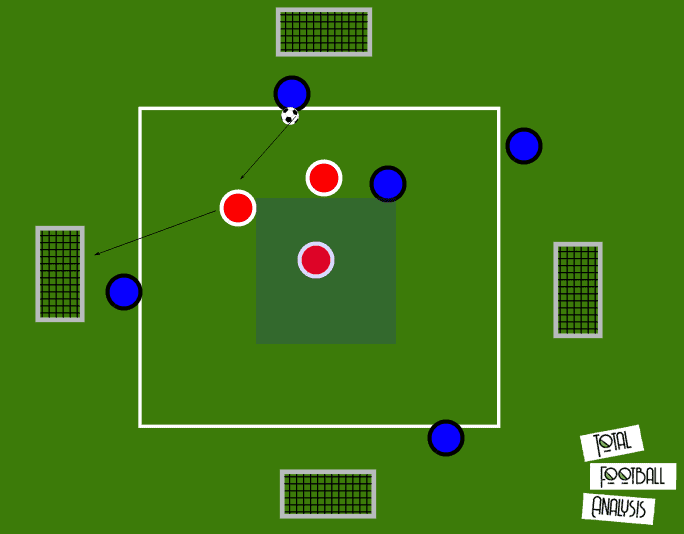
However, the blue team should also be encouraged to counter-press, and players can step in from the outside to pressure the ball once it has been overturned.
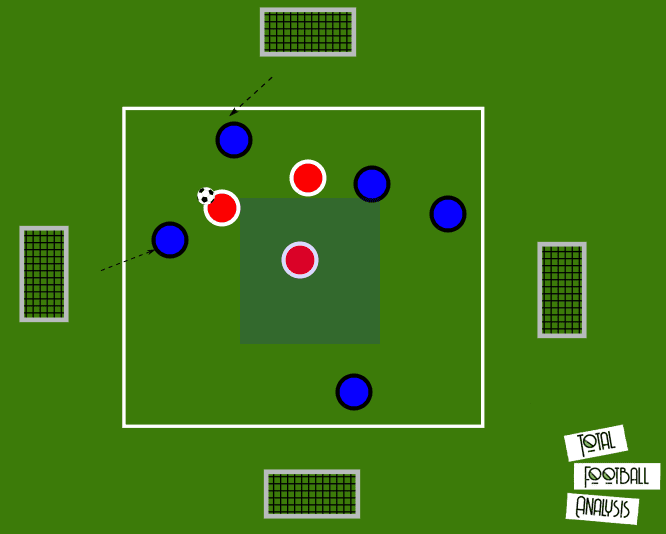
We can help them understand the importance of immediately transitioning once more after winning the ball again.
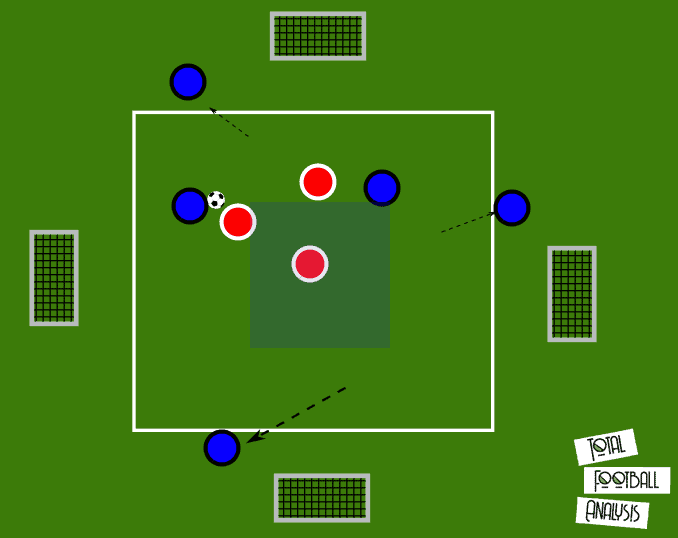
If they regain possession, the players shift quickly back to the outside to provide space and pass options.
Attacking Exercise 3
Finally, to make this even more of a game situation, a 7 + GK v 7 + GK is an effective way to bring out our collective goals from this session.
Playing the outfield players in a setting that encourages a man-to-man press will increase the likelihood of turnovers and, therefore, produce more moments for us to work on attacking transition in this game situation.
Either team can start, with both working on attacking transition once they win possession, but in the example shown below, the red team has possession.
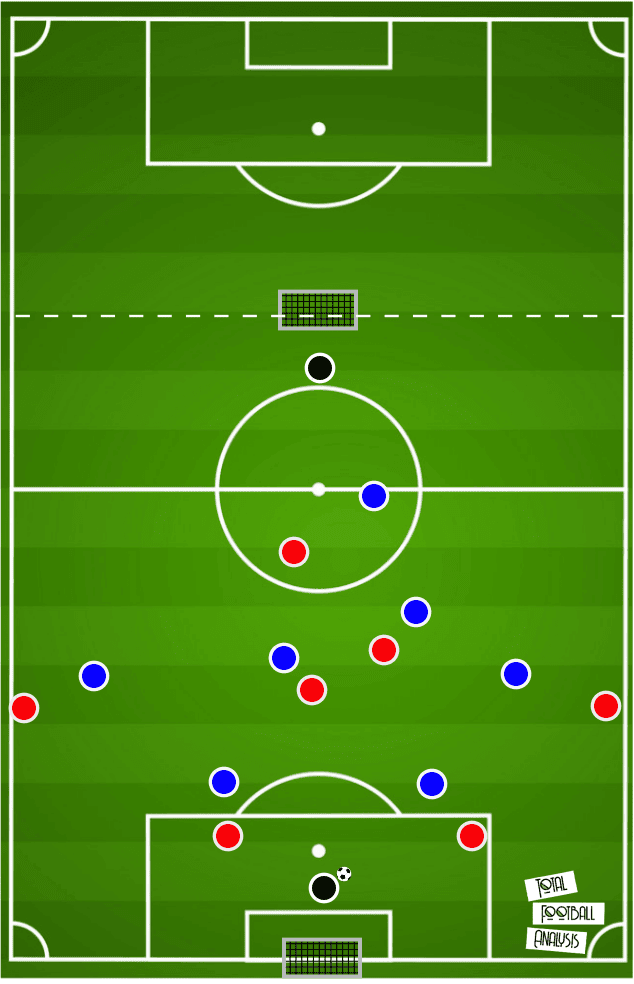
Naturally, the red team are looking to break forward and score against the opposition keeper.
However, upon a turnover, we are looking for the blue team to now put into practice today’s learning and forge a goalscoring opportunity or retain possession at this moment if this is not possible.
If there is a chance to play forward first, then this is what we want them to prioritise.
In order to do this, goals scored within eight seconds of a turnover can be worth double.
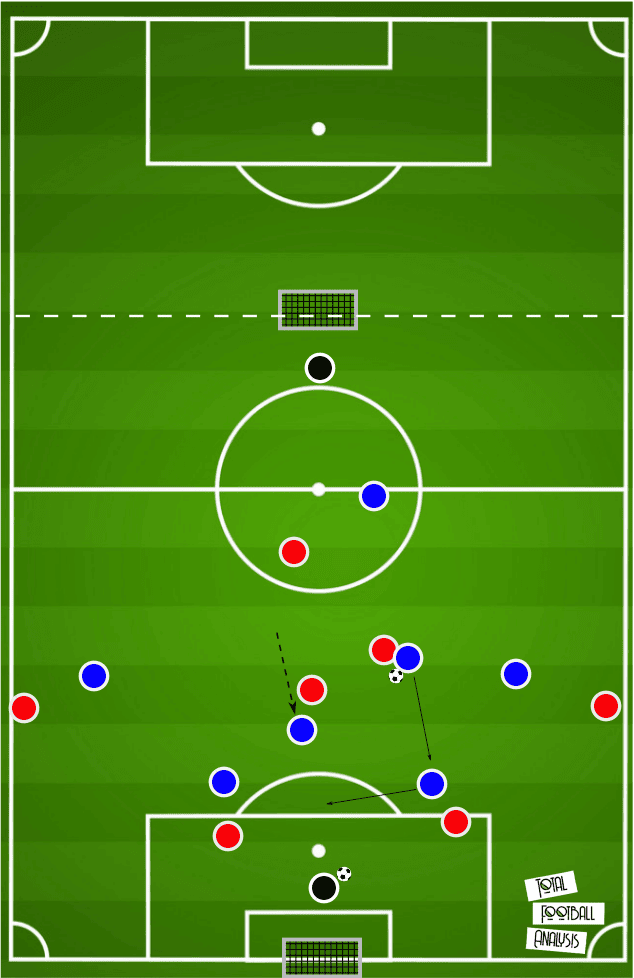
If this first option isn’t available, then they can recycle possession.
However, we still want to challenge them to put the learning, specifically from part 2 of this session, into practice.
Can the goalkeeper of the team in transition be brave, step forward, and provide that deeper option, for example, before looking to break lines?
If the ball is won further forward, can the blue team’s number six do this as well?