Alberto Aquilani Tactics At Sassuolo 2026/2027: Can He Build On His Catanzaro Achievements? – Tactical Analysis
Alberto Aquilani arrives at Sassuolo with a clear tactical identity. This analysis examines his 3-4-2-1 at Catanzaro, including structured build-up, pressing and positional rotations, before assessing how those principles could translate to a 4-2-3-1 in Serie A.

Who Is Alberto Aquilani?
Following Fabio Grosso's departure to ACF Fiorentina, US Sassuolo appointed Alberto Aquilani as their new head coach.
The former midfielder enjoyed an outstanding playing career with clubs including AS Roma, Juventus, AC Milan and Liverpool before moving into management.
Aquilani enhanced his growing reputation at US Catanzaro, guiding the club to the Serie B promotion playoff final, where they were narrowly defeated by AC Monza in a penalty shootout.
His tactical intelligence, combined with his ability to develop players and build a cohesive team, has established him as one of Italy's most promising young coaches.
This Alberto Aquilani tactical analysis examines Aquilani's tactical approach at Catanzaro during the 2025/2026 season to provide an idea of what he'll bring to US Sassuolo in Serie A 2026/2027.
Alberto Aquilani Preferred Formation & Lineup At Catanzaro
During the 2025/2026 season, Alberto Aquilani predominantly used a 3-4-2-1 formation at Catanzaro.
Mirko Pigliacelli was the first-choice goalkeeper behind a back three of Matias Antonini Lui, Tommaso Cassandro and Nicolò Brighenti, who featured regularly throughout the campaign.
In midfield, Jacopo Petriccione and Simone Pontisso formed the double pivot, providing control in possession and stability out of possession.
Constantino Favasuli and Gabriele Alesi operated as wing-backs, offering width and supporting both phases of play.
Behind the striker, Pietro Iemmello and AC Milan's Alphadjo Cissé started together for much of the first half of the season until Cissé's injury, which opened the door for Mattia Liberali to become a regular starter.
Up front, Filippo Pittarello led the line as the lone striker.
Alberto Aquilani Tactics In Possession
Catanzaro adopted an ambitious and fluid build-up structure under Alberto Aquilani tactics.
The goalkeeper was an active participant in possession, regularly pushing high outside the penalty area to provide an additional passing option during the first phase.
This allowed the central defenders to split wide, stretching the opposition's first line of pressure and increasing the angles available for progression.
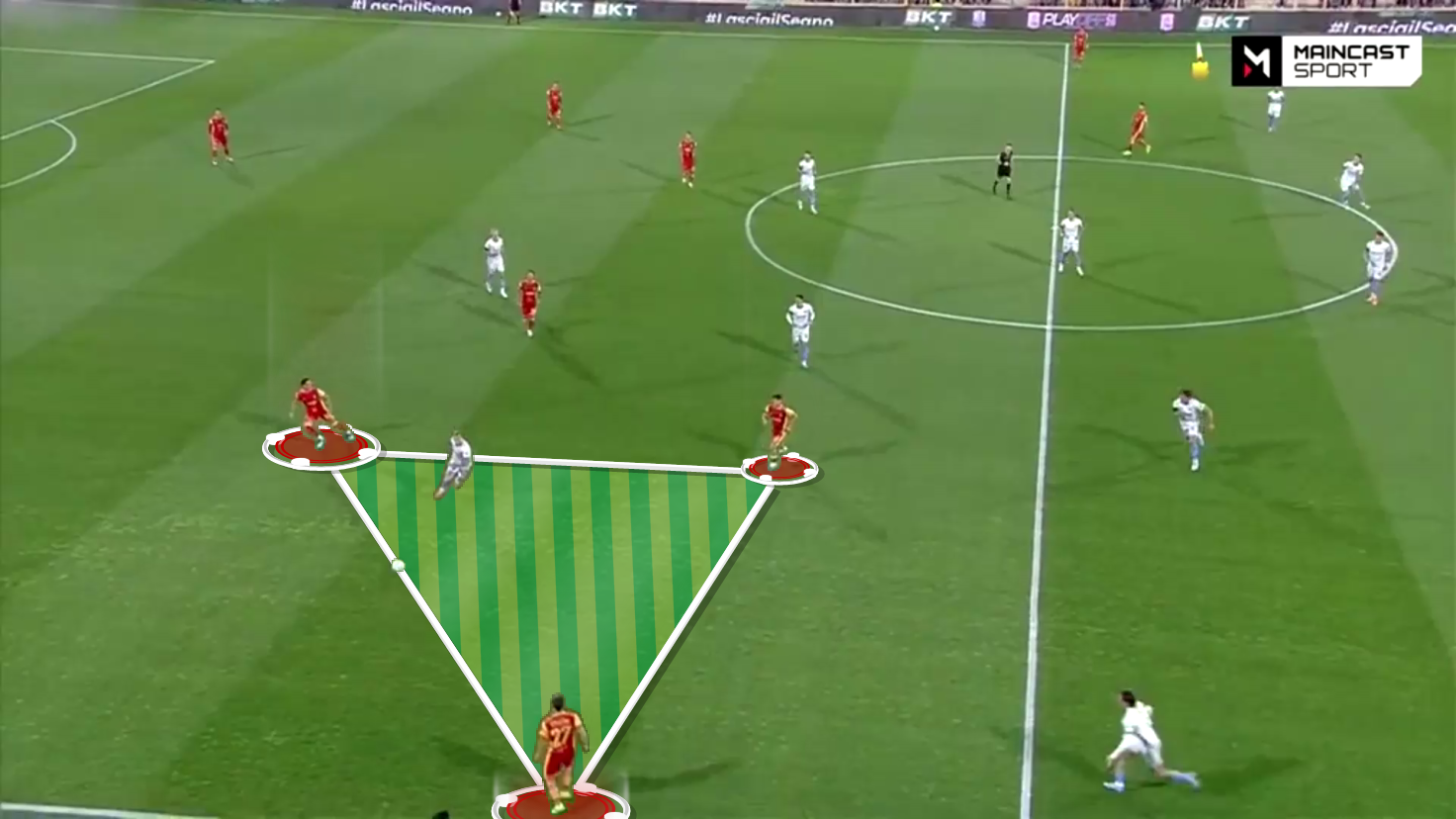
The team generally built in a staggered 3+2 structure, with the double pivot remaining intact ahead of the defensive line, as seen in Figure 1.
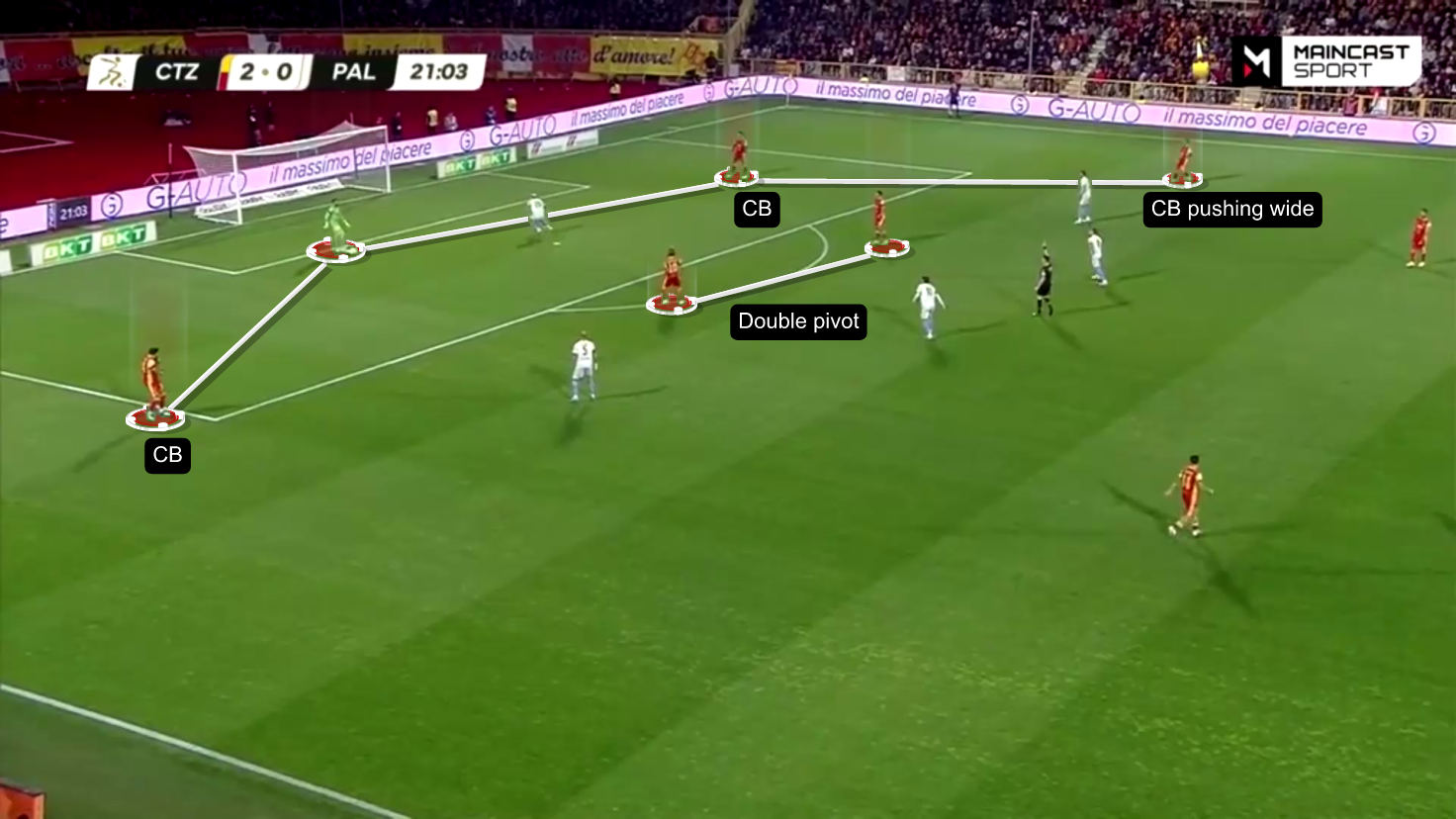
This provided constant support both behind and in front of the ball, ensuring Catanzaro always had multiple passing options regardless of where the opposition attempted to press.
A key feature of Aquilani's system is the flexibility of the defensive line.
The far-side central defender frequently moves wider to occupy the space vacated by the advancing wing-back, allowing the wing-back to push higher without compromising the team's rest defence.
These positional adjustments maintain balance while creating greater attacking width.
When opponents attempt to overload the build-up with an aggressive high press, Catanzaro responds through intelligent rotations.
One of the holding midfielders would drop into the defensive line to create a back three, while one of the inside forwards moved into midfield to restore the double pivot.
These movements ensure numerical superiority is maintained in the first phase and provide additional passing lanes to escape pressure.
These positional shifts are not random but are designed to create overloads on one side of the pitch.
By attracting more opposition players towards the ball, Catanzaro manipulated the defensive shape and created favourable situations where they could either combine through tight spaces or quickly exploit the free side.
Another important objective for Aquilani is to deliberately bait the opposition press.
Rather than avoiding pressure, Catanzaro invited opponents forward in order to create larger spaces between the opposition's second and third defensive lines, as seen in Figure 2.
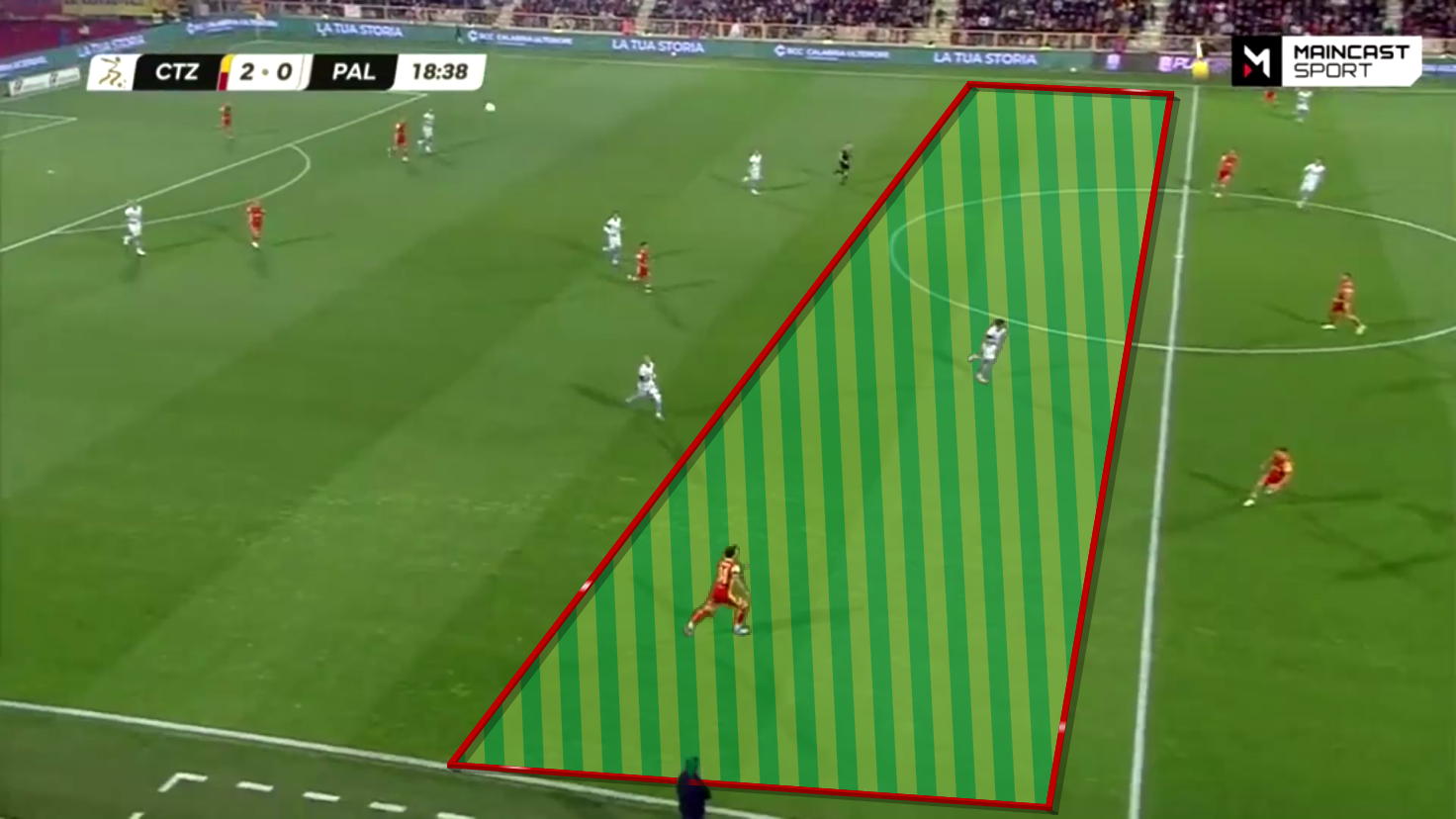
Once those gaps appear, vertical passes can be played into midfield or the attacking line, allowing the team to progress through the centre instead of relying solely on wide areas.
If central progression was not available, Catanzaro created structured passing triangles along the flanks as seen in Figure 3.