
FIFA World Cup 2026: Transition Football's Growing Influence – Data Analysis

For decades, possession has been viewed as one of football’s most valuable indicators of control.
Teams have sought to dominate the ball, dictate tempo, and gradually break down opponents through sustained periods of circulation.
The 2026 FIFA World Cup is increasingly challenging that assumption.
Across the opening stages of the tournament, matches have frequently been defined not by prolonged possession sequences but by what happens immediately after possession changes hands.
Rapid transitions, counterattacks, second-ball situations, and contested possession phases have become decisive features of games.
FIFA’s relatively new “in-contest possession” metric has further highlighted the growing importance of moments when neither team has full control of the ball, offering a more accurate picture of football’s chaotic and transitional nature.
In this World Cup data analysis, we examine how transition football has shaped the 2026 FIFA World Cup, exploring possession trends, direct attacking patterns, and the growing influence of reaction-based football on match outcomes.
The Round of 32 exits of Germany and the Netherlands add important context.
Both ranked among the tournament's most transitional sides.
Their eliminations reinforce the idea that strength in transitions alone doesn't guarantee progression, despite its stylistic prominence at the elite level.
Tactical efficiency, flexibility, game management, finishing and the fine margins of knockout football remain equally decisive.
Direct Circulation, Faster Attacks: Why Possession Is Becoming Increasingly Vertical
The 2026 FIFA World Cup is demonstrating that possession alone is no longer the primary measure of attacking intent.
Instead, many of the tournament’s leading nations are using possession as a platform to accelerate attacks rather than prolong them.
Passing Rate Per Minute Of Possession Among 2026 FIFA World Cup Nations
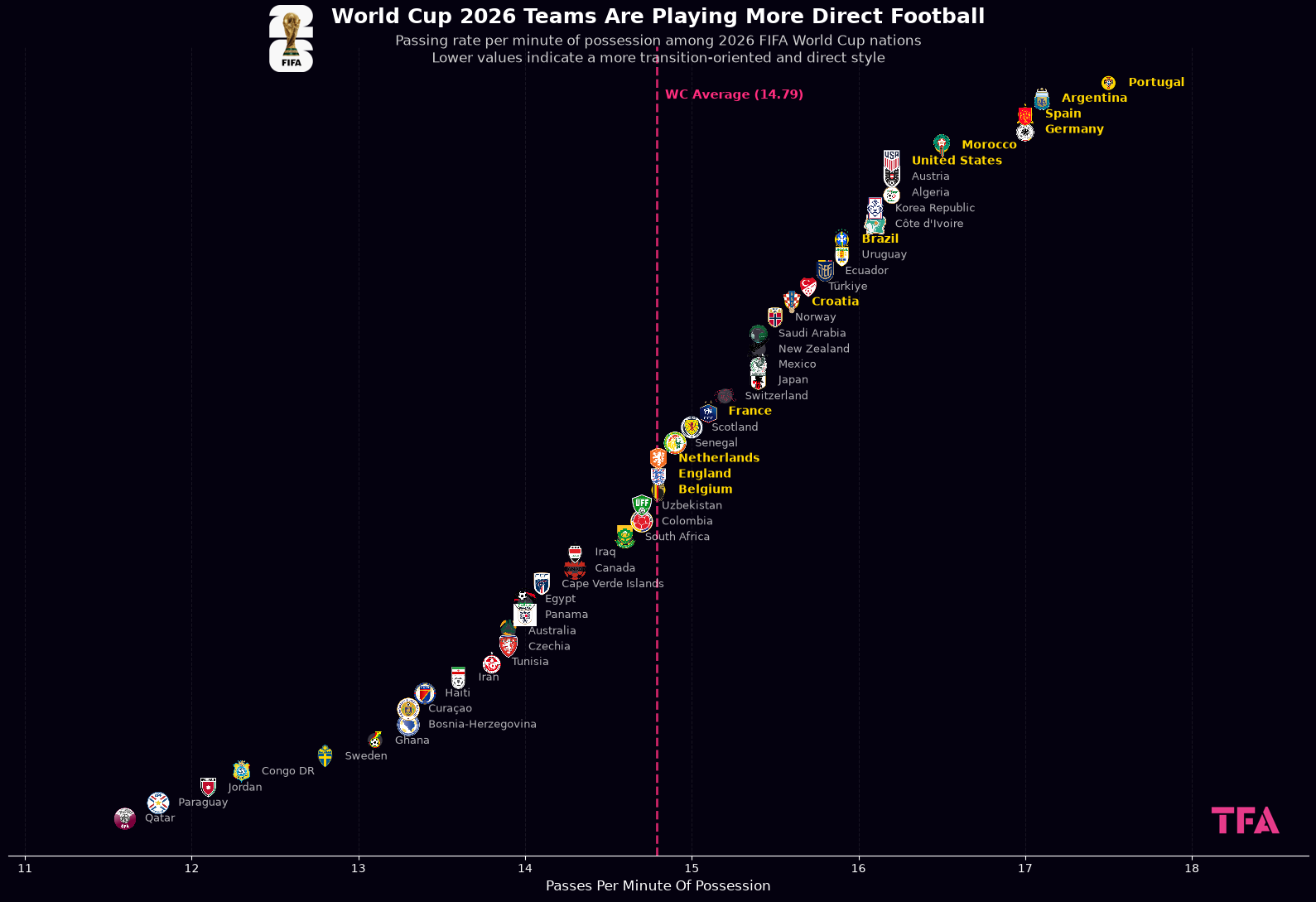
The Passes per Minute of Possession (PPM) metric highlights this shift, with the tournament average standing at 14.79 passes per minute.
Among the leading contenders, almost every side exceeds that benchmark, Portugal leads the competition with 17.5, followed closely by Argentina (17.1), while both Spain and Germany record 17.0.
Brazil also remain comfortably above average at 15.9.
In contrast, France (15.1), the Netherlands (14.8) and England (14.8) all operate much closer to the tournament average, with 23 teams recording a faster passing rate while in possession.
Rather than suggesting a lack of attacking quality, these figures reflect a deliberate tactical preference.
Didier Deschamps, Ronald Koeman and Thomas Tuchel have generally favoured more measured circulation before attacking directly, valuing structural balance, defensive security and the quality of decisive actions over constant ball speed.
Their teams are less concerned with maximising passing frequency and more focused on identifying the right moment to attack vertically, often creating transition opportunities through patient positioning rather than relentless circulation.
The tactical profiles of the remaining contenders reinforce the broader statistical trend.
Roberto Martínez’s Portugal, Lionel Scaloni’s Argentina, Luis de la Fuente’s Spain and Julian Nagelsmann’s Germany all encourage rapid ball circulation designed to provoke defensive shifts before exploiting vertical passing lanes.
Likewise, Carlo Ancelotti’s Brazil have combined greater positional control with quicker progression than in previous tournaments.
Collectively, the data suggests that the modern World Cup is moving away from possession for possession’s sake.
Instead, faster circulation has become a mechanism for creating transition-like situations within organised possession, blurring the traditional distinction between positional play and counterattacking football.
The ball is increasingly being moved with purpose rather than simply retained, reflecting a tournament in which verticality has become just as valuable as control.
Running To Transition: Physical Intensity Behind The World Cup’s Fastest Attacks
The tactical evolution of the 2026 FIFA World Cup has not only been reflected in how quickly teams move the ball, but also in how aggressively they attack space without it.
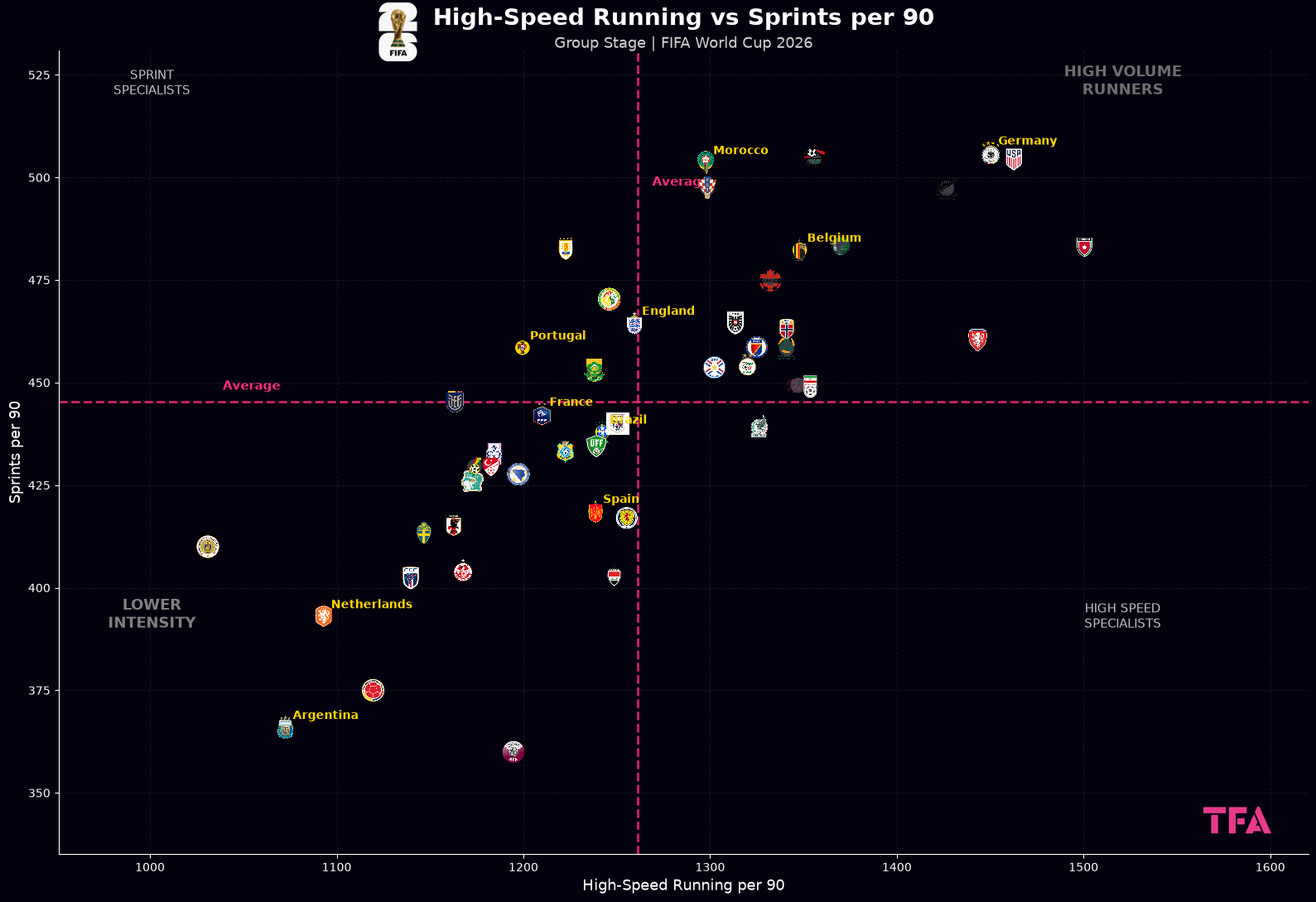
The tournament’s high-speed running data illustrates that transition football is driven as much by physical intensity as tactical organisation.
High-Speed Running Vs Sprints Per 90 - Group Stage - FIFA World Cup 2026