Julian Nagelsmann Tactics At Germany 2026: Spatial Manipulation & The Blueprint For A Deep World Cup Run – Tactical Analysis

When looking back at Germany's historical failures across recent World Cups, a recurring theme invariably presents itself: structural rigidity.
For years, the German national team seemed trapped between the remnants of high-possession dogmatism and an inability to find structural balance in defensive transitions.
However, as Julian Nagelsmann prepares to lead his country into the 2026 FIFA World Cup, the tactical landscape looks entirely different.
The current iteration of the Nationalelf has engineered a highly sophisticated tactical identity that rejects rigid positional profiles, opting instead for extreme spatial manipulation, positional interchanges, and a directed, territory-based defensive block.
Rather than overpowering opponents through natural wide outlets or relying on the sheer individual brilliance of a traditional focal point, Nagelsmann's system operates as an intellectual, geometric network.
It is a structure explicitly designed to manipulate defensive lines, suffocate central channels during build-up phases, and lock opponents into hyper-specific traps without possession.
This tactical analysis examines Germany's structural mechanics, personnel variations, and how their tactical blueprint seeks to establish a new era of dominance on the world stage.
The Structural Blueprint: Germany Formations & Personnel Inversions
To fully comprehend how Germany intend to dictate matches at this World Cup, we must first look at their structural baseline.
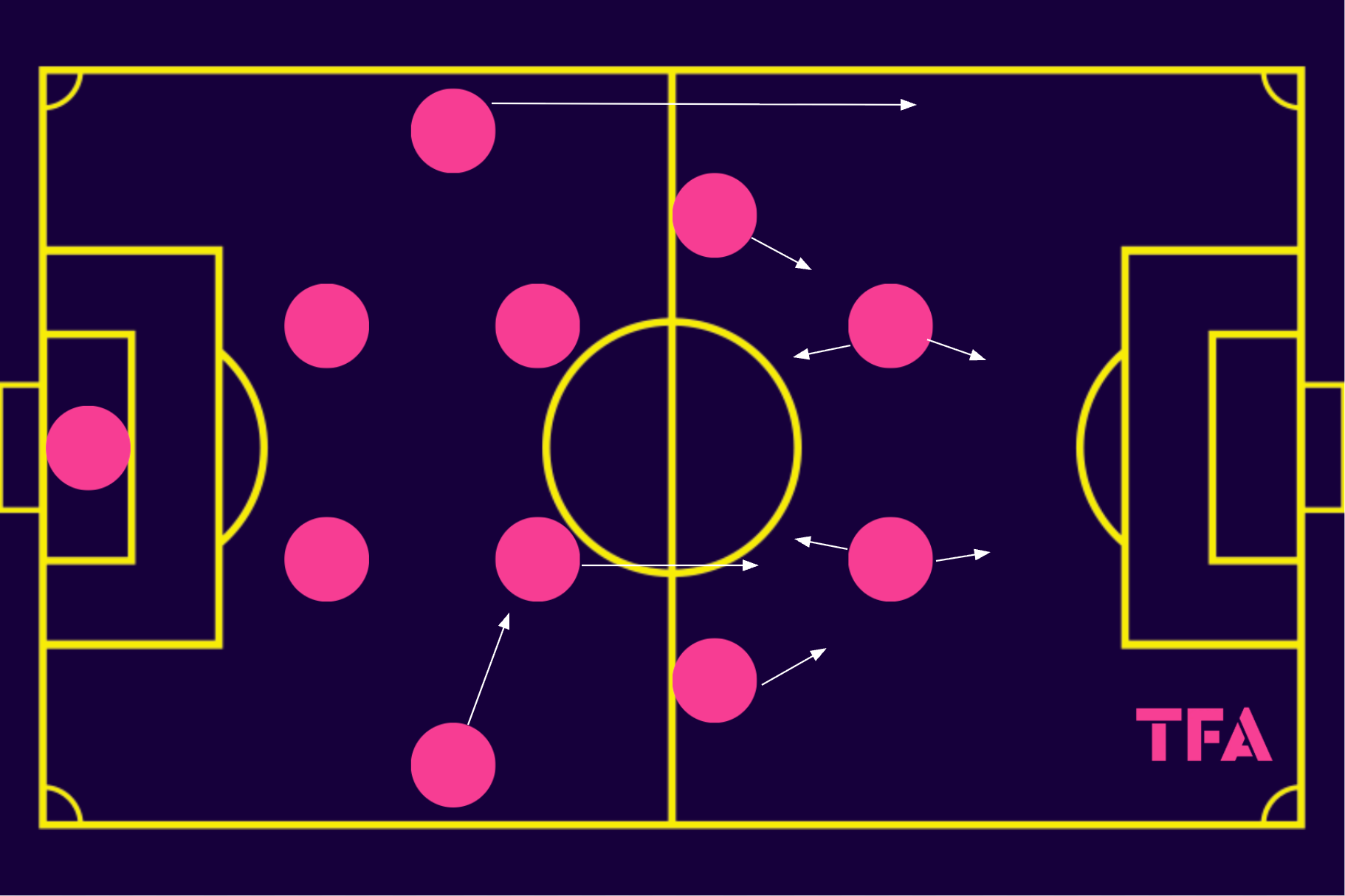
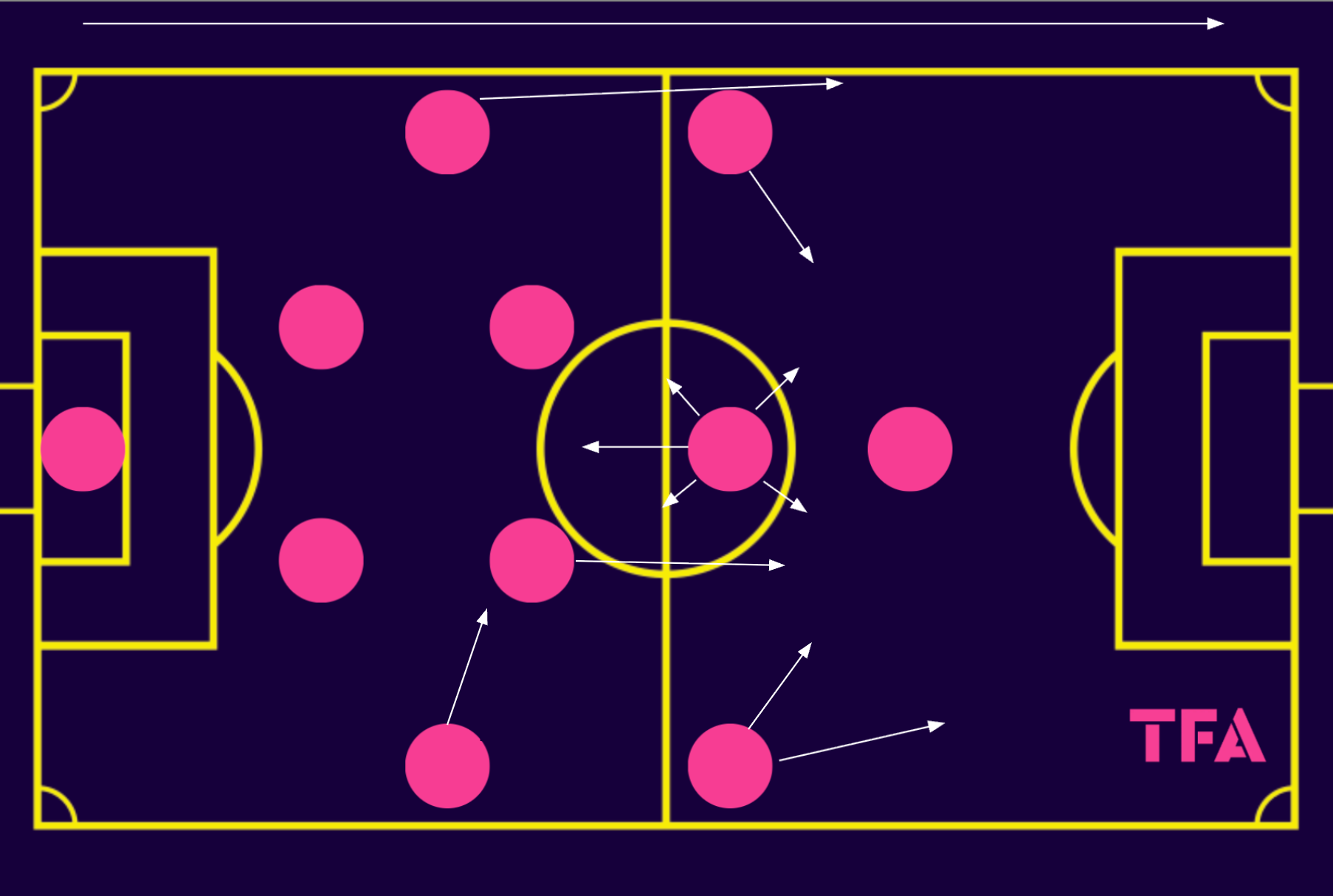
On paper, Julian Nagelsmann deploys a 4-2-3-1 system.
However, in modern tactical theory, a starting formation is nothing more than a temporary arrangement for the pre-match graphic; it is the fluid transformations between phases that reveal a team's true tactical intent.
Germany Lineup & Core Profiles
In goal, the veteran Manuel Neuer remains the absolute foundation of Germany’s defensive and build-up mechanics.
His role transcends traditional shot-stopping, serving as an active sweeper and an auxiliary centre-back during deep possession phases.
The backline features a highly deliberate mix of physical dominance and progressive passing metrics.
In the central pairing, Nico Schlotterbeck occupies the left-sided centre-back position, offering elite line-breaking capabilities with his left foot and a natural tendency to carry the ball forward into midfield vacuums.
Alongside him, Jonathan Tah provides the necessary physical security, aerial dominance, and elite recovery speed required to cover large defensive spaces when Germany pushes their lines high up the pitch.
At left-back, David Raum is selected for his high-volume crossing metrics and relentless linear athleticism.
At the same time, Joshua Kimmich operates on the right side, playing a highly inverted role that fundamentally shapes Germany's entire possession structure.
In the engine room, Nagelsmann has opted for a double pivot consisting of Aleksandar Pavlović and Felix Nmecha.
This pairing balances press-resistance with dynamic ball-carrying ability.
Pavlović functions primarily as the deep anchor, moving metronomically to collect the ball from the centre-backs and dictate the tempo of short-pass circulation.
Nmecha provides a more vertical presence, using his physical frame to shield possession and explode forward through central lines when the opponent's midfield steps out to press.
The attacking midfield trident is where Germany’s fluid identity truly comes alive.
Florian Wirtz is stationed on the left wing but is given a complete license to drift inside, while Jamal Musiala acts as the central puppet master in the No. 10 space.
On the right wing, the emerging tactical profile of Lennart Karl was going to pose an inside-out threat, using his creative passing vision and technical efficiency in half-spaces to serve as an additional playmaker.
However, he has been removed from the squad through injury, opening up the door to a likely starting spot for Leroy Sané.
Sané tends to start wider, using his pace and dribbling threat to beat the full-back and progress the ball.
While he can offer the possibility of stretching the opposing defence more than Karl, the left-footer may be required to invert into the right half-space more if Germany seek a central overload in the final third.
This trio sits immediately behind Kai Havertz, who leads the line not as a static centre-forward, but as an elite space-manipulating false-nine.
The injury to Serge Gnabry really hurts the team; he was the perfect fit between Havertz, Musiala, and Wirtz.
His well-timed runs in behind and finishing will be missed by Nagelsmann at the World Cup.
Tactical Alternations: The Goretzka, Undav, & Woltemade Dynamics
While the aforementioned XI represents the most probable configuration, Nagelsmann has built an array of tactical variations into the squad to combat specific defensive blocks.
The first major variation resides in the double pivot.
Against elite, high-pressing oppositions that look to physically dominate the centre of the pitch, Leon Goretzka can seamlessly slot into the midfield engine room in place of Felix Nmecha.
Goretzka provides a significantly more aggressive, box-to-box profile.
His tactical value lies in his ability to make late, third-man runs into the penalty box while offering elite-level counterpressing intensity that helps lock down opposing transitions before they can form.
The second, and perhaps more radical, structural alteration involves changing the nature of the frontline itself.
When confronted with an exceptionally deep low block that completely suffocates central spaces between the lines, Nagelsmann can pivot away from the wide profile of Leroy Sané to introduce either Deniz Undav or Nick Woltemade.
This personnel swap completely alters Germany's attacking geometry, morphing the shape into a distinct 4-2-2-2 formation.
In this variation, Undav or Woltemade partners directly with Kai Havertz upfront, establishing a dual-striker system.
Undav offers exceptional penalty-box gravity, sharp back-to-goal link play, and instinctive finishing inside the 18-yard box.
Woltemade, on the other hand, brings a unique physical profile, combining immense height with the technical dribbling characteristics of an attacking midfielder.
By utilising a dual-striker partnership in a 4-2-2-2, Germany forces the opponent’s central defenders into direct physical engagements, pinning them deep within their own box.
This structural modification creates an artificial separation between the opponent's defensive and midfield lines, opening precisely the types of central half-space pockets that Musiala and Wirtz require to dismantle organised defences.