Morgan Rogers Scout Report At Chelsea 2026/2027: Can He Complement Cole Palmer Style Of Play In Xabi Alonso Tactics? – Player Analysis
This Morgan Rogers scout report analyses his ball-carrying, combination play, off-the-ball movement and pressing, assessing how his versatility can complement Cole Palmer and strengthen Xabi Alonso’s Chelsea in possession and out of possession during the 2026/2027 season.

Chelsea have completed the signing of Morgan Rogers, after a successful 2025/2026 season with Aston Villa.
Rogers was an important figure in Villa's UEFA Europa League triumph, scoring and assisting in the final against SC Freiburg.
His display throughout the season earned him a spot in the England squad for the 2026 FIFA World Cup; he made seven appearances in the competition, providing an assist in the semi-final against Argentina.
The 24-year-old plays as an attacking midfielder and can operate as a winger on either side.
His positional versatility is a key reason why Chelsea opted for the signing.
While Cole Palmer naturally enjoys life in the right half-space where he can act as an attacking focal point, Rogers' dribbling and off-the-ball movement can create extra space for his new Chelsea teammate to receive and influence the game.
Through this Morgan Rogers scout report and player analysis, we will examine Morgan Rogers’ style of play in and out of possession and how he can be useful under Xabi Alonso tactics during the 2025/2026 season.
Morgan Rogers Style Of Play In Possession
A big part of Rogers’ game is his ability to carry the ball.
The Englishman uses his ability to help his side in transition.
His tendency to play direct is useful in games with a high counterattacking volume.
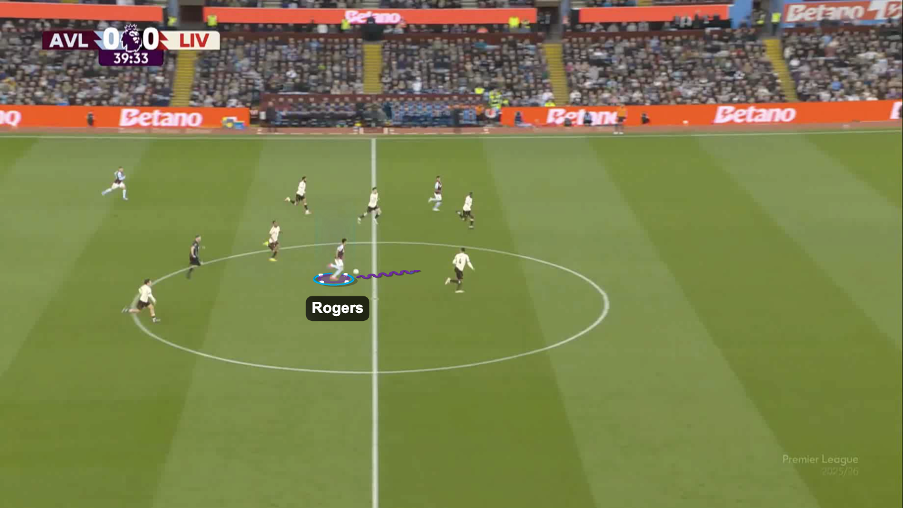
Rogers carries the ball in positive transition.
This not only attracts opponents, but also gives his teammates time and space to make supporting runs.
This could be of benefit to Cole Palmer, as he can sit between the lines waiting for the moment the defence collapses to receive in dangerous pockets.
Meanwhile, he holds onto the ball using his large frame.
Standing 187cm tall, the attacking midfielder uses his size to shield the ball in tight situations.
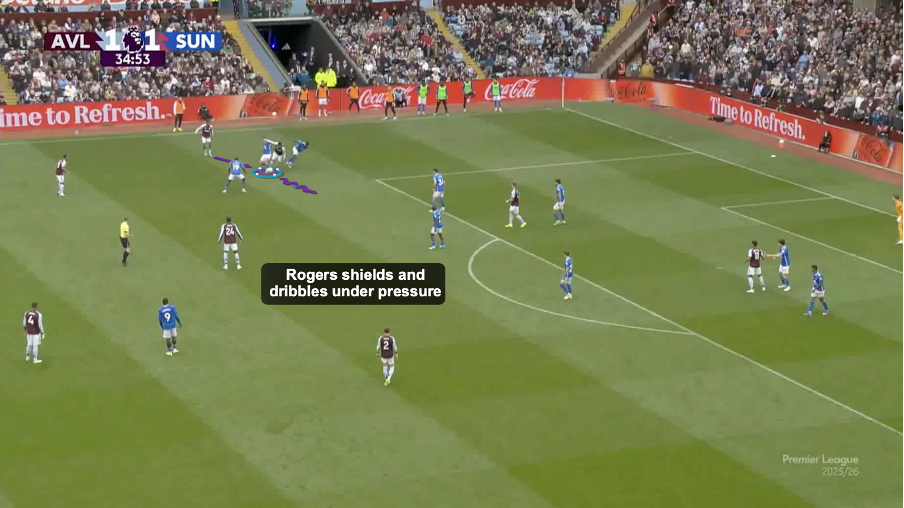
He often receives in situations where he has pressure from behind.
Here, he holds off two defenders and cuts inside.
Actions like this create space for his attacking teammates to exploit.
For instance, Rogers could draw multiple defenders towards him, thus leaving Palmer isolated 1v1 against a defender.
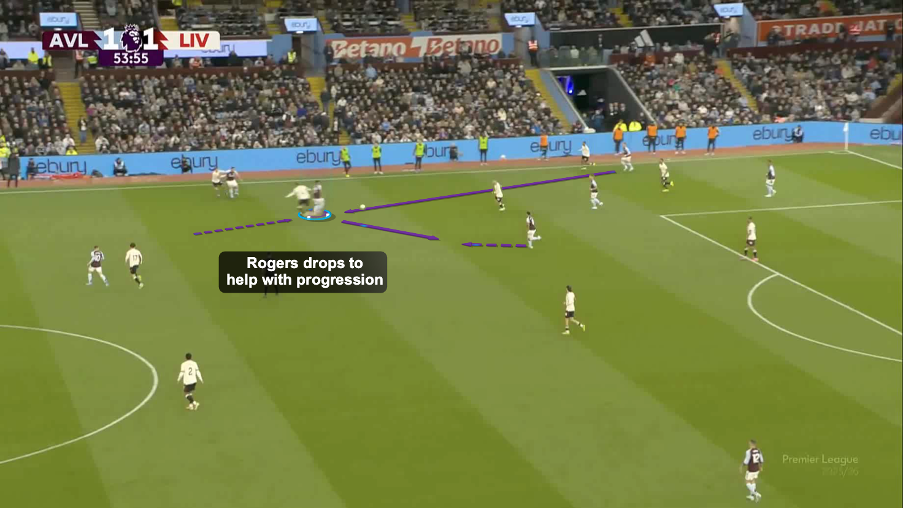
Using his physicality, he also helps out by providing solutions in build-up.
The full-back is stuck in the wide channel in the defensive third.
Rogers drops deep to offer a passing option.
Although he has pressure on his back, he gets the ball out of pressure by playing a bounce pass to a deeper midfielder facing forward.
This action takes a minimum of five opponents out of the game and speeds the play up for his side.
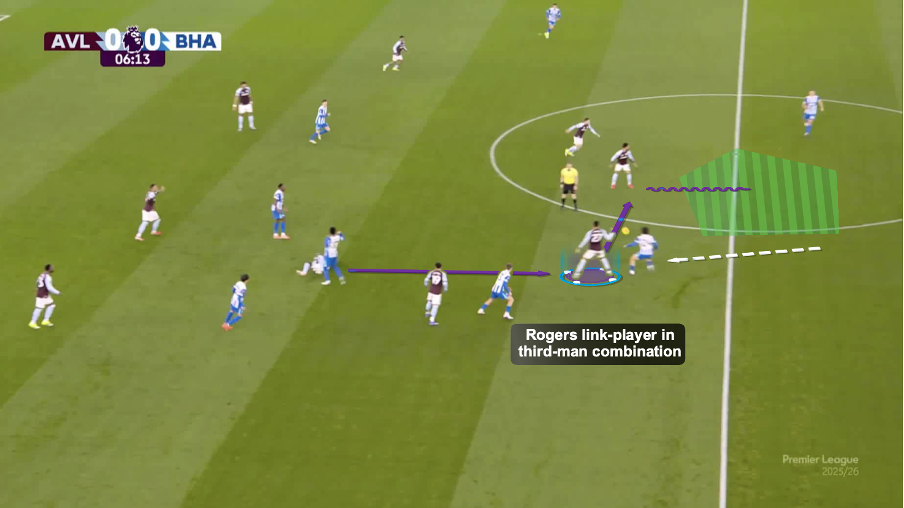
Another example of a third-man combination that frees up space for a teammate.
Rogers acts as the link player here, dragging an opponent out of his position.
When the Englishman plays the set pass, the third player in the combination has access to enough space to drive up the pitch.
The player who follows Rogers cannot get goal-side in time to delay the ball carrier.
Morgan Rogers has a large radius of action and receives the ball in multiple different areas across the pitch.
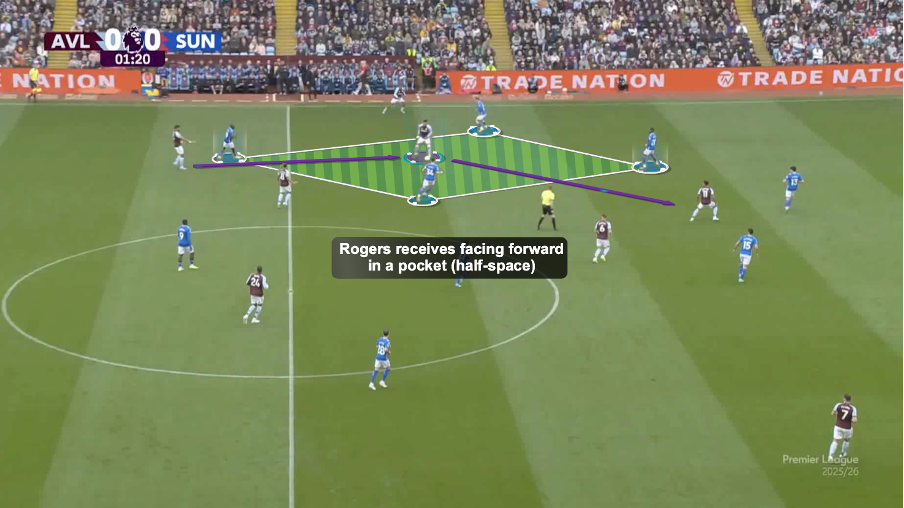
The 24-year-old receives a vertical pass in a pocket in the half-space.
This can happen when he drifts sideways from an attacking midfielder position or when he drifts inside from a winger position.
The noticeable detail here is that he receives on the half-turn when there is no immediate blind-side pressure, which allows him to find a forward pass to his striker.
With Palmer often occupying an adjacent half-space with Rogers, Chelsea could force defenders to decide whether to step towards Rogers' carrying ability or Palmer's passing range, making it difficult to contain both at the same time.
Once again, Rogers plays the role of a connector in the mid-third.
This allows Palmer to focus on high-risk creative actions while Rogers provides security and support.
Another way he helps his side is by offering solutions to shift play.
This will be useful for a team like Chelsea under Xabi Alonso, who would look to attack with possession.
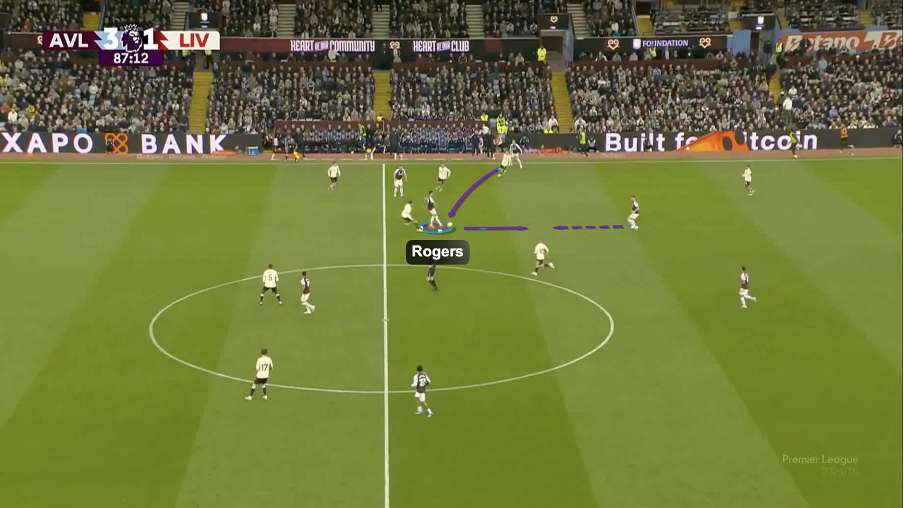
Villa’s right-back is stuck in a wide situation where he is potentially under pressure from multiple opponents.
Rogers makes himself available to offer an exit option.
As he drops to receive the inside pass with pressure on his back, the 24-year-old sets the ball to a fellow midfielder who has enough space and time to open up and shift play.
Villa end up holding onto possession and progress to the opponent half by safely shifting play.
While receiving in the half-space, Rogers also enables his wide teammates.
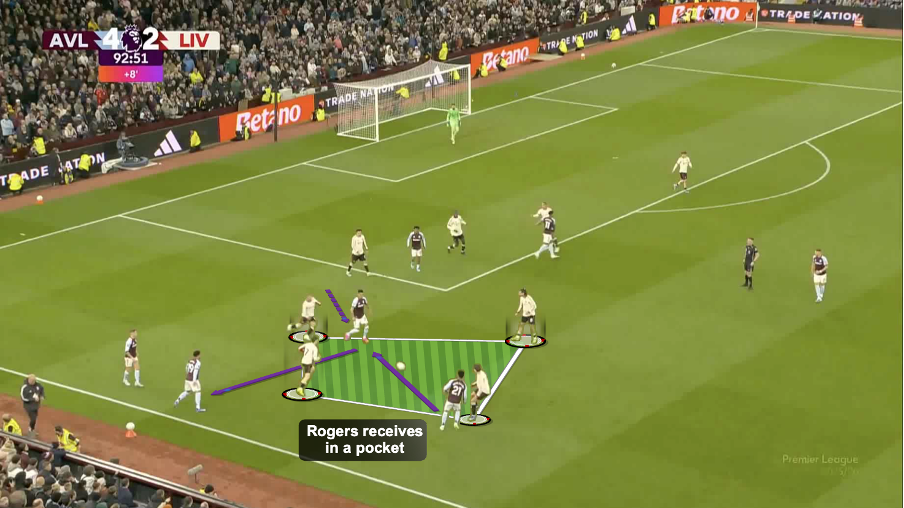
Rogers receives in yet another pocket in the wide channel.
Since the direct passing lane to his wide teammate is initially blocked, the way to include him is through an in-to-out pass.
Rogers drops into the pocket, drawing the attention of the opponents around him.
He plays a first-time pass to his winger, who can exploit the space down the line.
If Palmer occupies the opposite half-space to Rogers, Chelsea can threaten both sides of the pitch at the same time, making defensive shifts a lot more difficult.
Apart from being the link in quick third-man combinations, Rogers can also receive between the lines to drive forward.
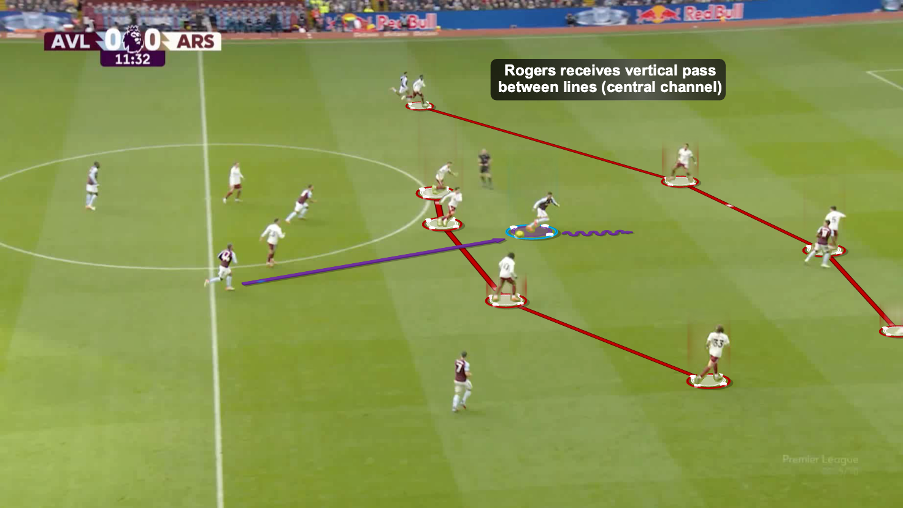
The Englishman receives a vertical pass in the central channel between the opponent's lines of midfield and defence.
With no opponents putting blind-side pressure, he receives on the turn and starts driving forward.
In situations where the opponents are horizontally compact, he peels out to receive in the half-space.
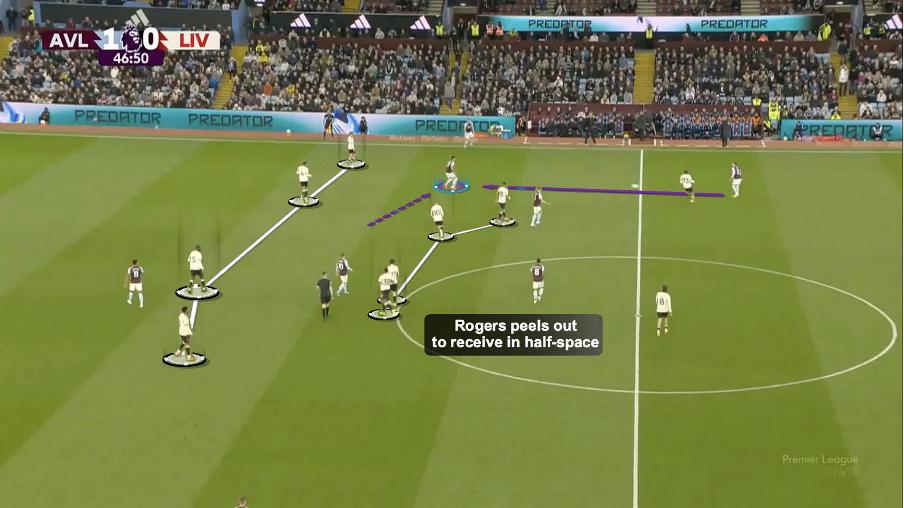
The opponents keep their midfield line compact.
Rogers peels wide to receive from his centre-back.
With a wide teammate already positioned at the touchline, he can drive at the opposition full-back to create a wide overload.
These combinations in the wide areas give rise to shot-creating actions, where Rogers has had a significant amount of involvement.
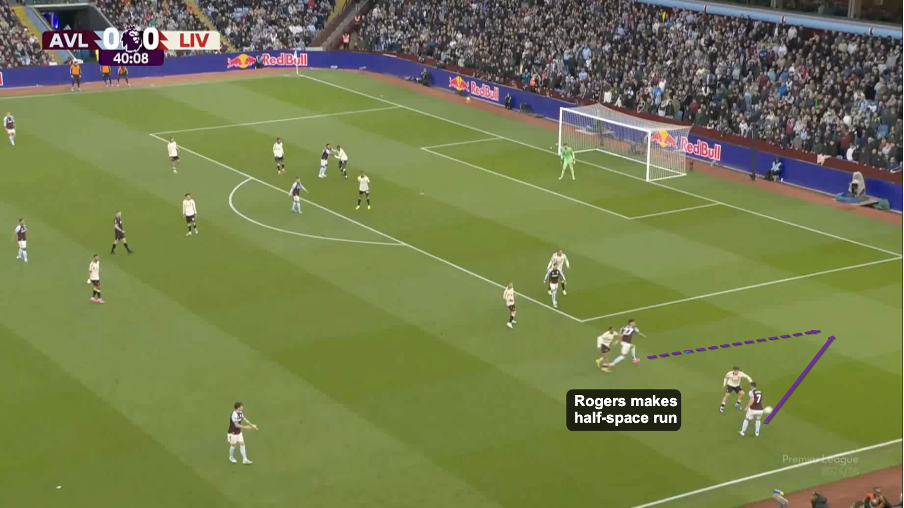
Rogers frequently makes underlaps in the half-space to exploit the full-back’s blind side.
This can happen when he is either the third player in a third-man combination or when he plays a one-two with the winger.
These channel runs either disrupt the opponent's backline shape or create dangerous crossing opportunities.
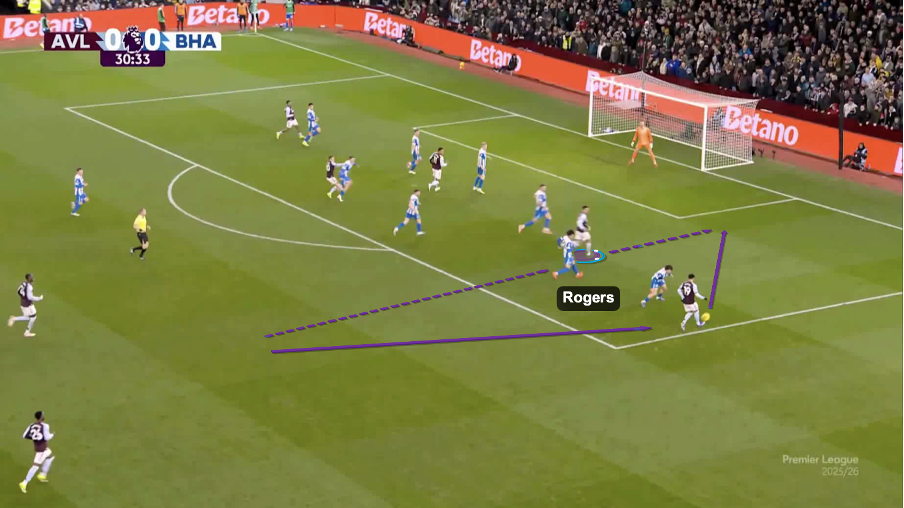
A similar run, if made more centrally, can lead to a direct shot from the channel runner himself.
Rogers plays the winger to feet and continues his run to receive the edge of the six-yard box.
These movements reduce Palmer's creative load, ensuring Chelsea can threaten the penalty area via multiple avenues.
He can execute a snapshot or a cut back from that situation depending on the angle at which the defenders close him down.