How To Coach 4-3-3 Pressing Tactics Like Luis Enrique's PSG & Pep Guardiola's Manchester City - Tactical Theory

As coaches prepare for the upcoming season, implementing a cohesive pressing system is crucial for teams seeking to control games when they do not have the ball and when trying to force the opposition to play into areas they feel they can exploit.
Working on a variety of pressing options early in pre-season, even from within the same general system, can become useful later in a hectic season when trying to implement a system to face a specific opposition.
This tactical theory article examines how teams can press in a 4-3-3 formation, similar to that employed by Pep Guardiola and Luis Enrique, and the subtle adjustments that can be made within the same setup to create turnovers in high-risk areas.
This football analysis features two distinct pressing systems within a 4-3-3 formation, utilising examples from Manchester City and PSG during last summer's FIFA Club World Cup.
Some of the weaknesses inherent in these pressing setups are also analysed.
This tactical football analysis outlines how coaches can utilise the training ground to implement pressing tactics, which incorporate elements of man-to-man marking and setting pressing traps.
How PSG Pressed Vs Real Madrid
This section analyses how Paris Saint-Germain, the UEFA Champions League and Ligue 1 winners, pressed against Real Madrid in the Club World Cup Semi-Final.
The following images show Les Parisiens pressing from a midfield area, but the principles were the same higher up the pitch.
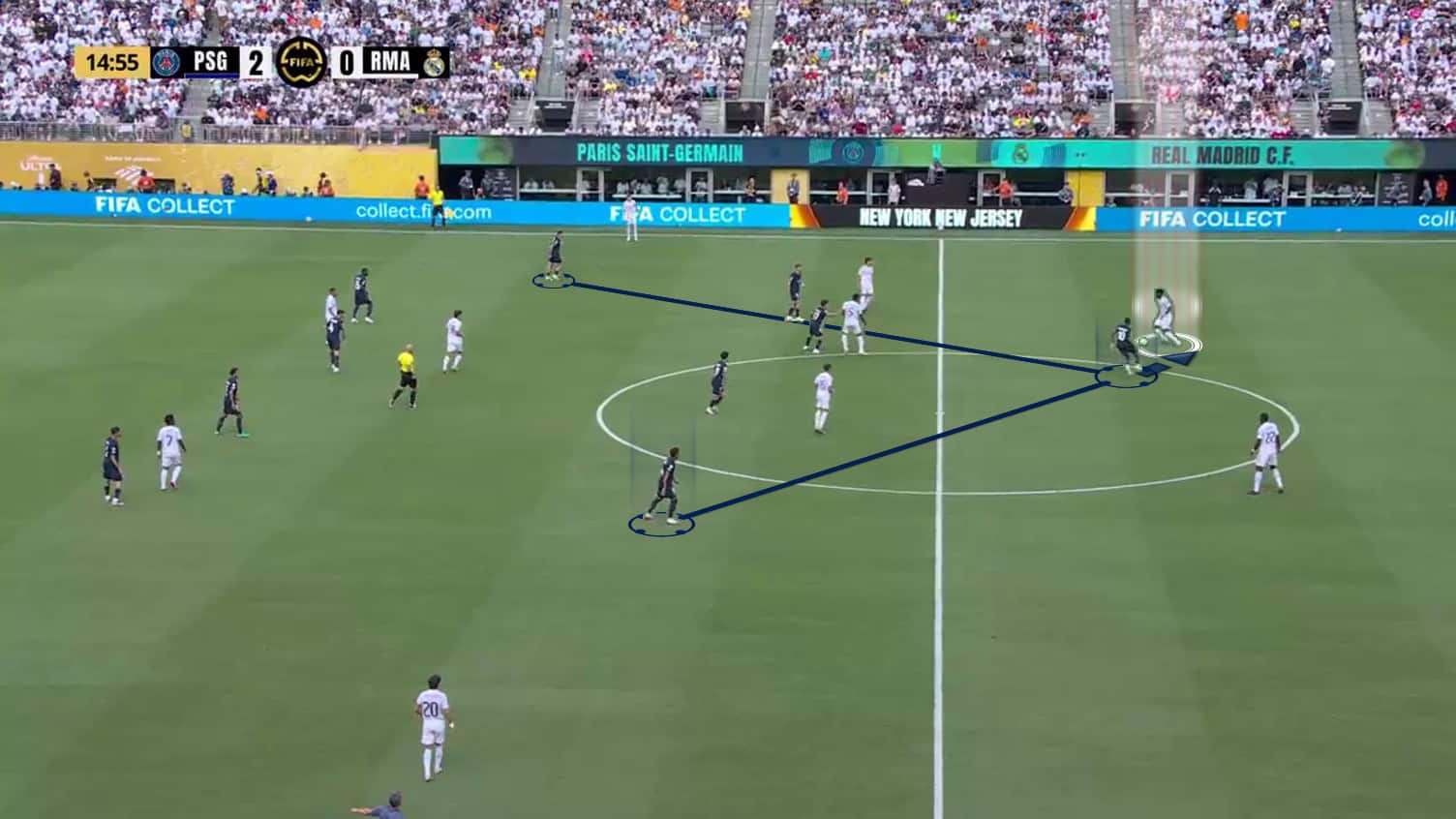
PSG’s press aimed to force the La Liga runners-up down one side of the pitch.
This was done by the striker aggressively pressing towards the ball-carrying centre-back's inside foot to cut off his defensive partner.
The striker's pressing run was more diagonal than looping to avoid the centre-back being able to step forward with the ball, past the line of the oncoming striker, where he could switch it to the opposite centre-back.
As highlighted in the image above, the wingers dropped off to either side of the midfield, behind the central forward.
The left and ball-near winger, Khvicha Kvaratskhelia dropped off, almost to his backline, in relation to the opposition's wide midfielder.
The ball-far winger forms a four with the three in midfield, who are man-to-man marking.
As shown next, the ball-far wingers' more advanced position becomes essential later in the move.
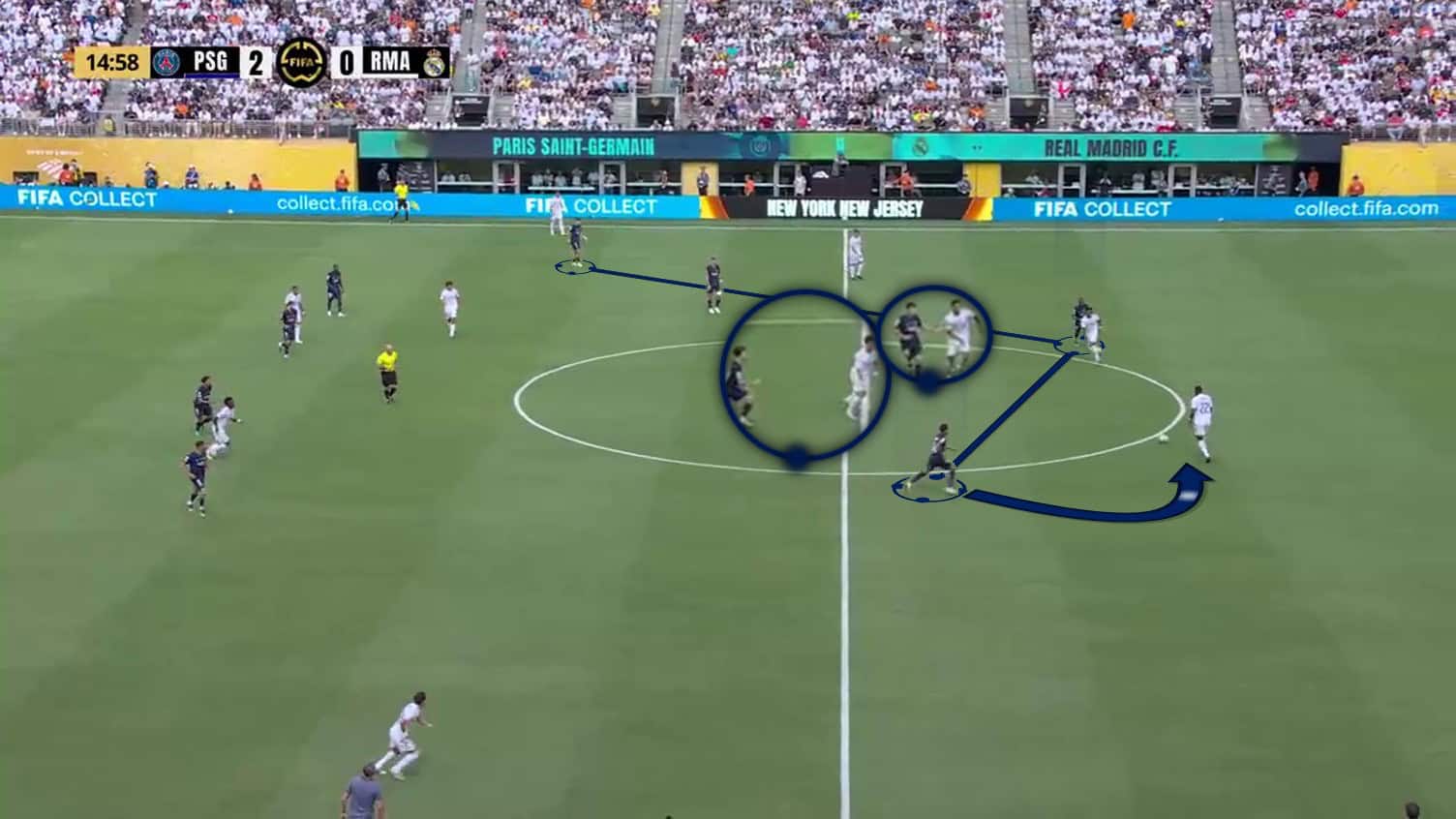
As highlighted above, in the centre of the pitch, PSG’s midfield went man-to-man with their counterparts, remaining almost touch tight.
The above image shows the moment after Los Blancos' midfield created enough separation to bounce the ball via a central midfielder to the opposite centre-back.
Once Real Madrid had escaped the initial press from the striker, the now ball-near winger of PSG jumped, pressing from the outside in an attempt to force the ball back in the direction it came from.
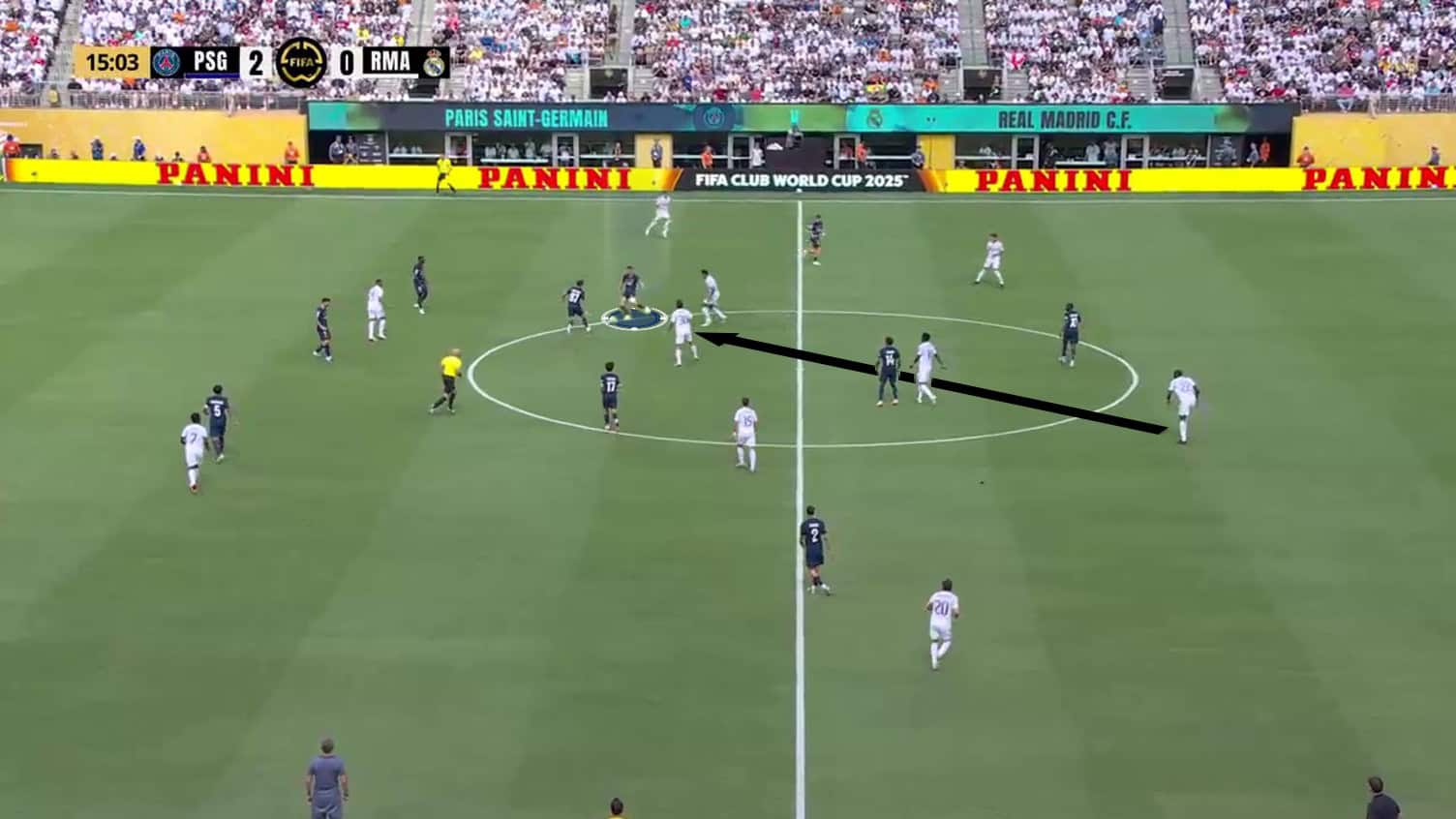
This forced Real Madrid to retreat into the crowded area where their central midfielders are marked, and, because they did not have to rush into the wide areas, PSG’s full-backs were tucked in.
In this instance, as they attempt to thread the needle and find one of their forwards’ feet, Real Madrid are forced into a turnover.
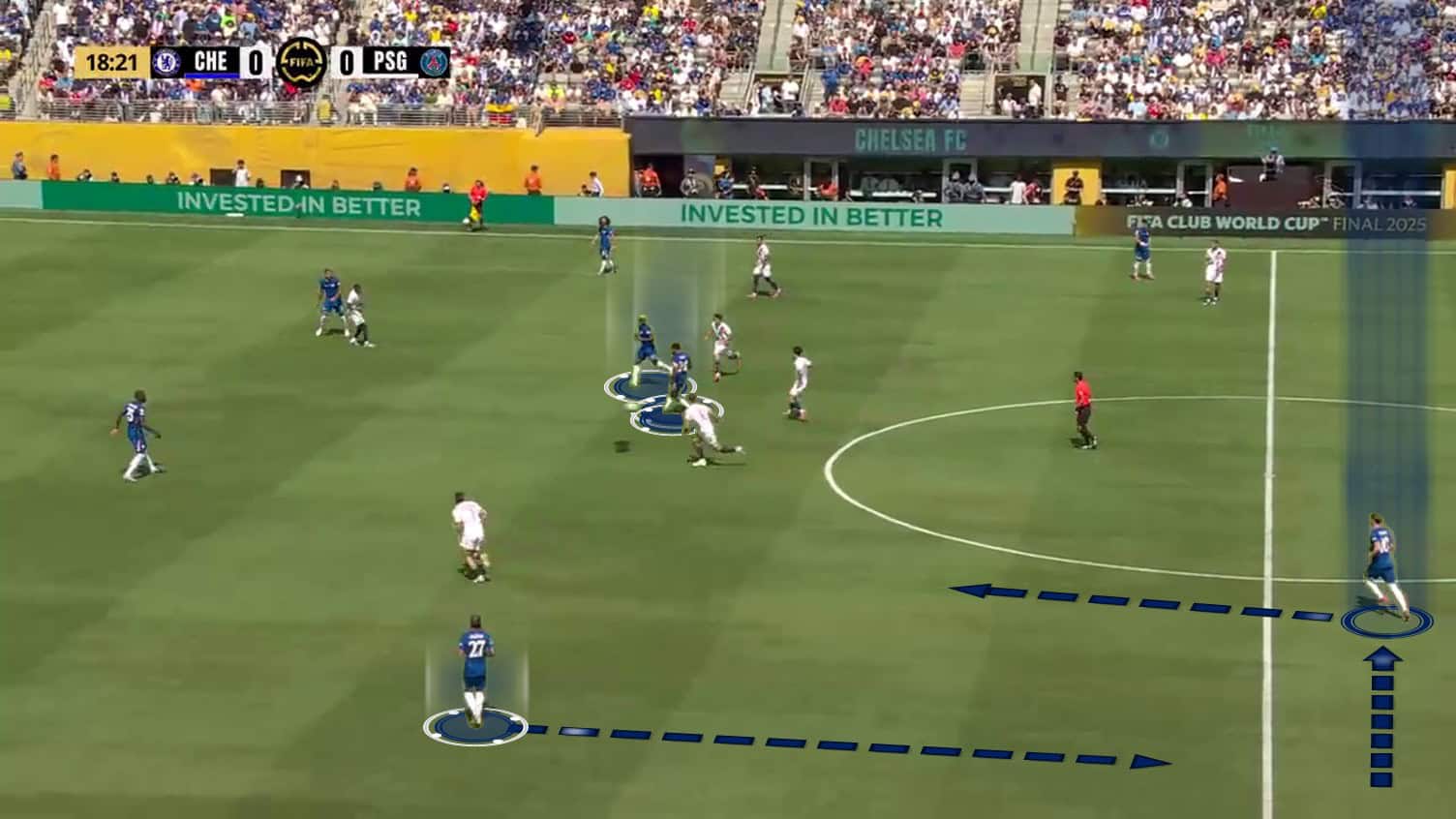
Whilst this technique of man-marking can make it very hard for the marked players to get on and hold on to the ball, it also allows them to manipulate where the space is.
In the Club World Cup Final, the eventual champions, Chelsea, positioned their central midfielders low and close together.
This allowed Cole Palmer, highlighted on the right of the image, the space to come inside from a right-wing position.
Right-back Malo Gusto then made a forward run, preventing PSG's left-back from tracking Palmer.
The England international was able to receive alone beyond PSG's midfield line.
How Manchester City Pressed From The Outside-In
Another option for forwards when initiating a press, and one deployed by Pep Guardiola’s Manchester City in their semi-final defeat by Saudi Pro League side Al-Hilal, is to press from the outside in, forcing teams into central areas.
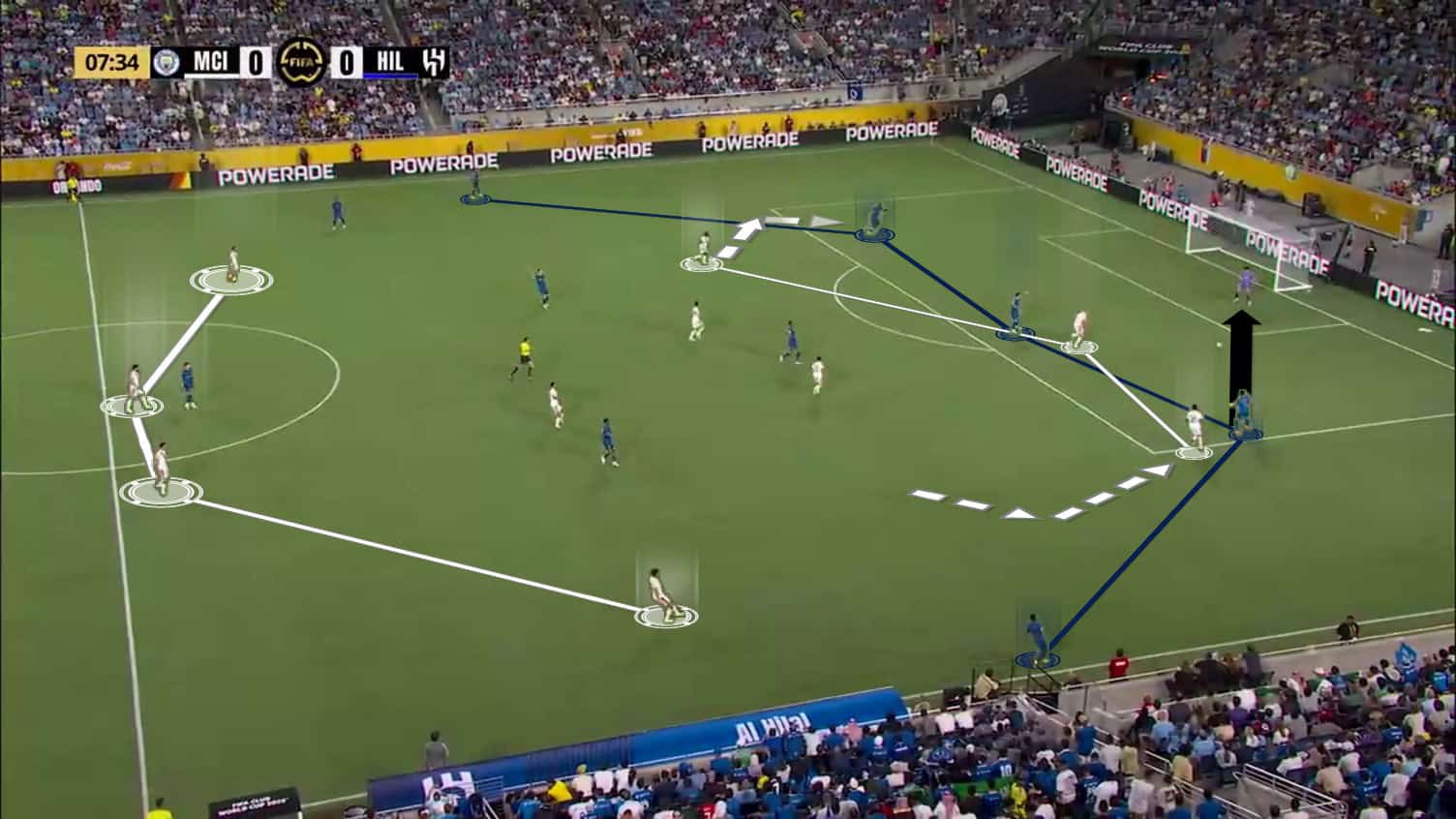
The above image shows Al Hilal (in blue) during their build-up phase, with Simone Inzaghi’s men playing with a back three.
When the ball was played into either side's centre–back, Man City’s wingers made big looping runs to press the ball while cutting off the Saudi side's wing-backs.
This allowed City’s full-backs to remain intact with their centre-backs, their midfielders to go man for man in the middle and, effectively, allowed City to use three players to take care of five opposition players.
Striker Erling Haaland positioned himself close to the central centre-back and stepped onto the goalkeeper when he received a pass back.
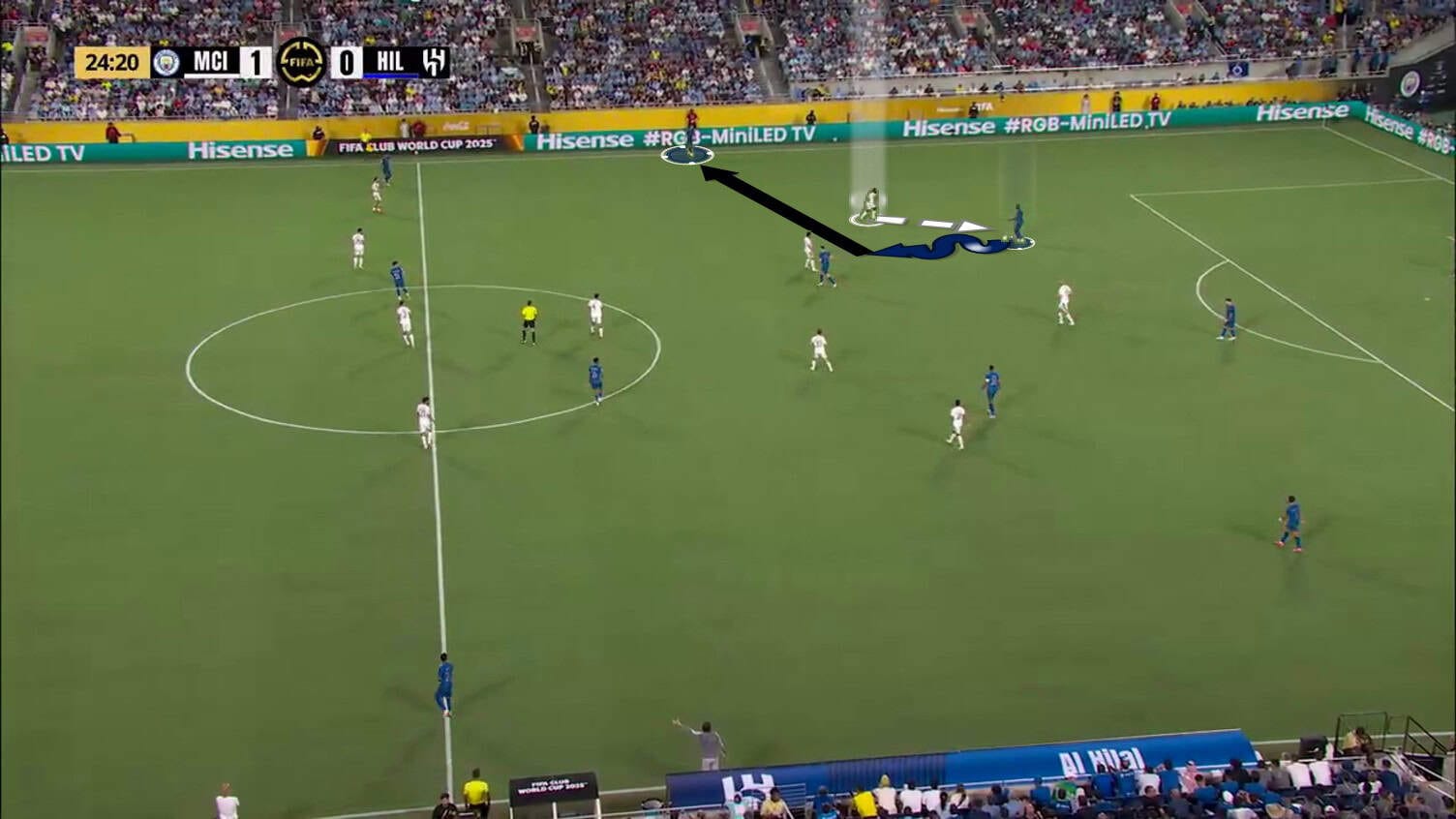
Although all three centre-backs were occupied, their wing-backs cut off, and their central midfielders man-marked, Inzaghi’s side found various ways to break down the press.
One way was for the receiving side centre-back to drive with the ball, beyond the winger's press, to find the now wide-open wing-back.
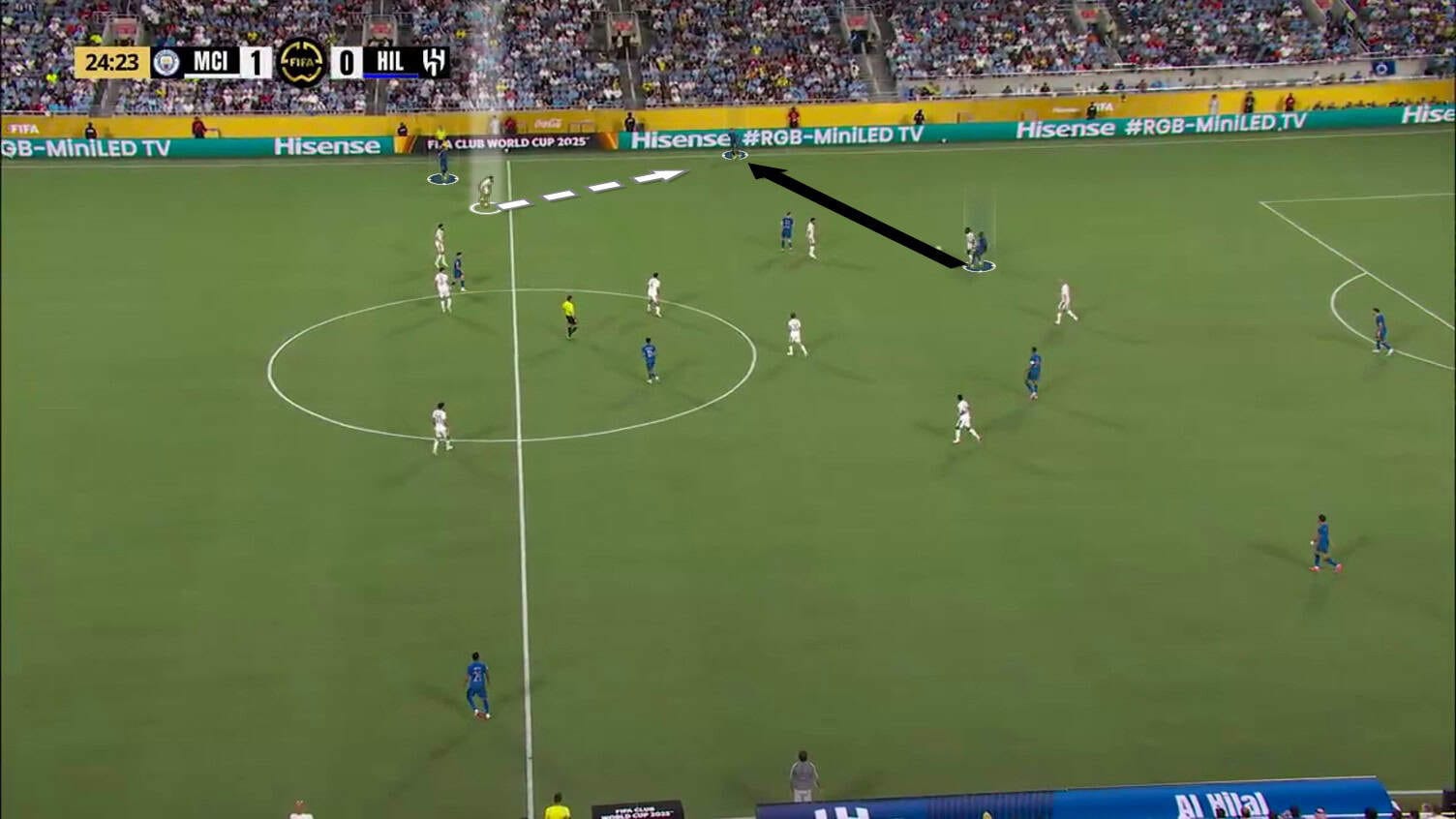
This caused Manchester City’s full-back to press the ball, leaving his mark in the wide area.
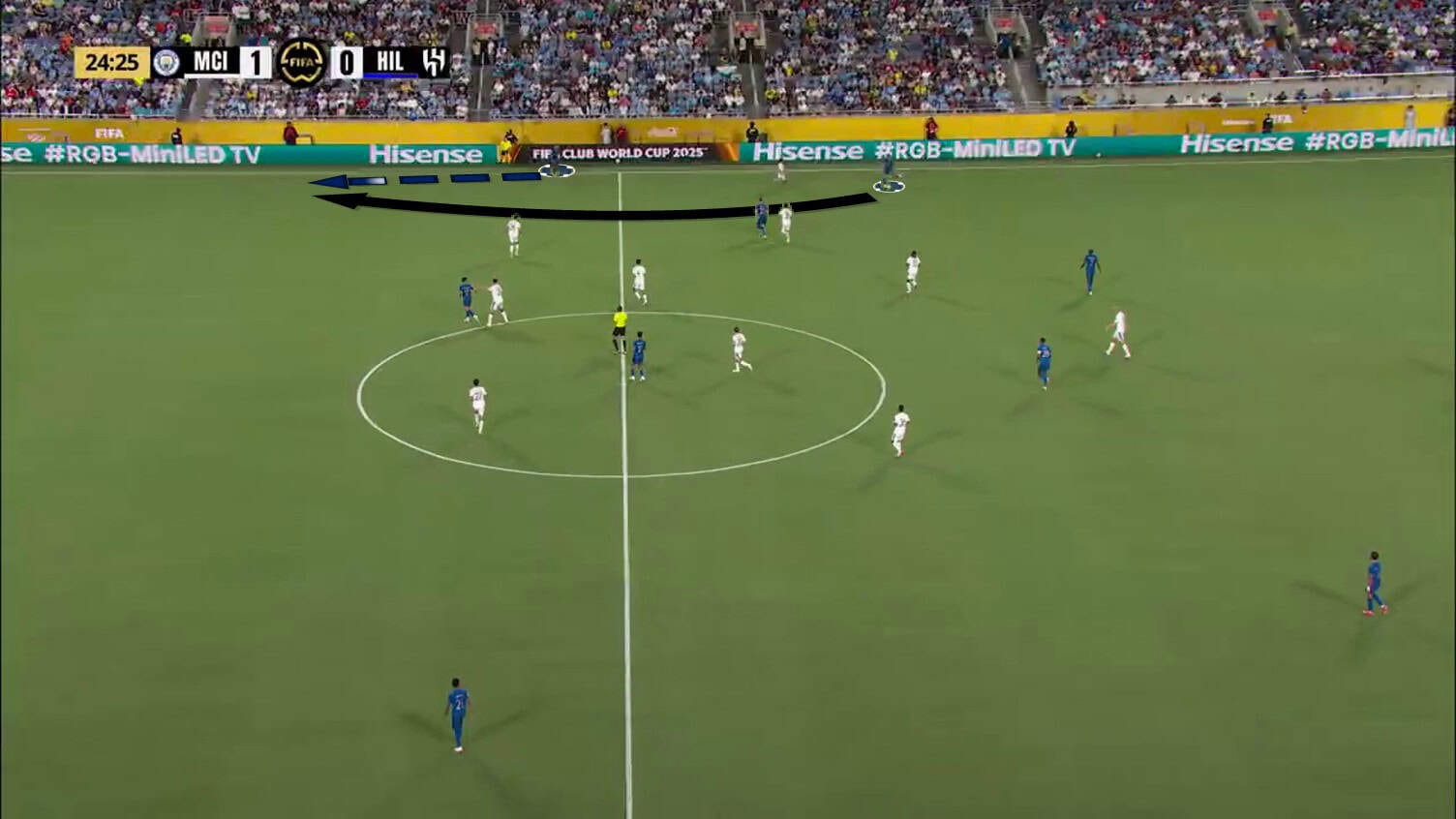
This left the wide player free to receive a ball from the left-wing back alone.
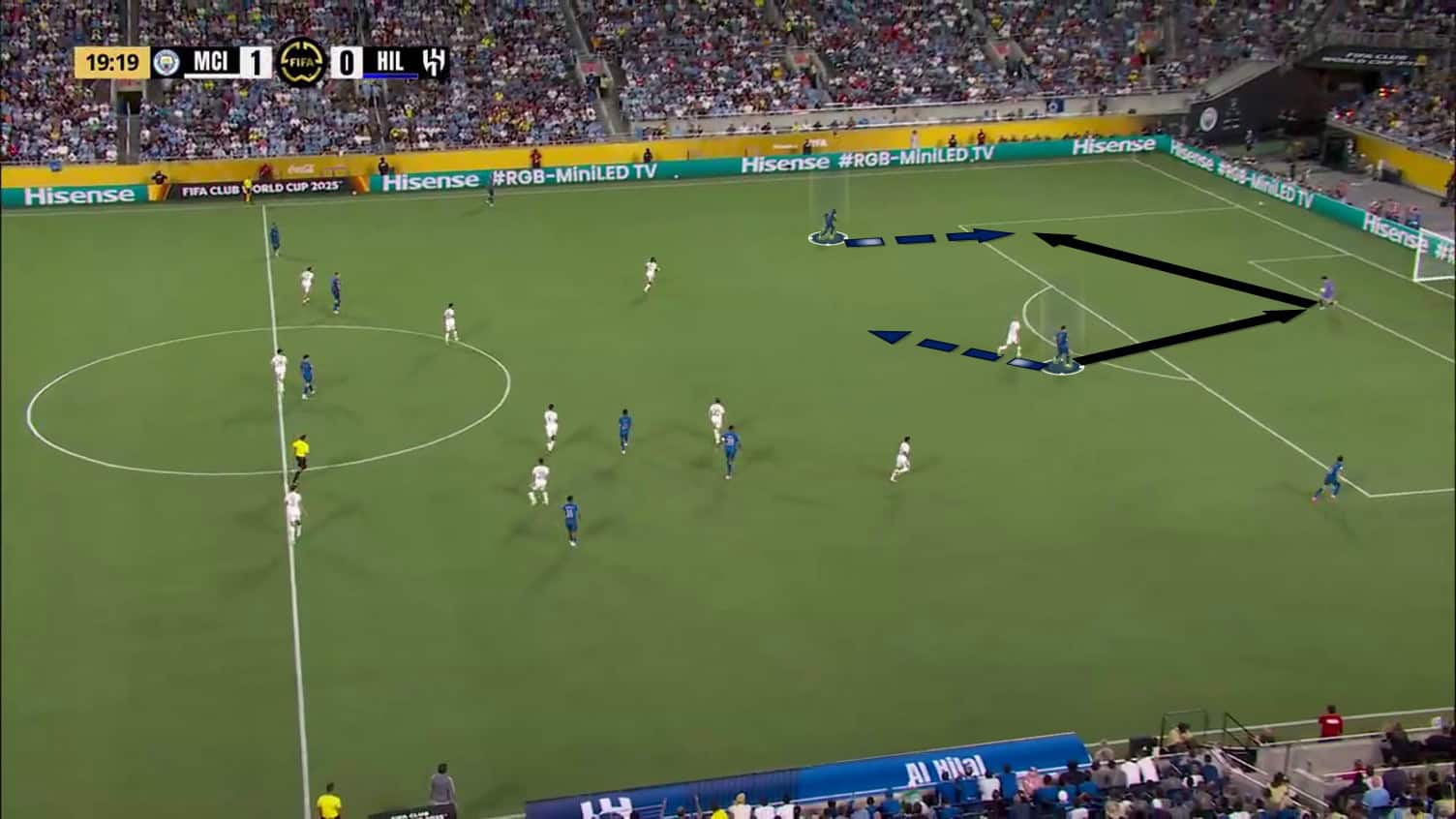
Another tactic used was for the ball to be played back to the goalkeeper, and Haaland to leave the central centre-back to press him.
The side centre-back would then drop low to receive.
This took the defender far enough away from City’s winger that he could receive facing forward.
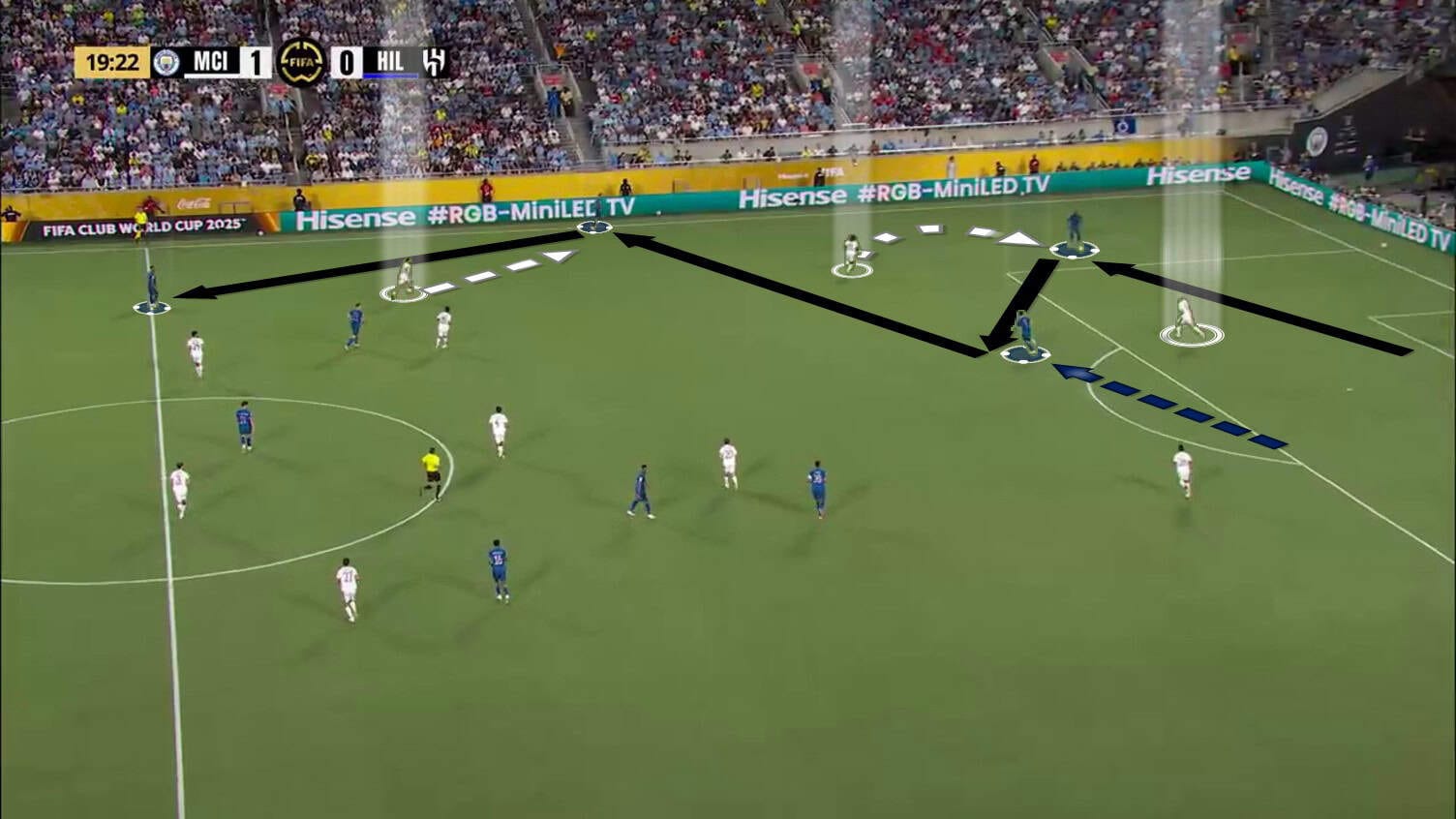
As the ball travelled wide, the central centre-back moved behind Haaland to receive the ball alone in a pocket behind the forwards.
This had the knock-on effect of causing City’s left-back to jump to the wing-back, and Al Hilal's most advanced wide player to be left alone again.
Coaching Pressing In A 4-3-3
The following two exercises will be incorporated into the warm-up for sessions focused on the high pressing phase.
They are designed to prepare players physically while also addressing the individual technical aspects and team tactical elements of various pressing structures.
Whilst they are designed for separate elements of the pressing phase, they could be used sequentially, preparing players to press both teams down one side of the pitch and man-marking those closest to the ball.
Pressing Down One-Side Activation
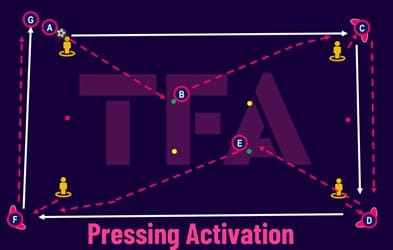
The above passing exercise works specifically on forward pressing teams to one side.
Player ‘A’ begins the sequence with a firm pass to player ‘C’.
‘C’ moves off the mannequin or cone to receive at an angle before passing to ‘D’.
This continues with the ball constantly being rotated around the outside of the rectangle.
When the ball is played down the long side of the area, the players in the middle, shown as ‘B’ and ‘E’, press the receiving player by sprinting at their inside leg.
The press should be initiated as soon as the ball is released.
The pressing player should run at as high an intensity as possible, but not steal the ball to allow the drill to flow.
Players ‘A’ then becomes the pressing player, ‘B’ the receiving player and so on.
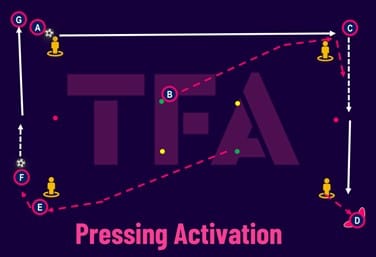
A progression to this pressing exercise is for the receiving players to dribble with the ball to around halfway towards the next player while still being pressed before releasing the ball.
This allows forwards to work on the scenario analysed above, with Al Hilal’s centre-backs driving forwards with the ball beyond the pressing wingers.
Using the yellow markers to position the pressing players, the drill can be repeated in the opposite direction.
Man-To-Man Warm-Up
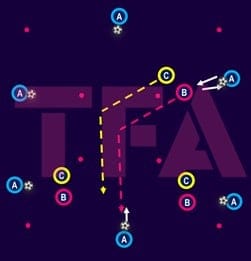
The above exercise is designed to hone the player’s ability to press man-to-man, as PSG’s central midfielders do.
The players should be split into two groups of even numbers.
As shown above, Group A is distributed evenly around the outside of the large square or rectangle, each with a ball in their hands.
The second group is then put into pairs, shown as ‘B’ and ‘C’ above, with one player serving as a chaser.
The goal of the inside players, starting with the ‘B’s, is to run through the smaller central square before receiving a thrown ball in their hands.
They must catch the ball and return it without the chasing player ‘tagging’ them with the ball in their hands.
If the chaser does manage to get close enough to tag the receiving player, their roles switch.
This can progress to the chased players receiving the ball with their feet and, if they have created enough separation, turning out to pass to another side player.
How To Work On Pressing Within A Small-Sided Game
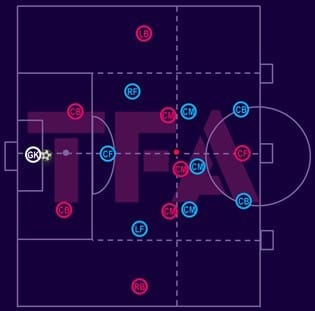
When implementing a pressing strategy, dividing pitches into zones can help guide players on when and where to press.
This game of nine (with a goalkeeper) against eight is played on a half-pitch, divided into four vertical zones and two horizontal zones.
The aim of the attacking team, shown as pink, is to build the play from their goalkeeper and score into one of the three small-sided goals on the halfway line.
To make the game as realistic as possible in an 11v11 scenario, the attacking team's full-backs are restricted to the wide zones, and their striker must stay central and in the final zone.
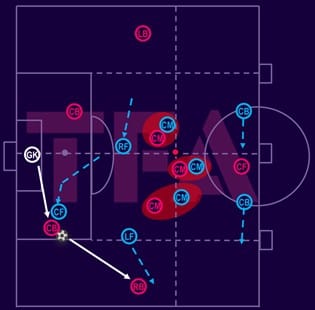
The play should start with the attacking team's goalkeeper playing out to either one of their centre-backs.
Using the central line of the pitch as a starting point, the striker should press intensely with the same angle as worked on in the passing exercise.
The pressing team's aim should be to keep the pinks going down that side of the pitch, ensuring the ball does not cross back over the central dividing line.
If a man-to-man system is implemented in central midfield, as seen in PSG, the blue midfielders should closely track their opposite number.
The ball-near winger should protect the half-space whilst maintaining a body shape that allows them to sprint to the full-back should they receive the ball.
This sprinting action should be underneath the full-back to prevent them from progressing forward.
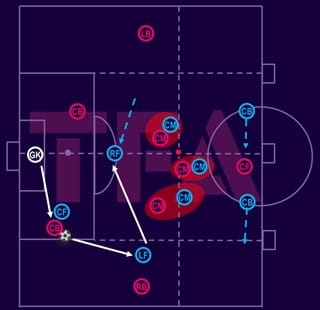
The ball-far winger should tuck in, but no further than the central dividing line to ensure the team remains balanced.
Should the blue team recover the ball, the aim should be to find this spare player immediately.
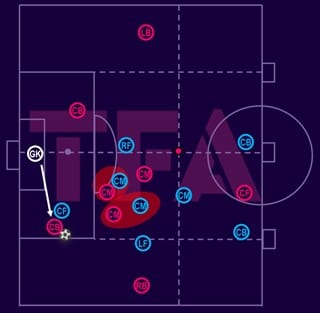
To avoid situations similar to the one PSG found themselves in against Chelsea, where all three midfielders pressed tightly and were dragged high and close together, a condition to the game can be introduced: at least one central midfielder must stay goal-side of the dashed line running across the pitch.