
![Argentina Vs Switzerland [3–1 AET] – FIFA World Cup 2026: How Murat Yakin Tactics Gave The Champions Another Scare – Tactical Analysis](https://cdn.mymidnight.blog/77f959f119f4fb2321e9ce801e2f5163/size/w1000/2026/07/Argentina-Vs--Switzerland-World-Cup-2026-1.png)
Argentina Vs Switzerland [3–1 AET] – FIFA World Cup 2026: How Murat Yakin Tactics Gave The Champions Another Scare – Tactical Analysis
Argentina secured their place in the semifinals of the 2026 FIFA World Cup after defeating Switzerland 3-1 following extra time in a fiercely contested quarter-final.

Argentina Vs Switzerland World Cup 2026 Match Overview
Argentina secured their place in the semifinals of the 2026 FIFA World Cup after defeating Switzerland 3-1 following extra time in a fiercely contested quarter-final.
Alexis Mac Allister gave Argentina an early lead in the tenth minute before Dan Ndoye restored parity with a 65th-minute equaliser.
Switzerland's task became significantly harder just four minutes later when Breel Embolo was shown a second yellow card and sent off.
Despite their numerical advantage, Argentina had to wait until the 112th minute to regain the lead through Julián Álvarez.
As Switzerland pushed forward in search of another equaliser, Lautaro Martínez sealed the victory with a goal in the dying embers of the game.
This World Cup tactical analysis examines how Argentina and Switzerland approached the game both in and out of possession.
It also breaks down the well-worked set-piece that led to Argentina's opening goal before examining how Switzerland found ways to break through Argentina's deep defensive block and create their equaliser.
Argentina Vs Switzerland Lineups & Formations
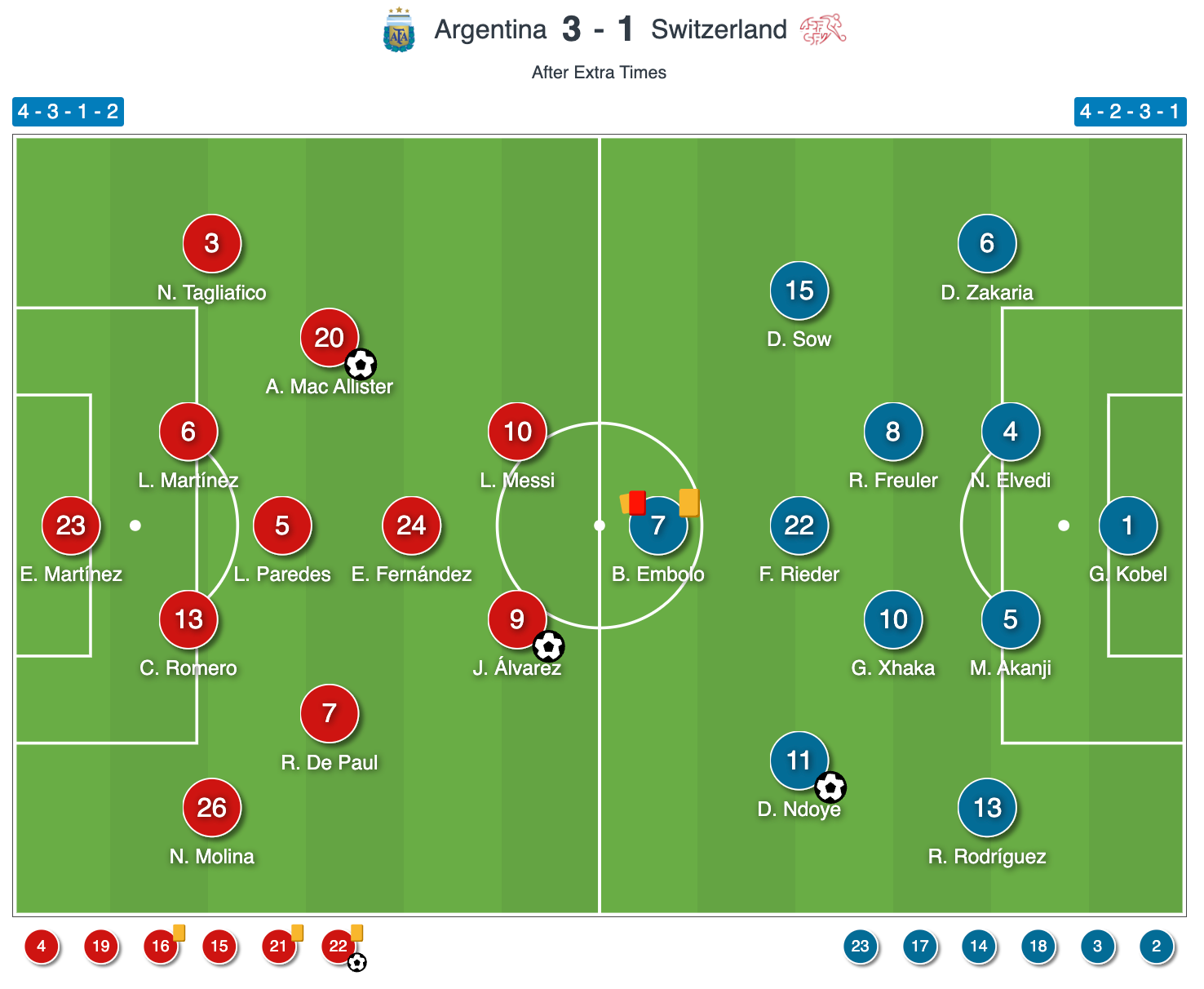
Argentina Lineup Vs Switzerland
Argentina named an unchanged starting XI from their victory over Egypt.
Emiliano Martínez retained his place in goal behind a back four of Nicolás Tagliafico, Lisandro Martínez, Cristian Romero and Nahuel Molina.
Lionel Scaloni once again opted for a midfield diamond, with Leandro Paredes operating at the base, Mac Allister and Rodrigo De Paul providing support on either side, and Enzo Fernández playing at the tip.
Up front, Lionel Messi partnered with Álvarez as Argentina looked to combine control in possession with attacking fluidity.
Switzerland Lineup Vs Argentina
Switzerland made just one change from the side that defeated Colombia, with Djibril Sow replacing Ardon Jashari.
Murat Yakin also altered his tactical setup, moving away from the 4-3-3 used previously and adopting a 4-2-3-1 system.
Gregor Kobel started in goal behind a defence of Ricardo Rodríguez, Manuel Akanji, Nico Elvedi and Denis Zakaria.
Granit Xhaka and Remo Freuler formed the double pivot, while Ndoye, Fabian Rieder and Sow supported Embolo in attack.
Argentina In Possession Tactics
Argentina's build-up structure was generally based around a 2 plus 2 shape in possession.
The two central defenders split wide to stretch Switzerland's first line of pressure, while the full-backs advanced into wider positions to provide passing options and improve the team's ability to progress through the thirds.
However, Lionel Scaloni's side did not follow this structure rigidly, instead showing the positional flexibility that has become a hallmark of their play.
Whenever Switzerland committed players forward to press high, Paredes regularly dropped deeper to support the first phase of build-up to improve Argentina's numerical superiority against the Swiss press.
Argentina's primary objective in possession was to overload the space between Switzerland's second and third defensive lines.
Messi was given complete positional freedom to drift into whichever pockets of space appeared, making him extremely difficult to track.
Rather than remaining alongside Álvarez, Messi constantly searched for spaces between the midfield and defence where he could receive on the half-turn and immediately threaten the Swiss backline.
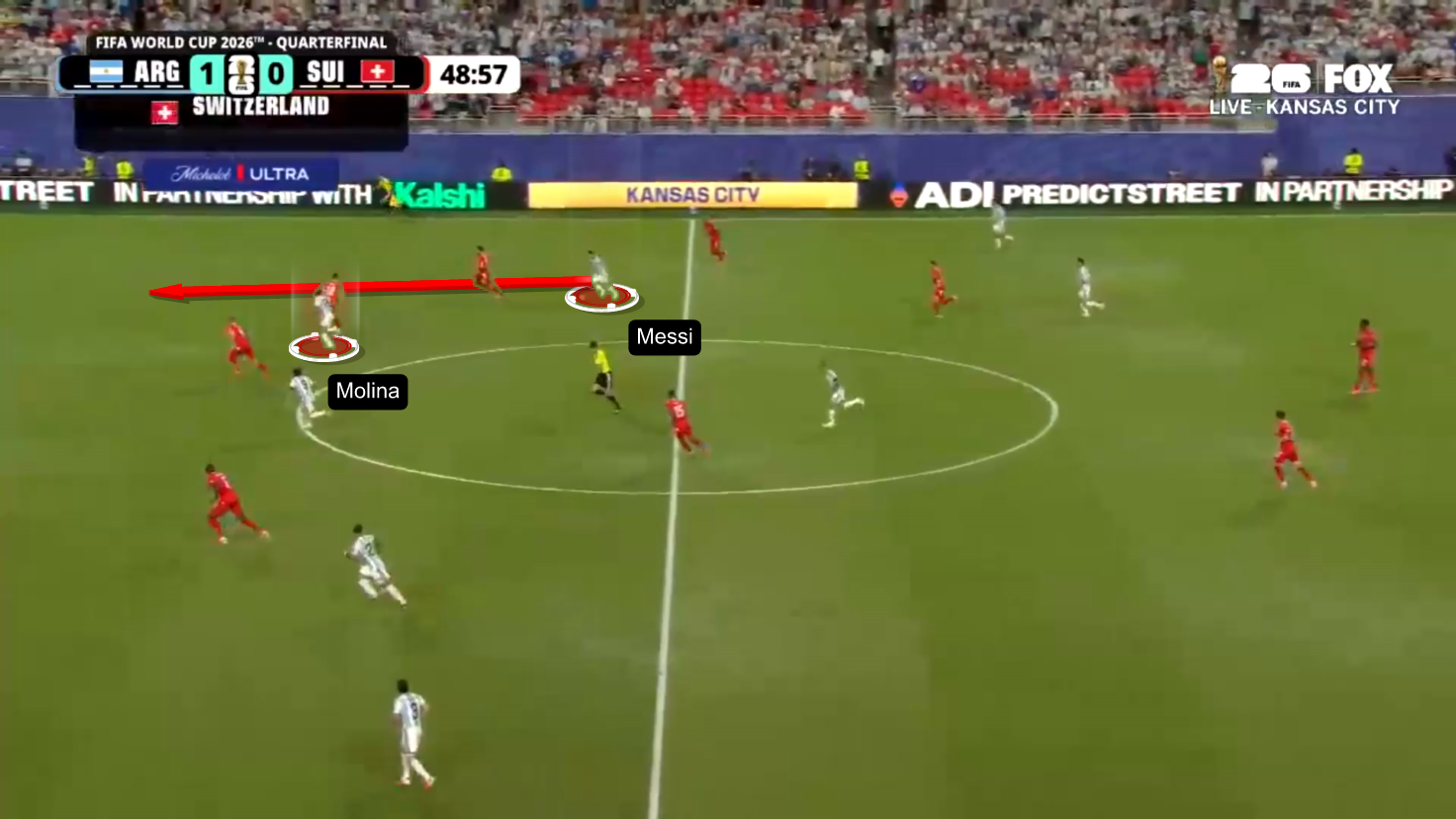
An example of this is when Messi received between the second and third lines, he turned quickly and played a pass into the path of Molina, whose well-timed forward runs from deeper positions exploited the spaces left by Switzerland's shifting defensive block, as seen in Figure 1.
Meanwhile, Álvarez complemented Messi's movements by repeatedly dropping into midfield.
His deeper positioning disrupted Switzerland's man-oriented pressing structure, forcing defenders and midfielders into difficult decisions over whether to follow him or maintain their positions.
Another important feature of Argentina's possession play was their ability to tilt attacks towards one side of the pitch, as seen in Figure 2.
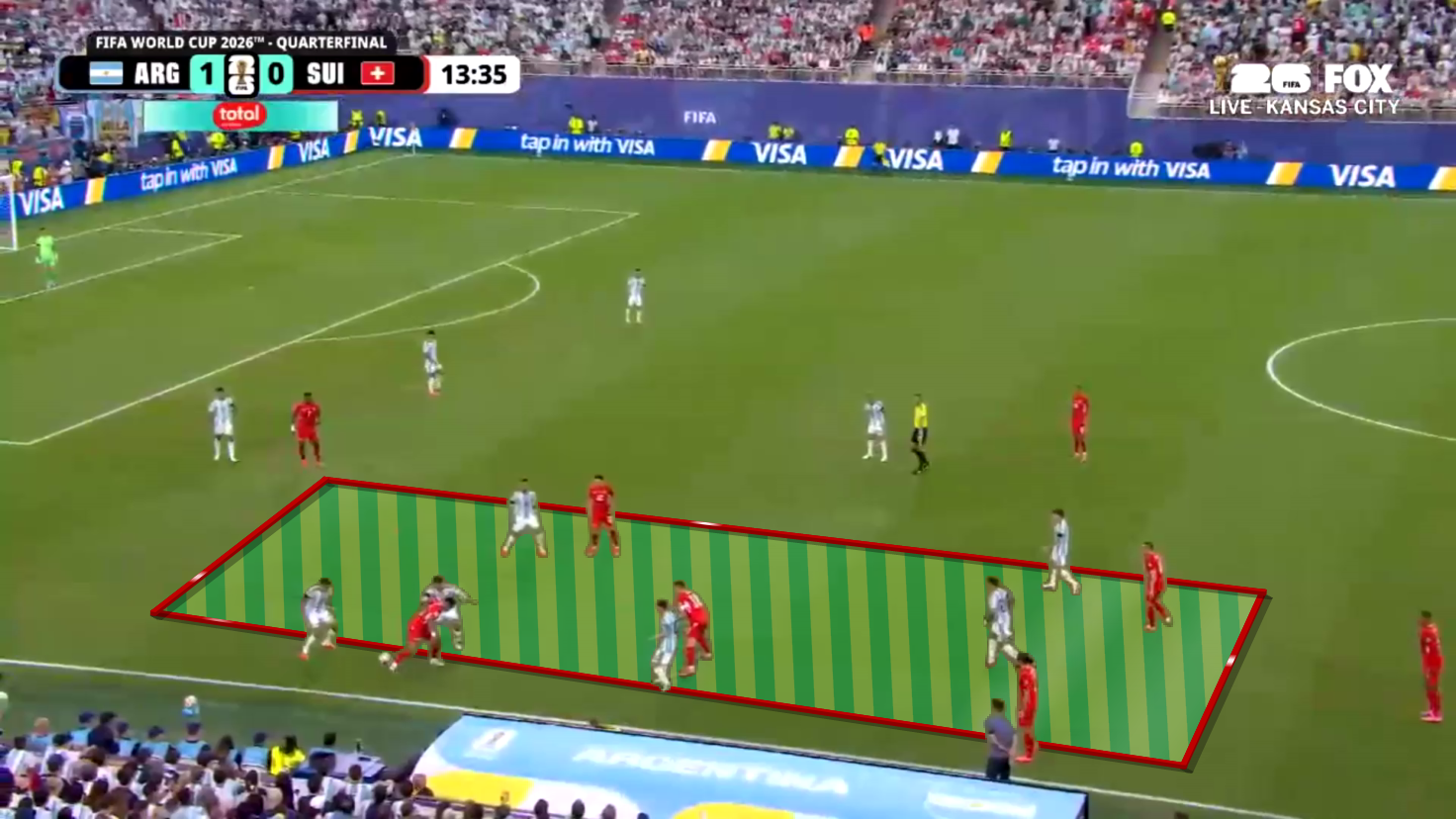
By deliberately attracting Switzerland's press into one area, they created space elsewhere.
Argentina Out Of Possession Tactics
Argentina defended in an asymmetric 4-2-3-1 shape whenever they were out of possession.
Rather than engaging in an aggressive high press, Scaloni's side prioritised defensive compactness and organisation.
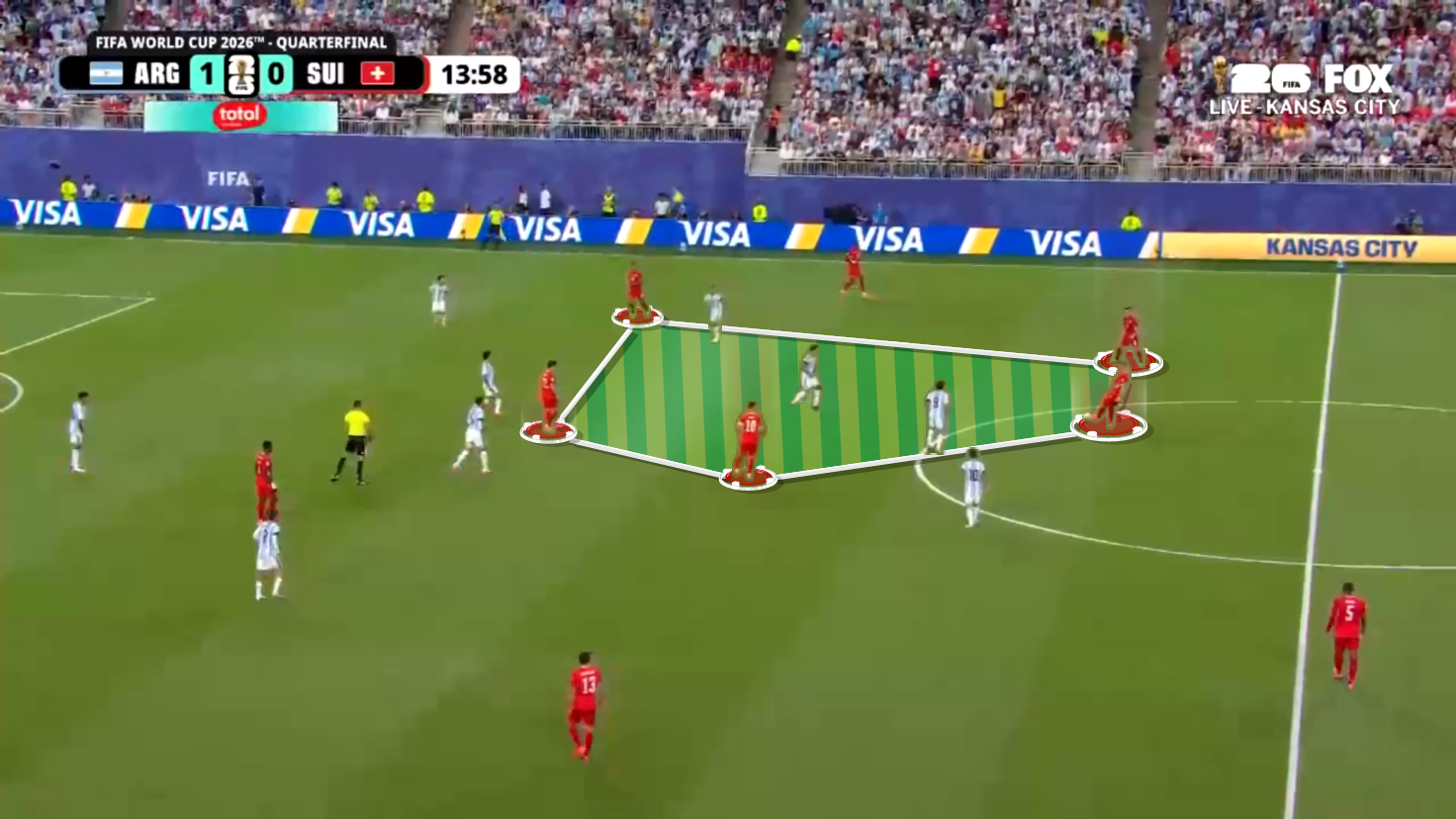
Their narrow shape ensured the central areas remained well protected, making it extremely difficult for Switzerland to progress through midfield or find passing lanes into the forward, as seen in Figure 3.
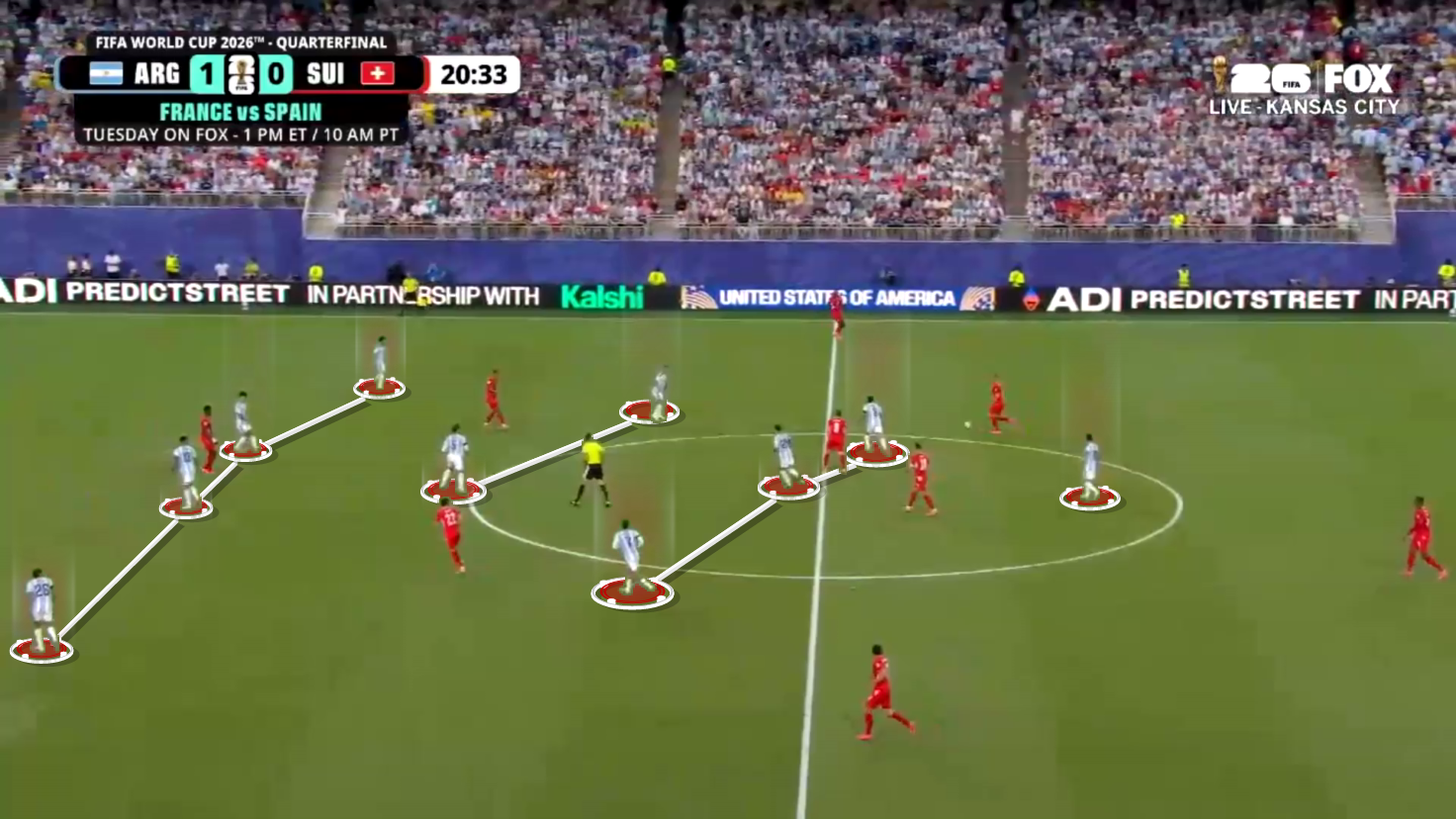
By congesting the middle of the pitch, Argentina forced their opponents to move possession towards the flanks, where they believed they could control the situation more effectively.
Once Switzerland shifted the ball into wide areas, Argentina reacted collectively to create numerical superiority around the ball.
Their compact movement allowed them to establish four versus three overloads near the touchline, limiting the ball carrier's options while cutting off nearby passing lanes.
This approach reduced Switzerland's ability to create sustained attacks from wide positions and frequently forced turnovers, providing Argentina with opportunities to launch quick transitions after regaining possession.
Switzerland In Possession Tactics
In possession, Switzerland alternated between a 3-4-2-1 and a 3-2-4-1 structure depending on the phase of play.
Their flexible positioning allowed them to create a stable rest defence while committing numbers forward during sustained attacks.
A key feature of Switzerland's attacking play was the movement of the wide players.
Rather than remaining on the touchline, the wingers regularly drifted into the half-spaces and central areas.
Their inward movement created space for the full-backs to make overlapping runs, stretching Argentina's defensive shape horizontally and providing width in advanced areas.
Switzerland also sought to create ball side overloads, particularly in wide areas.
By committing several players around the ball, they attempted to combine through short passes and rotations before progressing into the final third, as seen in Figure 4.
![Borussia Dortmund Vs Werder Bremen [2-2] Bundesliga 2026/2027: How Daniel Thioune Tactics Earned A Late Comeback With 29% Possession - Tactical Analysis](https://cdn.mymidnight.blog/77f959f119f4fb2321e9ce801e2f5163/size/w600/2026/10/Borussia-Dortmund-vs-Werder-Bremen---Tactical-Analysis.png)
![Croatia Vs Spain [1-2] UEFA Nations League 2026/2027: How Slaven Bilić High Pressing Tactics Troubled Spain - Tactical Analysis](https://cdn.mymidnight.blog/77f959f119f4fb2321e9ce801e2f5163/size/w600/2026/10/Croatia-Vs-Spain--1-2--UEFA-Nations-League-20262027---Tactical-Analysis.png)

![Scotland Vs Switzerland [0-3] UEFA Nations League 2026/2027: How Aggressive Pressing Backfired & Murat Yakin Took Advantage - Tactical Analysis](https://cdn.mymidnight.blog/77f959f119f4fb2321e9ce801e2f5163/size/w600/2026/10/Scotland-Vs-Switzerland-20262027---Tactical-Analysis.png)
![Olympique De Marseille Vs PSG [1-2] Ligue 1 2026/2027: How Bruno Génésio Transitions Troubled PSG - Tactical Analysis](https://cdn.mymidnight.blog/77f959f119f4fb2321e9ce801e2f5163/size/w600/2026/09/Marseille-Vs-PSG-2026_2027---Tactical-Analysis.png)
![Fulham Vs Manchester United [1-1] Premier League 2026/2027: How Álvaro Arbeloa Tactics Exposed The Red Devils' Problems - Tactical Analysis](https://cdn.mymidnight.blog/77f959f119f4fb2321e9ce801e2f5163/size/w600/2026/09/Fulham-FC-Vs-Man-United-2026_2027---Tactical-Analysis.png)
![AS Roma Vs Inter Milan [2-2] Serie A 2026/2027: When Undefeated Giallorossi Attack Met Nerazzurri Comeback Resilience - Tactical Analysis](https://cdn.mymidnight.blog/77f959f119f4fb2321e9ce801e2f5163/size/w600/2026/09/AS-Roma-Vs-Inter-Milan-2026_2027---Tactical-Analysis.png)
![Real Sociedad Vs Bournemouth [1-2] Europa League 2026/2027: How Do Marco Rose Pressing Tactics Work? - Tactical Analysis](https://cdn.mymidnight.blog/77f959f119f4fb2321e9ce801e2f5163/size/w600/2026/09/Real-Sociedad-Vs-Bournemouth-20262027---Tactical-Analysis-1.png)