
![England Vs Norway [2–1 AET] – FIFA World Cup 2026: Thomas Tuchel Adjustments Decide The Tie – Tactical Analysis](https://cdn.mymidnight.blog/77f959f119f4fb2321e9ce801e2f5163/size/w1000/2026/07/Norway-Vs-England-World-Cup-2026.png)
England Vs Norway [2–1 AET] – FIFA World Cup 2026: Thomas Tuchel Adjustments Decide The Tie – Tactical Analysis
The strategic landscape of elite international football is defined by a team's capacity to modify its geometric orientation under intense pressure.

England Vs Norway World Cup 2026 Match Overview
The strategic landscape of elite international football is defined by a team's capacity to modify its geometric orientation under intense pressure.
Ståle Solbakken's highly organised Norway clashed with Thomas Tuchel's possession-heavy England in a match that provided a masterclass in modern knockout-stage warfare.
Both nations entered the encounter with deeply ingrained tactical identities.
England sought to assert absolute dominance through high-volume horizontal circulation and structural positional play.
Norway embraced a compact mid-block engineered to suffocate central penetration before launching explosive vertical transitions through their frontline.
The match developed into a complex, multi-phased tactical chess game that ultimately required extra time to find a definitive resolution.
The opening phase saw England establish complete control of the ball, yet their possession remained largely sterile as they struggled to convert territorial dominance into high-value opportunities.
As the first half progressed, Norway capitalised on structural fatigue within the English midfield, manipulating the space directly in front of the defensive line to seize the lead through Andreas Schjelderup.
However, the true narrative of the match was defined by England's profound tactical resilience and structural adjustments.
This World Cup tactical analysis examines how, led by a generational performance from Jude Bellingham, the Three Lions systematically altered their offensive mechanics, grinding down the Norwegian low block to secure a dramatic 2-1 comeback victory.
Norway Vs England Lineups & Formations
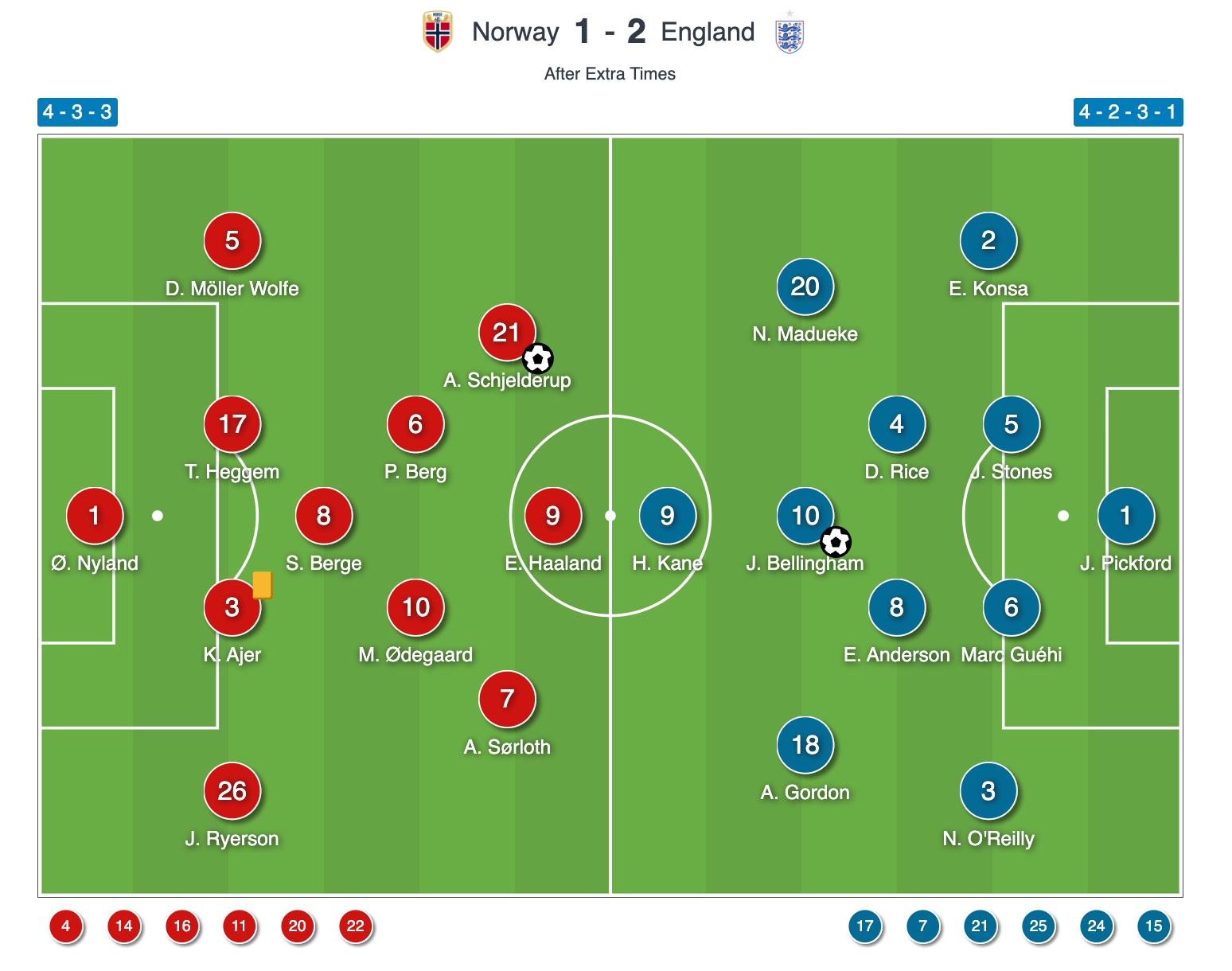
England Lineup Vs Norway
Thomas Tuchel organised England in a highly flexible 4-2-3-1 base alignment designed to morph fluidly into an asymmetric 3-2-5 or 2-3-5 configuration during sustained possession phases.
Jordan Pickford occupied his position between the posts, functioning as the vital sweeping anchor behind the defensive line.
The central defensive partnership featured John Stones and Marc Guéhi, a pairing selected for their elite combination of line-breaking distribution and physical duel capability in open space.
Following recent defensive injuries and suspensions, Ezri Konsa shifted from his natural central role to operate as a conservative right-back, while the young Nico O'Reilly was deployed as a positionally disciplined, inverted left-back.
The midfield engine room was anchored by a double pivot comprising Declan Rice and the energetic Elliot Anderson, tasked with protecting the rest of the defence and facilitating lateral ball circulation.
Out wide, Noni Madueke occupied the right wing, while Anthony Gordon patrolled the left flank, both maintaining natural touchline width to stretch the opponent.
Jude Bellingham operated as the advanced central playmaker, floating between the lines with total spatial freedom behind captain Harry Kane, who spearheaded the attack.
Norway Lineup Vs England
Ståle Solbakken countered by deploying Norway in a highly compact, structurally rigid 4-1-2-3 base system that compressed into a deeply resilient 4-5-1 defensive block out of possession.
Ørjan Nyland guarded the Norwegian goal, protected by a central defensive partnership consisting of Kristoffer Ajer and Torbjørn Heggem.
Julian Ryerson operated as a highly defensive right-back tasked with tracking Anthony Gordon, while David Møller Wolfe occupied the left-back position to handle the threat of Noni Madueke.
In the engine room, Patrick Berg anchored the base as the single defensive pivot, flanked by the tireless physical presence of Sander Berge and the elite technical leadership of captain Martin Ødegaard.
The forward line featured a highly dynamic, narrow attacking trident where Andreas Schjelderup operated from the left wing and Alexander Sørloth occupied the right interior channel.
Erling Haaland spearheaded the lineup as the isolated lone striker, a physical profile selected specifically to pin Englands center-backs and offer an immediate vertical outlet for direct transitions.
Sterile Dominance: England's Possession Control & Final-Third Sterility
The opening 30 minutes of the match established a definitive tactical pattern that perfectly illustrated the contemporary dilemma of possession-based football against a disciplined mid-block.
England completely dominated the structural metrics, recording high volume possession and executing long sequences of horizontal circulation across their backline.
John Stones and Marc Guéhi were permitted absolute freedom to advance to the halfway line, operating with comfortable time and space as Norway's front three consciously refrained from initiating an aggressive press.
Tuchel's offensive blueprint relied heavily on the full-backs creating interior overloads to unbalance the opposition.
![Borussia Dortmund Vs Werder Bremen [2-2] Bundesliga 2026/2027: How Daniel Thioune Tactics Earned A Late Comeback With 29% Possession - Tactical Analysis](https://cdn.mymidnight.blog/77f959f119f4fb2321e9ce801e2f5163/size/w600/2026/10/Borussia-Dortmund-vs-Werder-Bremen---Tactical-Analysis.png)
![Croatia Vs Spain [1-2] UEFA Nations League 2026/2027: How Slaven Bilić High Pressing Tactics Troubled Spain - Tactical Analysis](https://cdn.mymidnight.blog/77f959f119f4fb2321e9ce801e2f5163/size/w600/2026/10/Croatia-Vs-Spain--1-2--UEFA-Nations-League-20262027---Tactical-Analysis.png)
![Scotland Vs Switzerland [0-3] UEFA Nations League 2026/2027: How Aggressive Pressing Backfired & Murat Yakin Took Advantage - Tactical Analysis](https://cdn.mymidnight.blog/77f959f119f4fb2321e9ce801e2f5163/size/w600/2026/10/Scotland-Vs-Switzerland-20262027---Tactical-Analysis.png)
![Olympique De Marseille Vs PSG [1-2] Ligue 1 2026/2027: How Bruno Génésio Transitions Troubled PSG - Tactical Analysis](https://cdn.mymidnight.blog/77f959f119f4fb2321e9ce801e2f5163/size/w600/2026/09/Marseille-Vs-PSG-2026_2027---Tactical-Analysis.png)
![Fulham Vs Manchester United [1-1] Premier League 2026/2027: How Álvaro Arbeloa Tactics Exposed The Red Devils' Problems - Tactical Analysis](https://cdn.mymidnight.blog/77f959f119f4fb2321e9ce801e2f5163/size/w600/2026/09/Fulham-FC-Vs-Man-United-2026_2027---Tactical-Analysis.png)
![AS Roma Vs Inter Milan [2-2] Serie A 2026/2027: When Undefeated Giallorossi Attack Met Nerazzurri Comeback Resilience - Tactical Analysis](https://cdn.mymidnight.blog/77f959f119f4fb2321e9ce801e2f5163/size/w600/2026/09/AS-Roma-Vs-Inter-Milan-2026_2027---Tactical-Analysis.png)
![Real Sociedad Vs Bournemouth [1-2] Europa League 2026/2027: How Do Marco Rose Pressing Tactics Work? - Tactical Analysis](https://cdn.mymidnight.blog/77f959f119f4fb2321e9ce801e2f5163/size/w600/2026/09/Real-Sociedad-Vs-Bournemouth-20262027---Tactical-Analysis-1.png)