
![Spain Vs Belgium [2–1] – FIFA World Cup 2026: How Mikel Merino Solved Luis De La Fuente's Biggest Problem – Tactical Analysis](https://cdn.mymidnight.blog/77f959f119f4fb2321e9ce801e2f5163/size/w1000/2026/07/Spain-Vs-Belgium-World-Cup-2026-1.png)
Spain Vs Belgium [2–1] – FIFA World Cup 2026: How Mikel Merino Solved Luis De La Fuente's Biggest Problem – Tactical Analysis
Spain reached the 2026 FIFA World Cup semi-finals after beating Belgium 2-1, although Luis de la Fuente’s side needed another decisive late contribution from Mikel Merino. Spain controlled most of the quarter-final through possession, territory and sustained pressure.

Spain Vs Belgium World Cup 2026 Match Overview
Spain reached the 2026 FIFA World Cup semi-finals after beating Belgium 2-1, although Luis de la Fuente’s side needed another decisive late contribution from Mikel Merino.
Spain controlled most of the quarter-final through possession, territory and sustained pressure.
They registered 17 shots to Belgium’s five, eight efforts on target to two and generated just over two expected goals, while keeping their opponents below 0.5 xG.
However, this World Cup tactical analysis shows that Spain’s superiority did not always translate into a fluid attacking performance.
Pau Cubarsí and Rodri progressed the ball consistently, while the right-sided relationship between Pedro Porro and Lamine Yamal caused Belgium repeated problems.
Nevertheless, Belgium’s compact defensive structure restricted central access, and Spain sometimes lacked a player occupying the centre-backs inside the penalty area.
Merino’s introduction corrected that weakness and ultimately decided the match.
Spain Vs Belgium Lineups & Formations
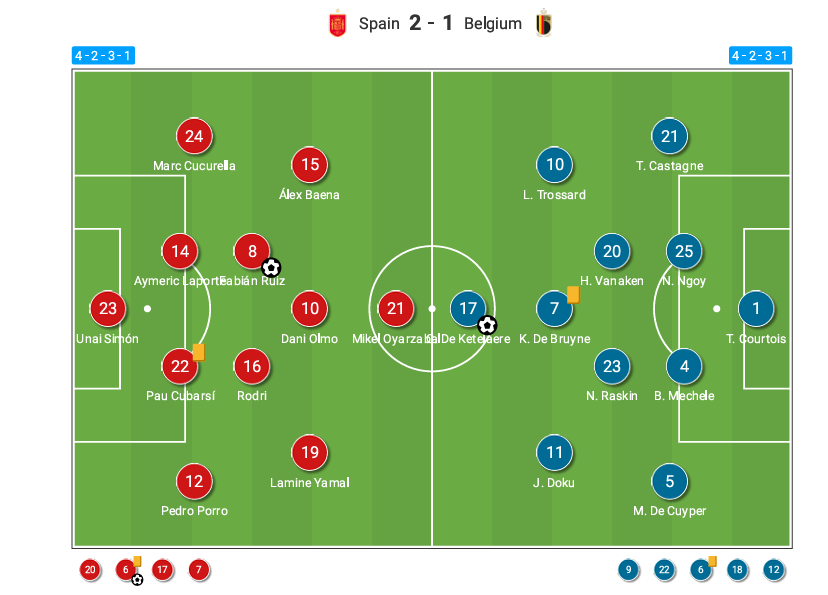
Spain Lineup Vs Belgium
Spain started in their usual 4-2-3-1 formation.
Unai Simón was protected by a back four of Pedro Porro, Pau Cubarsí, Aymeric Laporte and Marc Cucurella.
Rodri and Fabián Ruiz formed the double pivot, although their roles were not identical.
Rodri remained as the main reference in the first phase of possession, while Fabián operated higher and was encouraged to make forward runs beyond Belgium’s midfield line.
Dani Olmo played as the No. 10, with Lamine Yamal on the right, Álex Baena on the left and Mikel Oyarzabal leading the attack.
Fabián’s inclusion ahead of Pedri was significant.
Luis de la Fuente appeared to want an additional runner from midfield, as well as more physical presence around Rodri.
His ability to move beyond the ball was particularly important against a compact Belgian block and eventually led to Spain’s opening goal.
Belgium Lineup Vs Spain
Belgium also started in a 4-2-3-1 formation.
Thibaut Courtois was protected by a back four of Timothy Castagne, Nathan Ngoy, Brandon Mechele and Maxim De Cuyper.
Hans Vanaken and Nicolas Raskin formed the midfield base, while Kevin De Bruyne operated as the No. 10.
Leandro Trossard started on the left, with Jérémy Doku on the right, while Charles De Ketelaere played as the centre-forward.
Out of possession, Belgium’s 4-2-3-1 often became a compact 4-4-1-1.
Vanaken and Raskin protected the central corridor, while De Bruyne remained close to De Ketelaere and looked to screen passes into Rodri.
Belgium did not press Spain aggressively for long periods.
Instead, they prioritised central compactness, tried to force Spain towards the wings and prepared to attack quickly after regaining possession, mainly through Doku’s ball-carrying and De Bruyne’s passing between the lines.
Spain Build-Up Through Pau Cubarsí & Rodri
Belgium did not apply constant high pressure, but they occasionally used selective, man-oriented jumps to disrupt Spain’s short build-up.
De Ketelaere led the first line, while the nearby midfielders moved towards Rodri and Spain’s advanced central players whenever the ball travelled towards one side.
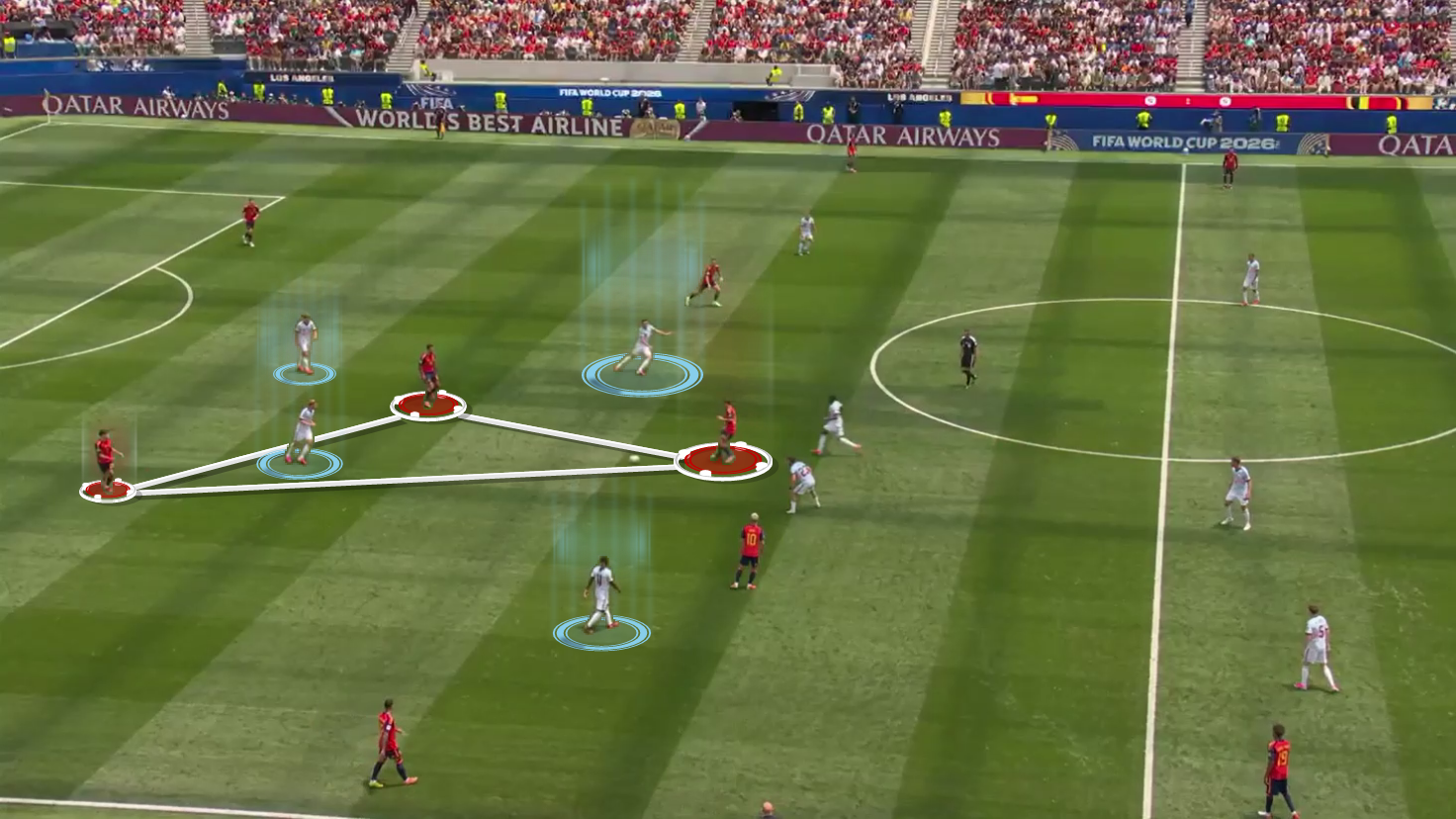
The sequence below shows how Spain responded to that pressure.
As the ball was played towards the left-sided centre-back, Belgium’s centre-forward moved across to close him down, while another opponent stayed close to Rodri.
Rather than remaining in a fixed position, Rodri dropped towards the ball-side half-space and created a short passing triangle with the centre-backs.
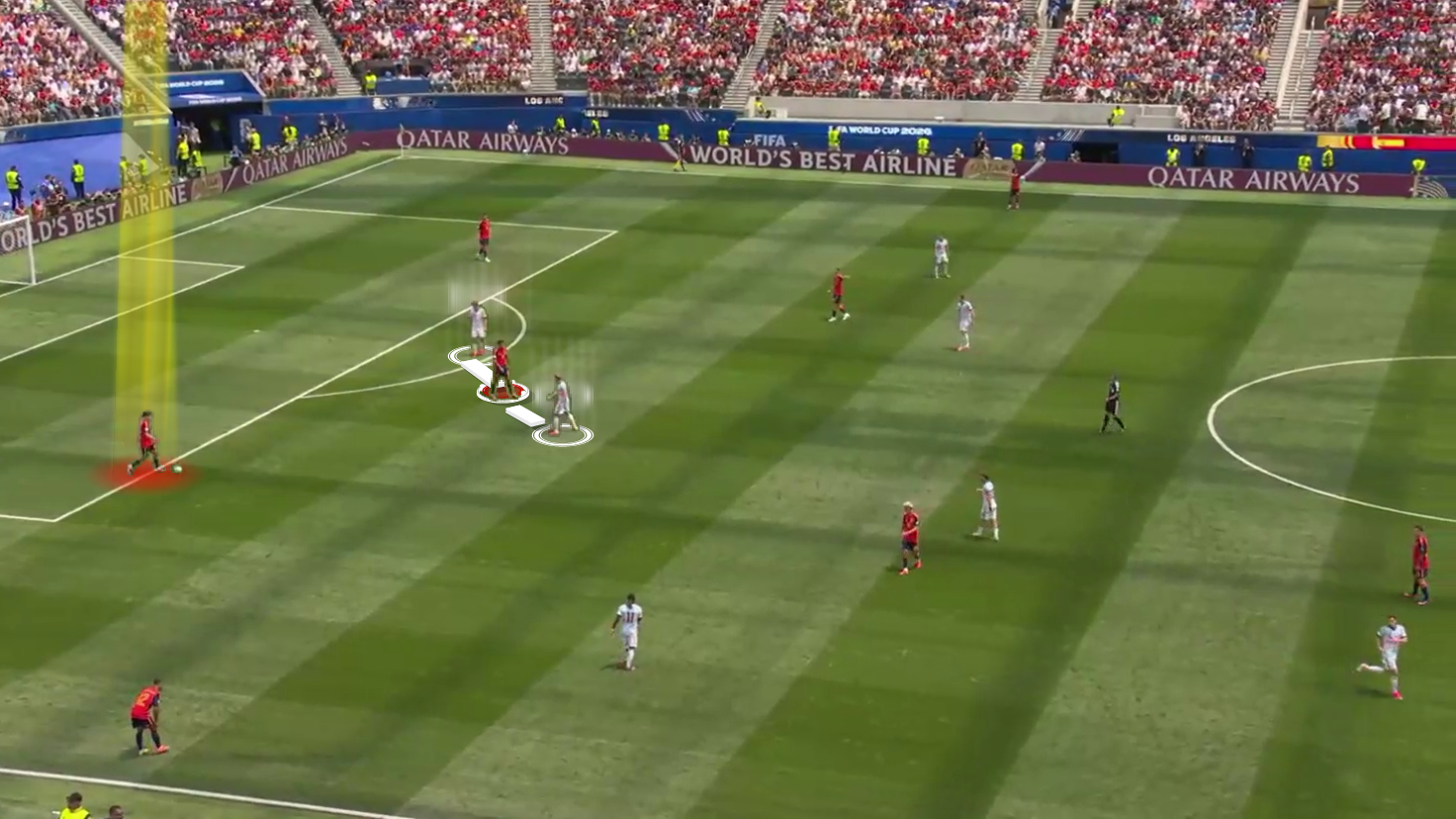
Belgium close the short build-up options and prepare to press Spain near their own penalty area.
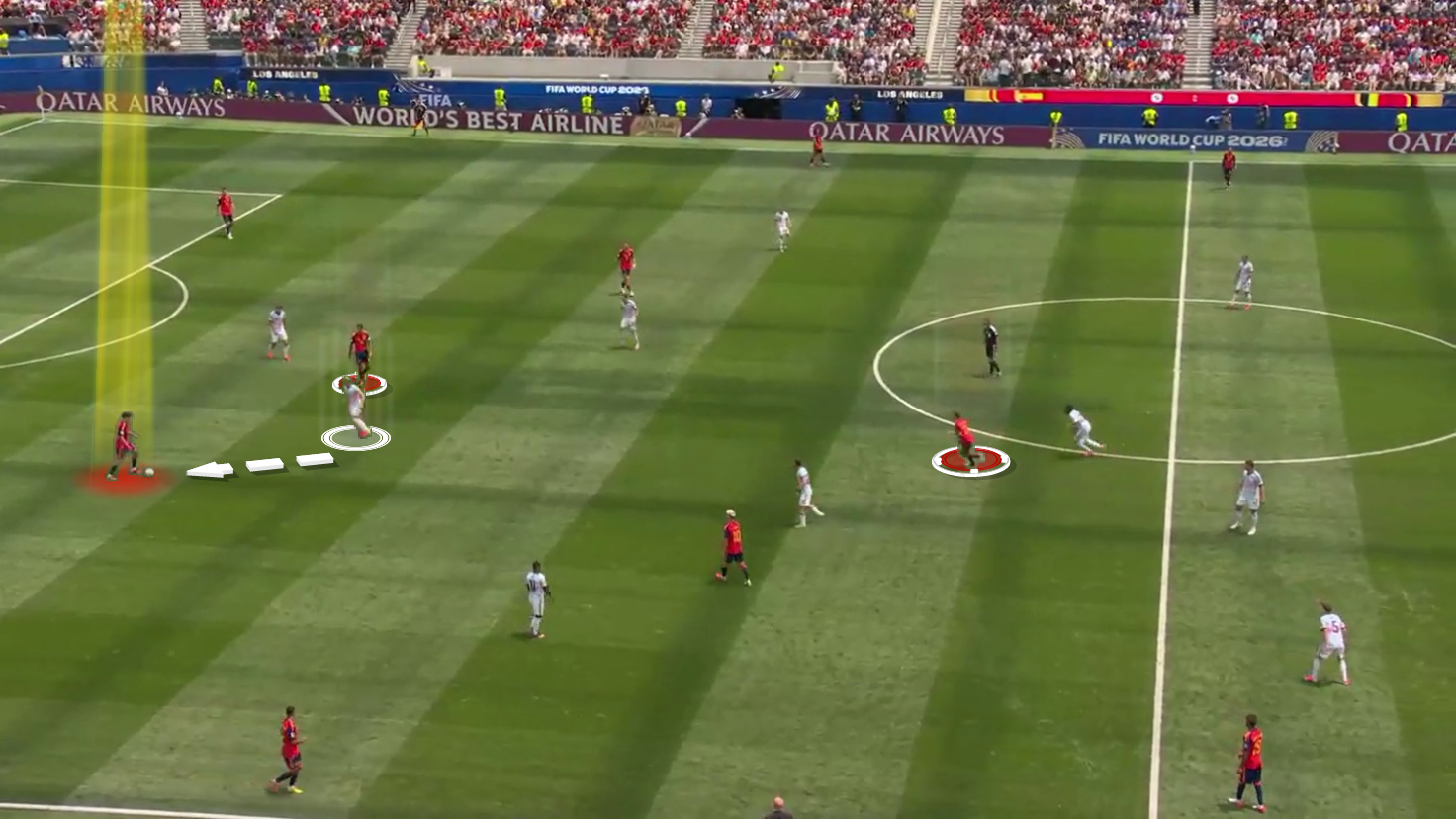
The Belgian forward jumps towards the ball-side centre-back, while Rodri moves closer to provide a supporting passing lane.
![Borussia Dortmund Vs Werder Bremen [2-2] Bundesliga 2026/2027: How Daniel Thioune Tactics Earned A Late Comeback With 29% Possession - Tactical Analysis](https://cdn.mymidnight.blog/77f959f119f4fb2321e9ce801e2f5163/size/w600/2026/10/Borussia-Dortmund-vs-Werder-Bremen---Tactical-Analysis.png)
![Croatia Vs Spain [1-2] UEFA Nations League 2026/2027: How Slaven Bilić High Pressing Tactics Troubled Spain - Tactical Analysis](https://cdn.mymidnight.blog/77f959f119f4fb2321e9ce801e2f5163/size/w600/2026/10/Croatia-Vs-Spain--1-2--UEFA-Nations-League-20262027---Tactical-Analysis.png)

![Scotland Vs Switzerland [0-3] UEFA Nations League 2026/2027: How Aggressive Pressing Backfired & Murat Yakin Took Advantage - Tactical Analysis](https://cdn.mymidnight.blog/77f959f119f4fb2321e9ce801e2f5163/size/w600/2026/10/Scotland-Vs-Switzerland-20262027---Tactical-Analysis.png)
![Olympique De Marseille Vs PSG [1-2] Ligue 1 2026/2027: How Bruno Génésio Transitions Troubled PSG - Tactical Analysis](https://cdn.mymidnight.blog/77f959f119f4fb2321e9ce801e2f5163/size/w600/2026/09/Marseille-Vs-PSG-2026_2027---Tactical-Analysis.png)
![Fulham Vs Manchester United [1-1] Premier League 2026/2027: How Álvaro Arbeloa Tactics Exposed The Red Devils' Problems - Tactical Analysis](https://cdn.mymidnight.blog/77f959f119f4fb2321e9ce801e2f5163/size/w600/2026/09/Fulham-FC-Vs-Man-United-2026_2027---Tactical-Analysis.png)
![AS Roma Vs Inter Milan [2-2] Serie A 2026/2027: When Undefeated Giallorossi Attack Met Nerazzurri Comeback Resilience - Tactical Analysis](https://cdn.mymidnight.blog/77f959f119f4fb2321e9ce801e2f5163/size/w600/2026/09/AS-Roma-Vs-Inter-Milan-2026_2027---Tactical-Analysis.png)
![Real Sociedad Vs Bournemouth [1-2] Europa League 2026/2027: How Do Marco Rose Pressing Tactics Work? - Tactical Analysis](https://cdn.mymidnight.blog/77f959f119f4fb2321e9ce801e2f5163/size/w600/2026/09/Real-Sociedad-Vs-Bournemouth-20262027---Tactical-Analysis-1.png)