Daichi Kamada Scout Report At Crystal Palace & Japan 2026: The World Cup's In-Form Midfield Connector – Player Analysis

Crystal Palace midfielder Daichi Kamada has been making waves at the FIFA World Cup so far.
The 29-year-old has scored twice in Japan’s opening two games, first a late, crucial equaliser against the Netherlands, and then the opener in a 4-0 thrashing of Tunisia.
The central midfielder did not just pop up; rather, he has had a steady career progression in the 2020s.
He was one of the key players in Oliver Glasner’s UEFA Europa League victory with Eintracht Frankfurt in 2022, famously knocking out Barcelona in the quarter-final.
Kamada was then brought to Crystal Palace by Glasner, where he has lifted the FA Cup, the FA Community Shield, and the UEFA Conference League titles.
In this Daichi Kamada scout report and player analysis, we examine Daichi Kamada’s style of play in and out of possession and determine the types of teams where he would best represent a tactical fit.
Daichi Kamada Style Of Play In Possession
Kamada can operate in multiple areas of the pitch.
He helps his team in the build-up by operating outside the opponent's structure when the other midfielders are better suited to playing between the lines.
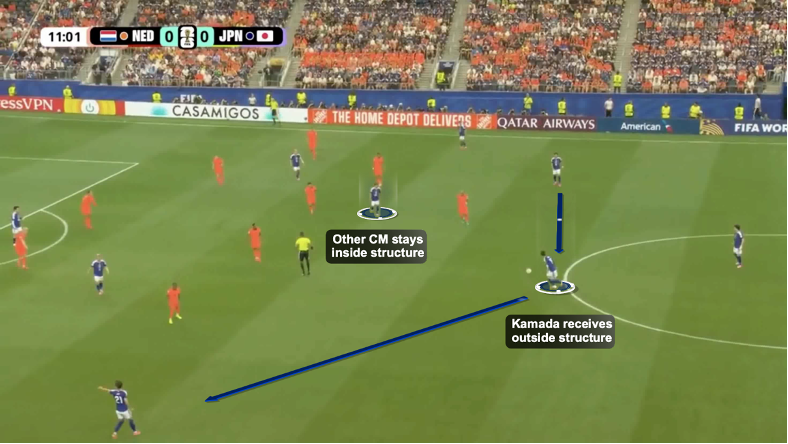
Kamada drops outside the structure to receive from one of the centre-backs to move the ball to the other side.
In this game against the Netherlands, Kamada’s midfield partner was more of an advanced midfielder.
This is why Kamada was seen playing as the deepest midfielder.
He often dropped alongside the centre-backs.
Since Japan played with a back three, one of the centre-backs moved wide and high when the Crystal Palace midfielder dropped.
Japan made multiple positional rotations during this game.
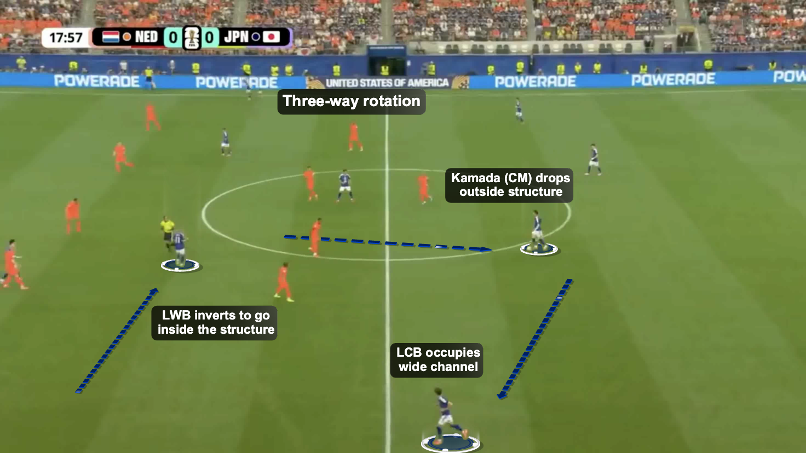
Here, the Samurai Blue make a three-way rotation: Kamada drops outside the structure, which allows the left centre-back to push to the wide channel.
This, in turn, allows the left wing-back to invert into midfield.
These rotations make it difficult for the opponents to track the Japanese players.
Another form of rotation to get on the ball more is a direct interchange with the midfield partner.
In the game against Tunisia, Kamada was deployed as an attacking midfielder.