
![Brazil Vs Morocco [1–1] – FIFA World Cup 2026: Another Statement From The Atlas Lions – Tactical Analysis](https://cdn.mymidnight.blog/77f959f119f4fb2321e9ce801e2f5163/size/w1000/2026/06/Brazil-Vs-Morocco-World-Cup-2026--1-.png)
Brazil Vs Morocco [1–1] – FIFA World Cup 2026: Another Statement From The Atlas Lions – Tactical Analysis

Brazil faced Morocco at the MetLife Stadium in New Jersey for both teams' opening match of the 2026 FIFA World Cup.
The match ended with a 1-1 draw that reflects the balance between both teams’ performances.
Morocco continues to impress the world with their performances, having established themselves in the conversation around the world's top teams in the 2022 FIFA World Cup, when they beat Belgium and Canada in the group stage, before knocking out both Spain and Portugal in the knockout phase.
The Atlas Lions topped their group at that World Cup and will have belief they can do the same this time around in a group that includes Brazil, Scotland, and Haiti.
On the other hand, Brazil will aim to achieve better results than in the last two editions, as they have been unable to reach the semi-finals since their historic defeat to Germany in the 2014 FIFA World Cup.
Since that tournament, Brazil have reached the quarter-finals in the tournaments that followed, but did not succeed in beating Belgium in 2018 or Croatia in 2022.
Carlo Ancelotti’s side will therefore be eager to reach the final rounds again this time, especially with the Italian head coach’s extensive experience in such knockout tournaments.
In this tactical analysis, we focus mainly on Morocco’s attacking performance, how Mohamed Ouahbi tactics troubled Brazil’s defence, and the solutions they used to perform so well in attack.
Brazil Vs Morocco Lineups & Formations
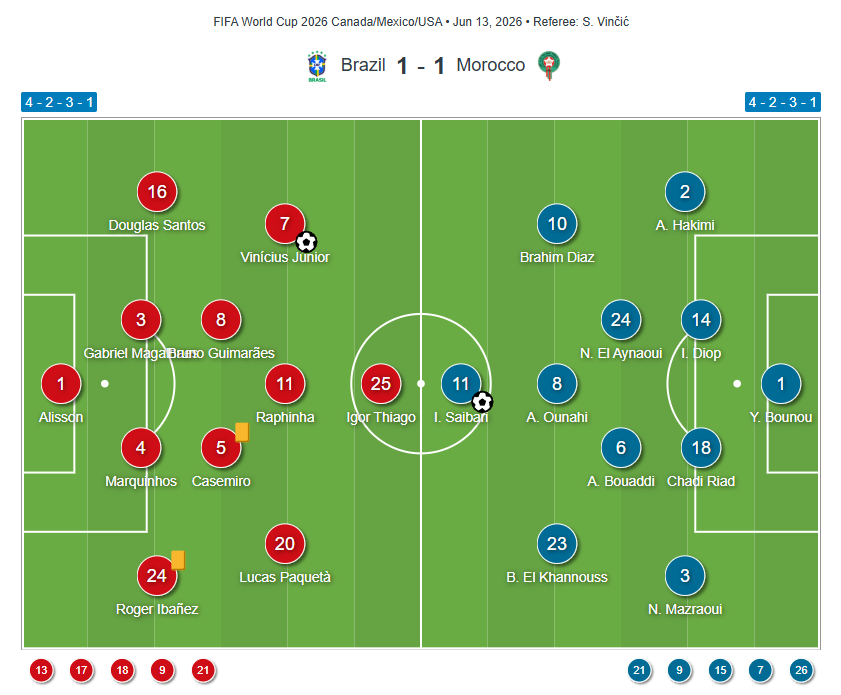
Brazil Lineup Vs Morocco
Ancelotti tactics preferred to start the match using a 4-2-3-1 formation with Alisson Becker as a goalkeeper, Marquinhos and Gabriel Magalhães as centre-backs, Roger Ibañez as a right-back, and Douglas Santos as a left-back.
The midfield was made up of Casemiro and Bruno Guimarães as central midfielders, Raphinha as an advanced playmaker, Lucas Paquetá on the right wing, Vinícius Júnior on the left wing, and Igor Thiago as the team’s striker.
Morocco Lineup Vs Brazil
For Morocco, Ouahbi tactics started the match with the 4-2-3-1 formation as well, with Yassine Bounou as a goalkeeper, Achraf Hakimi as a right-back, Chadi Riad and Issa Diop as centre-backs, and Noussair Mazraoui as a left-back.
The midfield was composed of Ayyoub Bouaddi and Neil El Aynaoui as central midfielders, Azzedine Ounahi as the advanced playmaker, and both Brahim Díaz and Bilal El Khannouss playing on the wings.
The main striker was Ismael Saibari.
Morocco Crucial Medium Recoveries
Morocco’s performance against Brazil was impressive to watch and analyse, mainly because they proved once again that they can challenge any world-class team.
This ability to complicate matters for the top teams stems from the chemistry within this group of players and the work done with the Moroccan national team over recent years.
Morocco started the match with a tangible determination to advance continuously and play as much as possible inside Brazil’s half.
To do so, Morocco kept a mid-block and were extremely intelligent in predicting and anticipating Brazil’s passes in build-up.
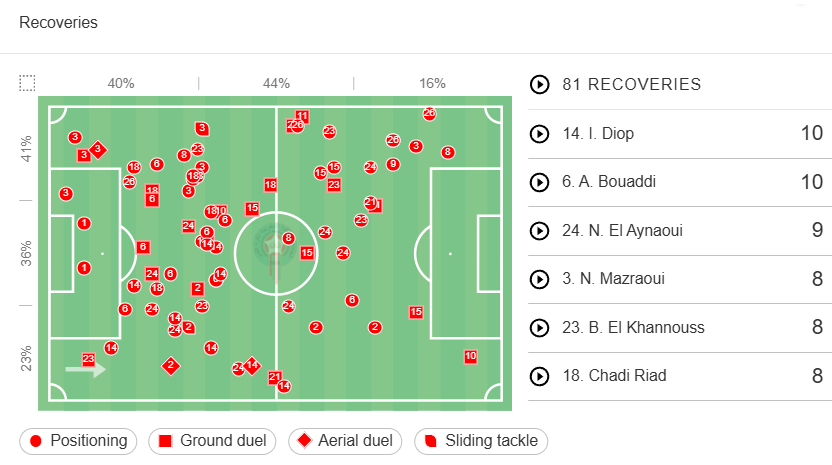
They made 81 recoveries, matching Brazil’s total, highlighting Morocco’s strong focus on this aspect.
Firstly, it was very important for Morocco to limit Brazil's possession in Morocco’s half to reduce the risk of conceding dangerous chances.
At the same time, focusing on intercepting the ball in midfield or inside Brazil’s half helped Morocco in using one of their most powerful attacking weapons: their attacking transitions.
In fact, Morocco made 38 medium recoveries, compared with 28 for Brazil.
This highlights Morocco’s success in intercepting passes and applying double marking to Brazil’s midfielders in the middle of the pitch to deny them time and space to penetrate into Morocco’s half or provide key passes to the attacking players.
The following graphic shows that most recoveries (44%) occurred in the middle third.
Although many of them were made just inside Morocco’s half, the Atlas Lions were quick enough to launch some attacking transitions that made these recoveries look as though they were high recoveries.
Morocco Flying Wing-Backs & Attacking In Numbers
The ease with which Morocco advanced whenever they regained possession was impressive, with Bouaddi and El Aynaoui the players responsible for quickly launching counterattacks with progressive passes, usually towards the wings.
What helped Morocco succeed in many of their attacking transitions was that they advanced with eight players or more in almost every attack.
This left Brazil in an equal 8v8 scenario at times and forced an overload at others, given that one or two attacking players did not always retreat quickly enough into Brazil’s third.
Morocco exploited this well enough to create space, especially from the wings, as both El Khannouss and Díaz tended to move inward with or without the ball, creating openings for Hakimi and Mazraoui.
![Real Sociedad Vs Bournemouth [1-2] Europa League 2026/2027: How Do Marco Rose Pressing Tactics Work? - Tactical Analysis](https://cdn.mymidnight.blog/77f959f119f4fb2321e9ce801e2f5163/size/w600/2026/09/Real-Sociedad-Vs-Bournemouth-20262027---Tactical-Analysis-1.png)
![AC Milan Vs Benfica [0-2] Europa League 2026/2027: How Marco Silva Tactics Exposed Rúben Amorim Defensive Problems - Tactical Analysis](https://cdn.mymidnight.blog/77f959f119f4fb2321e9ce801e2f5163/size/w600/2026/09/AC-Milan-Vs-Benfica-20262027---Tactical-Analysis.png)
![Sunderland Vs AZ Alkmaar [1-0] Europa League 2026/2027: Why The Black Cats Make Better Underdogs - Tactical Analysis](https://cdn.mymidnight.blog/77f959f119f4fb2321e9ce801e2f5163/size/w600/2026/09/Sunderland-Vs-AZ-Alkmaar-20262027---Tactical-Analysis.png)
![Leeds United Vs Newcastle United [4-1] Premier League 2026/2027: Why Did Daniel Farke Tactics Dominate The Magpies? - Tactical Analysis](https://cdn.mymidnight.blog/77f959f119f4fb2321e9ce801e2f5163/size/w600/2026/09/Leeds-United-Vs-Newcastle-2026_2027---Tactical-Analysis.png)
![Real Sociedad Vs Atlético Madrid [0-3] La Liga 2026/2027: How Diego Simeone Tactical Precision Rescued A Late Victory - Tactical Analysis](https://cdn.mymidnight.blog/77f959f119f4fb2321e9ce801e2f5163/size/w600/2026/09/Real-Sociedad-Vs-Atl--tico-Madrid-20262027---Tactical-Analysis-1.png)
![Manchester United Vs Manchester City [0-1] Premier League 2026/2027: How Enzo Maresca Tactics Secured Victory With 10 Men - Tactical Analysis](https://cdn.mymidnight.blog/77f959f119f4fb2321e9ce801e2f5163/size/w600/2026/09/Manchester-United-Vs-Manchester-City--20262027---Tactical-Analysis.png)
![Tottenham Hotspur Vs Everton [0-0] Premier League 2026/2027: Why Can't Spurs Score? - Tactical Analysis](https://cdn.mymidnight.blog/77f959f119f4fb2321e9ce801e2f5163/size/w600/2026/09/Tottenham---Vs-Everton-20262027---Tactical-Analysis.png)
![West Ham United Vs Wrexham [6-0] EFL Championship 2026/2027: The Cost Of Passive Defending Against Smart Movement - Tactical Analysis](https://cdn.mymidnight.blog/77f959f119f4fb2321e9ce801e2f5163/size/w600/2026/09/West-Ham-United-Vs-Wrexham-2026_2027---Tactical-Analysis.png)