FIFA World Cup 2026: Why Are The Underdogs So Hard To Beat? – Data Analysis

The 2026 FIFA World Cup has challenged one of football’s longest-standing assumptions: that the traditional elite will inevitably prevail.
Instead, this tournament has been defined by the emergence of organised, tactically disciplined underdogs capable of competing with, and eliminating, some of the world’s biggest footballing nations.
Paraguay’s historic victory over Germany, coupled with the impressive performances of several African sides, has reinforced the growing competitive balance across international football, where physical intensity, tactical flexibility and collective organisation are increasingly outweighing individual reputation.
Germany’s exit serves as a reminder that historical pedigree alone offers no guarantees, while other favourites, including Spain and Portugal, have also faced opponents capable of matching them for long periods of games.
The gap between football’s established powers and emerging nations has never appeared smaller.
In this World Cup data analysis, we examine the tactical and statistical trends behind the underdogs’ success, exploring how they defend, transition, create chances and expose the vulnerabilities of the tournament favourites.
Winning The Ball Before The Battle Begins
One of the clearest tactical trends behind the rise of the tournament’s underdogs has been their ability to regain possession high up the pitch and immediately disrupt opponents’ build-up.
Rather than relying on prolonged spells of possession, several emerging nations have prioritised aggressive pressing schemes, compact defensive distances and well-coordinated counterpressing structures.
Forced Turnovers Vs Ball Recoveries Stats - FIFA World Cup 2026
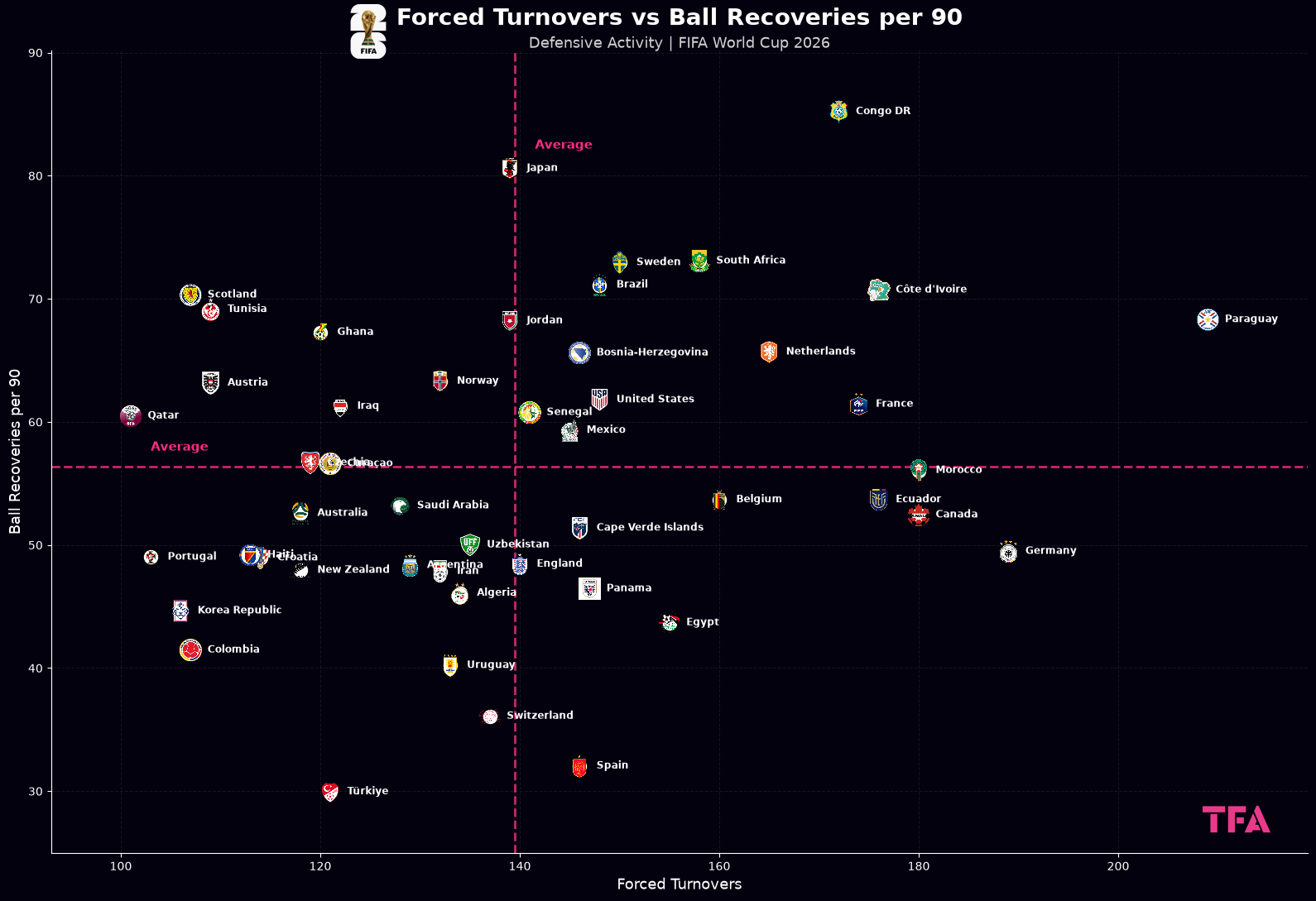
Paraguay provide the standout example.
Gustavo Alfaro’s side led the tournament with 209 forced turnovers, and that defensive intensity underpinned their historic Round of 32 elimination of Germany.
Operating from an organised 4-4-2/4-2-3-1 block, Paraguay consistently denied Germany clean progression through central areas before attacking quickly following regains, illustrating how defensive pressure can become an attacking weapon.
A similar pattern emerged elsewhere.
DR Congo, coached by Sébastien Desabre, combined athletic pressing with disciplined defensive organisation to record 85.2 ball recoveries, pushing England to the limit after leading for more than an hour before eventually losing 2-1 to two Harry Kane goals.
Japan also demonstrated the value of structured pressing despite their elimination, ranking among the tournament leaders with 80.59 ball recoveries while repeatedly forcing Brazil into uncomfortable build-up sequences during a narrow 2-1 defeat.
These performances suggest that ball recoveries and forced turnovers have become more than defensive statistics; they are increasingly reliable indicators of tactical competitiveness.
The underdogs may not dominate possession, but they are consistently dictating where, when and how elite opponents are allowed to play.
Defending Without The Ball, Controlling The Game
Paraguay’s famous victory over Germany was not built on deep defending alone, but on a remarkably proactive defensive performance that repeatedly disrupted one of the tournament favourites.
Gustavo Alfaro’s side combined an organised 4-4-2 defensive block with aggressive pressing triggers, preventing Germany from establishing the fluid central combinations that normally characterise their possession game.
The numbers illustrate the scale of that dominance out of possession.
Paraguay registered 59 forced turnovers, 91 possession regains, 59 tackles, 52 blocks and 10 interceptions, outperforming Germany across every major defensive metric despite facing sustained territorial pressure.
Paraguay's Defensive Performance VS Germany - FIFA World Cup 2026 - Round Of 32
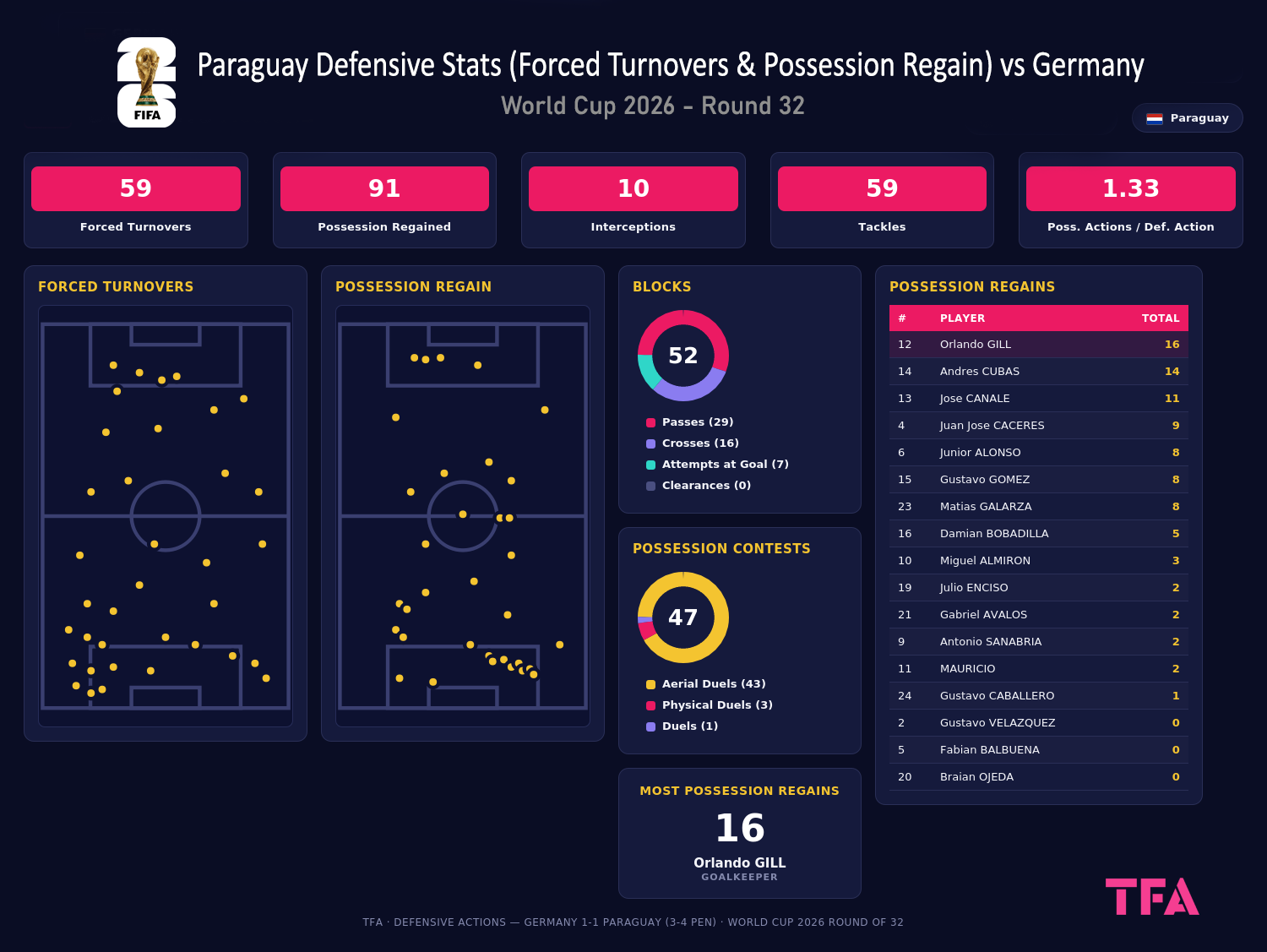
Rather than sitting permanently in a low block, Paraguay alternated between mid-block pressure and aggressive jumps towards the ball, recording 410 total pressures and 176 pressing actions into pressure, repeatedly forcing Germany away from central progression and towards less dangerous wide areas.
Germany generated large volumes of possession and circulation; many of their attacks were slowed before reaching the penalty area, allowing Paraguay's defensive unit to recover its shape and crowd the decisive spaces.
Several individuals embodied this collective defensive identity.
Andrés Cubas produced perhaps the outstanding midfield display, contributing 11 tackles, 14 possession regains and seven blocks, while continuously screening passing lanes into Germany's attacking midfielders.
Junior Alonso added seven tackles, eight recoveries and constant defensive pressure from the back line, whereas Juan José Cáceres delivered an exceptional all-round defensive performance with five tackles, seven blocks, and nine possession regains.
Paraguay demonstrated that elite defensive organisation is no longer synonymous with passive football.
Their defensive numbers reflected an active strategy built around winning duels, anticipating passes and recovering possession quickly, turning defensive resilience into the platform for one of the World Cup's biggest upsets.
Pressing With Purpose, Not Just Intensity
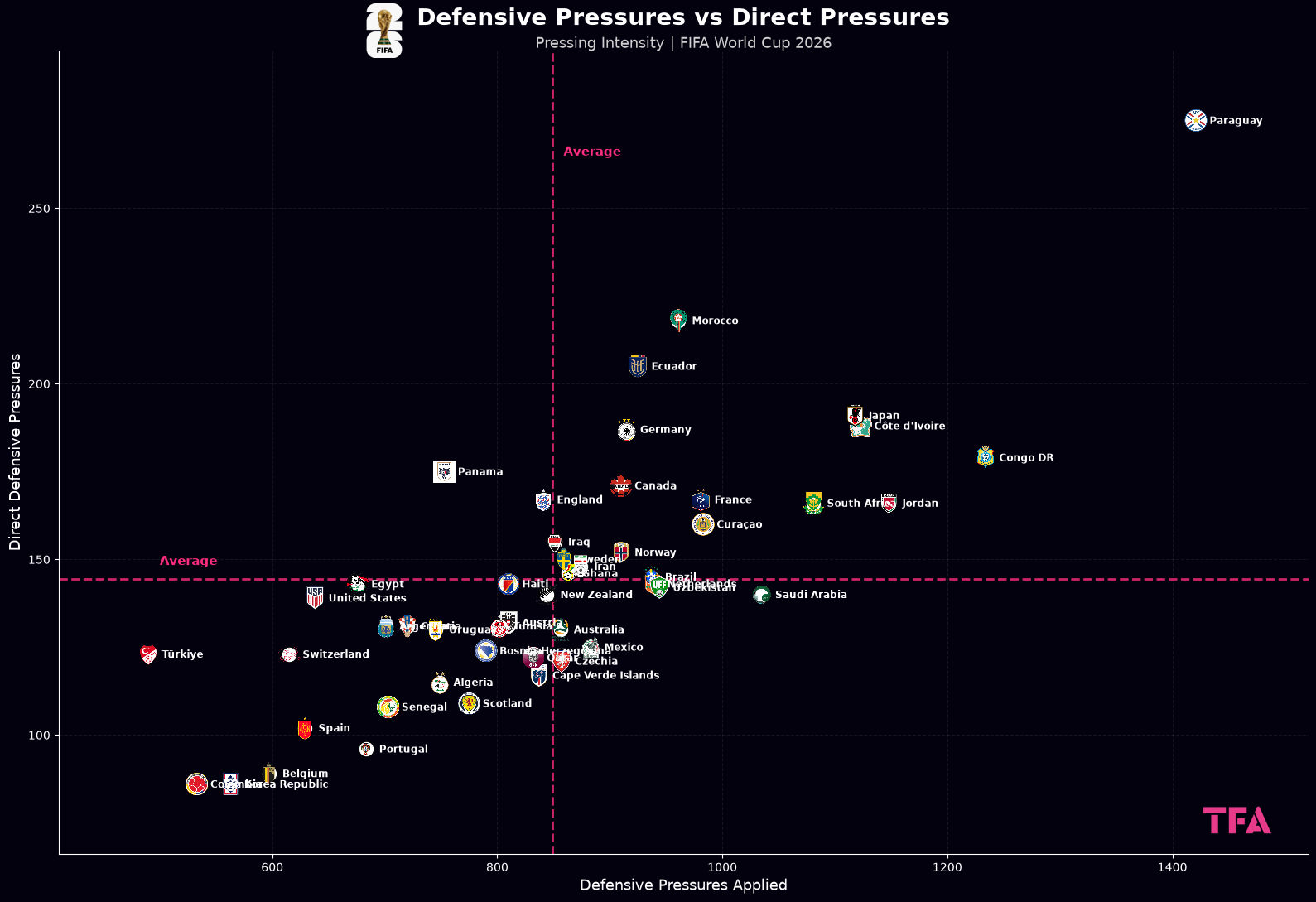
High pressing has become one of the defining tactical characteristics of the tournament's most competitive underdogs, but the data suggests that success depends not simply on the volume of pressure applied, but on where and how it is executed.
FIFA World Cup 2026 Pressing Intensity: Defensive Pressures Vs Direct Defensive Pressures