Didier Deschamps Tactics At France 2026: Are Les Bleus Ready For A Third World Cup Win? – Tactical Analysis

France enter the 2026 FIFA World Cup as one of the favourites, having made it to the Final in each of the previous two tournaments in the ‘Kylian Mbappé era’ thus far.
They won their second-ever FIFA World Cup in Russia back in 2018, but came up short in an epic clash with Lionel Messi’s Argentina four years ago in Qatar.
Our France tactical analysis profiles the 2026 iteration of Les Bleus under Didier Deschamps tactics.
This World Cup tactical preview analyses the French National Team’s setup in and out of possession, detailing why their system and sheer heavyweight knockout power could take them to World Cup number three this year.
France Predicted Starting XI & Formation
France will likely set up in a 4-2-3-1 shape this summer, with Mike Maignan currently the preferred No. 1.
Maignan prevented an average of 5.14 goals, with a 75.35% save rate, over the past calendar year with AC Milan, both of which rank at a high level when compared with other goalkeepers from Europe’s top-five leagues.
He’ll provide a strong base from which the French can build.
Jules Koundé (right-back) and Lucas Digne (left-back) are the probable starters in the full-back positions, with the centre-back pairing of Ibrahima Konaté and Dayot Upamecano likely to be favoured at the heart of defence.
France's centre-back partnership is likely to be built around Ibrahima Konaté, but the choice of partner could depend somewhat on the demands of the opposition.
An Ibrahima Konaté-William Saliba could reasonably be argued for due to the balance it provides.
Saliba is a specialist in defending through elite positioning and composure, which may complement Konaté's recovery pace and physicality well.
However, there is also sense in sticking with the more tried-and-tested Konaté-Upamecano duo.
Upamecano offers something different to both Konaté and Saliba in that he’s by far the most proactive of the three, frequently stepping out of the backline to disrupt opposition build-up before attacks can develop.
In that partnership, forged in battle with both France and RB Leipzig, Konaté provides the security behind Upamecano to cover space and defend in depth.
So, while Saliba-Kontaté offers maximum stability and control, Konaté-Upamecano provides some aggression and front-foot defending.
Aurélien Tchouaméni will provide the midfield's defensive foundation; that is almost certain.
The profile of his chosen partner can, then, significantly alter the character of the team and will likely change depending on what Deschamps deems most important in that moment.
Adrien Rabiot offers the most balanced option to partner Tchouaméni.
He offers a combination of progressive passing, creativity, ball-carrying, aerial presence and tactical discipline, which may make him the natural fit to achieve the control and stability that Deschamps prefers.
Manu Koné provides greater dynamism and transition threat.
I think the argument for ‘best midfield partnership’ effectively boils down to Tchouaméni-Rabiot or Tchouaméni-Koné.
Rabiot will probably get the nod due to the overall balance he can provide the midfield.
He’s the ‘safest’ and more positionally disciplined of the two.
Koné has a strong chance of being introduced with France trailing and in need of a serious transitional ball-carrying threat in midfield.
His high-tempo game naturally increases the number of duels and the level of unpredictability, which is a great option to have if France need to change the game state.
Warren Zaïre-Emery offers additional technical quality and possession security.
He is most likely to be introduced if France seek more control of the ball.
N’Golo Kanté, meanwhile, is a valuable squad member who provides a game-management option.
The veteran midfielder can help France to protect a lead and survive the closing stages of high-pressure matches.
Finally, up front, Les Bleus boast one of the deepest and most versatile attacking units at the World Cup.
Kylian Mbappé, Ousmane Dembélé and Michael Olise are most likely nailed in the strongest French XI.
The final position in the front four is likely to be contested between Bradley Barcola and Désiré Doué.
Barcola offers greater final-third productivity, having posted more impressive xGC-per-90 numbers with PSG over the last calendar year, while providing constant depth and penetration through his movement.
Doué contributes more heavily to the construction phase before the goal or assist, however.
He offers defence-splitting creative passing, combined with quality combination play and cross volume, plus a strong work rate off the ball.
Deschamps’ decision between the two may ultimately depend on the opponent, with Barcola potentially favoured in more open, transition-heavy matches and Doué offering additional creativity against deeper defensive blocks.
One player who could alter the equation entirely is Rayan Cherki, who I believe does feature as the ‘10’ in the hypothetical ‘strongest French XI’, but I realistically see him featuring more as an impact substitute at the World Cup, based on his limited involvement with the national team until recently.
While the Manchester City playmaker has not been a starter under Deschamps, his unparalleled creativity could make him the World Cup’s ultimate ‘joker card’, so to speak.
France Stats 2025/2026
France enter the 2026 FIFA World Cup as perhaps the most well-balanced side in terms of quality and tactical identity.
This is also evident in the team’s Statistical Profile.
France FIFA World Cup 2026 Statistical Profile
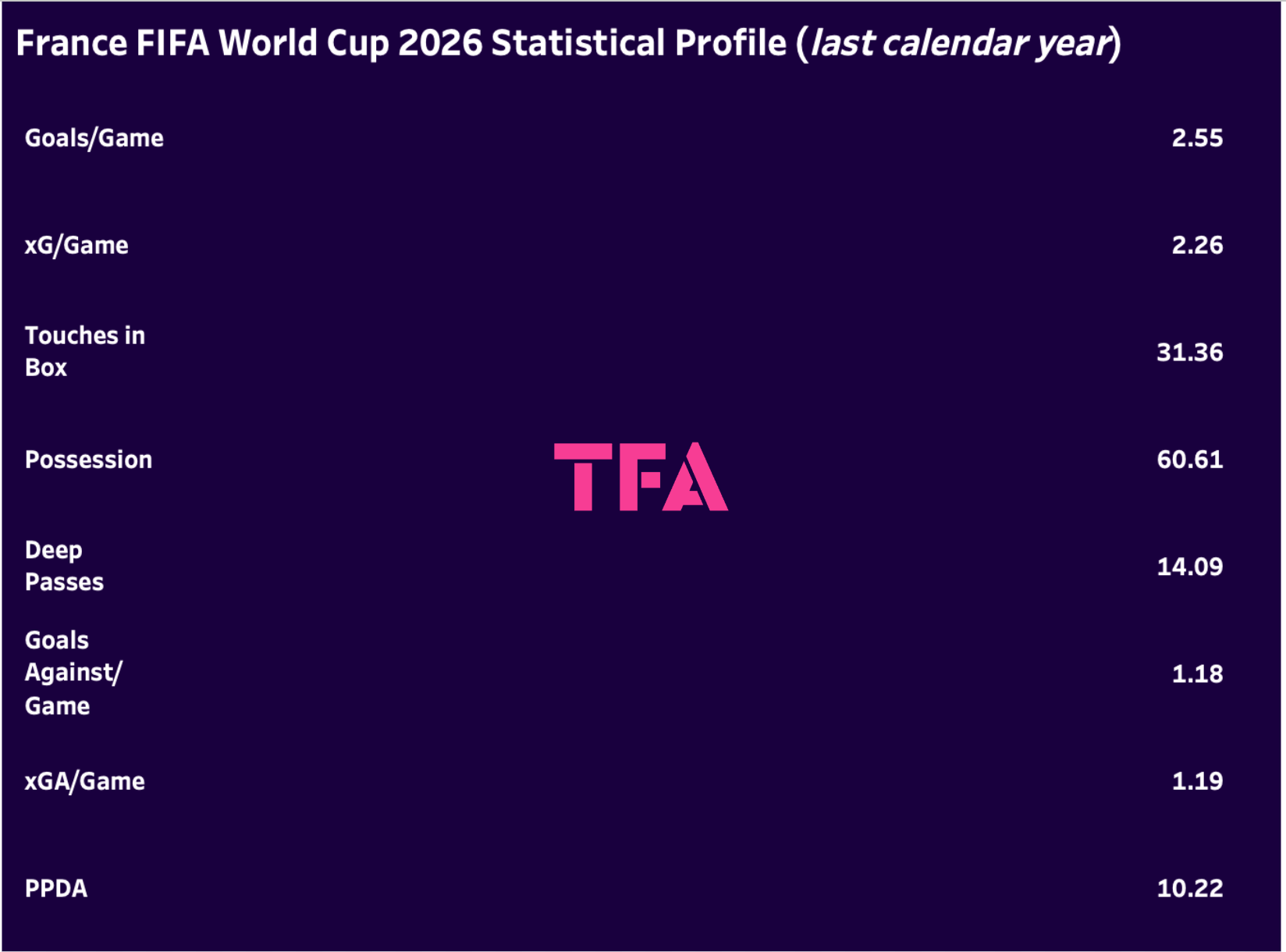
The data portrays a team built around balance and control.
Sustained pressure is a clear theme in their attacking data, with an average of 2.55 goals and 2.26 xG per 90 pointing to high-volume chance creation and strong finishing.
Meanwhile, they concede just 1.18 goals and 1.19 xGA per match.
Match footage suggests they focus on staying compact to protect central spaces and controlling opposition progression, relying on anticipation to cut off likely progressive passing lanes.
Les Bleus average 60.6% possession and 14.1 deep completed passes per match, which reinforces the image of a team that’s comfortable dominating the ball and proactively playing into advanced areas.
With this stylistic base, France’s individual quality can help them to thrive in a tournament dynamic.
France Performance Profile 2025/2026
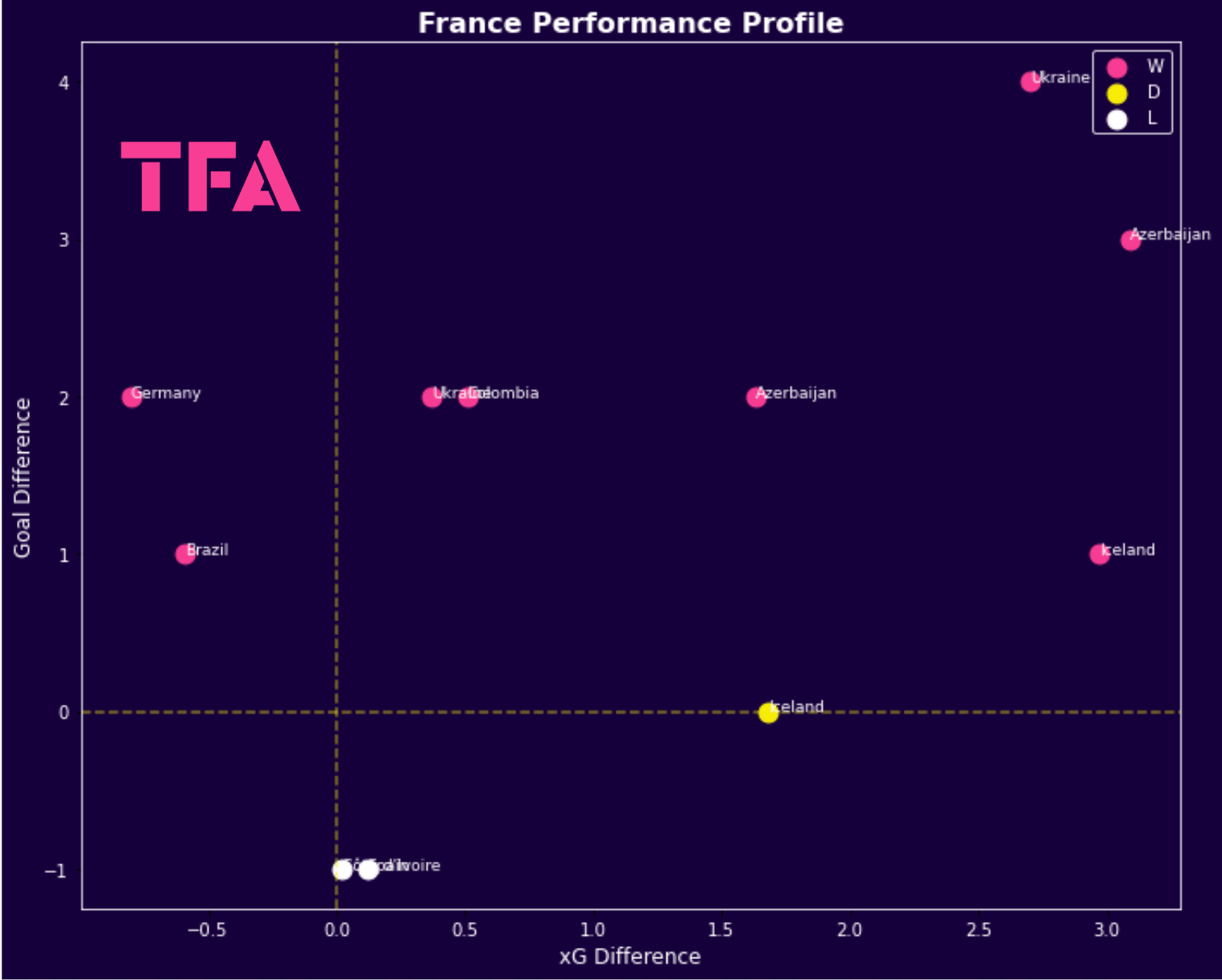
As per the Performance Profile, France combine strong underlying performance with the ability to secure results even without statistical dominance.
France recorded positive xG differentials in nine of their 11 matches over the last calendar year at the time of writing.
This reflects consistent territorial control and high-volume chance creation.
Victories over Germany and Brazil were achieved despite negative xG differentials.
This reflects France's elite individual quality, which can decide matches even when the underlying numbers aren’t so convincing.
On the other hand, France drew with Iceland 2-2 and suffered narrow defeats to both Spain (5-4) and, more recently, Côte d'Ivoire (1-2) despite posting a positive xG differential, so not every dominant performance translated into results.
Overall, France’s success is driven by strong underlying processes, but their outcomes are also heavily influenced by game management and the elite match-winning quality within the squad.
France Style Of Play In Possession
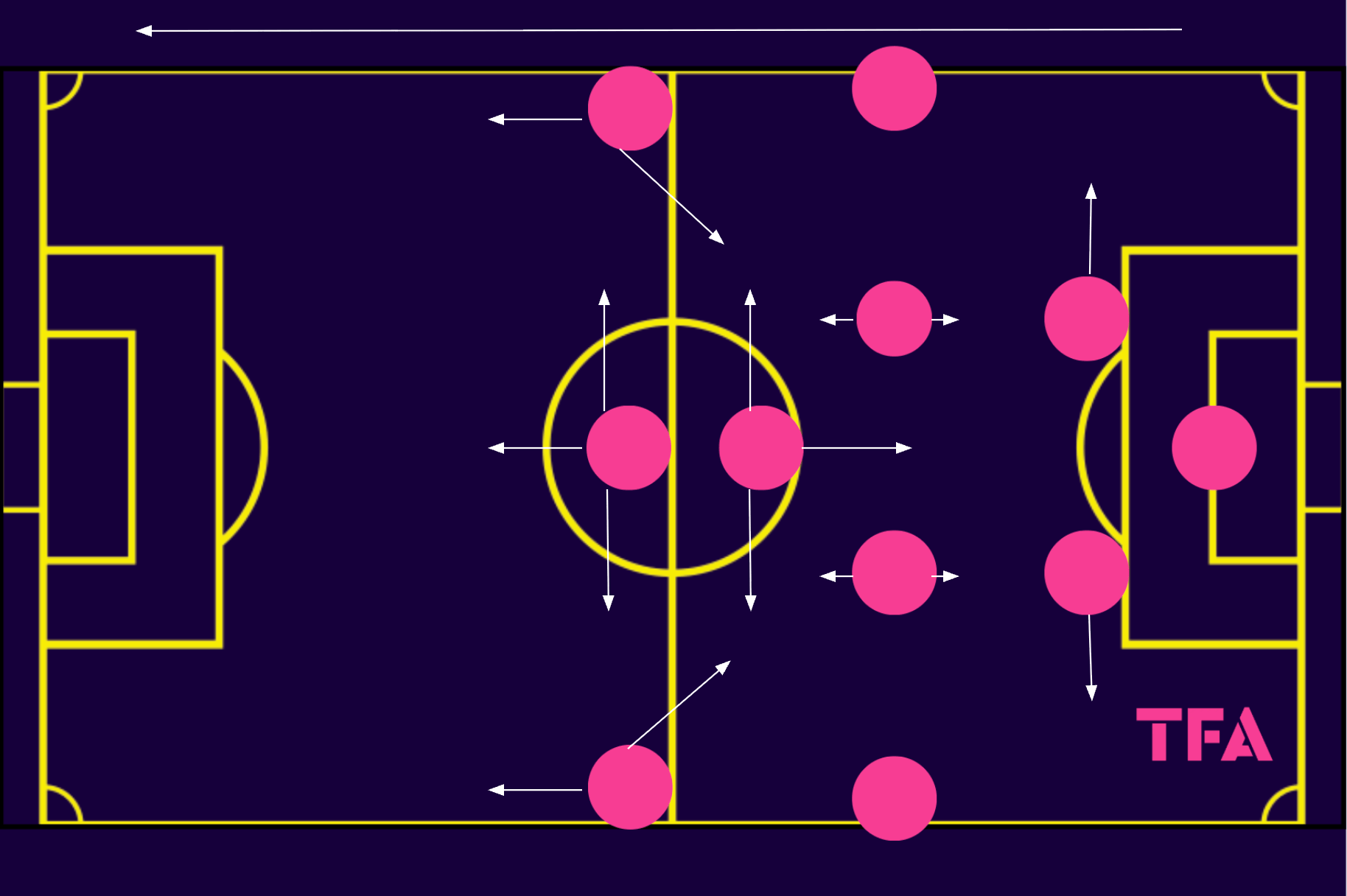
Building out from the back, France’s full-backs will push on into the same line as their holding midfielders.
The midfielders should stagger their positioning to ensure they offer their teammates multiple vertical passing options while making themselves more difficult to press.
Expect the centre-backs to push out wide, facilitating the full-backs to move higher and opening space for one of the midfield duo to drop in centrally, creating a temporary back-three.
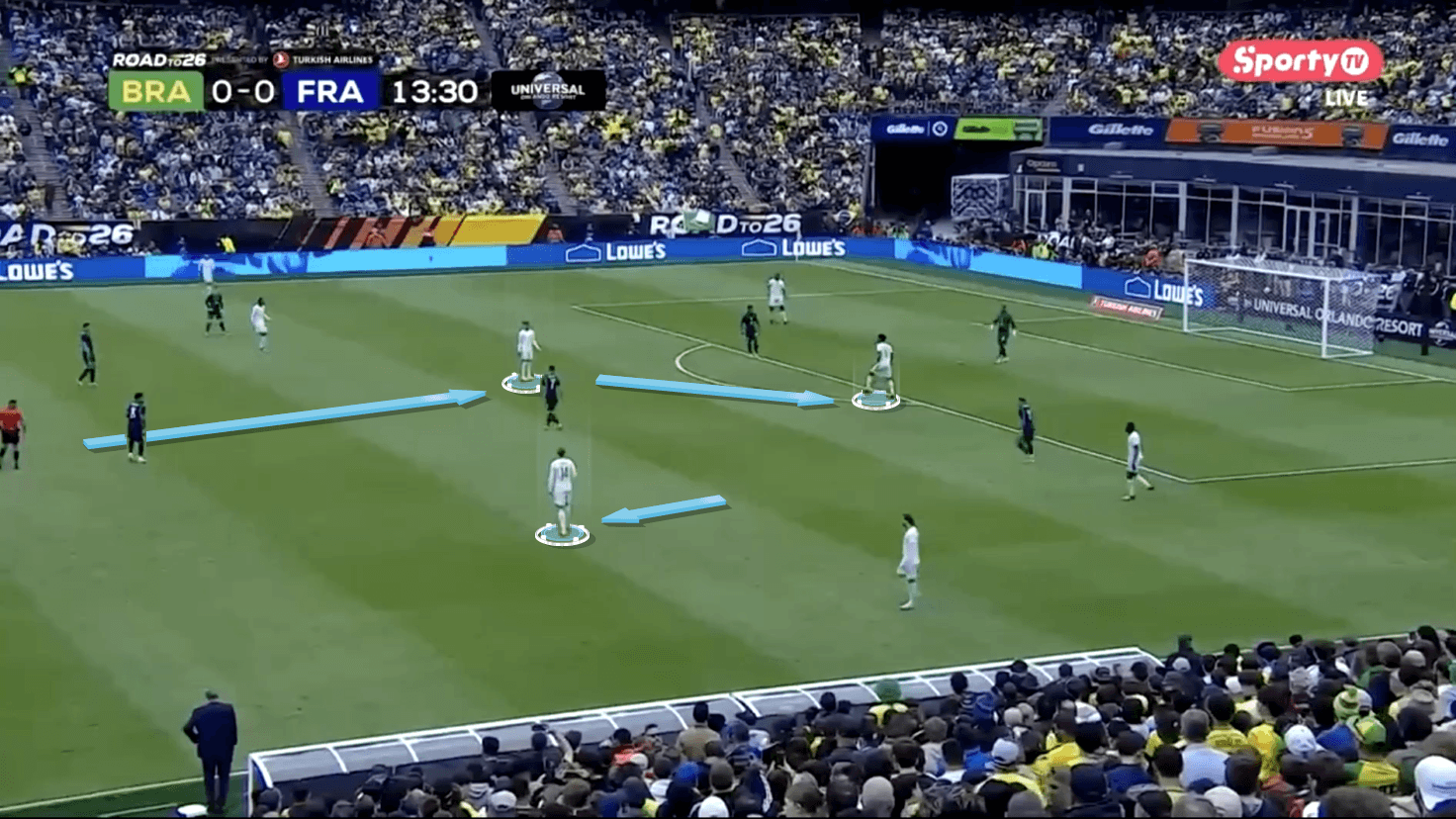
As one of the double-pivot drops, the ‘10’ might also drop deep, especially if playing against high pressure and in need of bodies closer to the ball to build out securely.
If the ‘6’ drops into the backline and attracts high pressure from his marker, that may create an opportunity for the ‘10’ to drop into the space vacated by the ‘6’ and receive freely if the passer can find him.
If not, France are comfortable playing the ball long and going directly to the wings, where they’ll look to set their wingers and full-backs up in favourable duels.
The movement of the front four is where things get interesting for France in possession.
Their attackers are going to be extremely fluid, with a lot of positional rotations among all four positions.
Mbappé may line up as the centre-forward on paper, but expect him to drop deep to receive to feet or rotate out wide at times, enabling Dembélé to rotate into the centre.
The same is true for Olise, Cherki, Doué and Barcola.
All of France’s attackers are comfortable playing on the wings or centrally, and this is an asset for the team’s attack.
They will rotate frequently, interchanging positions with one another and constantly changing the questions they pose to the opposing defence.