
![Everton Vs Manchester United [2-2] Premier League 2026/2027: Why The Red Devils Left Two Points Behind - Tactical Analysis](https://cdn.mymidnight.blog/77f959f119f4fb2321e9ce801e2f5163/size/w1000/2026/09/Everton-Vs-Man-United-2026_2027---Tactical-Analysis.png)
Everton Vs Manchester United [2-2] Premier League 2026/2027: Why The Red Devils Left Two Points Behind - Tactical Analysis
Manchester United twice led at Everton but left with a 2-2 draw. This tactical analysis examines how Cunha’s movement and midfield rotations opened passing lanes, before slow switches, costly turnovers and gaps in United’s press allowed Everton back into the game.

Everton hosted Manchester United in gameweek three of the 2026/2027 Premier League season; the contest ended in a 2-2 draw as the hosts came from behind twice to settle the score deep into stoppage time.
The Red Devils started well, controlling the speed of the game and finding progression through positional rotations.
While the first half ended goalless, United started strong by scoring early in the second period.
However, the Toffees found the equaliser in the 83rd minute before the visitors took the lead again in the 88th minute.
The game had more to offer, as super sub Ainsley Maitland-Niles scored a screamer late on (90’+6) to secure a point for his side.
In this Everton versus Manchester United tactical analysis, we will discuss Manchester United tactics, highlighting areas where they did well and areas where they struggled against Everton.
Everton Vs Manchester United Formations & Lineups
Let's look at how David Moyes and Michael Carrick fielded their squads.
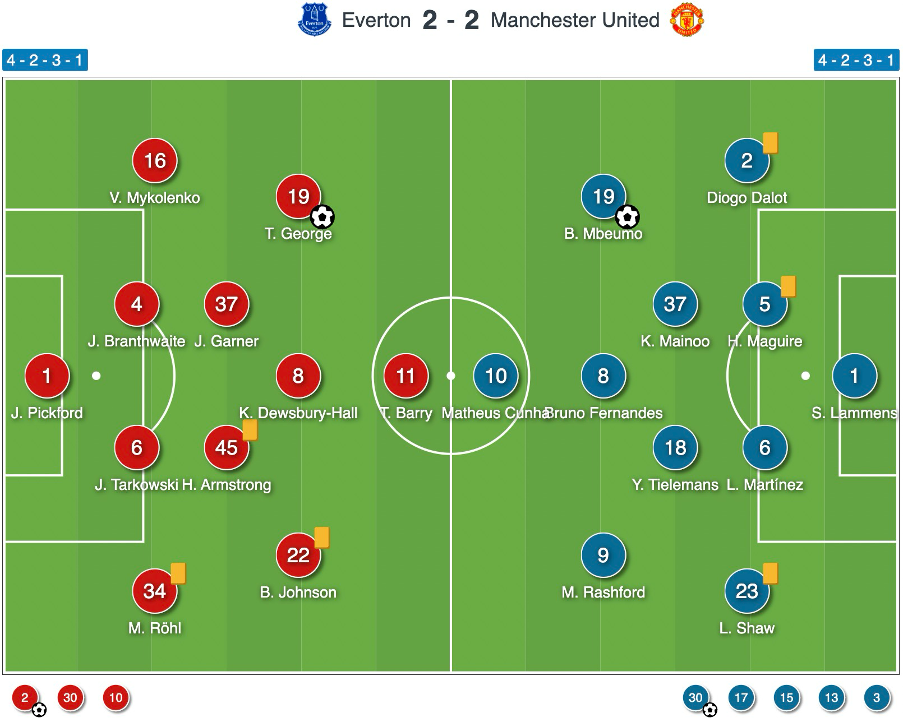
Everton Lineup Vs Manchester United
Everton played in a 4-2-3-1 formation.
Jordan Pickford started in goal.
The back four were Merlin Röhl (right-back), skipper James Tarkowski (right centre-back), Jarrad Branthwaite (left centre-back), and Vitalii Mykolenko (left-back); Hayden Hackney replaced Röhl (75’).
Harrison Armstrong and James Garner operated as the double pivot.
Maitlan-Niles replaced the injured Garner after 77 minutes.
Brennan Johnson (right) and Tyrique George (left) were the wingers, with Kiernan Dewsbury-Hall as the attacking midfielder; Thierno Barry played as the striker.
Jack Grealish came on for Johnson (66’).
Manchester United Lineup Vs Everton
Man United also played in a 4-2-3-1 formation.
Senne Lammens started between the sticks.
The back four consisted of Diogo Dalot (right-back), Harry Maguire (right centre-back), Lisandro Martínez (left centre-back), and Luke Shaw (left-back); Leny Yoro and Noussair Mazraoui replaced Dalot (84’) and Shaw (90’ +1), respectively.
Kobbie Mainoo and Youri Tielemans played as the double pivot.
Mainoo was replaced by Andrey Santos (84’).
Bryan Mbeumo (right) and Marcus Rashford (left) were the wingers, with skipper Bruno Fernandes as the attacking midfielder; Matheus Cunha played as the striker.
Patrick Dorgu and Benjamin Šeško came on for Rashford (70’) and Cunha (70’), respectively.
Manchester United Build-Up: Midfield Diamonds And Attacking Rotations
Man United carried out their build-up with a back three.
This would include the two centre-backs, along with a full-back or one of the pivots dropping outside the structure.
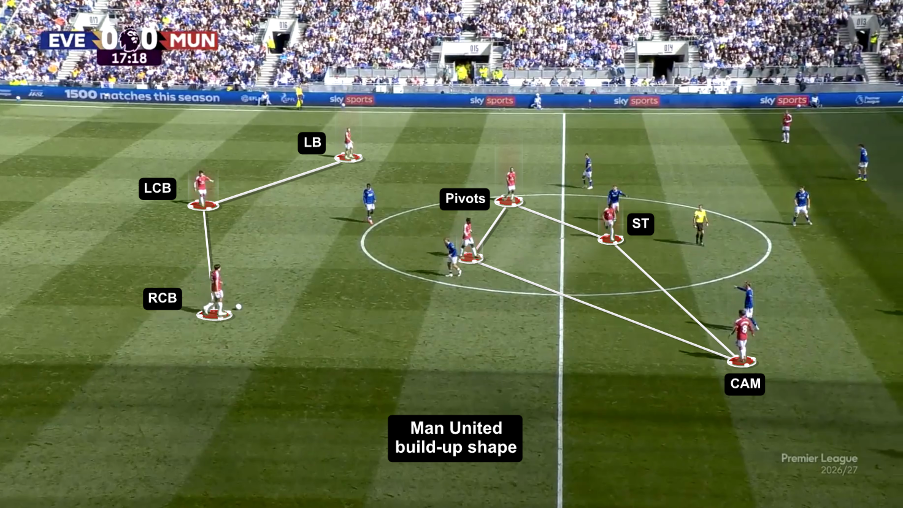
Dalot (RB) pushes up, and Shaw (LB) stays to make a back three.
Meanwhile, Cunha (ST) drops into midfield to make a diamond.
With four receivers in the central channel in the mid-third, United’s progression became simpler as they were often able to find the free player inside the structure.
Everton’s defensive shape was a 5-4-1 for the most part; however, one midfielder occasionally stepped up to help the striker with pressing.
This changed their shape to a 5-3-2 momentarily.
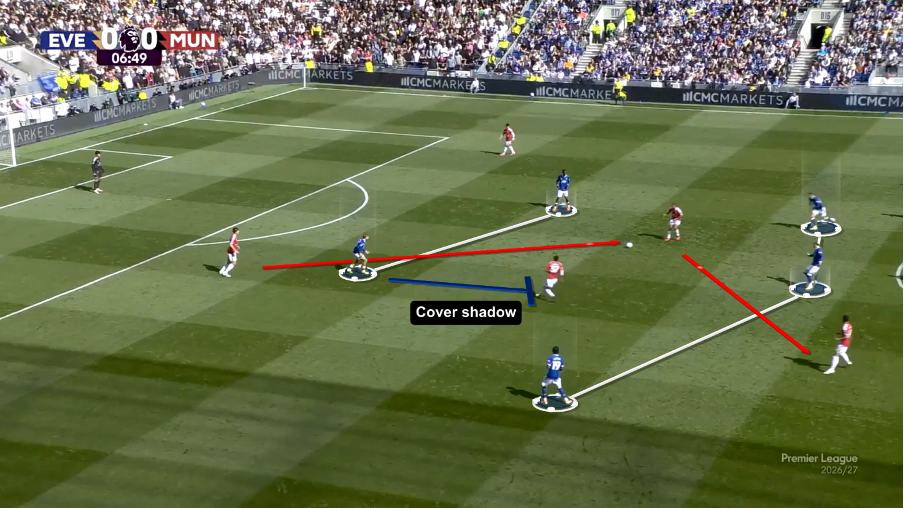
Everton’s 3-2 shape is visible.
United’s pivots are positioned behind the first line of pressure.
The Everton player presses the ball-carrier while keeping Mainoo in his cover shadow.
However, Tielemans is available at an angle; this helps United bypass the first line.
The Belgian receives on the half-turn to break another line with a pass to Fernandes.
In situations where Everton overcommitted with their first line, Man United isolated them to progress through numerical advantage.
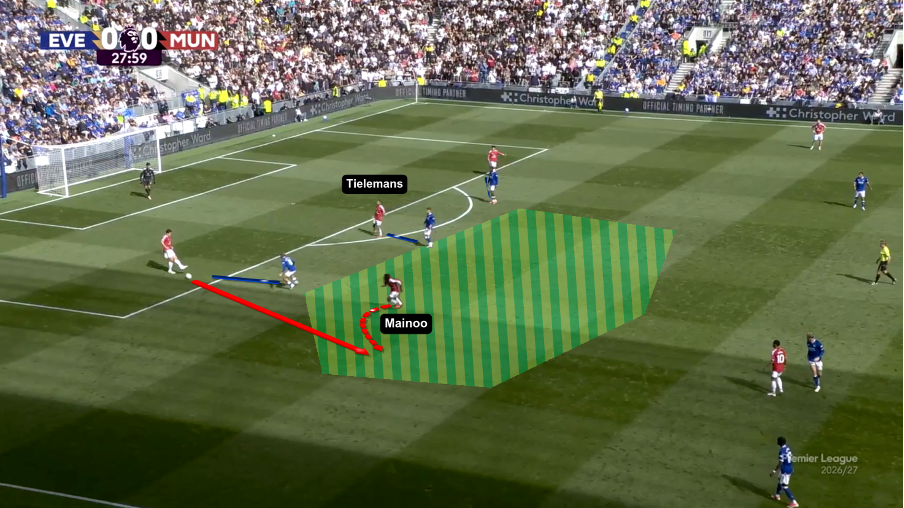
Everton commit three players to press high, while the second line stays deep.
This also happens because of the United full-backs pushing high and wide, which helps pin some opponents deep.
This gives the Red Devils a 5v3 situation in build-up.
With Tielemans dropping alongside the centre-backs, Mainoo can stay on the blind side and receive in the half-space while the Everton players screen the central channel.
When Everton stayed compact, Man United shifted play to find space for progression.
![Bayern Munich Vs Arsenal [2-2] Champions League 2026/2027: How Vincent Kompany & Mikel Arteta Tactics Cancelled Each Other Out - Tactical Analysis](https://cdn.mymidnight.blog/77f959f119f4fb2321e9ce801e2f5163/size/w600/2026/10/Bayern-Munich-Vs-Arsenal---Tactical-Analysis.png)
![PSG Vs Barcelona [4–2] – Champions League 2026/2027: PSG Attacking Persistence Exposes Barcelona Defensive Problems – Tactical Analysis](https://cdn.mymidnight.blog/77f959f119f4fb2321e9ce801e2f5163/size/w600/2026/10/PSG-Vs-Barcelona----Tactical-Analysis.png)
![Brighton & Hove Albion Vs Crystal Palace [5-0] Premier League 2026/2027: How Fabian Hürzeler Combined Pressing & Positional Rotations To Dominate The M23 Derby - Tactical Analysis](https://cdn.mymidnight.blog/77f959f119f4fb2321e9ce801e2f5163/size/w600/2026/10/Brighton---Hove-Albion-Vs-Crystal-Palace-2026_2027----Tactical-Analysis.png)
![Newcastle United Vs Aston Villa [0-1] Premier League 2026/2027: How Unai Emery Tactics Punished Wasteful Magpies - Tactical Analysis](https://cdn.mymidnight.blog/77f959f119f4fb2321e9ce801e2f5163/size/w600/2026/10/Newcastle-United-Vs-Aston-Villa--0-1--Premier-League-2026_2027_-How-Unai-Emery-Tactics-Punished-Wasteful-Magpies---Tactical-Analysis.png)
![Celta Vigo Vs Juventus [1-2] Europa League 2026/2027: How The Old Lady Escaped With A Late Comeback Despite Predictable Attacking Play - Tactical Analysis](https://cdn.mymidnight.blog/77f959f119f4fb2321e9ce801e2f5163/size/w600/2026/10/Celta-Vigo-Vs-Juventus---Tactical-Analysis.png)
![Villarreal Vs Napoli [3-1] Champions League 2026/2027: How Iñigo Pérez Tactics Exploited Massimiliano Allegri Mistakes - Tactical Analysis](https://cdn.mymidnight.blog/77f959f119f4fb2321e9ce801e2f5163/size/w600/2026/10/Villarreal-Vs-Napoli---Tactical-Analysis.png)
![Manchester City Vs PSG [2-4] Champions League 2026/2027: How Luis Enrique Tactics Controlled The Key Moments - Tactical Analysis](https://cdn.mymidnight.blog/77f959f119f4fb2321e9ce801e2f5163/size/w600/2026/10/Manchester-City-Vs-PSG---Tactical-Analysis.png)
![Borussia Dortmund Vs Werder Bremen [2-2] Bundesliga 2026/2027: How Daniel Thioune Tactics Earned A Late Comeback With 29% Possession - Tactical Analysis](https://cdn.mymidnight.blog/77f959f119f4fb2321e9ce801e2f5163/size/w600/2026/10/Borussia-Dortmund-vs-Werder-Bremen---Tactical-Analysis.png)