
![Celta Vigo Vs Juventus [1-2] Europa League 2026/2027: How The Old Lady Escaped With A Late Comeback Despite Predictable Attacking Play - Tactical Analysis](https://cdn.mymidnight.blog/77f959f119f4fb2321e9ce801e2f5163/size/w1000/2026/10/Celta-Vigo-Vs-Juventus---Tactical-Analysis.png)
Celta Vigo Vs Juventus [1-2] Europa League 2026/2027: How The Old Lady Escaped With A Late Comeback Despite Predictable Attacking Play - Tactical Analysis

Celta Vigo hosted Juventus at Estadio Abanca Balaídos for the second gameweek of the 2026/2027 UEFA Europa League.
The win puts Juventus at the top of the competition standings for now, with two wins and a better goal difference than their opponents.
Perhaps the most difficult matches remaining for Juventus in this competition will be against Rennes at home, against Real Sociedad, and against Ferencvárosi away.
On the other side, Celta Vigo struggled to preserve their advantage and suffered from a disappointing loss in this match despite their attempts to defend in a compact manner and try to score from counterattacks.
This result puts them in 28th place in the standings following two losses.
Therefore, it will be crucial for them to bounce back as soon as possible and start earning points in order to battle for a playoff qualification ticket.
That said, the mission of Claudio Giráldez and his staff will not be as simple as it might sound, as they face Celtic away in the next fixture, with games against teams like Bournemouth and Olympique de Marseille left to play.
In this tactical analysis, we examine Luciano Spalletti's tactical choices and playmaking issues.
Celta Vigo Vs Juventus Lineups & Formations
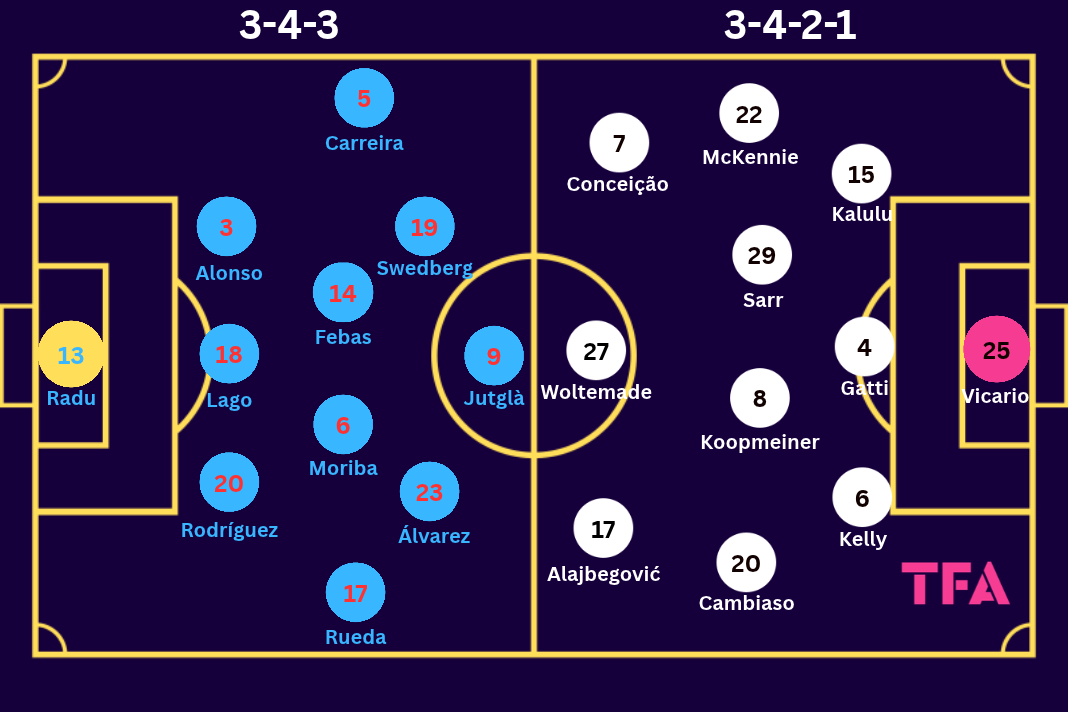
Celta Vigo Lineup Vs Juventus
Giráldez used a 3-4-3 formation with Ionuț Radu as a goalkeeper, and a back-three defence made up of the veteran Marcos Alonso, Yoel Lago, and Javi Rodríguez.
The midfield was made up of Ilaix Moriba and Aleix Febas as central midfielders, Javier Rueda and Sergio Carreira as wing-backs, with Williot Swedberg and Hugo Álvarez as wide playmakers in support of the striker, Ferrán Jutglà.
Juventus Lineup Vs Celta Vigo
For Juventus, Spalletti used a 3-4-2-1 formation with Guglielmo Vicario as the goalkeeper, and a back-three made up of Pierre Kalulu, Federico Gatti, and Lloyd Kelly.
In midfield, he used Pape Matar Sarr and Teun Koopmeiners as central midfielders, Weston McKennie and Andrea Cambiaso as wing-backs, while Francisco Conceição and Kerim Alajbegović started as wingers behind the main striker, Nick Woltemade.
Juventus Insufficient Vertical Risk-Taking
Juventus started the match in a relatively positive way as they had more possession than Celta Vigo and were able to impose their game through ball circulation throughout the pitch, succeeding in overcoming Celta Vigo’s press most of the time.
This possession was not always horizontal, as we saw Juventus players attempt long passes towards the target man Woltemade on several occasions, with the aim being to exploit his excellent abilities in the air and physical superiority to win the ball inside Celta Vigo’s half and help drive the team forward.
However, Juventus did not use this solution well, especially in the first period of the match, as there was a lack of Juventus bodies in that area.
In other words, Juventus did not advance with sufficient players in attack in order to create numerical superiority or disturb Celta Vigo’s defensive organisation.
This made Celta Vigo’s defensive mission very obvious most of the time, as they usually knew what to expect and from whom exactly.
Apart from McKennie, who tended to switch sides and move from the right to the left wing at times, the rest of the players moved in a classic way and without creating surprises, and Celta Vigo knew that they had to mark both Alajbegović and Conceição on the wings, and keep marking Woltemade wherever he goes in order to avoid threats.
In fact, Juventus failed to be surprising or unpredictable, especially in the first half when they had the possibility to attempt surprising vertical passes, for instance.
The failure to execute quick vertical short or long passes to the players who make the right movements towards the back of Celta Vigo’s defensive line represented one of the issues that prevented Juventus from scoring early in this match despite their advantage in terms of possession.
One of the most remarkable situations that highlight such a lack of risk-taking in terms of playmaking and long-passing, despite the right movement without the ball from the player, occurred in the following situation.
When Koopmeiners had the ball unmarked, McKennie made an intelligent diagonal movement without the ball towards the back of Celta Vigo’s defence and was hoping for a long pass towards that area from his teammate, who is known for being good at long passing.
However, Koopmeiners’ reaction was disappointing as he lacked courage and avoided such vertical passing towards his teammate despite the fact that he did not have a better passing solution to opt for.
It is a decision that reflects the passive playmaking mentality that obviously impacts the team’s attacking performances and makes their build-up play more monotonous and uninspiring.
What is even more disappointing and confusing in this action is that McKennie makes the movement without the ball twice, and Koopmeiners notices that but decides to not provide the pass just because there was an opponent near McKennie.
This also means that Koopmeiners did not believe in McKennie’s ability to surpass his opponent or win the duel, even though McKennie is known for being explosive enough and capable of beating anyone in such duels.
In fact, the second movement of McKennie allowed him to get away from the marking completely, as he could have found himself alone against the goalkeeper if Koopmeiners had provided that long pass to him.
![Villarreal Vs Napoli [3-1] Champions League 2026/2027: How Iñigo Pérez Tactics Exploited Massimiliano Allegri Mistakes - Tactical Analysis](https://cdn.mymidnight.blog/77f959f119f4fb2321e9ce801e2f5163/size/w600/2026/10/Villarreal-Vs-Napoli---Tactical-Analysis.png)
![Manchester City Vs PSG [2-4] Champions League 2026/2027: How Luis Enrique Tactics Controlled The Key Moments - Tactical Analysis](https://cdn.mymidnight.blog/77f959f119f4fb2321e9ce801e2f5163/size/w600/2026/10/Manchester-City-Vs-PSG---Tactical-Analysis.png)
![Borussia Dortmund Vs Werder Bremen [2-2] Bundesliga 2026/2027: How Daniel Thioune Tactics Earned A Late Comeback With 29% Possession - Tactical Analysis](https://cdn.mymidnight.blog/77f959f119f4fb2321e9ce801e2f5163/size/w600/2026/10/Borussia-Dortmund-vs-Werder-Bremen---Tactical-Analysis.png)
![Croatia Vs Spain [1-2] UEFA Nations League 2026/2027: How Slaven Bilić High Pressing Tactics Troubled Spain - Tactical Analysis](https://cdn.mymidnight.blog/77f959f119f4fb2321e9ce801e2f5163/size/w600/2026/10/Croatia-Vs-Spain--1-2--UEFA-Nations-League-20262027---Tactical-Analysis.png)

![Scotland Vs Switzerland [0-3] UEFA Nations League 2026/2027: How Aggressive Pressing Backfired & Murat Yakin Took Advantage - Tactical Analysis](https://cdn.mymidnight.blog/77f959f119f4fb2321e9ce801e2f5163/size/w600/2026/10/Scotland-Vs-Switzerland-20262027---Tactical-Analysis.png)
![Olympique De Marseille Vs PSG [1-2] Ligue 1 2026/2027: How Bruno Génésio Transitions Troubled PSG - Tactical Analysis](https://cdn.mymidnight.blog/77f959f119f4fb2321e9ce801e2f5163/size/w600/2026/09/Marseille-Vs-PSG-2026_2027---Tactical-Analysis.png)
![Fulham Vs Manchester United [1-1] Premier League 2026/2027: How Álvaro Arbeloa Tactics Exposed The Red Devils' Problems - Tactical Analysis](https://cdn.mymidnight.blog/77f959f119f4fb2321e9ce801e2f5163/size/w600/2026/09/Fulham-FC-Vs-Man-United-2026_2027---Tactical-Analysis.png)