
![Villarreal Vs Napoli [3-1] Champions League 2026/2027: How Iñigo Pérez Tactics Exploited Massimiliano Allegri Mistakes - Tactical Analysis](https://cdn.mymidnight.blog/77f959f119f4fb2321e9ce801e2f5163/size/w1000/2026/10/Villarreal-Vs-Napoli---Tactical-Analysis.png)
Villarreal Vs Napoli [3-1] Champions League 2026/2027: How Iñigo Pérez Tactics Exploited Massimiliano Allegri Mistakes - Tactical Analysis
Napoli fell 3-1 to Villarreal after struggling for attacking balance and consistency. This tactical analysis examines Massimiliano Allegri’s formation, player positioning, set-piece threat, late changes and costly final-third decisions.

Villarreal hosted Napoli at the Estadio de la Cerámica for their second fixture of the 2026/2027 UEFA Champions League, and the match ended with a 3-1 Villarreal comeback win after Napoli took the lead early in the first half.
Napoli scored an early goal but failed to remain solid at the back and resist Villarreal’s attacks, as they also failed to exploit their attacking momentum and add a second goal in that period.
Napoli failed to deal with their momentum and their negative periods in the necessary way, aggravating their problems in the negative periods and failing to build on their momentum when they had to.
This eventually led to conceding goals and complicating the match for themselves.
Furthermore, the recurrent changes of players, their positions, and the formation too, confirm that the coaching staff failed to start with the most suitable lineup and formation in this match and tried to adapt.
This second loss in the UEFA Champions League makes Napoli’s situation a bit difficult at the start of the League phase journey, as they actually hold the 32nd position and need to react as quickly as possible and start getting points in the coming fixtures; otherwise, it will be very complicated for them to battle for qualification to the playoffs.
As for Iñigo Pérez’s side, the situation is getting rather positive for the team in the standings as these three points put them at the 14th spot, in a playoff qualification position.
That said, Villarreal are yet to face teams like Liverpool, PSG, and Manchester United.
In this tactical analysis, we focus mainly on Massimiliano Allegri’s tactical choices and attacking performance, while trying to explore the reasons behind the failure in this match.
Villarreal Vs Napoli Lineups & Formations
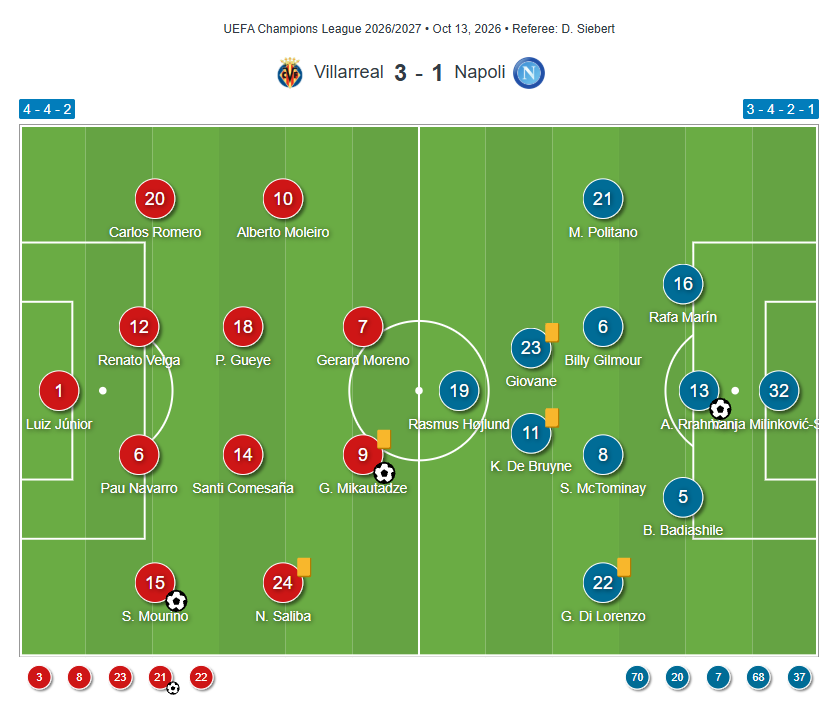
Villarreal Lineup Vs Napoli
Pérez opted for a usual 4-4-2 formation in this match, with Luiz Júnior as the goalkeeper, Santiago Mouriño as a right-back, Pau Navarro and Renato Veiga as centre-backs, and Carlos Romero as a left-back.
In midfield, he used Santi Comesaña and Pape Gueye as central midfielders, with Alberto Moleiro and Nathan-Dylan Saliba on the wings, and both Georges Mikautadze and Gerard Moreno forming the attacking duo.
Napoli Lineup Vs Villarreal
Allegri started the match using a 3-4-2-1 formation with Vanja Milinković-Savić in goal, and a back three made up of Rafa Marín, Amir Rrahmani, and Benoît Badiashile, from right to left.
In midfield, he used Billy Gilmour and Scott McTominay as central midfielders, with Matteo Politano and Giovanni Di Lorenzo as wing-backs.
For the attacking line, Allegri preferred to rely on both Giovane and Kevin De Bruyne as wide playmakers/second strikers in support of Rasmus Højlund, and that was an idea that Allegri wanted to use to make his team’s high press more effective, especially since Giovane has been reliable in this regard.
Allegri wanted to exploit Giovane’s positive recent run of form following his participation in the latest Serie A game and particularly his ability to press in an intense way and be explosive in counterattacks.
However, the organisation that Allegri used in attack limited some of the players’ performances, notably that of Giovane, De Bruyne, and Di Lorenzo.
Napoli Attacking Difficulties
From the start of the match, Allegri showed a different use of Giovane, as he used him as a left wide playmaker who retreats a lot in the defensive phase and gets closer to Højlund in some attacking situations only.
This limited the performance of Giovane, as he was not used in his best position (the second striker), apart from the fact that he had to play on the left wing, a side that does not allow him to be as dangerous as when he plays as an inverted winger.
Allegri tried to keep De Bruyne as close as possible to Højlund, given that he was the one who advanced more often to get near the main striker, as opposed to the midfield line, which was made up of Gilmour, McTominay, Politano, and Giovane.
However, De Bruyne was instructed to lean more often towards the right wing, an area that does not let De Bruyne perform at his best either.
It appears that Allegri wanted to fix this positioning issue during the match, but there was a lack of understanding between him and his player, as Allegri wanted De Bruyne to re-position himself in his most natural role, the advanced playmaker.
However, De Bruyne did not get his head coach’s idea in time, and that caused more confusion within Napoli’s attacking line.
At the back, Allegri used another line of four, with Di Lorenzo being used on the left flank to form a defensive line of four when out of possession.
That said, the use of Di Lorenzo out of his natural position was also a tactical tweak that Napoli did not need, since it impacted the team’s attacking and playmaking organisation, as the team lost the advancing possibilities and overlap attempts of Di Lorenzo from the right wing just to help in forming a more defensive back-four.
Given the absence of Mathías Olivera, Allegri could have opted for a more balanced choice in order to not impact the team’s playmaking potential, as using a player like Leonardo Spinazzola would have been much more useful, as he is already experienced in playing off the left.
The excuse given to the media for not using Spinazzola in that position was fatigue.
At the same time, this does not make the choice correct simply because the coaching staff decided to use Spinazzola for the previous Serie A fixture against Frosinone at the expense of the away UEFA Champions League fixture.
This means that Allegri and the coaching staff either prioritised the Serie A game over the UEFA Champions League match in terms of player choices, or did not evaluate their players’ conditions with attention before playing that Serie A match.
In either case, the decision was not successful as the use of Di Lorenzo on the left impacted the team’s attacking performance.
Allegri also had the possibility of using a more attacking-oriented left wing-back like Noa Lang and instructing him to be disciplined defensively, as Lang is used to playing as an inverted winger and would surely be much more dangerous than Di Lorenzo in that position.
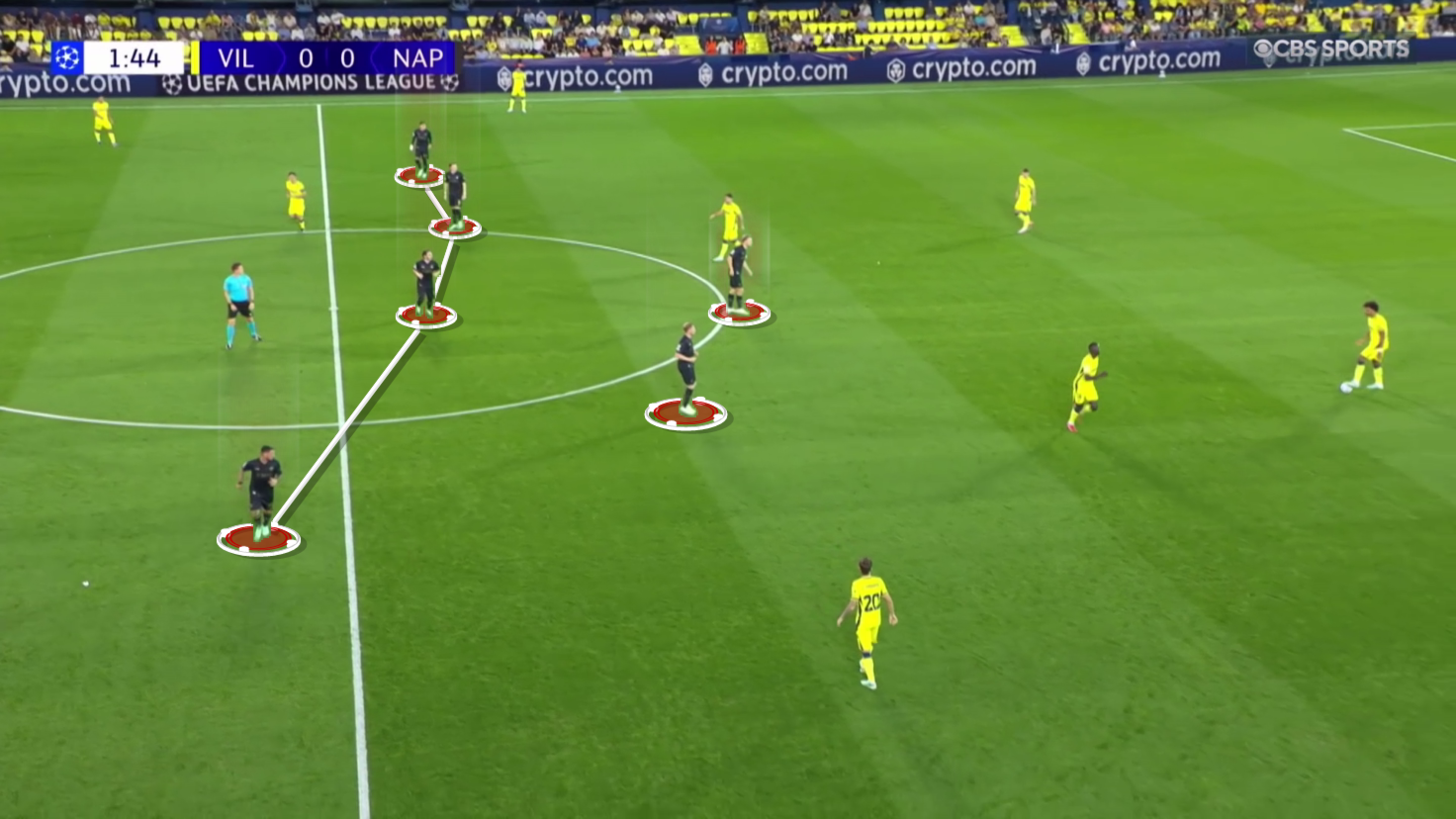
Napoli Set-Piece Solution
Napoli were successful in applying their set-piece plan for this match with accuracy from the first attempt, in a way that surprised Villarreal’s defenders, who looked unready for Napoli’s corner combination.
The idea was to make the third receiver of the ball following the execution of the corner cross towards the far post.
This third man was Gilmour, and he was intelligent enough to pretend as if he was going to shoot on goal before launching an accurate cross towards the far post.
Rrahmani’s abilities in offensive aerial duels are no longer a surprise, as the player has always been dangerous in this regard, hence Villarreal’s crucial error in marking the Napoli defender.
![Manchester City Vs PSG [2-4] Champions League 2026/2027: How Luis Enrique Tactics Controlled The Key Moments - Tactical Analysis](https://cdn.mymidnight.blog/77f959f119f4fb2321e9ce801e2f5163/size/w600/2026/10/Manchester-City-Vs-PSG---Tactical-Analysis.png)
![Borussia Dortmund Vs Werder Bremen [2-2] Bundesliga 2026/2027: How Daniel Thioune Tactics Earned A Late Comeback With 29% Possession - Tactical Analysis](https://cdn.mymidnight.blog/77f959f119f4fb2321e9ce801e2f5163/size/w600/2026/10/Borussia-Dortmund-vs-Werder-Bremen---Tactical-Analysis.png)
![Croatia Vs Spain [1-2] UEFA Nations League 2026/2027: How Slaven Bilić High Pressing Tactics Troubled Spain - Tactical Analysis](https://cdn.mymidnight.blog/77f959f119f4fb2321e9ce801e2f5163/size/w600/2026/10/Croatia-Vs-Spain--1-2--UEFA-Nations-League-20262027---Tactical-Analysis.png)

![Scotland Vs Switzerland [0-3] UEFA Nations League 2026/2027: How Aggressive Pressing Backfired & Murat Yakin Took Advantage - Tactical Analysis](https://cdn.mymidnight.blog/77f959f119f4fb2321e9ce801e2f5163/size/w600/2026/10/Scotland-Vs-Switzerland-20262027---Tactical-Analysis.png)
![Olympique De Marseille Vs PSG [1-2] Ligue 1 2026/2027: How Bruno Génésio Transitions Troubled PSG - Tactical Analysis](https://cdn.mymidnight.blog/77f959f119f4fb2321e9ce801e2f5163/size/w600/2026/09/Marseille-Vs-PSG-2026_2027---Tactical-Analysis.png)
![Fulham Vs Manchester United [1-1] Premier League 2026/2027: How Álvaro Arbeloa Tactics Exposed The Red Devils' Problems - Tactical Analysis](https://cdn.mymidnight.blog/77f959f119f4fb2321e9ce801e2f5163/size/w600/2026/09/Fulham-FC-Vs-Man-United-2026_2027---Tactical-Analysis.png)
![AS Roma Vs Inter Milan [2-2] Serie A 2026/2027: When Undefeated Giallorossi Attack Met Nerazzurri Comeback Resilience - Tactical Analysis](https://cdn.mymidnight.blog/77f959f119f4fb2321e9ce801e2f5163/size/w600/2026/09/AS-Roma-Vs-Inter-Milan-2026_2027---Tactical-Analysis.png)