
![Manchester City Vs PSG [2-4] Champions League 2026/2027: How Luis Enrique Tactics Controlled The Key Moments - Tactical Analysis](https://cdn.mymidnight.blog/77f959f119f4fb2321e9ce801e2f5163/size/w1000/2026/10/Manchester-City-Vs-PSG---Tactical-Analysis.png)
Manchester City Vs PSG [2-4] Champions League 2026/2027: How Luis Enrique Tactics Controlled The Key Moments - Tactical Analysis
PSG stunned Manchester City 4-2 at the Etihad with first-half dominance, quick transitions and collective attacking play. This tactical analysis examines how Luis Enrique exposed Enzo Maresca’s high press and defensive structure.

Manchester City hosted PSG at the Etihad Stadium for one of the most exciting European clashes in Gameweek 2 of the UEFA Champions League, and it was an entertaining game that ended with a 2-4 win for Les Parisiens.
PSG surprised Man City with an intense first-half performance that saw them score three goals and dominate the game in a way that confused Manchester City and prevented them from being dangerous in attack.
PSG dominated possession and resisted the Citizens’ high-pressing attempts very well, and that contributed to helping them prevent their opponent from attacking in the way they wanted and from imposing their game.
PSG looked more dangerous than Manchester City during the key moments, as Luis Enrique looked more prepared tactically to counter Enzo Maresca’s ideas and match plan; that was obvious during the match.
PSG’s remarkable team play and chemistry between the players inside the final third made the difference on many occasions.
With this win, PSG consolidated their top spot in the UEFA Champions League standings with two wins out of two, establishing that they remain the favourites to lift the trophy for a third season in a row.
For Manchester City, the painful loss against the title holders put them in 17th position, a spot that still qualifies them for the playoffs.
However, it is believed that a team like Manchester City has what it takes to bounce back in the coming fixtures and make up for this loss quickly, and why not challenge PSG for the top spot too?
In this Manchester City vs PSG tactical analysis, we examine how and why PSG succeeded in overcoming the Manchester City test and how their first-half dominance made the difference in this match.
Manchester City Vs PSG Lineups & Formations
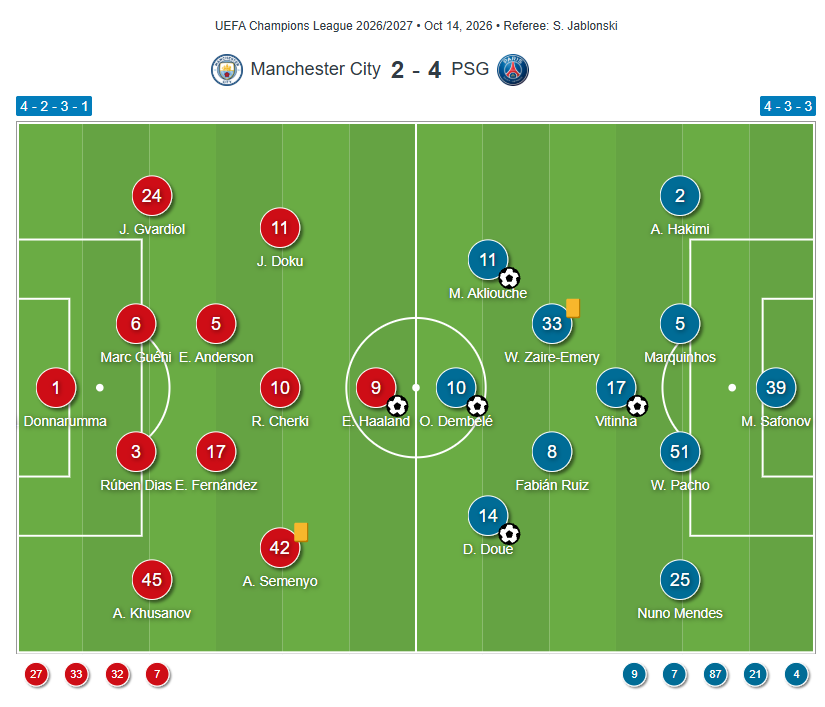
Manchester City Lineup Vs PSG
Maresca started the match using the 4-2-3-1 formation with Gianluigi Donnarumma as a goalkeeper, Abdukodir Khusanov as a right-back, Rúben Dias and Marc Guéhi as centre-backs, and Joško Gvardiol as a left-back.
The midfield was made up of Enzo Fernández and Elliot Anderson as central midfielders, Jérémy Doku and Antoine Semenyo on the wings, Rayan Cherki as the advanced playmaker, and Erling Haaland as the main striker.
PSG Lineup Vs Manchester City
For PSG, Enrique chose to start with the 4-3-3 formation with Matvey Safonov as the goalkeeper, and a defensive line made up of Achraf Hakimi as the right-back, Marquinhos and Willian Pacho as centre-backs, and Nuno Mendes as the left-back.
In midfield, Enrique relied on the usual midfield trio: Vitinha, Fabián Ruiz, and Warren Zaïre-Emery.
And in attack, he surprised Manchester City with the use of Désiré Doué on the left wing instead of Khvicha Kvaratskhelia, Maghnes Akliouche on the right wing, and Ousmane Dembélé as the main striker/false nine.
Enzo Maresca Insufficient Defensive Changes Vs PSG Attacking Transition Threats
Maresca decided to be extra defensive in terms of the choices of his back four in this match, knowing that his team was facing a side known for their dangerous abilities on both wings, especially during counterattacks.
That’s why Maresca opted to use both Gvardiol and Khusanov, who have experience in playing mainly as centre-backs.
This was done by Maresca to try to limit the threats of Hakimi, Mendes, Doué, and Akliouche, as he knew that relying on Nico O'Reilly and Matheus Nunes on the flanks would have been a riskier choice.
He opted to use two static centre-backs in those roles, and the idea was to avoid conceding counterattacks with numerical superiority to PSG as well as ensuring more aggressive/tight marking on the wingers.
However, these changes in the defensive line were not sufficient to prevent PSG from scoring, as the main problem that Manchester City suffered from, especially in the first goal action, was the high-line consequences when failing in the high-press attempts and the absence of double marking during such quick attacking transitions from PSG.
Manchester City paid the price for adopting a high-pressing plan, as this allowed PSG to launch their usual quick attacking transitions and rely on one of the wingers to finish the action.
In this goal action, it was Doué who did the job as he was obviously not double-marked during this attacking transition.
As he received the ball from Ruiz following some excellent build-up, Doué found himself in a situation that was favourable for shooting from distance.
His quick decision-making and ability to exploit spaces and the time he had with the ball allowed him to find the necessary shooting trajectory as he pretended to go for a curved shot towards the far post, then surprised Donnarumma with a powerful shot towards the near post instead.
The quick switch of play made by Akliouche and Ruiz was crucial in helping Doué get the time needed to prepare himself and execute his shot before Manchester City players surrounded him.
In fact, when PSG were advancing from the right wing, only Khusanov and Diaz were holding the backline, and that contributed to making PSG’s attack very dangerous, as the rest were unable to retreat on time.
Manchester City took a risk with their high-pressing plan and got punished for this risk-taking early in the match, mainly due to the quality of PSG’s players in attack and in playmaking from such situations that require quick transitions and quick switches of play.
![Villarreal Vs Napoli [3-1] Champions League 2026/2027: How Iñigo Pérez Tactics Exploited Massimiliano Allegri Mistakes - Tactical Analysis](https://cdn.mymidnight.blog/77f959f119f4fb2321e9ce801e2f5163/size/w600/2026/10/Villarreal-Vs-Napoli---Tactical-Analysis.png)
![Borussia Dortmund Vs Werder Bremen [2-2] Bundesliga 2026/2027: How Daniel Thioune Tactics Earned A Late Comeback With 29% Possession - Tactical Analysis](https://cdn.mymidnight.blog/77f959f119f4fb2321e9ce801e2f5163/size/w600/2026/10/Borussia-Dortmund-vs-Werder-Bremen---Tactical-Analysis.png)
![Croatia Vs Spain [1-2] UEFA Nations League 2026/2027: How Slaven Bilić High Pressing Tactics Troubled Spain - Tactical Analysis](https://cdn.mymidnight.blog/77f959f119f4fb2321e9ce801e2f5163/size/w600/2026/10/Croatia-Vs-Spain--1-2--UEFA-Nations-League-20262027---Tactical-Analysis.png)

![Scotland Vs Switzerland [0-3] UEFA Nations League 2026/2027: How Aggressive Pressing Backfired & Murat Yakin Took Advantage - Tactical Analysis](https://cdn.mymidnight.blog/77f959f119f4fb2321e9ce801e2f5163/size/w600/2026/10/Scotland-Vs-Switzerland-20262027---Tactical-Analysis.png)
![Olympique De Marseille Vs PSG [1-2] Ligue 1 2026/2027: How Bruno Génésio Transitions Troubled PSG - Tactical Analysis](https://cdn.mymidnight.blog/77f959f119f4fb2321e9ce801e2f5163/size/w600/2026/09/Marseille-Vs-PSG-2026_2027---Tactical-Analysis.png)
![Fulham Vs Manchester United [1-1] Premier League 2026/2027: How Álvaro Arbeloa Tactics Exposed The Red Devils' Problems - Tactical Analysis](https://cdn.mymidnight.blog/77f959f119f4fb2321e9ce801e2f5163/size/w600/2026/09/Fulham-FC-Vs-Man-United-2026_2027---Tactical-Analysis.png)
![AS Roma Vs Inter Milan [2-2] Serie A 2026/2027: When Undefeated Giallorossi Attack Met Nerazzurri Comeback Resilience - Tactical Analysis](https://cdn.mymidnight.blog/77f959f119f4fb2321e9ce801e2f5163/size/w600/2026/09/AS-Roma-Vs-Inter-Milan-2026_2027---Tactical-Analysis.png)