PSG Vs Barcelona [4–2] – Champions League 2026/2027: PSG Attacking Persistence Exposes Barcelona Defensive Problems – Tactical Analysis
PSG beat Barcelona 4-2 after repeatedly winning the ball high and exploiting defensive weaknesses. This tactical analysis examines their high recoveries, rushed finishing, counterattacks and how Luis Enrique’s side eventually punished Barcelona.

PSG hosted Barcelona for Gameweek Three of the 2026/2027 UEFA Champions League, and the match ended with an entertaining 4-2 win for Les Parisiens.
It is a win that puts PSG at the top of the standings in the league phase, with nine points so far.
As for Hansi Flick’s side, the team’s loss against PSG keeps them on six points, holding the eighth spot with all of Como, Manchester City, Club Brugge, Sporting CP, and Borussia Dortmund.
In fact, the loss against Luis Enrique’s side came at the worst possible time as it precedes their clash in La Liga against their rivals, Real Madrid, in El Clásico.
The loss in this match, therefore, disturbs the positive streak that the team was on and puts them in doubt ahead of that decisive match, something that Flick obviously would have liked to avoid.
What makes the loss even more painful for Barcelona is that they were able to equalise twice before PSG took the advantage again in the 81st minute, meaning that Barcelona’s breakdown only happened in the final minutes of the match.
In this tactical analysis, we examine PSG’s attacking performance and how their high press and high recoveries helped them make the difference against Barcelona’s shaky defence.
The analysis will also look at why PSG didn’t score earlier and how they could have exploited their opportunities in a more clinical way.
PSG Vs Barcelona Lineups & Formations
PSG Lineup Vs Barcelona
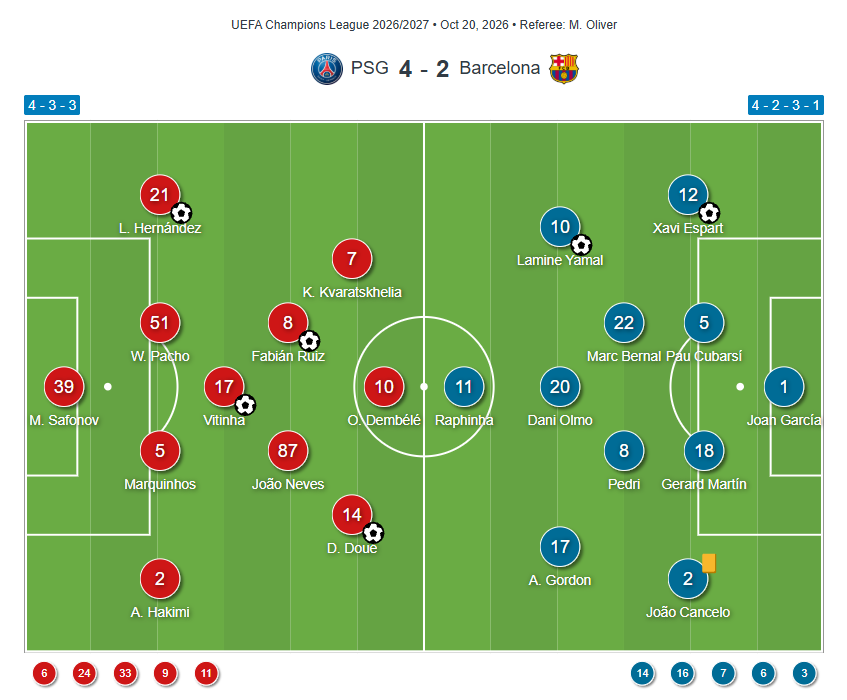
Enrique preferred to start the match using a 4-3-3 formation with Matvey Safonov as the goalkeeper, and a defensive line made up of Achraf Hakimi at right-back, Marquinhos and Willian Pacho at centre-back, and Lucas Hernández at left-back.
In midfield, Enrique relied on the following midfield trio: Vitinha, Fabián Ruiz, and João Neves.
In attack, he opted to use Désiré Doué on the right wing while relying on Khvicha Kvaratskhelia on the left wing.
Enrique used Ousmane Dembélé up front, before subbing him for Ferran Torres due to injury.
Barcelona Lineup Vs PSG
On the other hand, Flick used a 4-2-3-1 formation for this match, with Joan García in goal, a back four of Pau Cubarsí and Gerard Martín at centre-back, with both Xavi Espart and João Cancelo at full-back.
The midfield was made up of Pedri and Marc Bernal as central midfielders, with Dani Olmo as the advanced playmaker.
In attack, Barcelona deployed Anthony Gordon and Lamine Yamal as wingers, with Raphinha as the team’s main striker.
PSG High Recoveries
The match started in an immediate, intense way, with both teams trying to gain the advantage in terms of possession and imposing an effective high press.
PSG were extremely dynamic and explosive in their high-pressing attempts; that helped them make dangerous high recoveries from the beginning and get very close to scoring.
In fact, PSG spent more focused energy on making successful high recoveries inside Barcelona’s own half, while being less decisive in the second part of these actions.
To put it more simply, PSG failed to convert their high recoveries into goals during the opening minutes.
The following video highlights the superiority of PSG in the midfield duels and the impact of Ruiz, Neves, and Vitinha when applying tight marking on their direct opponents and anticipating potential passes.
In this action, Neves remained very close to Olmo until he got the chance to anticipate a pass coming his way.
However, as Neves provided a vertical pass to Dembelé, the latter failed to opt for the best possible solution as he went to shoot from distance without much conviction.
This was easy for Barcelona’s goalkeeper to save, knowing that he could provide an assist to Doué, who was providing an excellent passing solution and who was unmarked when Dembelé got the ball.