
Luis De La Fuente Tactics At Spain 2026: From European Champions To World Cup Favourites – Tactical Analysis
The Spanish National Team are widely regarded as one of the leading contenders to win the 2026 FIFA World Cup, following their triumph at the 2024 European Championship in Germany.

Who Is Luis De La Fuente?
The Spanish National Team are widely regarded as one of the leading contenders to win the 2026 FIFA World Cup, following their triumph at the 2024 European Championship in Germany.
This success reaffirmed their position among international football’s elite, while the presence of exceptional individual quality, including Lamine Yamal and Ballon d’Or winner Rodri, further strengthens their credentials heading into the tournament.
This World Cup tactical analysis of Luis de la Fuente's Spain examines their approach both in and out of possession.
It will assess the tactical features underpinning their status as one of the competition’s most formidable sides, while also considering where potential vulnerabilities may emerge in their overall approach.
Spain Tactics In Possession
Spain’s in-possession approach is rooted in positional play, with a strong emphasis on triangles, occupation of key zones, and control of the ball, rhythm, and tempo.
Possession is not used passively; Spain look to move the ball, move the opposition, and attack the spaces created.
While positional play remains the foundation, Luis de la Fuente’s side also blend this with greater verticality, showing a willingness to play in behind more often than might be expected.
Notably, Spain tactics are less reactive to the changing context of matches than many international sides, often maintaining their possession-based principles regardless of scoreline or momentum.
Spain usually build in a 4-3-3, with a holding midfielder positioned to support circulation, as illustrated in Figure 1.
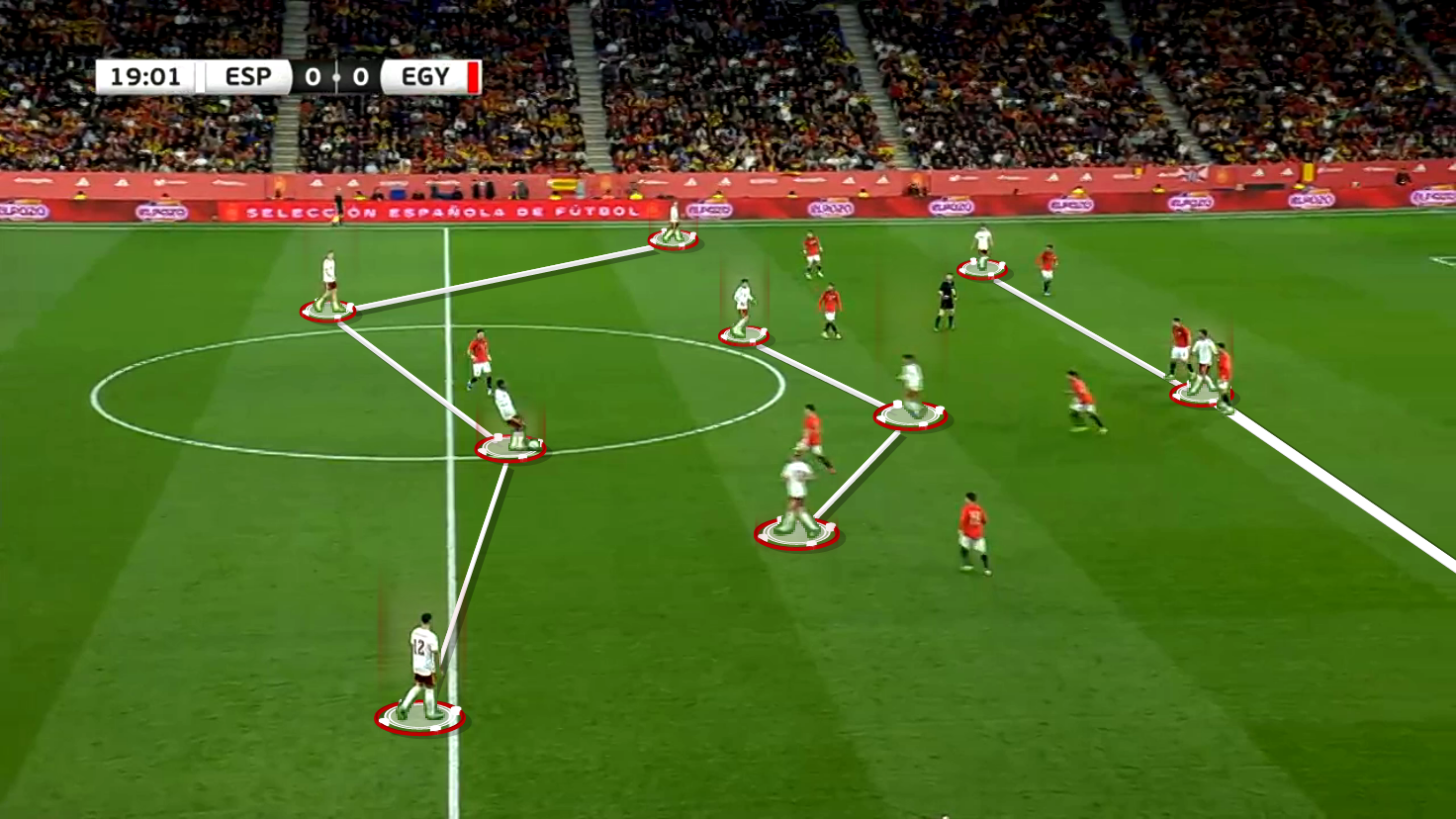
In moments of sustained pressure, this can develop into a higher 3-2-5 or 2-3-5 structure, where five players occupy the last line and the supporting players provide rest-defence coverage behind the attack, a dynamic highlighted in Figure 2.
These structures are less fixed in international football, where automatisms are harder to develop, but the key principle is clear: Spain seek to maintain occupation of the last line while preserving balance behind the ball.
The midfield is typically staggered across two vertical planes, often as a 1-2 but sometimes as a 2-1, allowing Spain to maintain passing angles and avoid flat central structures.
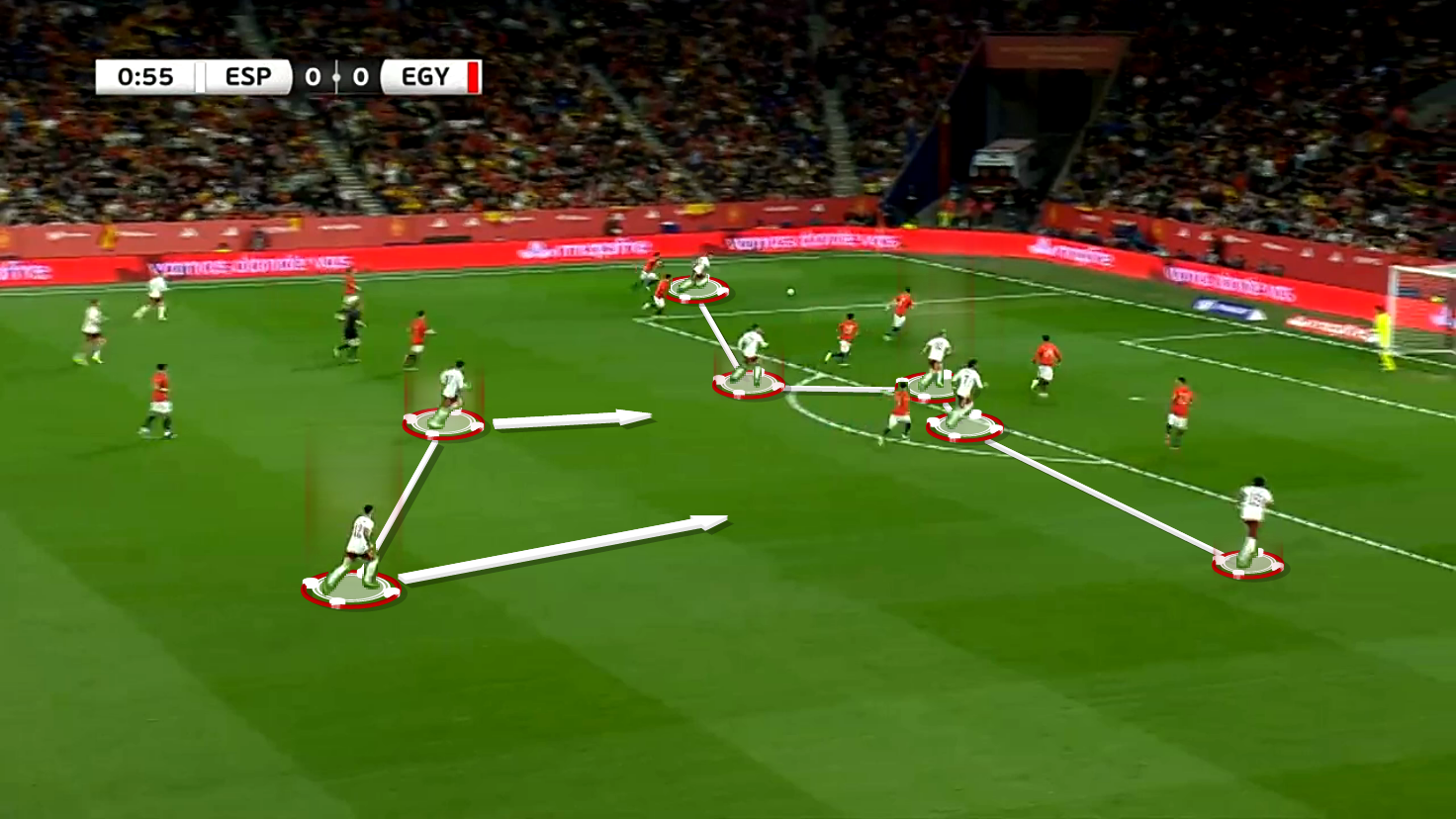
Rotations are central to their possession game.
Players can vacate zones as long as those zones are filled by others, ensuring the overall structure remains intact.
This is particularly important because Spain do not always use a traditional No. 9.
The striker may drop into midfield, but another player must then occupy the last line to preserve depth and maintain the attacking shape.
In build-up, Spain can be expansive, with relatively large distances between players.
This stretches the opposition press but demands elite technical quality, which Spain generally possesses.
Their centre-backs are encouraged to drive forward with the ball, attract pressure, and release passes between or beyond the lines.
This “attract to isolate” principle can be risky if the vacated space is not covered, but it also allows Spain to access dangerous areas quickly.
The full-backs are also important to Spain’s progression.
They can stay wide, rotate vertically with the wingers, or attack beyond the last line, sometimes becoming the players who deliver crosses.
At other moments, a full-back may invert or drive inside to support central areas and help protect against counterattacks.
Spain’s wide players provide a major source of chance creation.
Lamine Yamal and Nico Williams offer outstanding 1v1 quality, often forcing opponents to double up out wide.
This opens space centrally and in behind, while also giving Spain a powerful outlet in transition.
Yamal, in particular, can drive inside or play disguised passes from wide areas.
When opponents defend deeper to avoid being played through, Spain rely heavily on these creative wide players to unbalance compact blocks.
The more frequently they can isolate these players in advanced wide areas, channels, or behind the defensive line, the more threatening Spain become.
As a result, injuries to Yamal or Williams would significantly reduce one of their biggest attacking strengths.
Spain are difficult to press man-for-man because of the technical quality of their defenders and midfielders, the constant maintenance of triangles, and the threat of outlets beyond the press.
Central midfielders can also drop between centre-back and full-back to recycle possession, increase numbers in the first line, and create alternative build-up angles.
In sustained pressure, Spain can generate high attacking volume, although this may not always translate into high-quality chances.
They can commit several players into the box on crosses, sometimes up to five, which may compensate for the absence of a fixed traditional No. 9.
Behind the attack, rest-defence is essential.
Because Spain commit players high and allow rotations, they must keep enough coverage to defend counters.
Their counterpressing is therefore closely connected to their possession structure, helping them regain the ball quickly and continue circulating possession.
Spain Tactics Out Of Possession
Out of possession, Spain often defend from a 4-4-2 structure, with one central midfielder pushing higher to join the striker in the first line of pressure, as demonstrated in Figure 3.