Oliver Glasner Tactics At Crystal Palace 2025/2026: Can Corners Decide The UEFA Conference League Final? – Set-Piece Analysis

Crystal Palace are going to face Rayo Vallecano in the UEFA Conference League Final, aiming to win the first major European trophy in their history.
In these final matches, both teams always care about every fine margin, which can make the difference and decide the match.
Set-pieces are no longer merely minor details; they have become an integral part of the game.
In the UEFA Conference League, Oliver Glasner's side has the highest xG from set plays (7.35), having scored five goals (the second-highest, after AEK Athens with six).
In the Premier League, they have the fourth-highest xG from set plays (17.21)
In this set-piece analysis, we will explain the Eagles' tactics in attacking corners, showing how they are dangerous, simple and diverse.
Crystal Palace Far-Post Tactics
As a general attacking structure, Crystal Palace attack corners with six players inside the box, two on the edge of the box and a security player to defend counterattacks.
The six players inside the box are divided into two groups: three players in the six-yard box and three players near the penalty spot.
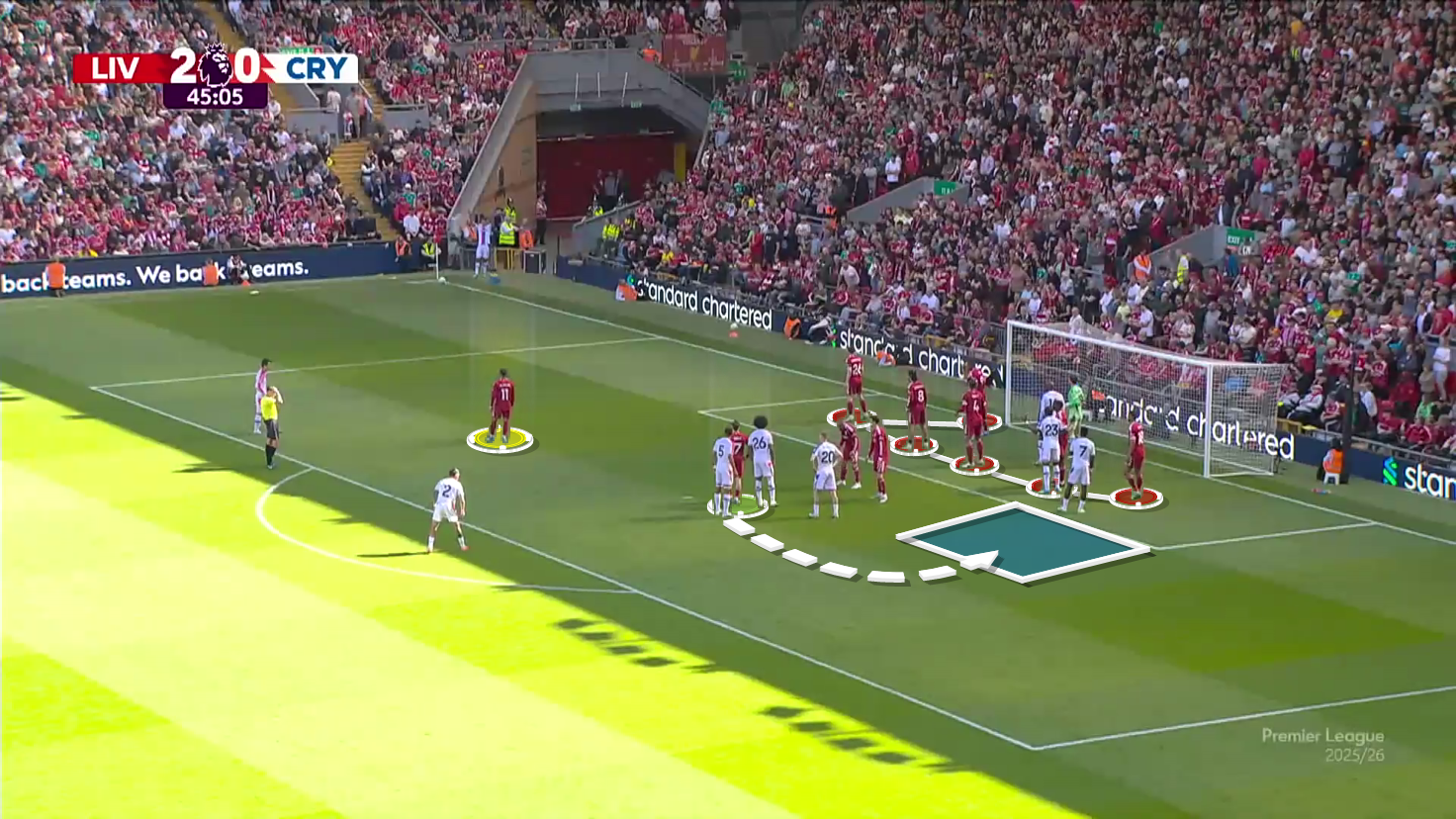
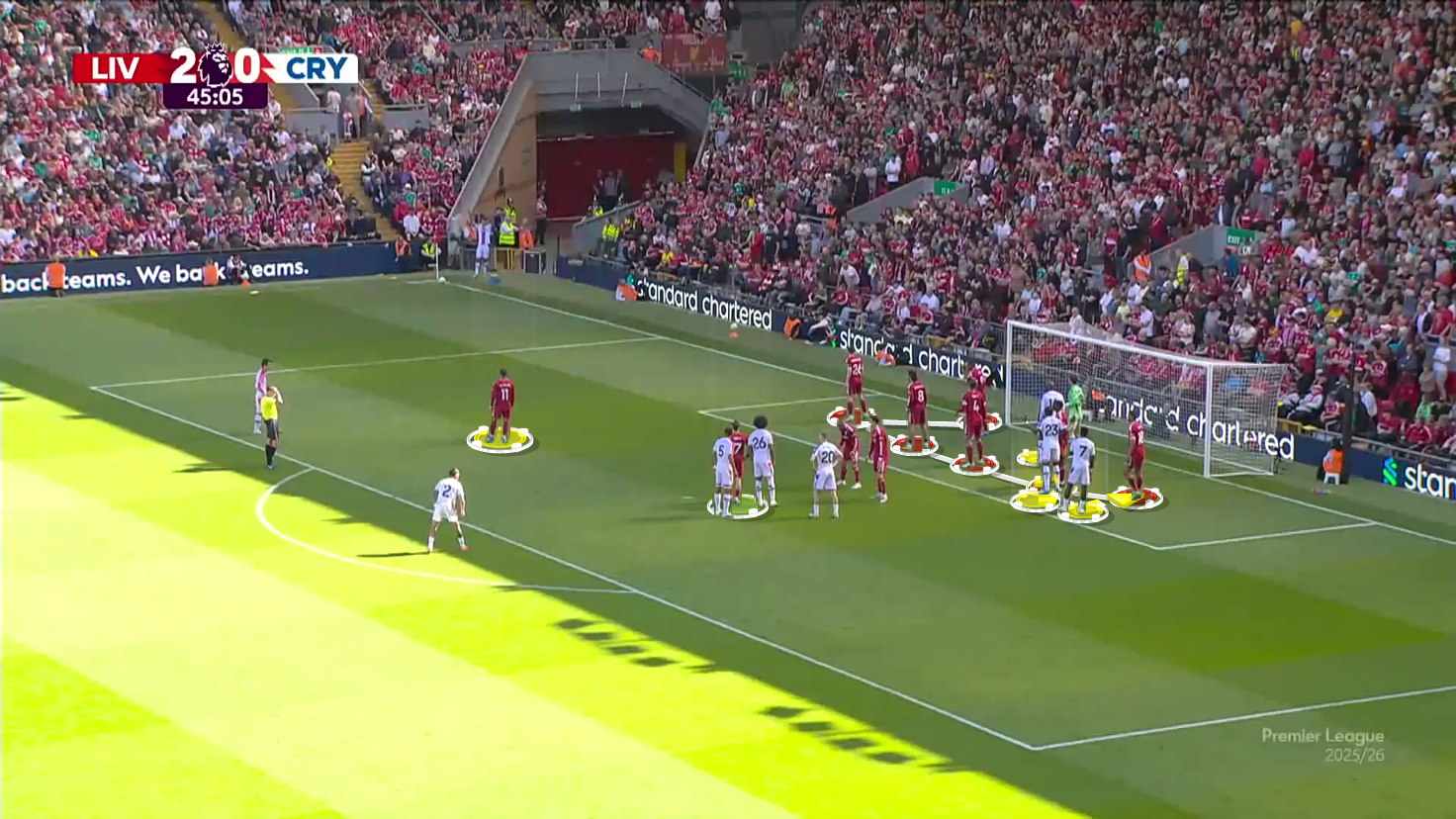
In Figure 1 below, Liverpool defend with six zonal defenders (red), two awaiting man-markers, a player for short corners (yellow) and a player for the rebound (green).
Crystal Palace target the highlighted area with the player in white.
To target this area, you have three obstacles:
- The last two zonal defenders
- The goalkeeper, who may go to claim the cross in the air
- Making the targeted player free from marking
Figure 2 below shows that three yellow players are solving the first two obstacles, a player will block the goalkeeper, and two players will block the last two zonal defenders.
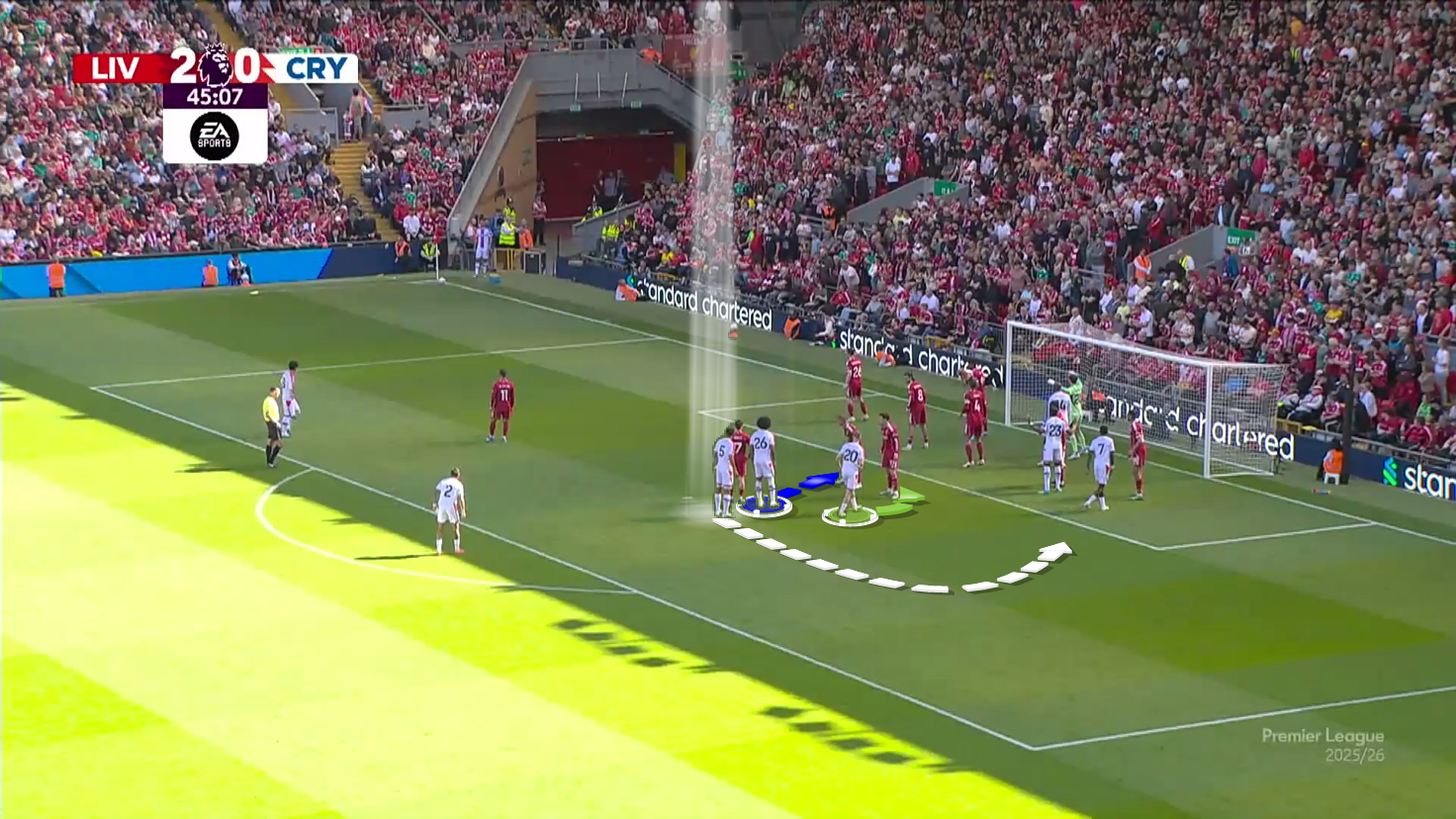
Going to the last obstacles, Figure 3 shows that the targeted player starts a little bit behind the other two attackers, who will run before him.
The first attacker (blue) runs toward the near post, dragging a man-marker with him, while the other attacker (green) runs in a curved way to block the other man-marker.
All is set in Figure 4 below, and now the targeted player is free to run towards the protected target area.
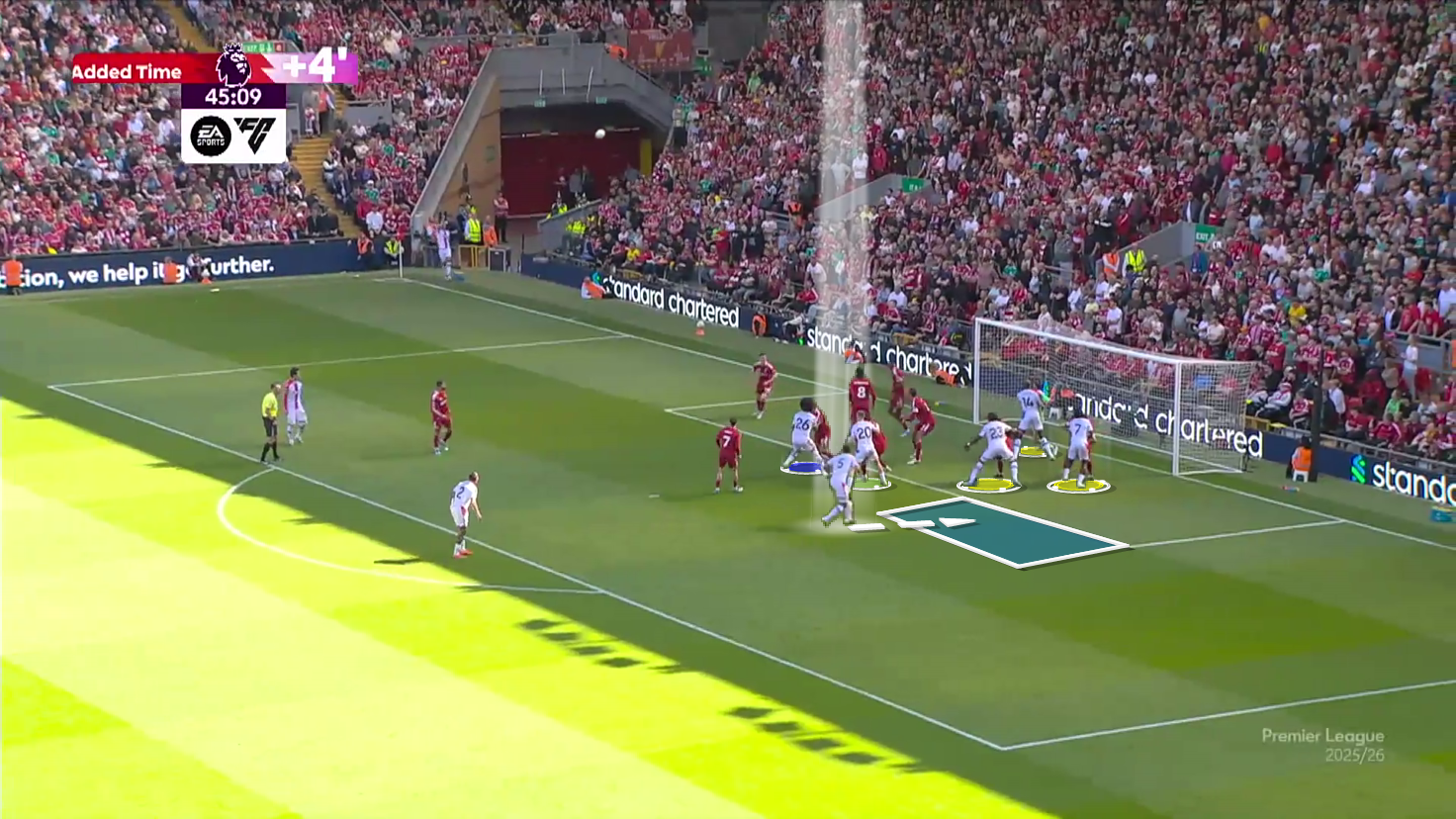
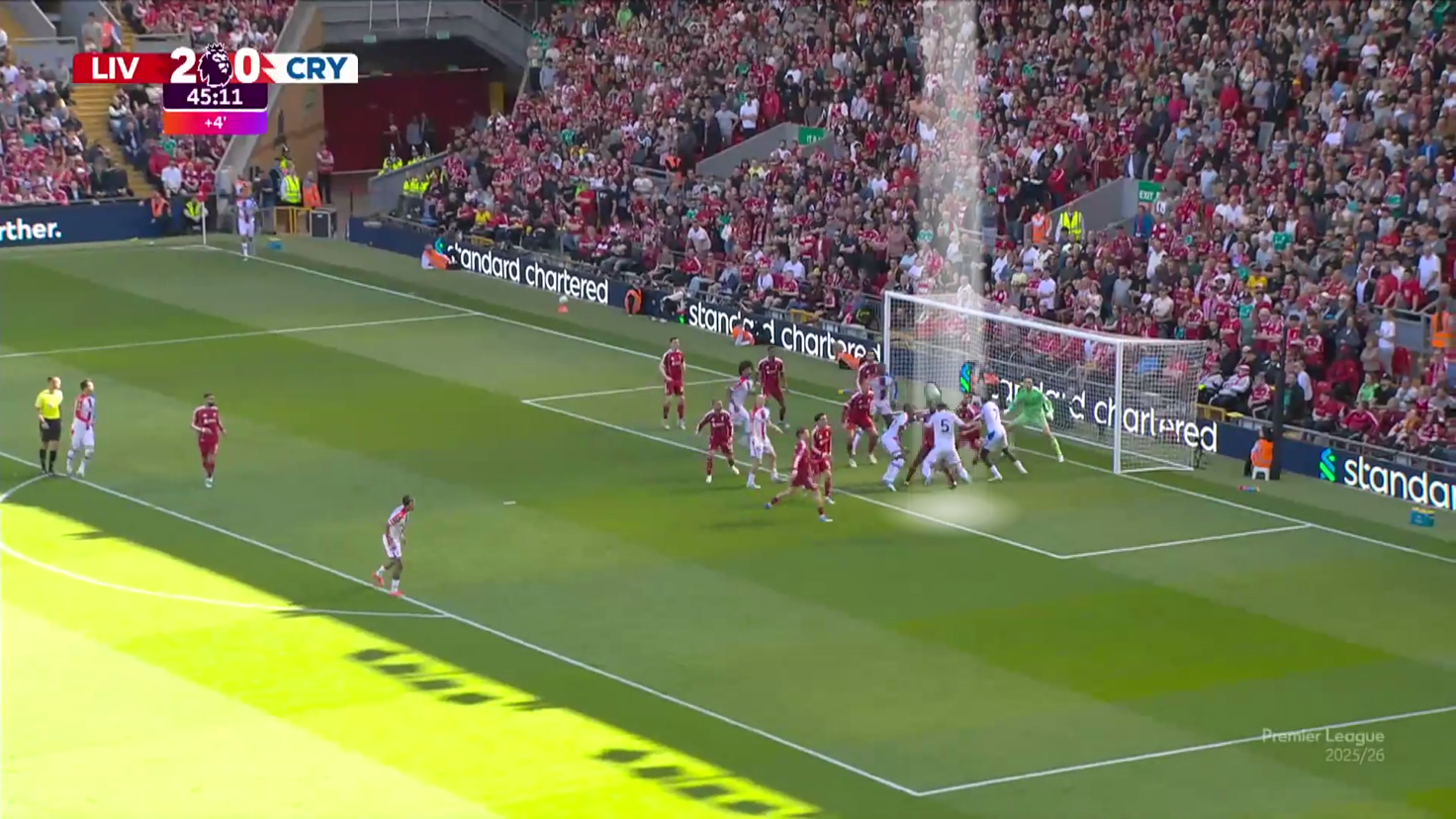
Figure 5 below shows that Crystal Palace's other attackers frame the goal, so you can, for example, see the player standing near the goalkeeper, turning his body towards the ball and stepping back to avoid being offside.
In the end, it leads to a dangerous chance.
Going to see how they deal when the three attackers near the penalty spot have three man-markers, we will see how they scored against Chelsea.
As in Figure 6 below, Chelsea defend with four zonal defenders (red), five man-markers and a player for the rebound (green).
Crystal Palace want to target the same area with the same position of the last runner (white).
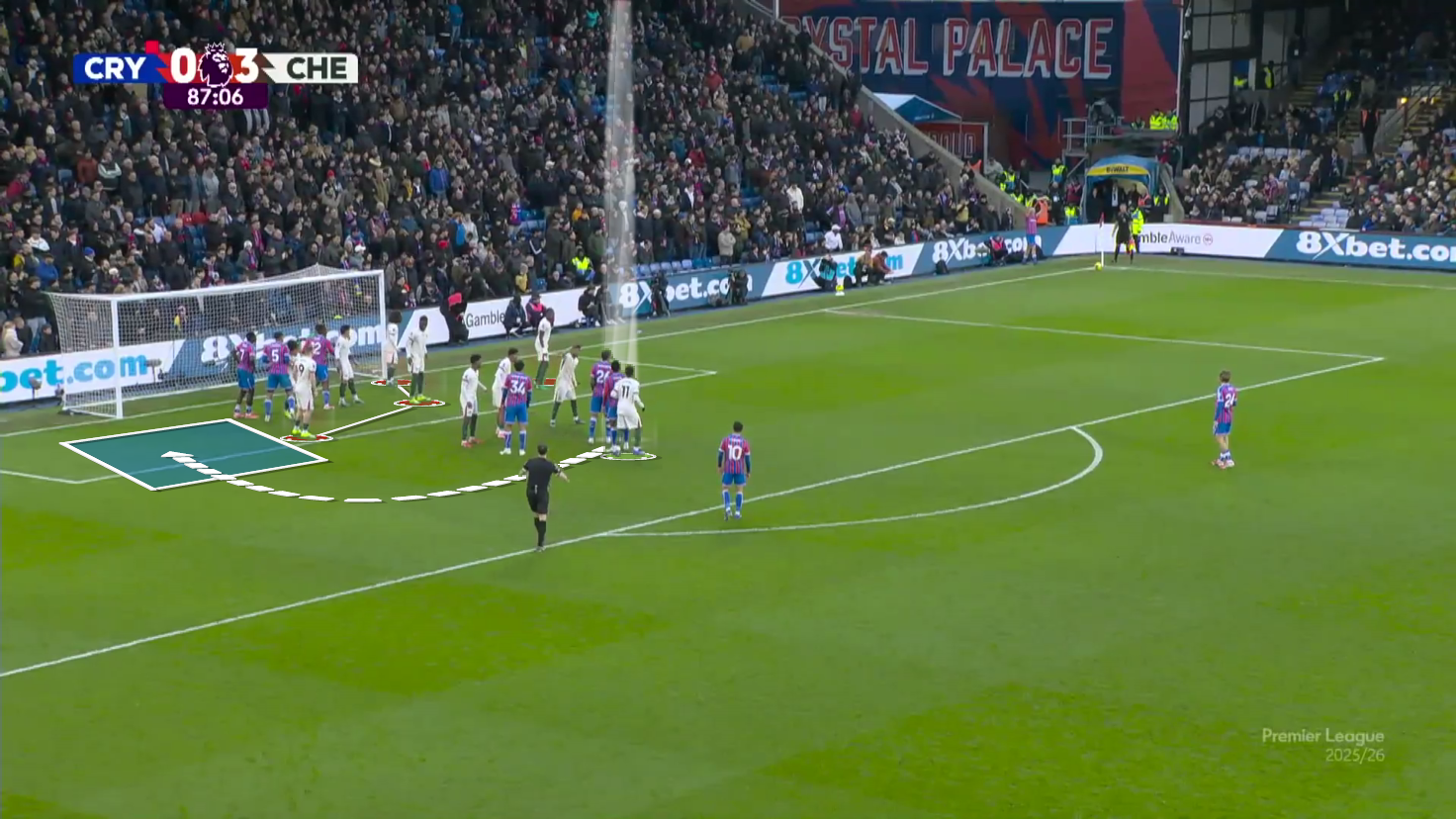
Note: Crystal Palace have a red card, but they dispense with the security player at the back, following the same strategy with six players in the box.
We see the three yellow usual blocks from the three players inside the six-yard box.
Two players position themselves to block the goalkeeper's path to the ball, preventing him from claiming it.
The last yellow player suddenly turns from the last zonal defender's blind side to block him.
Going to the targeted player, let's see how they may deal with it when they play against equal awaiting man-markers.
The targeted player starts in the middle, a little bit back, while the other two players (blue) go to block the two man-markers on the two sides.
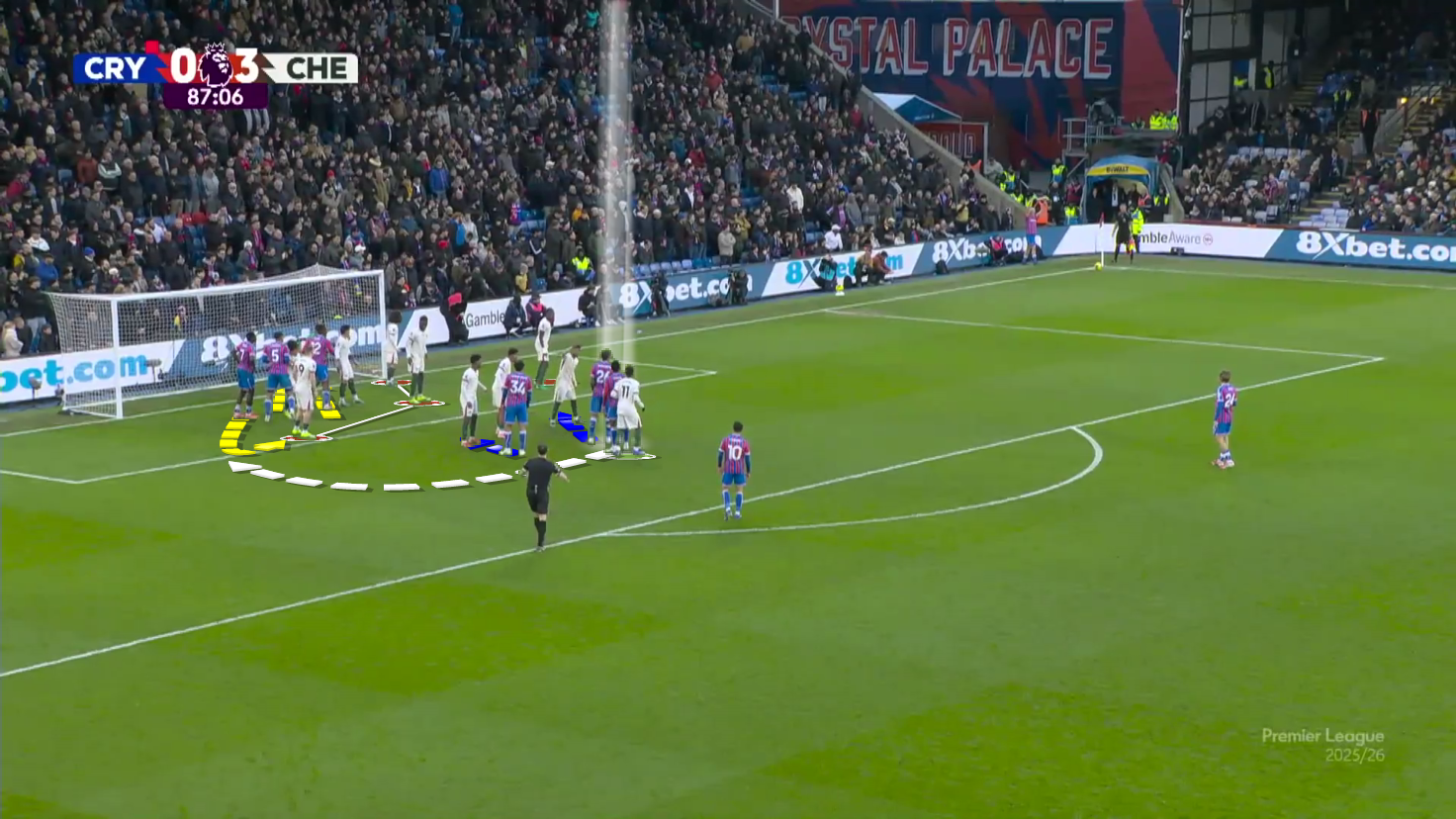
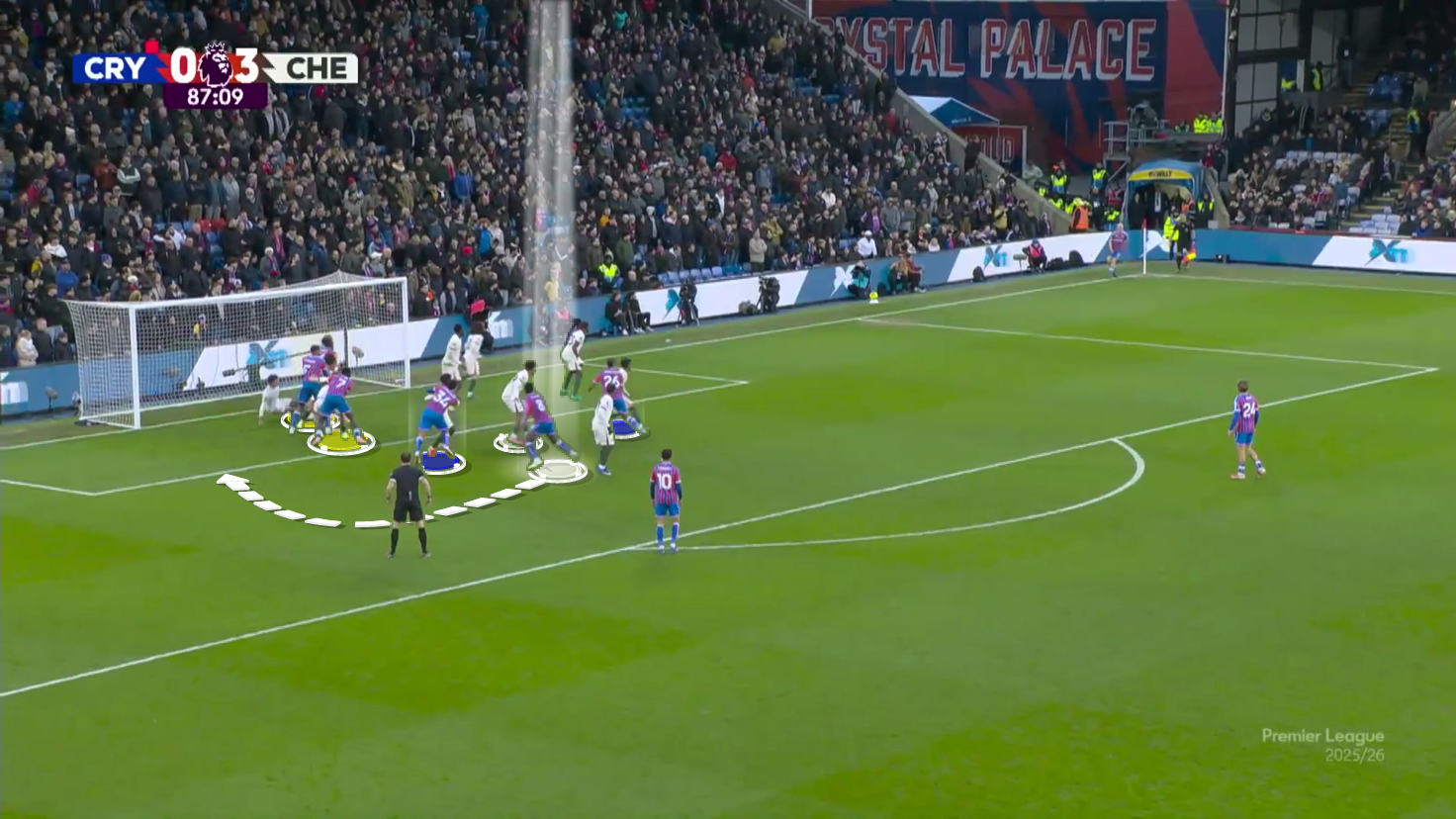
As shown below, the middle man-marker finds it difficult to track the cross in the air and the curved run of the targeted player at the same time.
Hence, he is forced to run with his back, losing the attacker or turn around facing the attacker and lose tracking the ball.
This is called an orientation problem, common in American football and Rugby.
The plan works, and the result is a goal.
They follow a similar strategy when they face teams that defend with fewer zonal defenders, depending more on tight man-markers, like Rayo Vallecano.
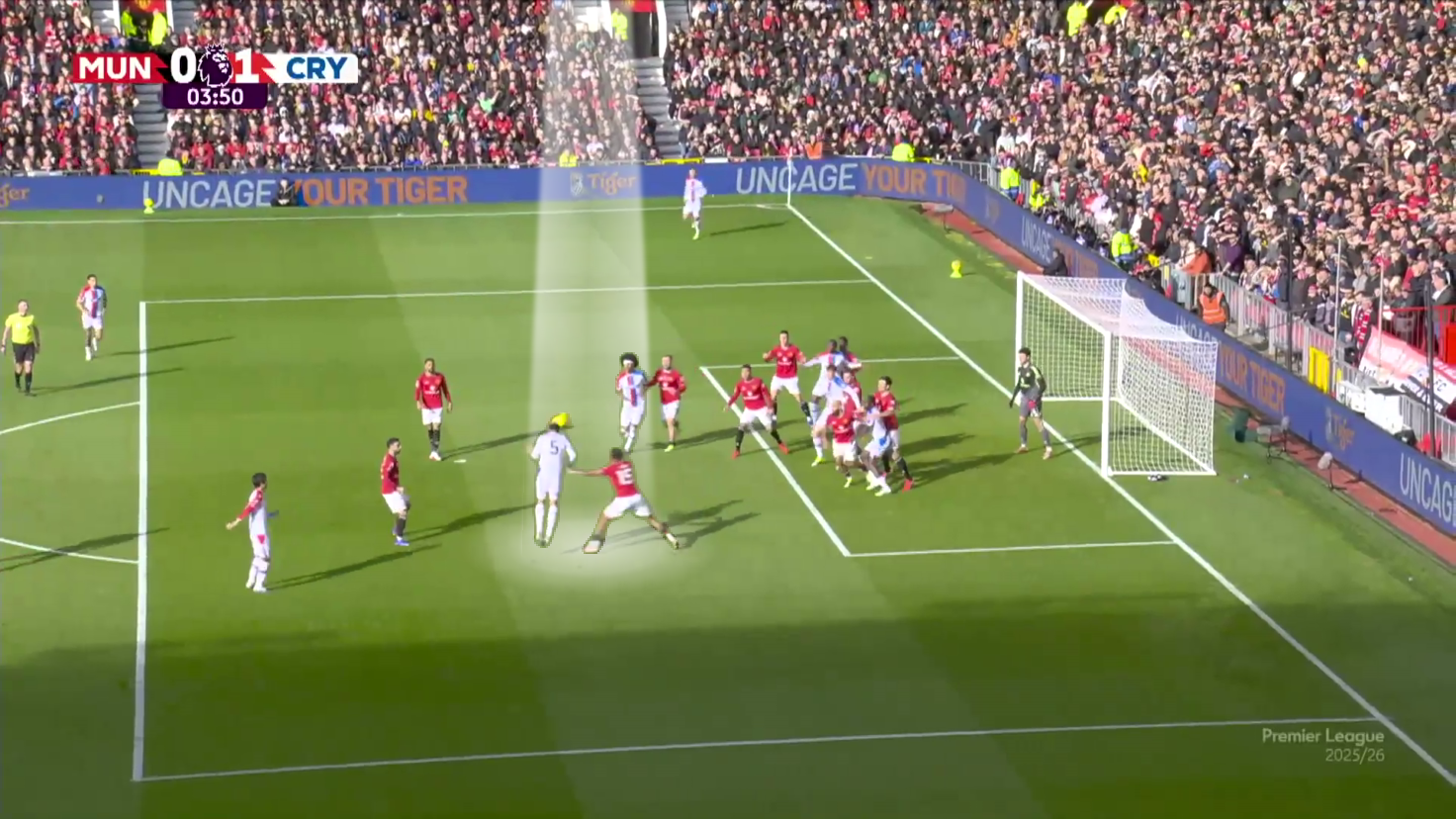
As in Figure 9 below, Manchester United defend with three zonal defenders (red), six man-markers and a rebound player (green).
Here, the man-markers are so tight, not waiting in a second line.
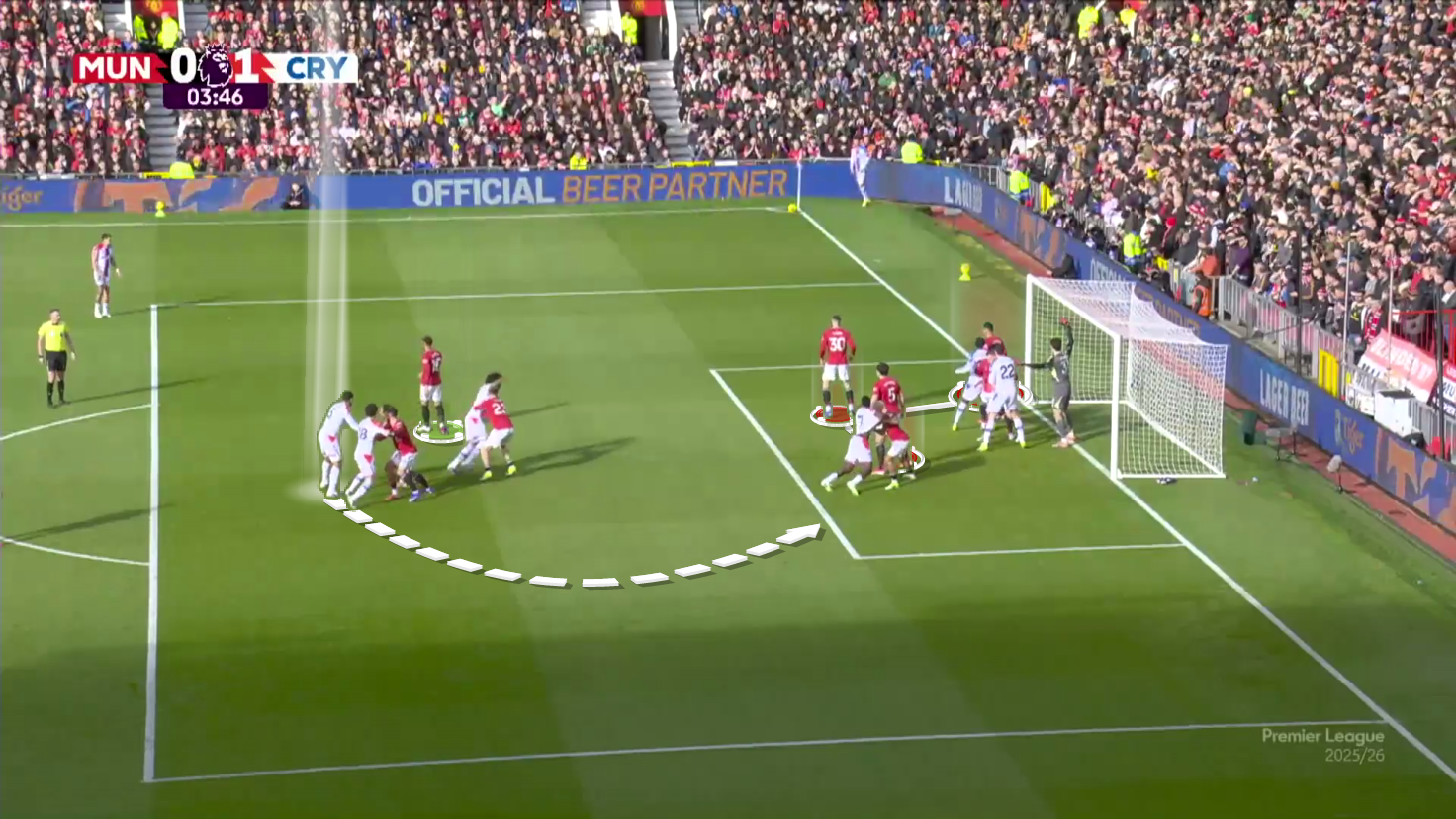
Let's see how they deal with tight man-markers when every attacker has a man a marker.
As in Figure 10 below, the three yellow players inside the box have the same role, while the targeted player (white) stands shoulder-to-shoulder with his mate (blue).
He turns around his mate, while his mate pushes his man-marker towards the targeted player's man-marker, trying to delay him from tracking the targeted player.
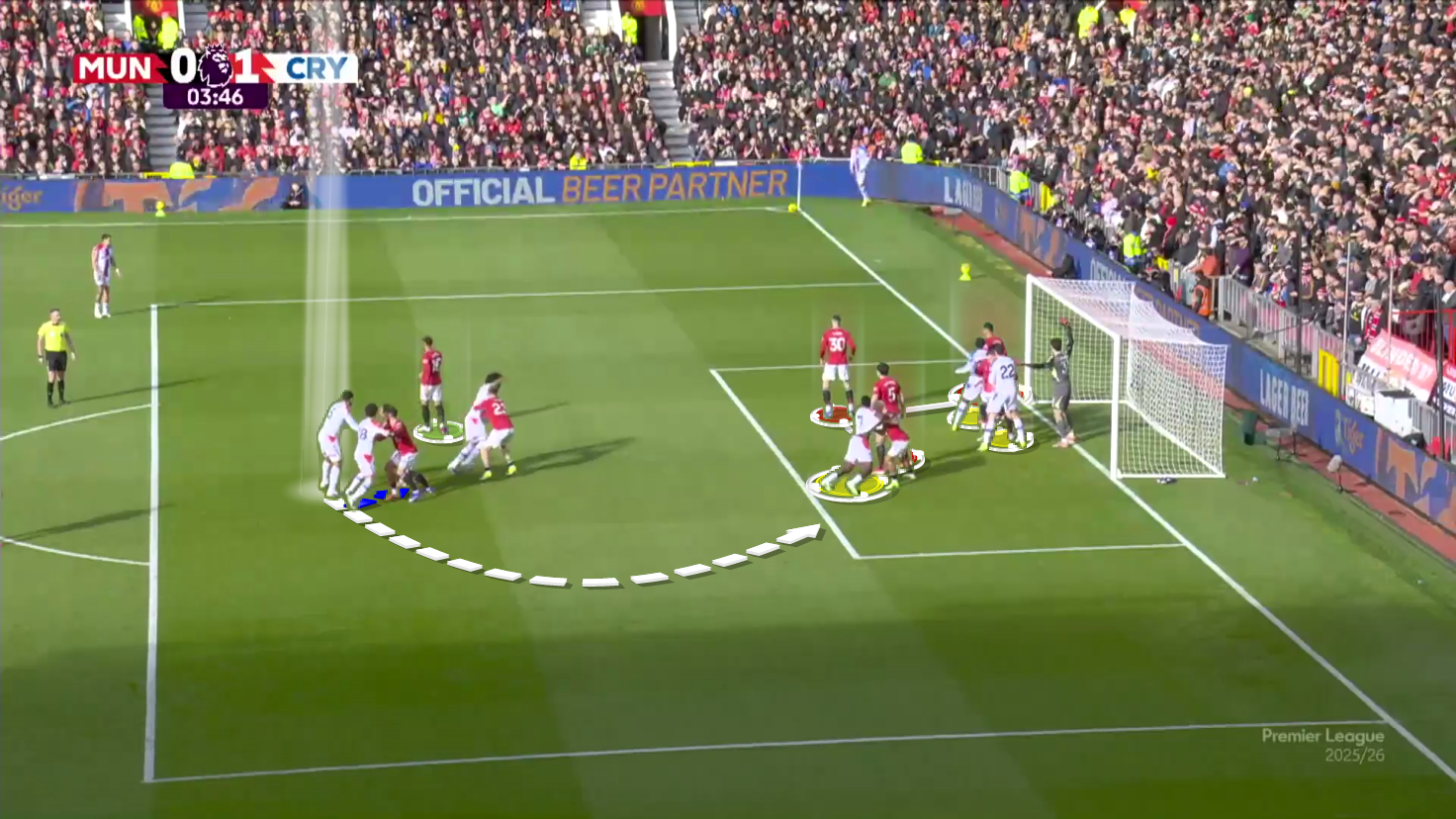
The targeted player's man-marker can escape from this push, but he is forced to turn around the blue player, trying to face the targeted player from the other side, as in Figure 11.
However, you can find them separated for moments, which is useful for the attacker to escape.
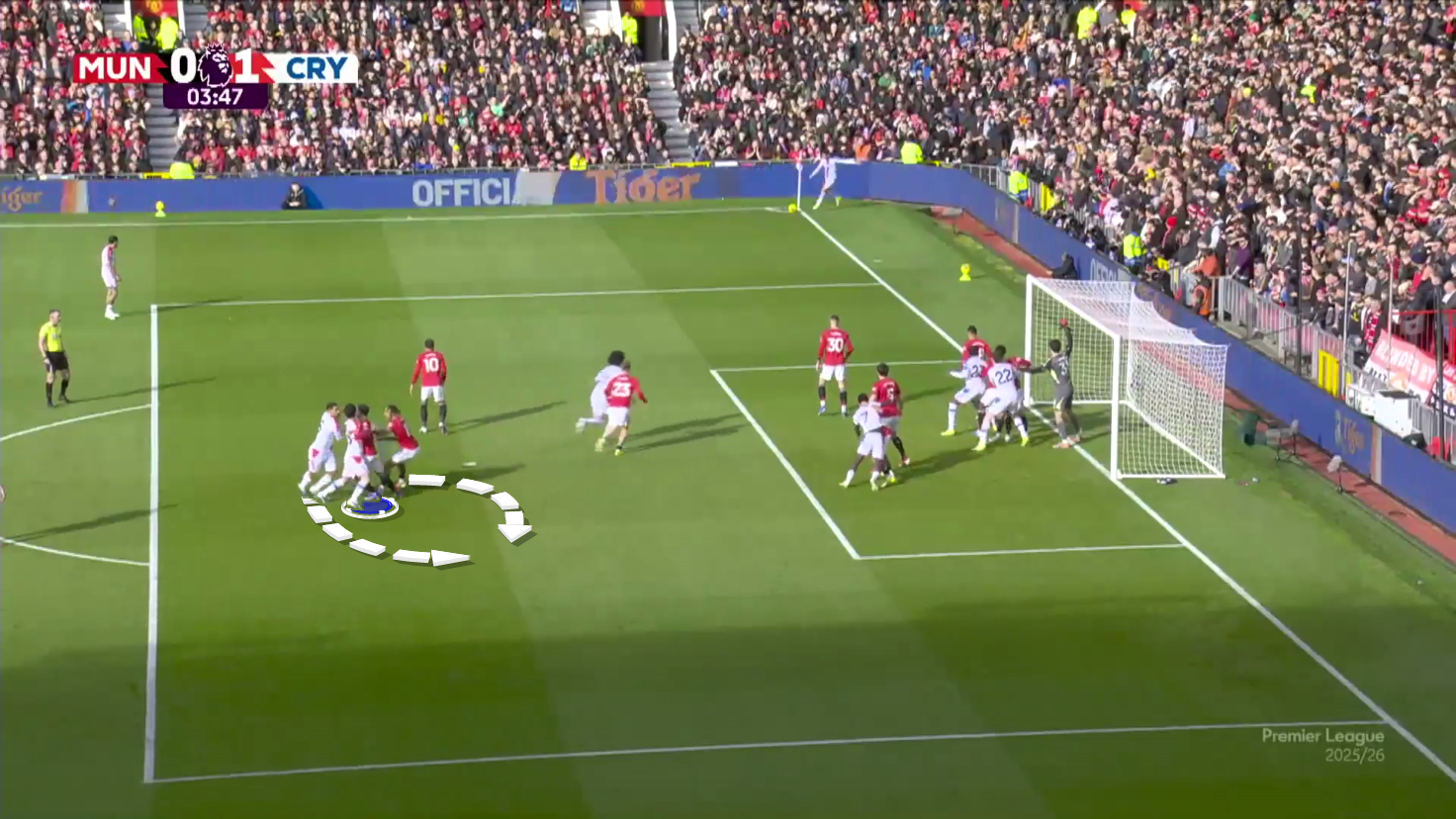
The other problem is the orientation problem, because the man-marker gives his back to the ball.
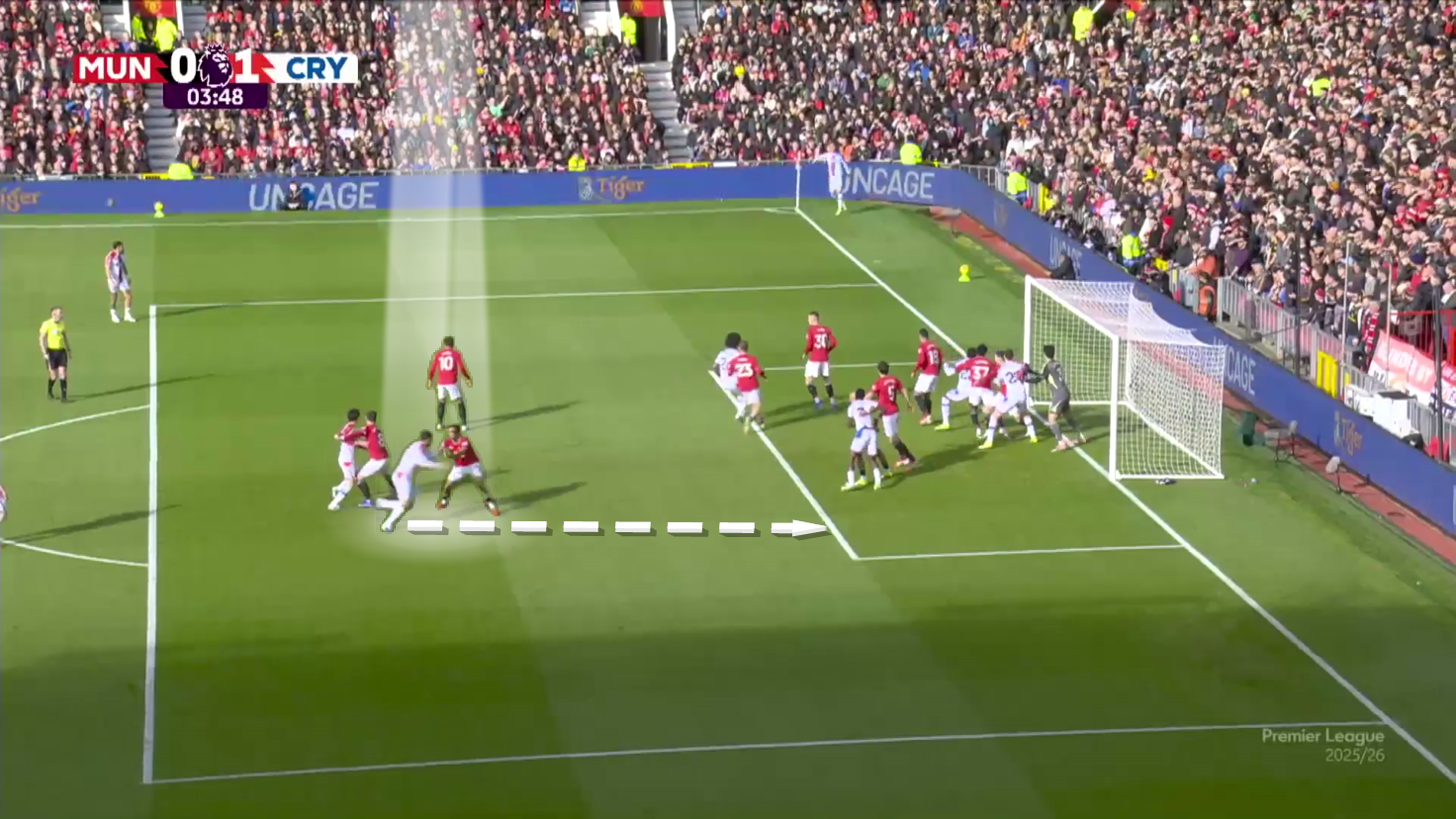
Figure 13 shows how the man-marker needs to take a look at the ball, and here, he loses the targeted player totally.
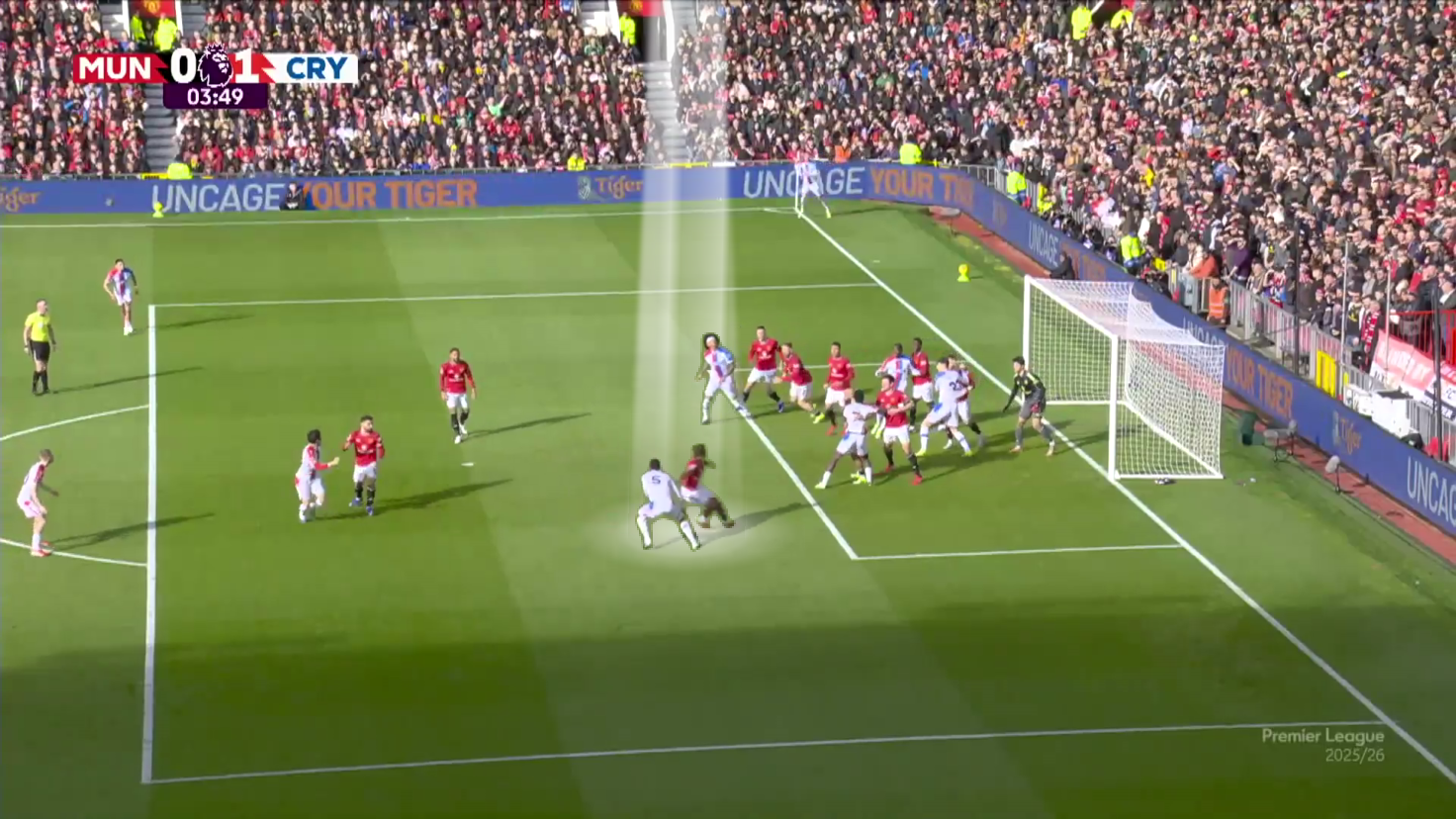
Figure 14 shows that the plan works and the result is a goal.