
![Croatia Vs Spain [1-2] UEFA Nations League 2026/2027: How Slaven Bilić High Pressing Tactics Troubled Spain - Tactical Analysis](https://cdn.mymidnight.blog/77f959f119f4fb2321e9ce801e2f5163/size/w1000/2026/10/Croatia-Vs-Spain--1-2--UEFA-Nations-League-20262027---Tactical-Analysis.png)
Croatia Vs Spain [1-2] UEFA Nations League 2026/2027: How Slaven Bilić High Pressing Tactics Troubled Spain - Tactical Analysis
Croatia pushed Spain to the limit despite losing 2-1. This tactical analysis examines Slaven Bilić’s compact defending, aggressive high press and vertical transitions, while showing how Croatia exploited Spain’s pressing structure.

Croatia hosted Spain at Stadion Poljud for their fourth fixture of the 2026/2027 UEFA Nations League group stage, and the match ended with a 1-2 win for the visitors following a challenging contest.
It was complicated for Spain mainly because they encountered a completely different version of Croatia compared to the team’s performance against England.
Croatia were successful in delivering a reaction against Spain as they got very close to winning the match or at least getting a point against the world champions, before they suffered a red card that impacted the team’s defensive performance and eventually contributed to a loss.
It counts for Spain that they did not stop believing in their ability to complete a comeback despite Croatia’s organised defence and dangerous attacking transitions.
Though Spain failed to really threaten Croatia’s goal, they were progressively able to pose a threat, especially during the second half, and continued doing so until they pushed Croatia’s players to commit crucial errors inside their penalty box.
Luis de la Fuente’s side confirmed once again that they are not world champions for nothing.
They reminded everyone that they know how to win difficult away matches, even when they do not perform in the best possible way, or rather, when opponents do not let them apply their match plan in their desired way.
In this Croatia vs Spain tactical analysis, we focus mainly on Slaven Bilić’s tactics and how his side relied on an intense high press, compact defending, and vertical passing in attacking transitions to punish Spain.
Croatia Vs Spain Lineups & Formations
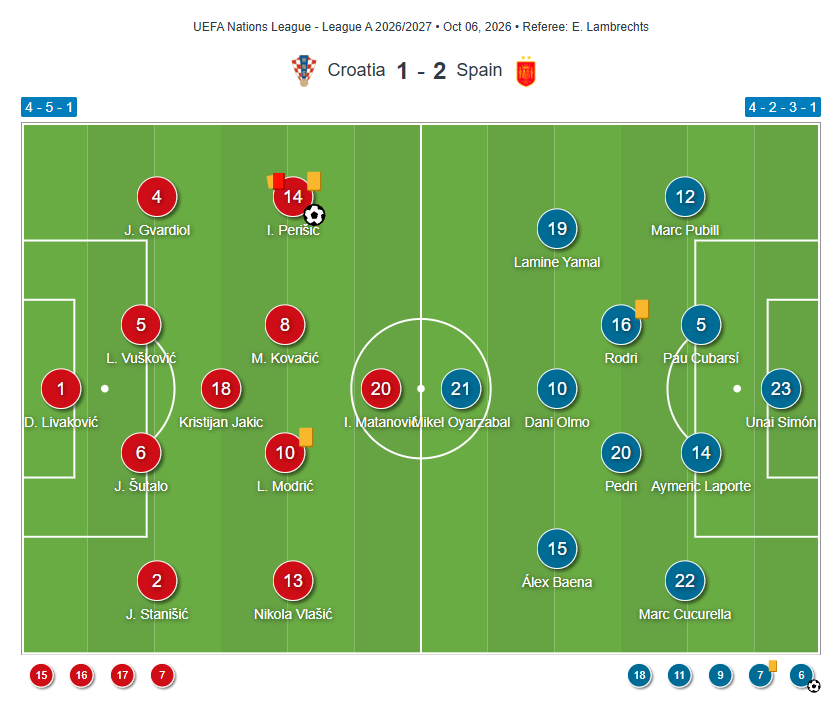
Croatia Lineup Vs Spain
Bilić used a 4-5-1 formation with Dominik Livaković as a goalkeeper, Josip Stanišić at right-back, Josip Šutalo and Luka Vušković as centre-backs, and Joško Gvardiol at left-back.
The midfield was made up of Luka Modrić, Kristijan Jakić, and Mateo Kovačić, with both Ivan Perišić and Nikola Vlašić playing as wingers and moving on the same line with the midfielders in the defensive phase, with Igor Matanović as the striker.
Spain Lineup Vs Croatia
On the other side, De La Fuente relied on a 4-2-3-1 formation with Unai Simón being the goalkeeper, Marc Pubill as the right-back, Pau Cubarsí and Aymeric Laporte as centre-backs, and Marc Cucurella as a left-back.
In midfield, De La Fuente used Rodri and Pedri as central midfielders, Dani Olmo as the advanced playmaker, Lamine Yamal and Álex Baena as wingers, with Mikel Oyarzabal being the team’s main striker.
Croatia Successful Initial Defensive Plan
Croatia's reaction to the England loss was tangible from the first minute against Spain, as they looked far more organised and compact, with all players making sure to retreat, including Vlašić and Perišić, who retreated automatically whenever Spain had possession.
This helped Croatia remain solid at the back and limit Spain’s dangerous counterattacks, and especially their reliance on the wings.
In fact, Croatia made sure to maintain close lines and a mid-block in order to prevent Spain from penetrating easily or finding quick passing solutions inside that final third.
This defensive plan worked for Croatia in the first period of the match, as it limited the threat of Yamal and Baena’s wing penetrations, knowing that Oyarzabal was also tightly marked by both Vušković and Šutalo.
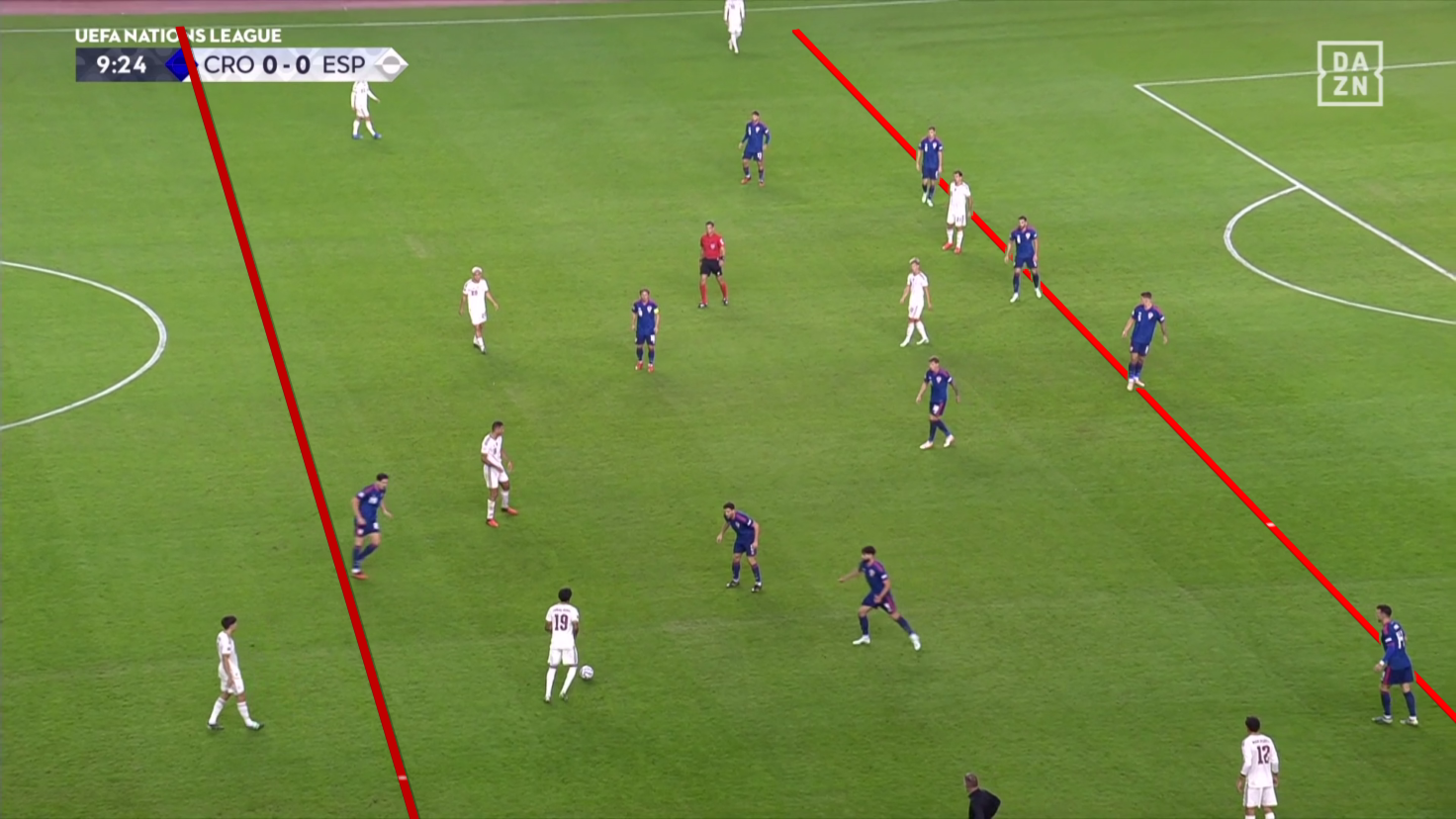
The following image highlights Croatia’s decision to defend compactly and tightly by keeping the defensive block away from the penalty box and trying to limit Spain’s options by making sure to apply tight man-marking on almost everyone in the Spanish team.
The hesitation of Yamal in this action when he was looking for a forward passing option is proof of Croatia’s correct and efficient defensive plan, knowing that Yamal was obliged to opt for a backward pass at that moment.
Croatia Intense/Aggressive High Press
Croatia’s initial defensive strategy was combined with an intelligent high-pressing plan aimed at disturbing Spain’s build-up from the back early in the game and preventing them from doing what they like most.
Croatia knew that Spain should not have the space and time needed to build up from the back without active, intense and aggressive disturbance; otherwise, they would progressively impose their game and prevent Croatia from having the ball, which also means tiring Croatia’s players by making them run after the ball most of the time.
For this reason, Croatia tried to counter Spain’s style of play by playing aggressively during their build-up from the back, to make high/mid recoveries and at the same time stress the Spanish players and make them play under continuous pressure.
The objective was also to provoke Spain’s players and force them to get more physical, something that suited the Croatian players, who were ready for such duels.
The following clip shows one of the perfect examples of Croatia’s aggressive high pressing, with Jakić disturbing Rodri, while Perišić and Matanović continue the pressing attempts and put Cucurella and Baena in trouble before Stanišić was able to intercept the ball.
Croatia were also able to turn their high pressure into dangerous attacks.
The experience, vision, and vertical passing skills of Modrić, combined with the crucial carries of Kovačić, made the difference in such attacks.
The only issue was that Croatia rushed their finishing to the point that they failed to finish their actions in an accurate and clinical way, especially when it came to their first attempts.

![Scotland Vs Switzerland [0-3] UEFA Nations League 2026/2027: How Aggressive Pressing Backfired & Murat Yakin Took Advantage - Tactical Analysis](https://cdn.mymidnight.blog/77f959f119f4fb2321e9ce801e2f5163/size/w600/2026/10/Scotland-Vs-Switzerland-20262027---Tactical-Analysis.png)
![Olympique De Marseille Vs PSG [1-2] Ligue 1 2026/2027: How Bruno Génésio Transitions Troubled PSG - Tactical Analysis](https://cdn.mymidnight.blog/77f959f119f4fb2321e9ce801e2f5163/size/w600/2026/09/Marseille-Vs-PSG-2026_2027---Tactical-Analysis.png)
![Fulham Vs Manchester United [1-1] Premier League 2026/2027: How Álvaro Arbeloa Tactics Exposed The Red Devils' Problems - Tactical Analysis](https://cdn.mymidnight.blog/77f959f119f4fb2321e9ce801e2f5163/size/w600/2026/09/Fulham-FC-Vs-Man-United-2026_2027---Tactical-Analysis.png)
![AS Roma Vs Inter Milan [2-2] Serie A 2026/2027: When Undefeated Giallorossi Attack Met Nerazzurri Comeback Resilience - Tactical Analysis](https://cdn.mymidnight.blog/77f959f119f4fb2321e9ce801e2f5163/size/w600/2026/09/AS-Roma-Vs-Inter-Milan-2026_2027---Tactical-Analysis.png)
![Real Sociedad Vs Bournemouth [1-2] Europa League 2026/2027: How Do Marco Rose Pressing Tactics Work? - Tactical Analysis](https://cdn.mymidnight.blog/77f959f119f4fb2321e9ce801e2f5163/size/w600/2026/09/Real-Sociedad-Vs-Bournemouth-20262027---Tactical-Analysis-1.png)
![AC Milan Vs Benfica [0-2] Europa League 2026/2027: How Marco Silva Tactics Exposed Rúben Amorim Defensive Problems - Tactical Analysis](https://cdn.mymidnight.blog/77f959f119f4fb2321e9ce801e2f5163/size/w600/2026/09/AC-Milan-Vs-Benfica-20262027---Tactical-Analysis.png)
![Sunderland Vs AZ Alkmaar [1-0] Europa League 2026/2027: Why The Black Cats Make Better Underdogs - Tactical Analysis](https://cdn.mymidnight.blog/77f959f119f4fb2321e9ce801e2f5163/size/w600/2026/09/Sunderland-Vs-AZ-Alkmaar-20262027---Tactical-Analysis.png)