
![Mexico Vs South Korea [1–0] – FIFA World Cup 2026: Javier Aguirre Wing Play Tactics – Tactical Analysis](https://cdn.mymidnight.blog/77f959f119f4fb2321e9ce801e2f5163/size/w1000/2026/06/Mexico-Vs-South-Korea-World-Cup-2026.png)
Mexico Vs South Korea [1–0] – FIFA World Cup 2026: Javier Aguirre Wing Play Tactics – Tactical Analysis

Mexico hosted South Korea at the Guadalajara Stadium for the second match of the 2026 FIFA World Cup group stage.
The hosts succeeded in beating their opponents 1-0 to secure their qualification to the knockout phase.
Mexico’s win comes following an initial victory over South Africa, which means that Mexico currently top Group A with six points, with South Korea second, the Czech Republic third, and South Africa fourth.
South Korea still have a good chance of finishing second in the group and therefore qualifying for the next phase, as they still have to face South Africa in the third game.
It will therefore be crucial for South Korea not to lose their last group-stage match to guarantee their qualification to the knockout phase.
The loss against Mexico means Hong Myung-bo’s side must wait until the last match to decide their future in this tournament.
Mexico continue to prove they can be a major player in this tournament, taking advantage of playing at home and aiming to prove they can disrupt any team.
Continuing to gain more confidence and improving their weaknesses would eventually help them a lot in case they face a very powerful team in the Round of 32 or in the later stages.
In this World Cup tactical analysis article, we focus mainly on Mexico’s attacking performance, their reliance on wingers, their post-goal counterattacking plans, and what they need to improve in attack.
Mexico Vs South Africa Lineups & Formations
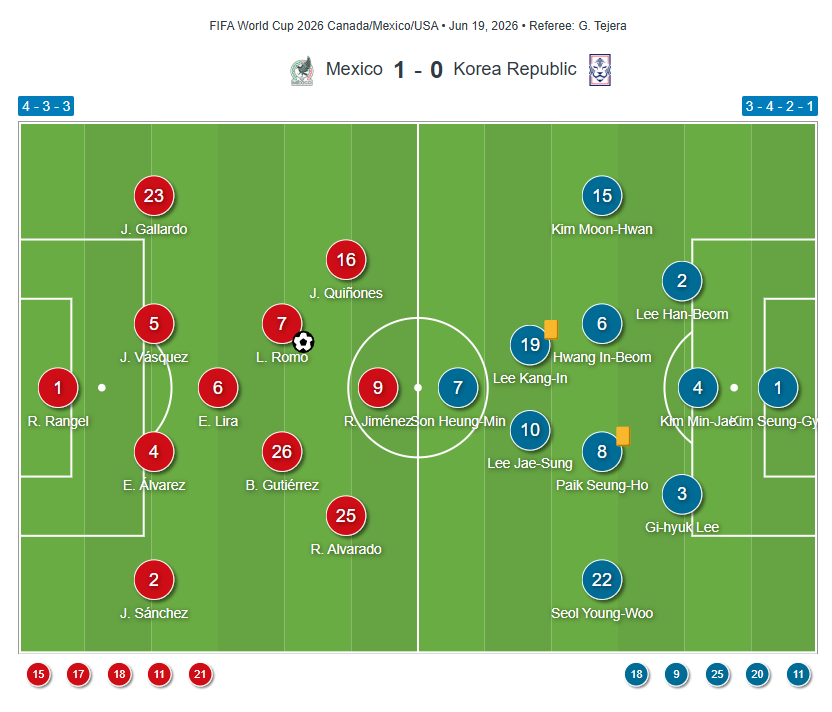
Mexico Lineup Vs South Korea
Javier Aguirre started the match according to a 4-3-3 formation with Raúl Rangel as a goalkeeper, Edson Álvarez and Johan Vásquez as centre-backs, Jorge Sánchez as a right-back, and Jesús Gallardo as a left-back.
The midfield was made up of Érik Lira as a defensive midfielder, with both Luis Romo and Brian Gutiérrez as central midfielders.
In attack, Aguirre used Julián Quiñones and Roberto Alvarado as wingers, with Raúl Jiménez as the main striker.
South Korea Lineup Vs Mexico
On the other side, Hong Myung-bo relied on a 3-4-2-1 formation with Kim Seung-gyu as the goalkeeper, and a backline made up of Lee Han-beom, Kim Min-jae, and Lee Gi-hyuk.
The midfield was composed of Hwang In-beom and Paik Seung-ho as central midfielders, Kim Moon-hwan and Seol Young-woo as wing-backs, with Lee Kang-in and Lee Jae-sung as the wide playmakers behind Son Heung-min.
Mexico Wing Combinations, Vertical Threats & Counterattacks
As soon as the match started, Mexico focused on establishing control via possession and sieging South Korea inside their own half.
Mexico exploited their chemistry at the back, passing ability, and compact defensive line to beat South Korea’s press and quickly overcome that first line of pressure.
That helped them reach South Korea’s half frequently and with ease, allowing them to maintain a high line in possession and even after losing the ball.
Mexico Wing Solutions
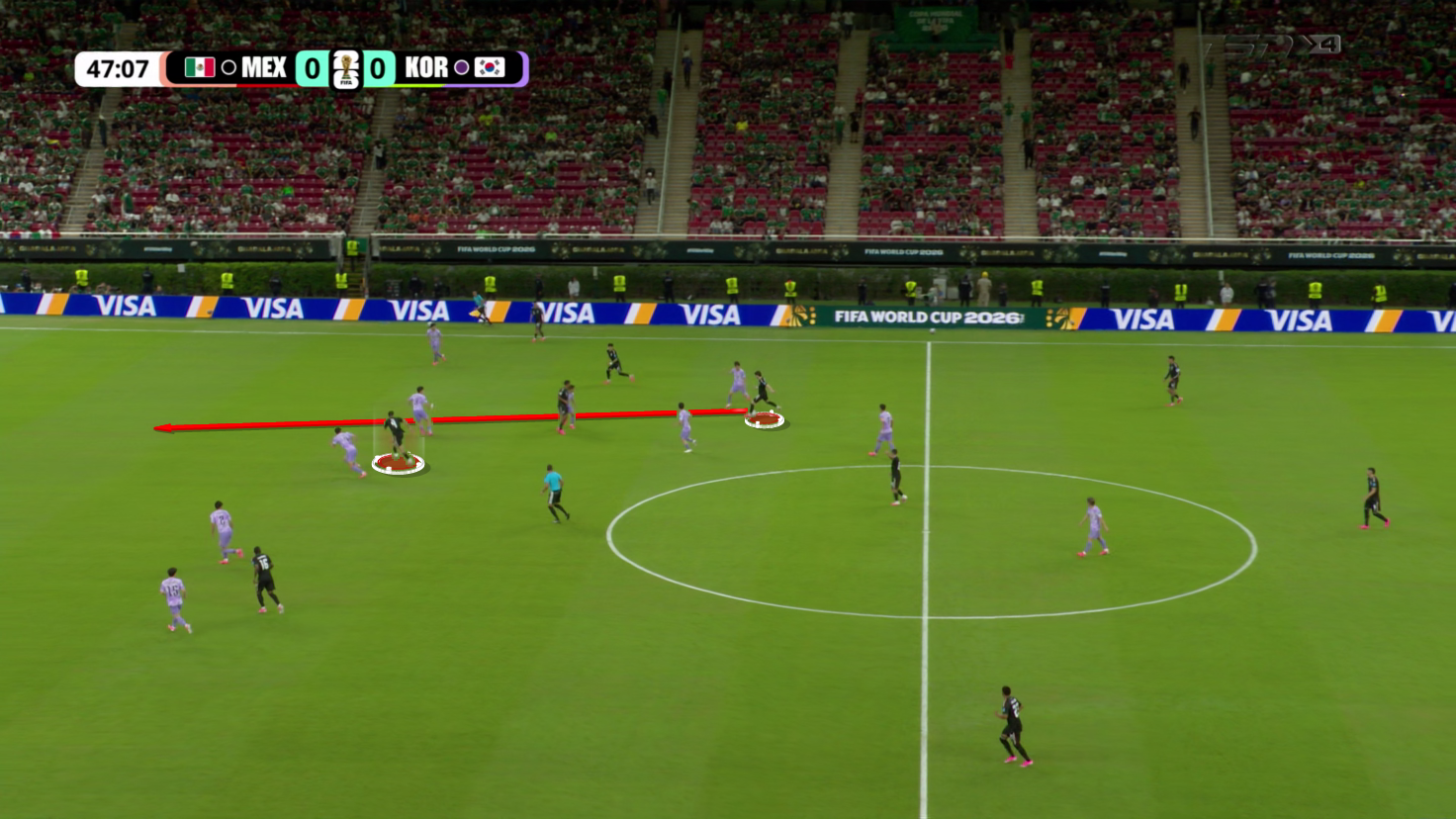
Mexico relied a lot on wing movements in space in order to exploit the space behind South Korea’s advanced defensive line.
Even though South Korea tried to limit Mexico’s possession and force them to stay in midfield by advancing their defensive line, Mexico still found ways to break that defensive line, mainly through extensive use of the wings.
The following picture highlights both teams’ use of high lines, something that leads to having tight areas for possession.
The solution that Mexico found to counter this was their reliance on through passes towards one of Quiñones or Alvarado, knowing that both players were very dynamic on the wings and were constantly providing passing solutions through their movements without the ball.
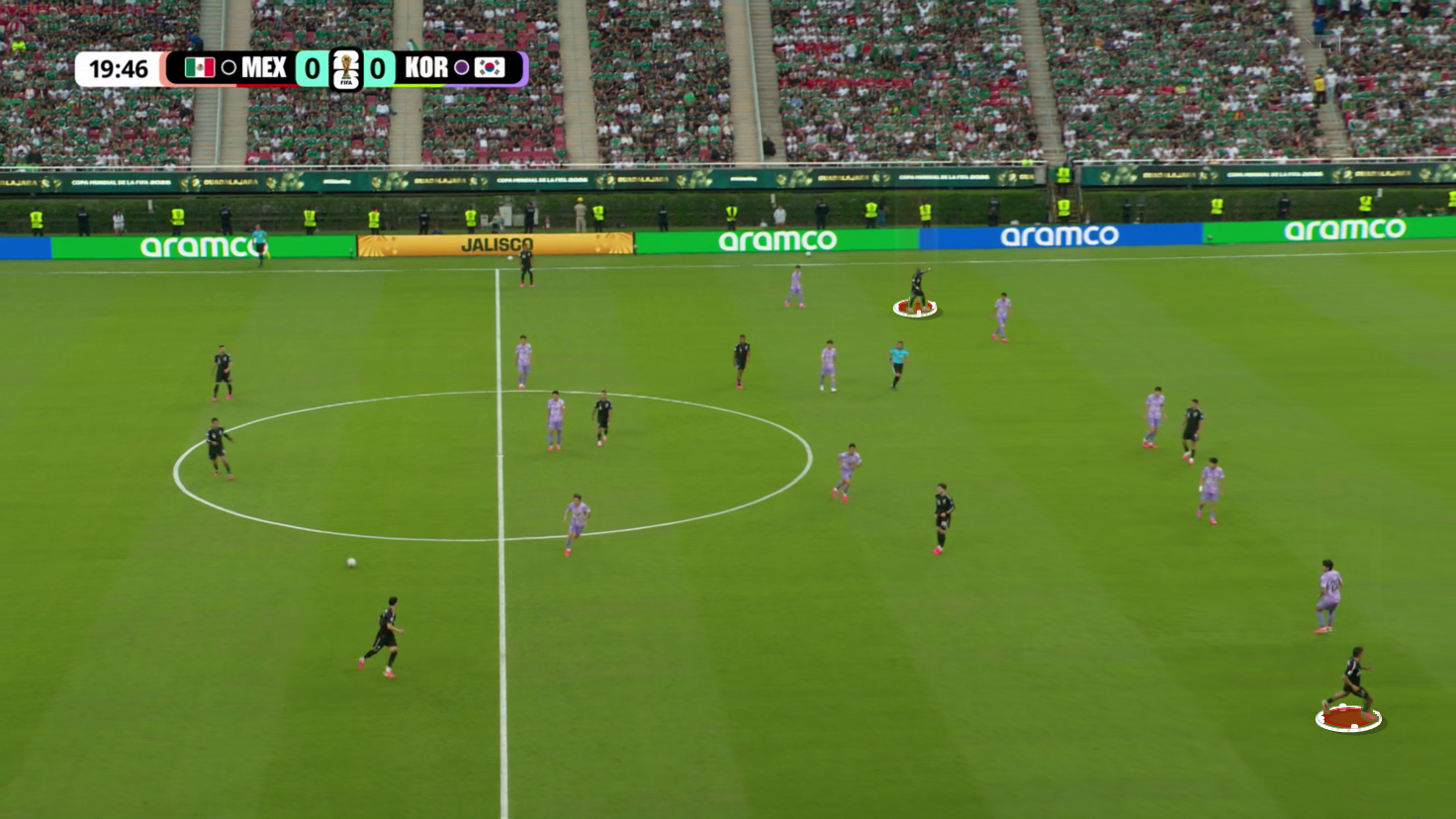
Mexico Wingers’ Combinations
What consolidates these two wingers’ attacking impact on the game is their ability to penetrate the middle whenever possible, with one of them at times becoming a second striker and creating key passing opportunities in valuable areas.
Quiñones was the one who made those penetrations more often and joined the box as a second striker, creating some confusion within South Korea’s defence and helping in having more than one passing destination for the ball holder.
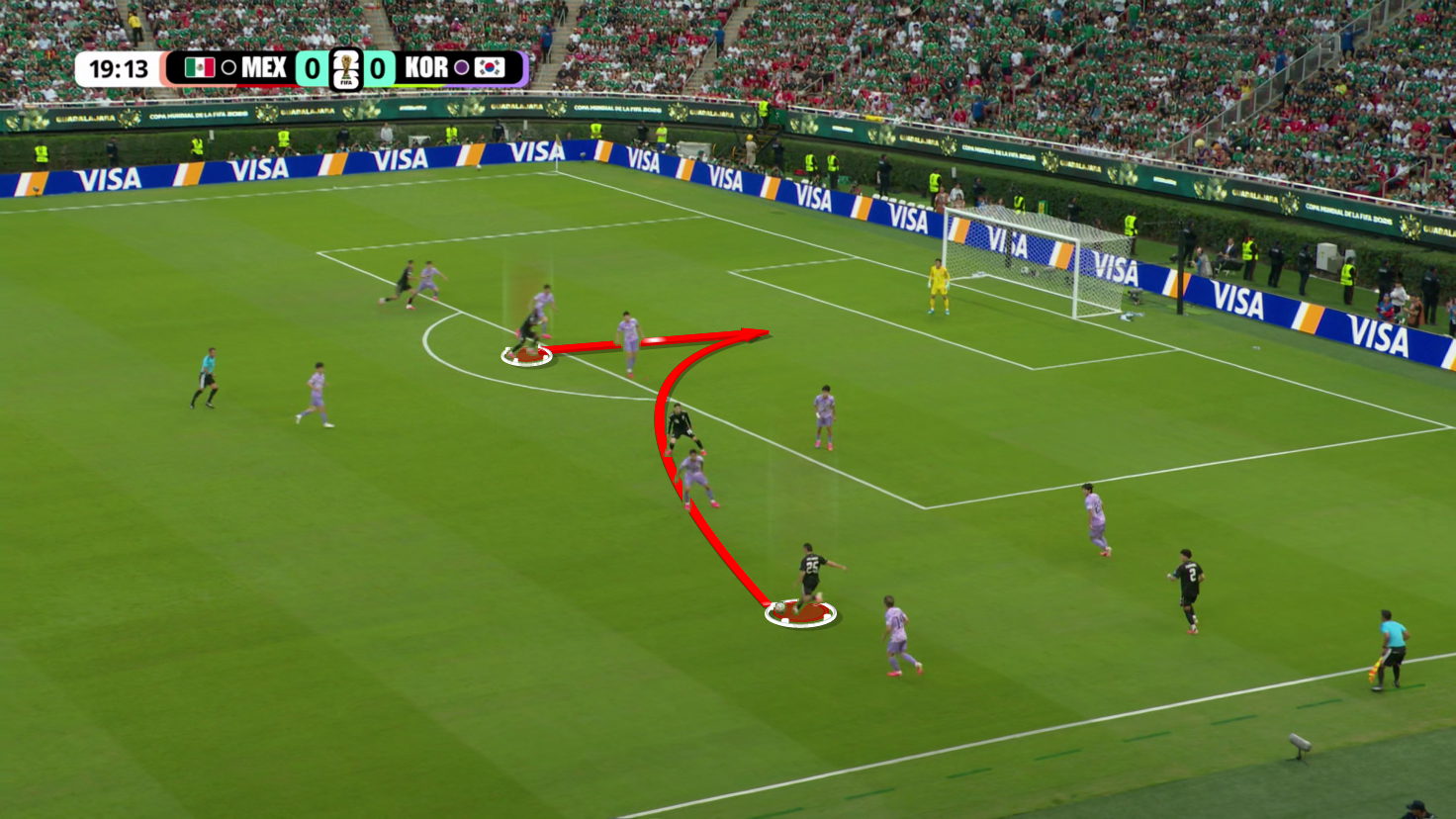
One of the key occasions for Mexico saw Quiñones advance to the box without the ball, positioning himself on the near post, while Alvarado was cutting inside from the right wing.
Alvarado did not hesitate to provide the cross towards Quiñones’ run, and the latter was able to get the advantage over his marker and touch the ball first, but his header was not powerful enough to beat the goalkeeper.
The action confirms the existing chemistry between both wingers and how useful they were for Mexico’s attacking line, especially when Jiménez was tightly marked and unable to receive passes.
Mexico Through Passing Hesitation & Errors
Although Mexico started the match well, they failed to maintain their momentum, especially after the first 20 minutes, due to South Korea’s remarkable resistance and organisation, which required Mexico to expend a lot of energy to create attacks.
What further complicated the playmaking process for Mexico was their tendency to miss key passing opportunities that could have started dangerous attacks for the team, especially in the second half.
In addition, some of the key passing attempts needed to be more accurate to reach their destination, resulting in a few dangerous situations being missed that could have helped the attacking players reach the box by receiving passes behind South Korea’s defensive line.
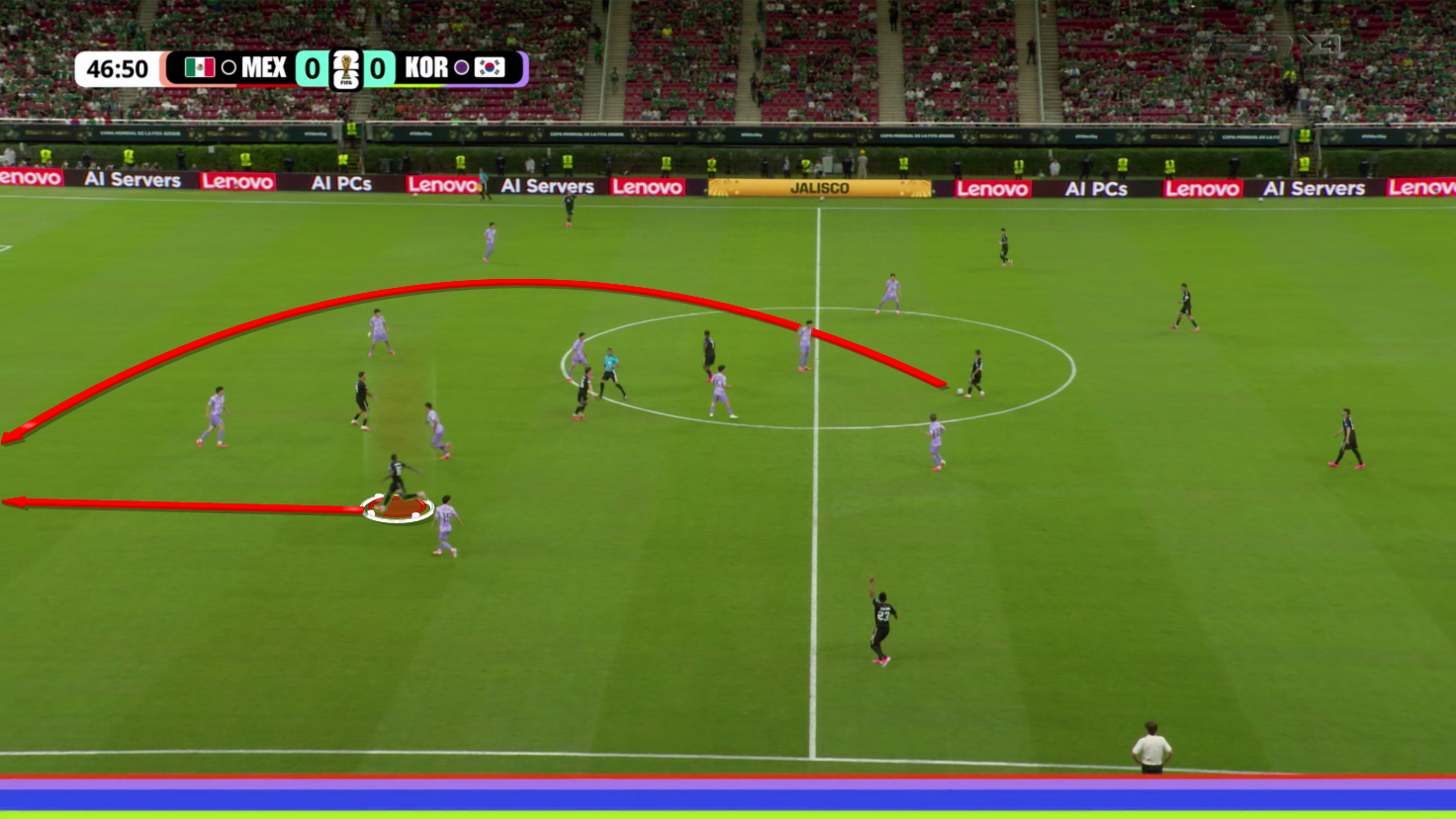
This second-half crossing opportunity for Lira was very inviting, as Quiñones was intelligent in surprising South Korea’s defensive line with a forward run towards their penalty box.
Despite noticing the movement, Lira chose not to cross towards the back of South Korea’s defensive line and instead opted for a simple horizontal pass.
This was one among few other occasions during which Mexico players preferred to not go for “risky” options and keep things safe, even though taking risks in such situations could have been rewarding, especially given Quiñones’s pace and physical abilities.
Another remarkable key pass situation that Mexico failed in dealing with in the needed way was Gutiérrez’s attempt in midfield when he noticed Jiménez making the forward movement at the back of the defensive line but failed to provide an accurate through pass to meet his run.
This was an even more crucial passing error by Mexico, as Jiménez had the chance to find himself in an inviting goal-scoring situation if he had received an accurate through pass.
Mexico needed to have more courage, determination, and accuracy in terms of their vertical key passing attempts, and that’s something that they need to improve going forward if they plan on becoming more dangerous in the knockout phase.
Mexico Post-Goal Counterattacking Plan
After scoring their single goal of the match, Mexico adopted a counterattacking plan as South Korea obviously advanced more and started to have more possession times inside Mexico’s half.
![Olympique De Marseille Vs PSG [1-2] Ligue 1 2026/2027: How Bruno Génésio Transitions Troubled PSG - Tactical Analysis](https://cdn.mymidnight.blog/77f959f119f4fb2321e9ce801e2f5163/size/w600/2026/09/Marseille-Vs-PSG-2026_2027---Tactical-Analysis.png)
![Fulham Vs Manchester United [1-1] Premier League 2026/2027: How Álvaro Arbeloa Tactics Exposed The Red Devils' Problems - Tactical Analysis](https://cdn.mymidnight.blog/77f959f119f4fb2321e9ce801e2f5163/size/w600/2026/09/Fulham-FC-Vs-Man-United-2026_2027---Tactical-Analysis.png)
![AS Roma Vs Inter Milan [2-2] Serie A 2026/2027: When Undefeated Giallorossi Attack Met Nerazzurri Comeback Resilience - Tactical Analysis](https://cdn.mymidnight.blog/77f959f119f4fb2321e9ce801e2f5163/size/w600/2026/09/AS-Roma-Vs-Inter-Milan-2026_2027---Tactical-Analysis.png)
![Real Sociedad Vs Bournemouth [1-2] Europa League 2026/2027: How Do Marco Rose Pressing Tactics Work? - Tactical Analysis](https://cdn.mymidnight.blog/77f959f119f4fb2321e9ce801e2f5163/size/w600/2026/09/Real-Sociedad-Vs-Bournemouth-20262027---Tactical-Analysis-1.png)
![AC Milan Vs Benfica [0-2] Europa League 2026/2027: How Marco Silva Tactics Exposed Rúben Amorim Defensive Problems - Tactical Analysis](https://cdn.mymidnight.blog/77f959f119f4fb2321e9ce801e2f5163/size/w600/2026/09/AC-Milan-Vs-Benfica-20262027---Tactical-Analysis.png)
![Sunderland Vs AZ Alkmaar [1-0] Europa League 2026/2027: Why The Black Cats Make Better Underdogs - Tactical Analysis](https://cdn.mymidnight.blog/77f959f119f4fb2321e9ce801e2f5163/size/w600/2026/09/Sunderland-Vs-AZ-Alkmaar-20262027---Tactical-Analysis.png)
![Leeds United Vs Newcastle United [4-1] Premier League 2026/2027: Why Did Daniel Farke Tactics Dominate The Magpies? - Tactical Analysis](https://cdn.mymidnight.blog/77f959f119f4fb2321e9ce801e2f5163/size/w600/2026/09/Leeds-United-Vs-Newcastle-2026_2027---Tactical-Analysis.png)
![Real Sociedad Vs Atlético Madrid [0-3] La Liga 2026/2027: How Diego Simeone Tactical Precision Rescued A Late Victory - Tactical Analysis](https://cdn.mymidnight.blog/77f959f119f4fb2321e9ce801e2f5163/size/w600/2026/09/Real-Sociedad-Vs-Atl--tico-Madrid-20262027---Tactical-Analysis-1.png)