
Murat Yakin Tactics At Switzerland 2026: Chasing First World Cup Quarter-Final Since 1954 – Tactical Analysis

Switzerland take part in the FIFA World Cup for the 13th time this year.
They come with the hope of achieving a memorable result this time, following a Round of 16 finish in all of the last three participations.
Historically, Switzerland reached the Round of 16 five times, with the best result being a quarter-final finish in the 1934, 1938, and 1954 editions.
Since then, Switzerland have failed to pass the Round of 16.
In their last three participations, Switzerland lost against Portugal, Sweden, and Argentina, respectively, in the Round of 16.
Another recurrent historical fact for Switzerland is that they finished second in the group stage in all of their last three participations.
This time, Murat Yakin has been developing an even more powerful team compared to the previous ones, as he has been achieving convincing results with the team so far.
In the 2026 World Cup, Switzerland face one of the hosts, Canada, as well as Qatar and Bosnia & Herzegovina.
On paper, Switzerland might look like favourites to top this group.
However, the reality is that both Canada and Bosnia & Herzegovina have what it takes to pull off surprises against Switzerland.
Qatar should not be underestimated either, as they have been developing considerably in recent years.
Otherwise, Switzerland might put themselves in trouble, especially because the match against Qatar will be Switzerland’s opening game.
Therefore, it will be crucial for the Swiss to prepare well for the Qatar match and ensure they win it to advance to the knockout phase.
In this Switzerland tactical analysis, we explore Switzerland’s expected tactics, formations, and best possible Swiss lineups.
The analysis sheds light on the team’s attacking strengths and areas of improvement, in addition to identifying their defensive weaknesses.
Switzerland Squad Depth, Predicted Starting XI, & Formations
Yakin’s spell with the Swiss national team has been positive so far, but to consolidate the work that has been done, it will be crucial for the coaching staff to start the tournament with the best possible lineup and use the most suitable formations.
In fact, Yakin is known for alternating between various playing systems and formations, depending on the opponent and on the players at his disposal.
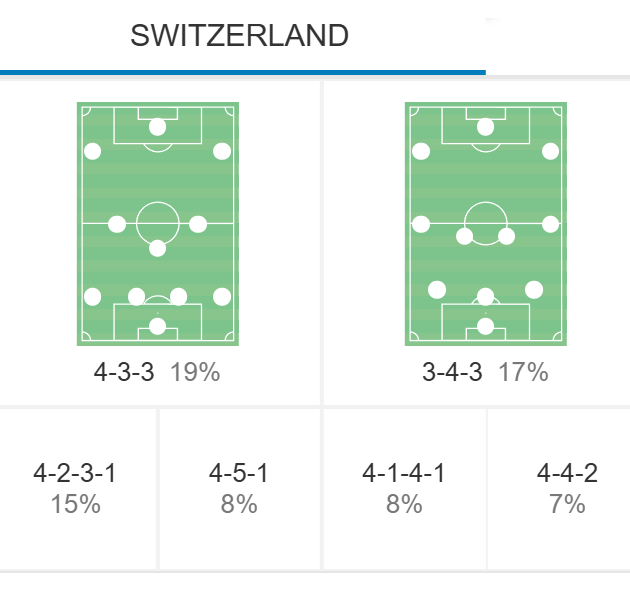
He usually prefers a back-four formation but leans towards the 3-4-3 formation when facing stronger teams.
He has been experimenting with the 4-4-2 formation in recent games, but the 4-3-3 formation remains his preferred setup for Switzerland.
Switzerland In-Game Formation Changes
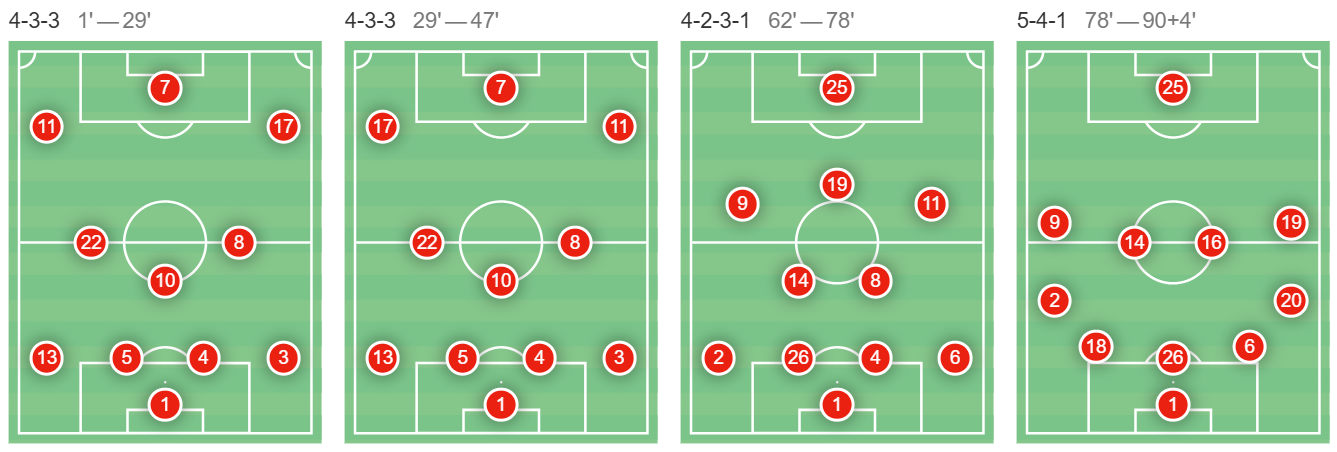
In cases of emergency, Yakin might switch to the 4-2-3-1 formation or even to the 5-4-1 formation, depending on the result and the objective (securing a lead, defending against a top team to avoid losing, or pushing for a goal).
This match example highlights his tendency to switch formations as needed to suit his match plan, as Yakin has accustomed his players to making frequent changes during games while keeping things balanced.
During the World Cup, Switzerland are expected to continue using the 4-3-3 as their main formation, but will more likely resort to the 3-4-3 during the knockout phase, especially when they face tough teams.
Even when using these two formations, Switzerland are expected to still change their shape during games.
Squad Depth & Best Predicted Switzerland Lineup
In terms of squad depth, the players at Yakin’s disposal can be considered powerful enough to help Switzerland lead their group or finish second in the worst case.
Their team is a mix of experienced and young but talented players, such as Johan Manzambi, Ardon Jashari, and Fabian Rieder, who are expected to add more squad depth and potential.
Manzambi, in particular, adds a valuable addition in attack thanks to his pace and impressive attacking abilities, proposing a reliable alternative for Yakin upfront, especially during games.
Yakin will still rely on the team’s more experienced players, especially in defence, where he already has a back-four that is used to playing together, guaranteeing greater chemistry and understanding.
Such defensive experience and understanding will be very important in such tournaments, with all of Ricardo Rodriguez, Manuel Akanji, Nico Elvedi, and Silvan Widmer having played alongside each other on numerous big occasions previously.
The midfield will be led by Granit Xhaka, who is one of this team’s leaders, if not the main leader, with Breel Embolo as Yakin’s attacking reference and both Rubén Vargas and Dan Ndoye representing Switzerland’s most reliable solutions on the wings.
Based on these preferences, Yakin will rely on Gregor Kobel as the first-choice goalkeeper, with Yvon Mvogo as plan B, and Marvin Keller as a backup goalkeeper.
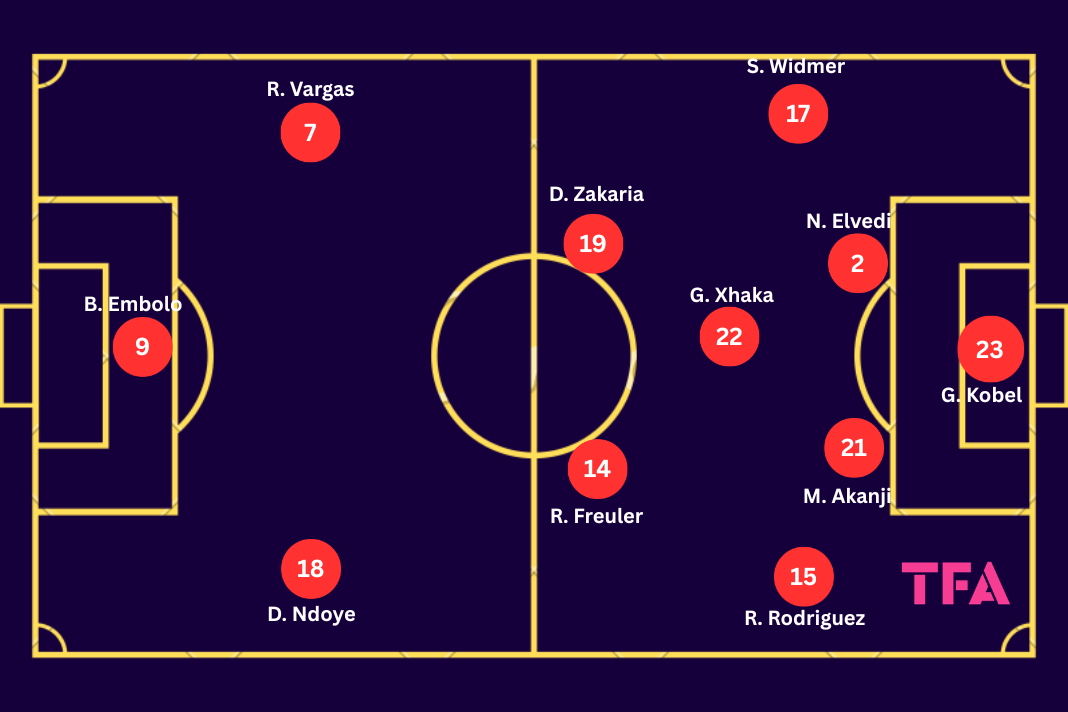
The defensive line will most likely be formed of a back-four made up of Rodriguez as a left-back, Akanji and Elvedi as the defensive duo, and Silvan Widmer as a right-back.
In case of switching to a 3-4-3 formation, Yakin prefers to rely on Akanji, Elvedi, and Denis Zakaria.
The use of Zakaria as a third centre-back represents an intelligent move from Yakin.
Zakaria is known as a defensive midfielder, and converting him to a centre-back can be rewarding, mainly because he is tall and strong in aerial duels, interceptions, and defensive duels.
These characteristics make him a good fit for a centre-back role.
Added to that, playing in defence helps Switzerland a lot in building from the back, since Zakaria clearly has better playmaking and passing skills than both Elvedi and Akanji.
Therefore, if Yakin resorts to the 3-4-3 formation, it is expected that Switzerland will initiate most of their attacks through Zakaria.
Miro Muheim will be the backup option for Rodriguez, while both Eray Cömert and Aurèle Amenda will be the backup players for the centre-back roles.
For Widmer, Yakin did not call up a replacement, and it is expected that he will be replaced by either a backup midfielder or a backup centre-back in case of injury.
The midfield will most likely be made up of Xhaka, Remo Freuler, and one of Denis Zakaria, Ardon Jashari, or Michel Aebischer.
Djibril Sow and Fabian Rieder will represent reliable backup options for these midfield roles, knowing that we might also see Yakin using a midfield duo made up of Xhaka and Freuler only in case of using the 4-4-2 formation.
Upfront, Yakin will be relying on his wing solutions, with Ndoye and Vargas as first-choice options, and Manzambi representing a solid option too.
The other backup options include Christian Fassnacht and Noah Okafor.
For the striker role, Embolo has the advantage over the rest of the players for the starting position, with Zeki Amdouni capable of playing as a second striker in a 4-4-2 formation, and Okafor and Cedric Itten as plan B options.
To resume, Yakin is expected to use the 4-3-3 as a first-choice formation, the 3-4-3 as a plan B, and the 4-4-2 as a plan C.
Switzerland Attacking Solutions
In terms of attacking solutions, Switzerland have got several strengths to rely on during this World Cup and perhaps some of the most remarkable and useful strengths are: wing efficiency and dynamism, midfielders’ crucial key vertical passing between the lines, and the reliance on crosses/exploitation of Embolo’s clinical abilities in the air.
These are some attacking ideas that have recurred for Switzerland this year and can be repeated with accuracy during the World Cup to help Switzerland score.
In addition to these plans, shooting from a distance can be a reliable option, since both Xhaka and Jashari are known for their excellent long-range shooting.
Furthermore, players like Manzambi and Ndoye are always capable of making the difference and creating unexpected surprises for opponents thanks to their dribbling and cutting-inside abilities.
Wing Solutions & Midfield Playmaking
Relying on both wingers has been a recurring strategy for Switzerland, especially against teams that prefer to play with higher defensive blocks and keep their back four compact.
This allows players like Ndoye and Manzambi to find the spaces they need to accelerate without the ball and propose a passing option at the back of defence, or receive the ball on the wing and dribble past their direct opponent.
To succeed in such actions, it is essential for the ball holder, and especially midfielders in this case, to notice the wingers’ movements and serve them at the right time.
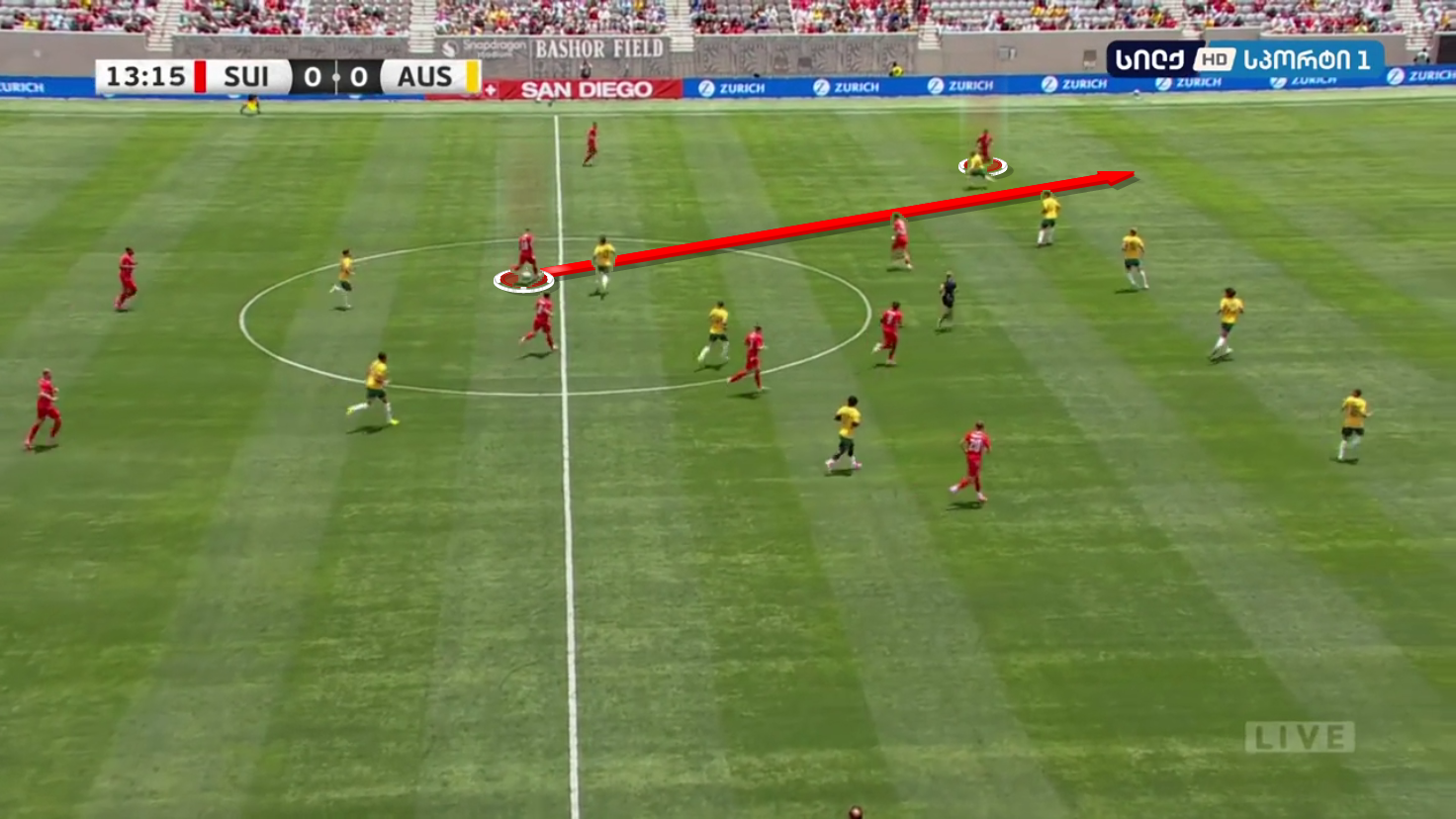
In the latest friendly game against Australia, Xhaka showed that his key passes can be very useful in this tournament, as he noticed Ndoye’s forward movement in time and gave him a perfect assist at the back of his direct marker, creating an excellent goalscoring opportunity for the winger.
Crossing Quality & Reliance On Aerial Duels Superiority
With tall players like Akanji, Zakaria, and, more importantly, Embolo, Switzerland have the right to rely on crosses and set-pieces since they can have the advantage over any team in aerial duels inside the box.
What makes Switzerland even more powerful in this regard is that it has two experienced crossing specialists, Widmer and Rodriguez.
Both full-backs are known for mastering crossing and delivering accurate/dangerous crosses from any spot on the flanks.
This helps strikers like Embolo a lot, especially since there is good chemistry and understanding between Embolo and both full-backs.
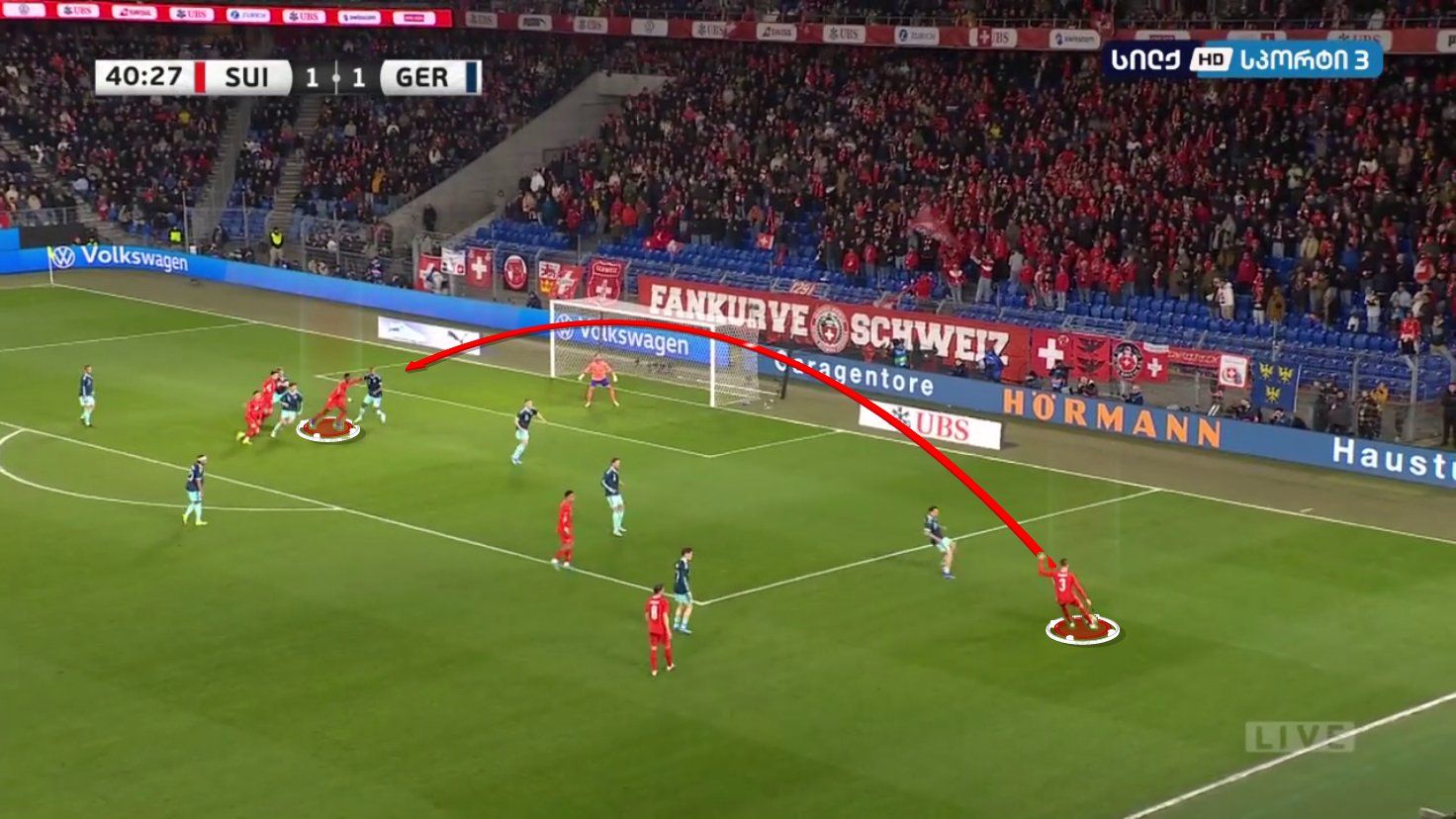
A perfect example of this chemistry was seen during the game against Germany earlier this year when Widmer received the ball on the right wing and did not hesitate to cross.
He immediately executed an accurate cross towards Embolo, surprising Germany’s defenders and allowing Embolo to follow the cross and score a header.
Embolo’s movements without the ball and his ability to escape from marking inside the box during such situations makes him a continuous threat on opposing defences.
Switzerland Defensive Issues
Switzerland will need to address collective positioning issues and improve individual marking concentration ahead of the World Cup if they plan to concede as few goals as possible in this tournament.