
![West Ham United Vs Wolverhampton Wanderers [4-2] EFL Championship 2026/2027: How Nuno Espírito Santo Found The Irons' Attacking Spark - Tactical Analysis](https://cdn.mymidnight.blog/77f959f119f4fb2321e9ce801e2f5163/size/w1000/2026/09/West-Ham-Vs-Wolves-2026_2027---Tactical-Analysis-1.png)
West Ham United Vs Wolverhampton Wanderers [4-2] EFL Championship 2026/2027: How Nuno Espírito Santo Found The Irons' Attacking Spark - Tactical Analysis
West Ham United claimed a 4-2 Championship win over Wolves as Nuno Espírito Santo’s 4-4-2 unlocked a more varied attack. This tactical analysis examines West Ham’s wing threats, two-striker combinations, Divine Mukasa’s midfield penetrations and the defensive weaknesses Wolves exposed.

West Ham United hosted Wolves at the London Stadium for their fourth match of the 2026/2027 EFL Championship campaign.
The contest ended with a 4-2 win for the hosts.
The win comes at an important time for West Ham, as they have endured relatively negative results to start the new season.
This win over a strong side in Wolves can only push the Irons to add to this victory and will surely boost their confidence levels.
Even though there are still several fixes that need to be made, especially defensively, the team proved in this match that they are capable of being extremely dangerous from an attacking perspective, as the variety displayed in this match in terms of attacking solutions was remarkable.
On the other hand, César Peixoto’s side were unable to prevent West Ham United from dominating the game.
Defending against two strikers made Wolves struggle to win the ball back quickly or advance often.
It is definitely a lesson that needs to be learned for Wolves to be more prepared for teams that like to change their attacking system so often.
In this West Ham vs Wolves tactical analysis, we look at how Nuno Espírito Santo’s side attacked while shedding some light on their defensive weaknesses.
West Ham United Vs Wolves Lineups & Formations
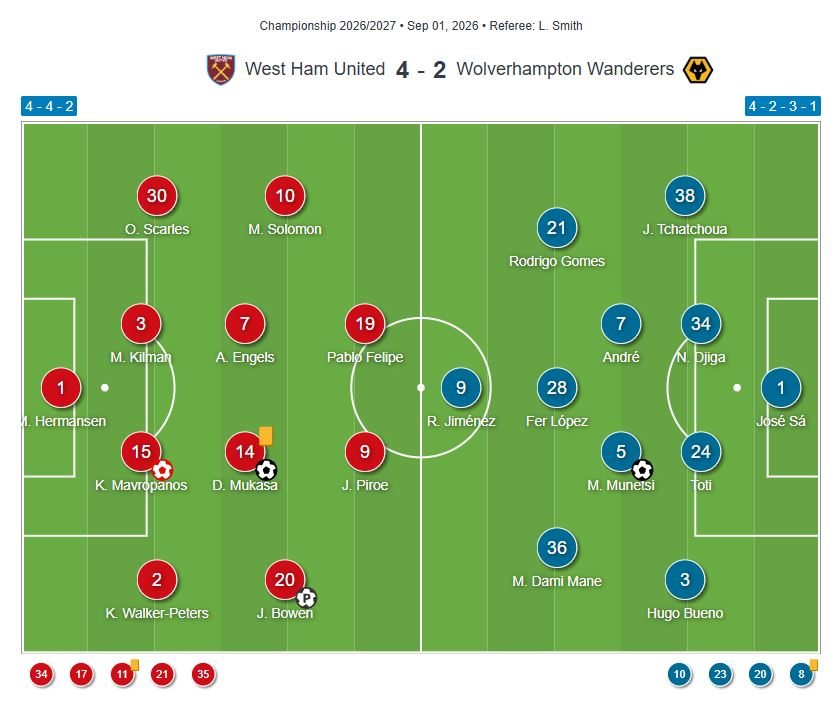
West Ham United Lineup Vs Wolves
Nuno chose to start the match in a 4-4-2 formation with Mads Hermansen in goal, Kyle Walker-Peters at right-back, Konstantinos Mavropanos and Max Kilman at centre-back, and Oliver Scarles at left-back.
The midfield was made up of Divine Mukasa and Arne Engels as central midfielders, Manor Solomon and Jarrod Bowen as wingers, with Joël Piroe and Pablo Felipe forming the attacking duo.
Wolves Lineup Vs West Ham United
On the other side, Peixoto preferred the 4-2-3-1 formation with José Sá in goal, Jackson Tchatchoua at right-back, Nasser Djiga and Toti Gomes as the centre-backs, and Hugo Bueno at left-back.
He relied on André and Marshall Munetsi as central midfielders, Fer López as the advanced playmaker, Rodrigo Gomes and Mateus Mané as wingers, with Raúl Jiménez as the main striker.
West Ham United Wing Threats
Wolves forced West Ham to defend in their own half a lot early on.
Progressively, they were able to create attacking actions, though, and relied mainly on the quick exchanges of passes inside the final third from central areas to wide areas in order to pave the way for their wingers to cross.
In fact, West Ham's attacks became more frequent as time progressed, and these actions had a common feature: Starting from the wings and penetrating through the box or crossing into the box.
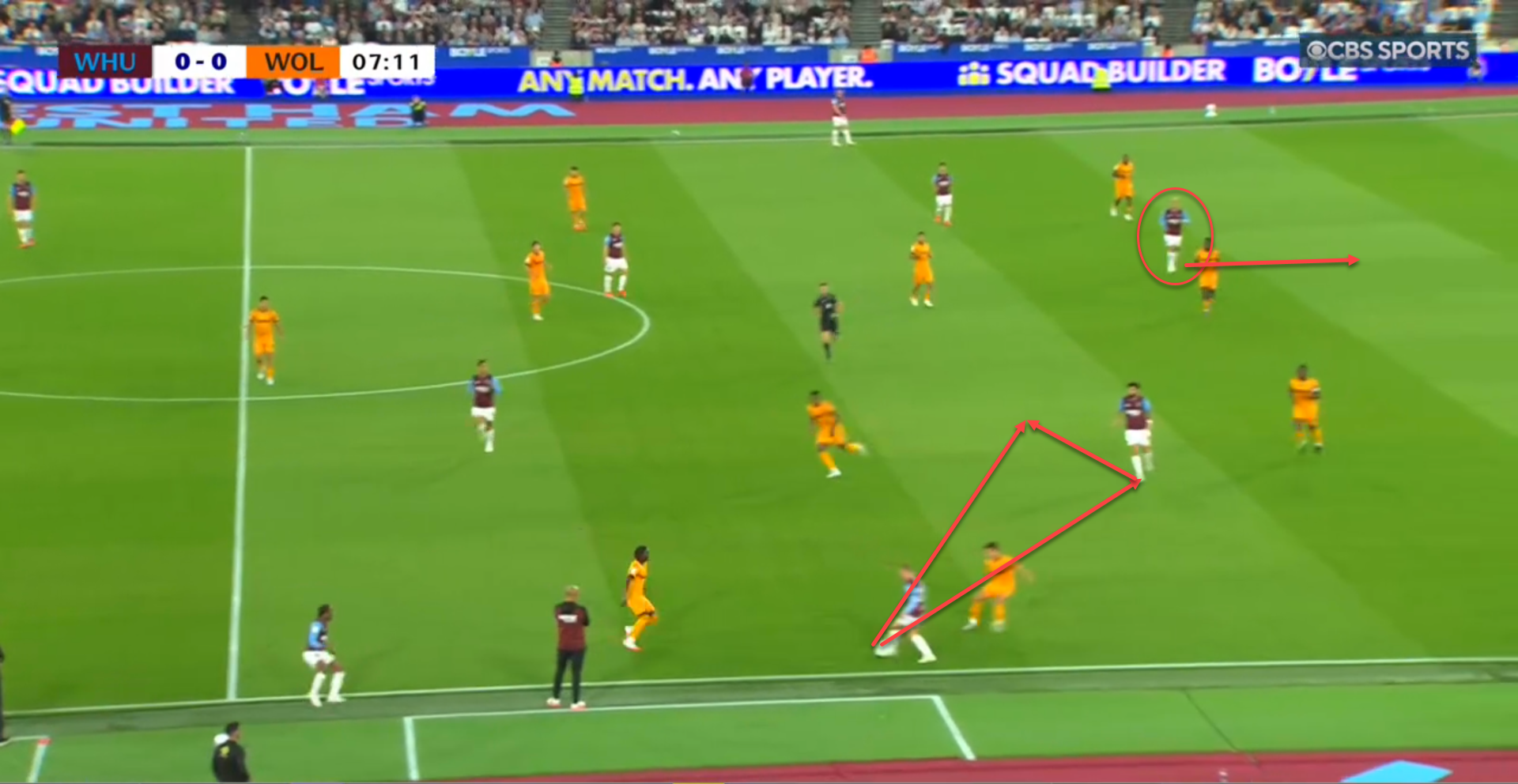
In this action, for instance, it was Bowen who made the difference on the right wing, as he played a one-two with Felipe and advanced quickly to receive the ball back in the right spot and continue his penetration before serving Piroe.
This type of action highlights the usefulness of the 4-4-2 formation for West Ham since it allows the team to attack with four players continuously, without counting the central midfielders.
The support that Bowen found from Felipe in this action before quickly finding a passing option would not have been possible if West Ham United were playing with a single striker, for instance, limiting the team’s attacking possibilities.
Furthermore, whenever Bowen was not involved in the attacking actions, it was Solomon on the left wing who initiated the attacks and made the difference either by cutting inside and trying to serve his attacking teammates or by serving Scarles as he made overlaps frequently on the left wing.
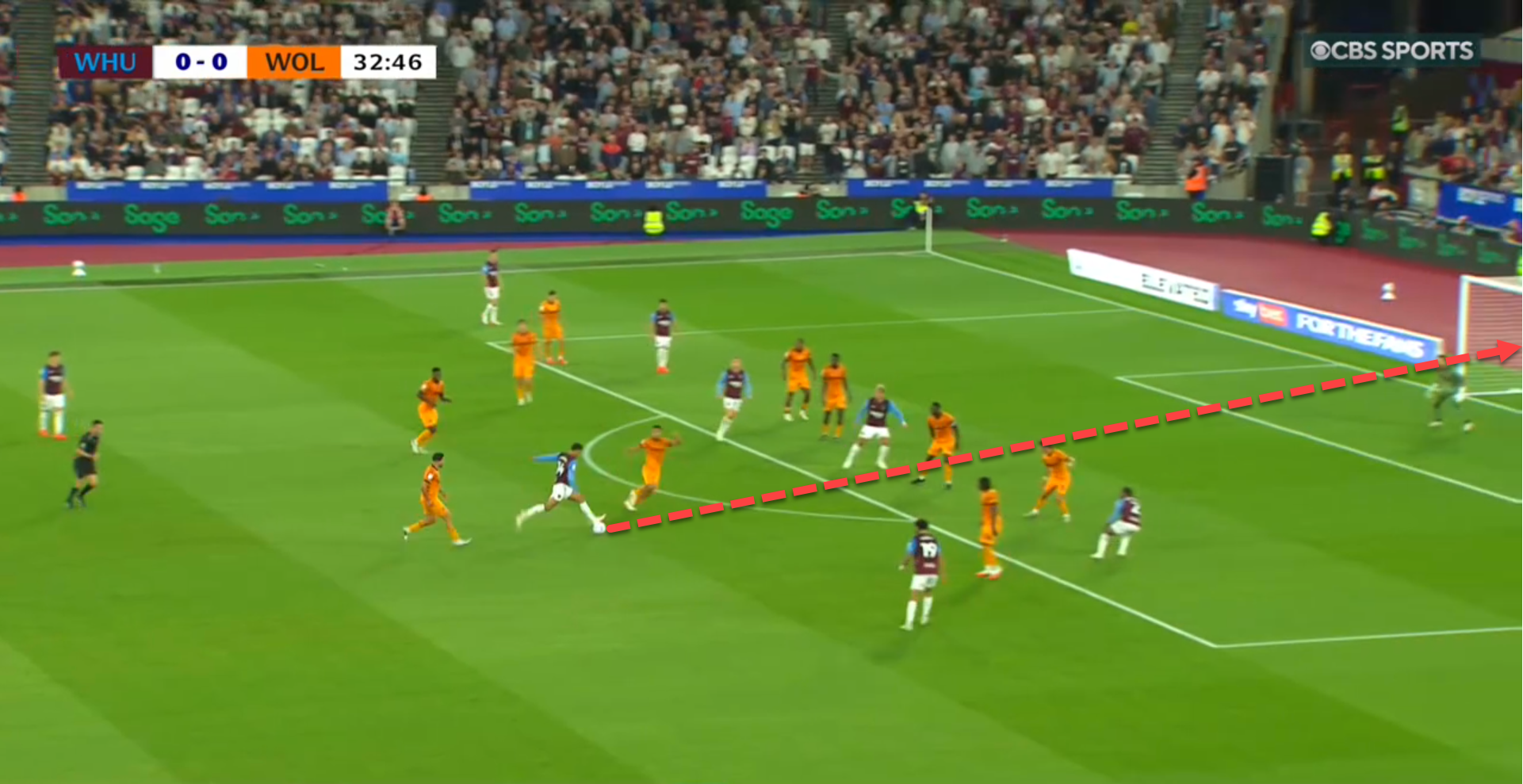
West Ham United Shooting From Distance Weapon
West Ham United eventually surprised Wolves with an unexpected opening goal.
West Ham relied mainly on wing play, but they changed this approach completely during the goalscoring action and that made the difference, surprising Wolves’ defence and goalkeeper.
Mukasa made the right choice when he opted to shoot from outside the box, as he received a pass in an inviting shooting position and was not really closed down by Wolves’ defenders.
Getting the required time and space to try shooting further encouraged Mukasa to finish the action in that way and give West Ham United the lead.
This goal action also gives the feeling that there is a lot of unexplored potential in terms of goalscoring, shooting from distance, and being creative inside the final third, overall, for West Ham, and that needs to be encouraged further this season.
If Nuno succeeds in helping West Ham’s attackers reach their full potential and be as creative as possible in that area, then West Ham United will become much more dangerous this season.
The fact that they were able to score four goals in this match against a team that had better results so far can only prove that the potential is there, attacking-wise.
![Brighton & Hove Albion Vs Crystal Palace [5-0] Premier League 2026/2027: How Fabian Hürzeler Combined Pressing & Positional Rotations To Dominate The M23 Derby - Tactical Analysis](https://cdn.mymidnight.blog/77f959f119f4fb2321e9ce801e2f5163/size/w600/2026/10/Brighton---Hove-Albion-Vs-Crystal-Palace-2026_2027----Tactical-Analysis.png)
![Newcastle United Vs Aston Villa [0-1] Premier League 2026/2027: How Unai Emery Tactics Punished Wasteful Magpies - Tactical Analysis](https://cdn.mymidnight.blog/77f959f119f4fb2321e9ce801e2f5163/size/w600/2026/10/Newcastle-United-Vs-Aston-Villa--0-1--Premier-League-2026_2027_-How-Unai-Emery-Tactics-Punished-Wasteful-Magpies---Tactical-Analysis.png)
![Celta Vigo Vs Juventus [1-2] Europa League 2026/2027: How The Old Lady Escaped With A Late Comeback Despite Predictable Attacking Play - Tactical Analysis](https://cdn.mymidnight.blog/77f959f119f4fb2321e9ce801e2f5163/size/w600/2026/10/Celta-Vigo-Vs-Juventus---Tactical-Analysis.png)
![Villarreal Vs Napoli [3-1] Champions League 2026/2027: How Iñigo Pérez Tactics Exploited Massimiliano Allegri Mistakes - Tactical Analysis](https://cdn.mymidnight.blog/77f959f119f4fb2321e9ce801e2f5163/size/w600/2026/10/Villarreal-Vs-Napoli---Tactical-Analysis.png)
![Manchester City Vs PSG [2-4] Champions League 2026/2027: How Luis Enrique Tactics Controlled The Key Moments - Tactical Analysis](https://cdn.mymidnight.blog/77f959f119f4fb2321e9ce801e2f5163/size/w600/2026/10/Manchester-City-Vs-PSG---Tactical-Analysis.png)
![Borussia Dortmund Vs Werder Bremen [2-2] Bundesliga 2026/2027: How Daniel Thioune Tactics Earned A Late Comeback With 29% Possession - Tactical Analysis](https://cdn.mymidnight.blog/77f959f119f4fb2321e9ce801e2f5163/size/w600/2026/10/Borussia-Dortmund-vs-Werder-Bremen---Tactical-Analysis.png)
![Croatia Vs Spain [1-2] UEFA Nations League 2026/2027: How Slaven Bilić High Pressing Tactics Troubled Spain - Tactical Analysis](https://cdn.mymidnight.blog/77f959f119f4fb2321e9ce801e2f5163/size/w600/2026/10/Croatia-Vs-Spain--1-2--UEFA-Nations-League-20262027---Tactical-Analysis.png)