
![Tunisia Vs Japan [0–4] – FIFA World Cup 2026: When Tactical Uncertainty Proves Costly – Tactical Analysis](https://cdn.mymidnight.blog/77f959f119f4fb2321e9ce801e2f5163/size/w1000/2026/06/Tunisia-Vs-Japan-World-Cup-2026-1.png)
Tunisia Vs Japan [0–4] – FIFA World Cup 2026: When Tactical Uncertainty Proves Costly – Tactical Analysis

Tunisia faced Japan at Estadio BBVA for the second match of the 2026 FIFA World Cup group stage, and the match ended with a crucial four-goal win for Japan.
The large win earned Japan the chance to challenge the Netherlands seriously for the top spot on the final day of the group stage, as both teams now have four points and the same goal difference.
Therefore, everything will be decided in the last fixture of the first- and second-place battle, with Hajime Moriyasu’s team facing Sweden and the Netherlands facing Tunisia.
On the other hand, newly appointed Hervé Renard’s side has been officially eliminated from the tournament, as two losses and a highly negative goal difference mean it will be impossible for them to qualify for the knockout phase, even if they beat the Netherlands by a high margin.
Tunisia’s participation can be considered one of the worst in the country’s history, as they were neither able to perform well nor win points.
This elimination and overall poor performance should motivate Tunisia to work harder to fix the issues surrounding the national team and their football setup in general.
In this World Cup tactical analysis article, we mainly explore Tunisia’s defensive and attacking issues against Japan.
Tunisia Vs Japan Lineups & Formations
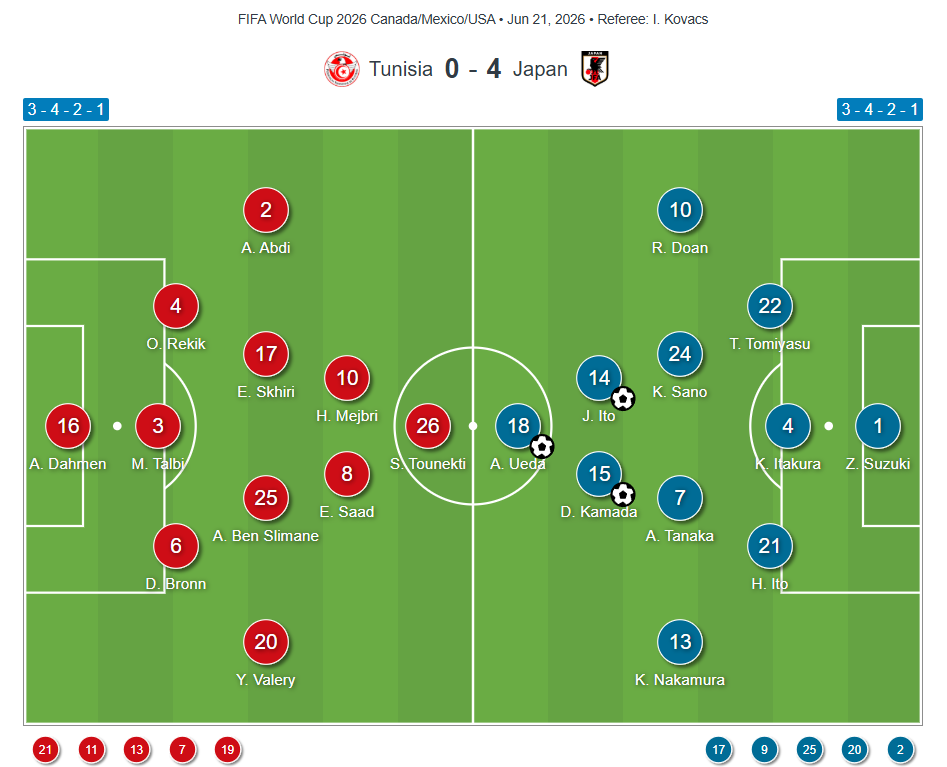
Tunisia Lineup Vs Japan
Renard used a 3-4-2-1 formation against Japan, relying on Aymen Dahmen as goalkeeper, with a back three of Dylan Bronn, Montassar Talbi, and Omar Rekik.
The midfield was composed of Anis Ben Slimane and Ellyes Skhiri as central midfielders, with Yan Valery as a right wing-back and Ali Abdi as a left wing-back.
In attack, Tunisia used both Hannibal Mejbri and Elias Saad as wide playmakers, with Sebastian Tounekti as a false nine.
Japan Lineup Vs Tunisia
Moriyasu preferred a 3-4-2-1 formation too, with Zion Suzuki as the goalkeeper and a back three of Takehiro Tomiyasu, Ko Itakura, and Hiroki Ito.
The midfield was made up of Kaishu Sano and Ao Tanaka, with Ritsu Doan and Keito Nakamura as wing-backs.
Up front, Japan relied on both Daichi Kamada and Junya Ito as wide playmakers, with Ayase Ueda as the main striker.
Tunisia’s Defensive Disarray & Attacking Disconnect
Following the head coach's change during the tournament, Tunisia’s tactics and player selections shifted in some positions and in terms of playing style.
However, that was not enough for the team to challenge Japan for a draw or try beating them.
In fact, the issues within the team are numerous and bringing a renowned head coach like Renard was not sufficient to turn the table in this group, as the French manager only had a few days to get to know his players, their strengths and weaknesses, and start conveying his ideas as well as preparing for the match.
It was very complicated for him to change a lot of things in such a short time, given that there a lot of errors committed by the previous coaching staff in terms of preparations, player choices, and even regarding the atmosphere within the team.
Tunisia Collective & Individual Defensive Organisation Issues
Tunisia have been preparing for the World Cup using a back-four formation in most of the matches they played before the tournament.
The sudden change to the 3-5-2 formation, or rather the 5-3-2 formation, in the first match confused many players, especially the defenders, as the chemistry and collective movements without the ball were obviously affected by not having tried these formations in the preparations.
This uncertainty and confusing tactical plans impacted the team against Sweden, something that led to conceding numerous goals due to collective and individual errors in defence.
Against Japan, the same issue recurred, as Renard opted for a 3-4-2-1 formation to secure the defensive line and keep up with Japan’s midfield, which was composed of four players plus two wide playmakers.
So, in order to guarantee that Japan won’t have numerical superiority, Renard preferred to use a formation that guarantees more midfield presence.
But, the impact of this choice was crucial on Tunisia’s defence, as it led to confusion in terms of defensive movements as well as errors in marking.
What confirms this confusion is the first conceded goal that was scored since the starting minutes, with Valery failing to mark his direct opponent properly, and Talbi being too hesitant and physically fragile in his duel against Japan’s forward.
More importantly, Tunisia left too much space for Japan between the lines, and there was insufficient pressure on the ball holder, which allowed Japan to advance with vertical passes without spending too much time trying to find space.
This helped Japan surprise Tunisia’s lines with a quick attacking transition, with Tanaka receiving the ball at the edge of the box and having the time and space to pass to Nakamura on the left wing.
Allowing Japan to execute their attacking transitions quickly also impacted Tunisia from a double-marking perspective, as it made it complicated for the attacking players, like Saad, to retreat quickly and support Valery in marking Nakamura.
This allowed Nakamura to advance and provide the assist towards the centre of the box, where Talbi failed in his direct marking mission.
Tunisia Passive Man-Marking
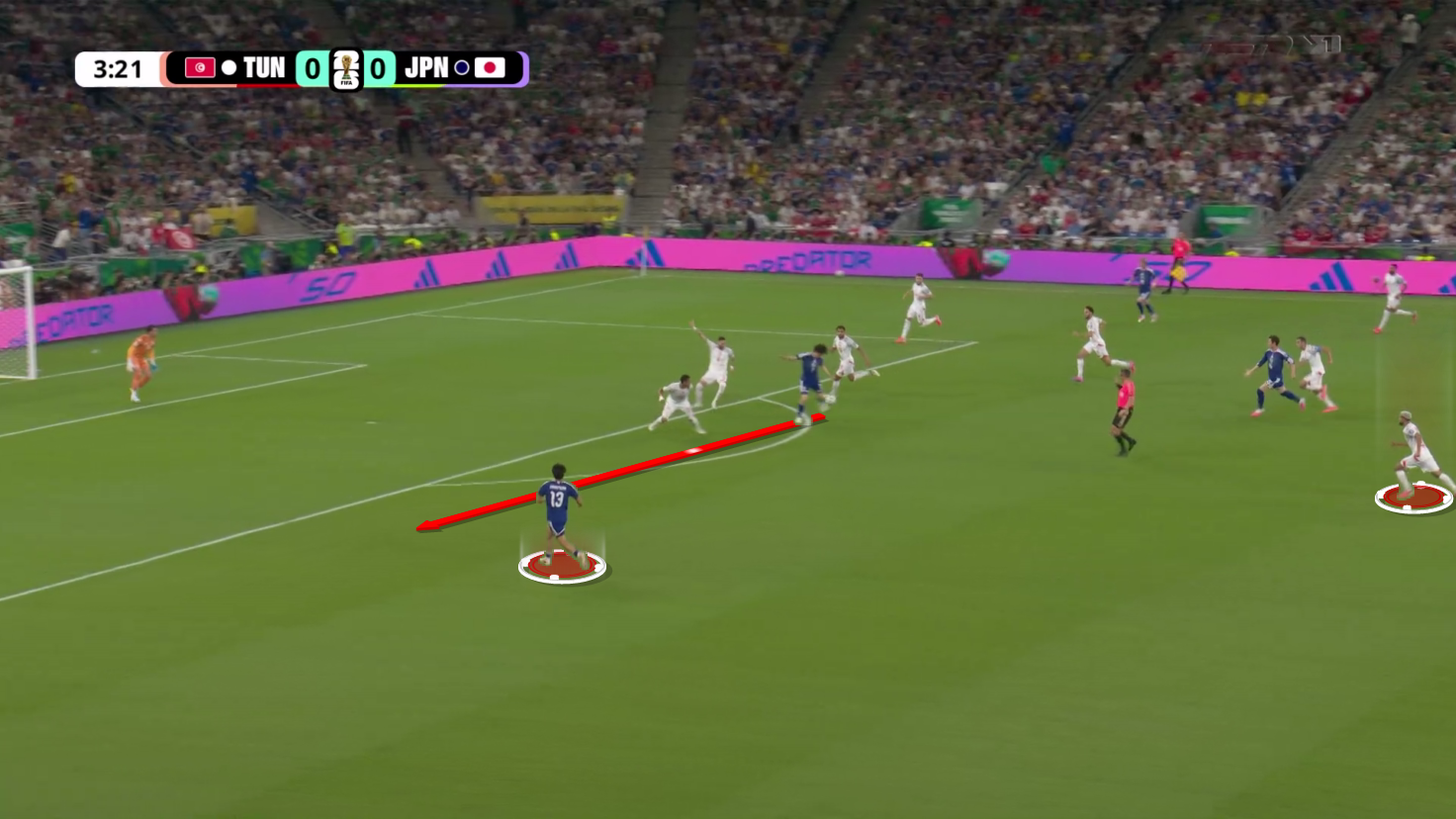
What led to the concession of the second goal, and what was generally problematic for Tunisia even in the first match against Sweden, was the passive man-marking applied to the opponent’s attacking players.
Knowing that they were playing against top forwards who are capable of shooting from anywhere and still create danger, Tunisia needed to be much more attentive and make sure to close down any penetration attempt or run with the ball inside the final third.
However, this was not the case against Japan, since the striker Ueda had all the time needed to advance with the ball in this action, thought about shooting, but preferred to continue advancing before shooting.
This means that Talbi knew that Ueda was thinking about shooting.
Despite that, he did not react or get closer to him, as he did not even try to block the shot.
Talbi’s dealing with this situation was repeated on other occasions too, and was not a case of lack of concentration but rather a general defensive issue.
Tunisia’s man-marking was too soft on Japan’s players, who were not bothered at all inside the final third and were given the opportunity to try shooting from distance, cross from the wings, and even touch the ball a lot inside the box.
This passive defensive approach against Japan’s top players contributed a lot to making Tunisia lose with a high goal margin.
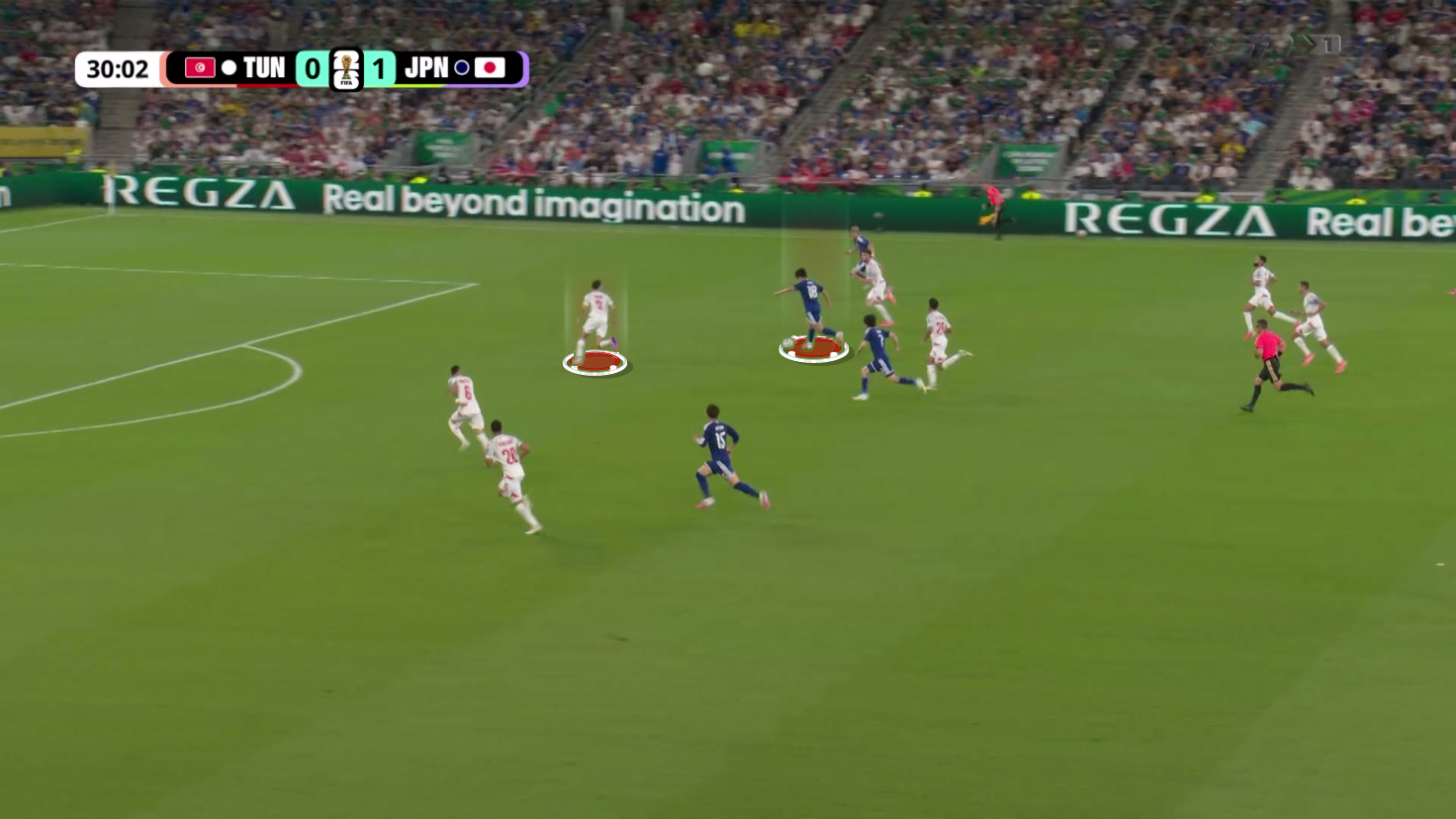
Tunisia Attacking Transition Weaknesses
In addition to the defensive issues, Tunisia suffered with a slow build-up from the back, which limited their attacking solutions against a very organised Japan team.
More importantly, Tunisia failed in most of their attacking transition situations and were unable to surprise Japan’s advance with counterattacks.
This meant that Tunisia failed to exploit the possibilities that would have allowed them to threaten Japan’s defence.
Tunisia wanted to launch counterattacks but failed to do so, mainly due to the complications of the first few passes that would launch that counterattack.
Whenever Tunisia make recoveries inside their half, the players fail to find quick passing possibilities mainly due to preferring to dribble past one or two opponents.
In fact, Tunisia’s players were often obliged to opt for dribbling because they don’t have automatic passing choices and have to think and lose time in looking for a close teammate.
This time was often exploited by the Japanese players, who would put pressure on the ball holder and try to double-mark him in order to prevent the attacking transition from happening.
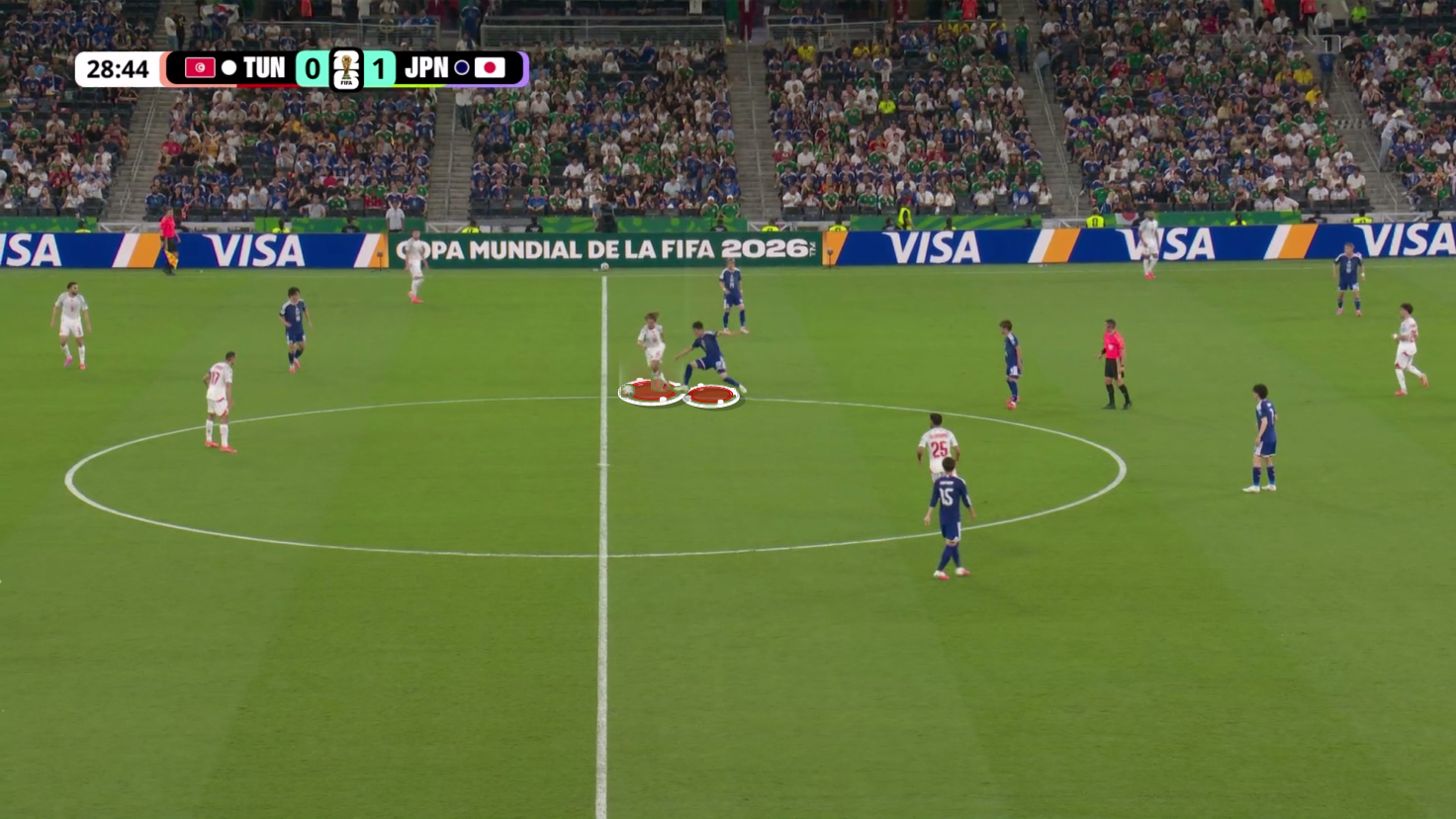
In this example of the many delayed/intercepted attacking transitions, Saad gets the ball following Ben Slimane’s interception and tries to advance with the ball, but finds an opponent.
So he retreats and opts for a complicated forward pass to Ben Slimane who already got surrounded by two opponents.
Saad could have opted for a more secure pass in order to avoid getting the ball intercepted, as Bronn was asking for the ball, for instance.
These types of actions confirm that Tunisia’s players did not have clear plans for build-up from the back or regarding attacking transitions, which made Saad hesitate and go for the more complicated solution while executing the pass incorrectly as well.
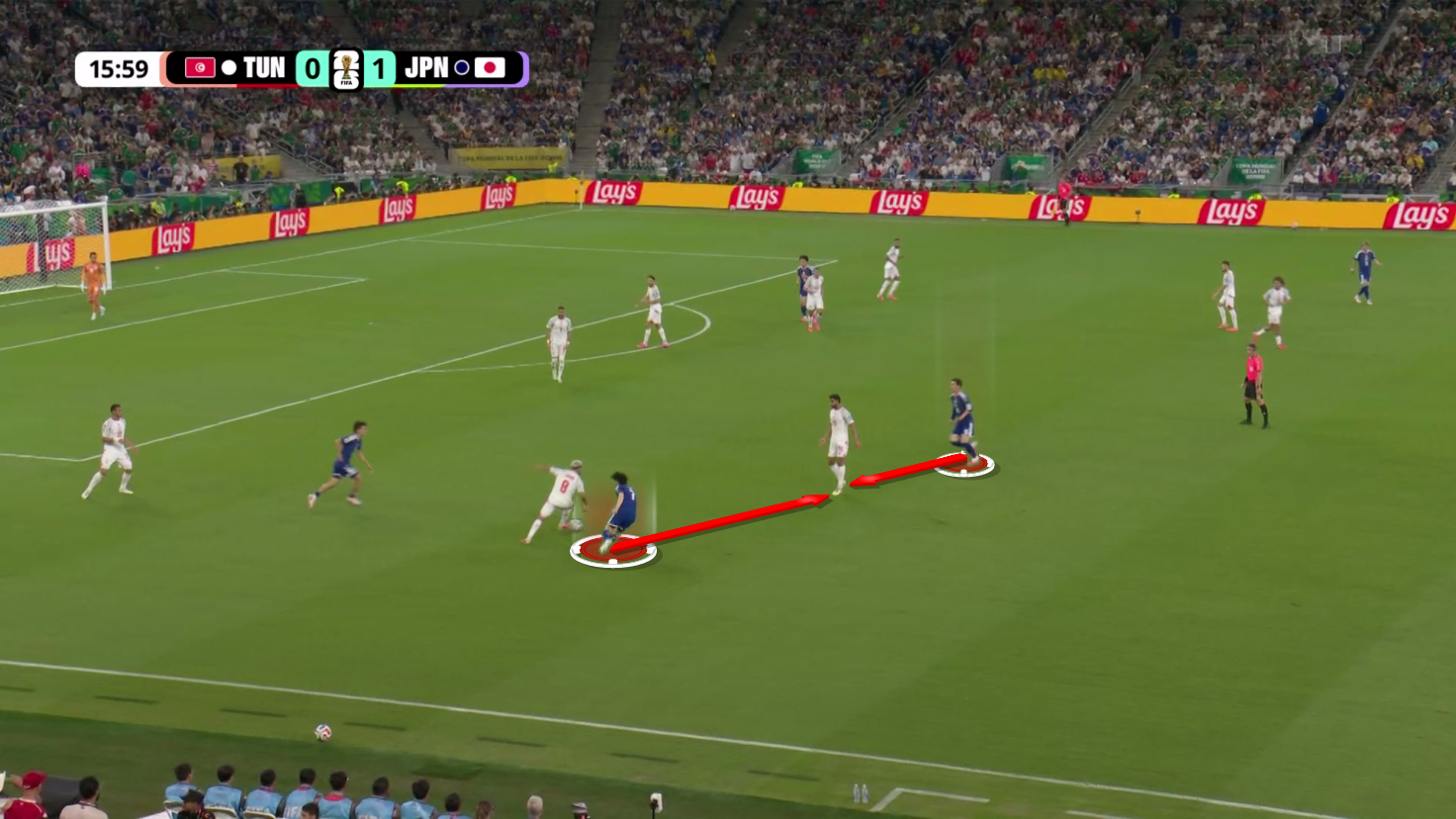
Tunisia Difficulties In Terms Of Vertical Passes
Due to Japan’s strict, disciplined man-marking of Tunisia’s key players, Tunisia failed to find alternative solutions that would have allowed them to rely on penetrations or vertical passes to reach the final third more easily.
Instead, the tight marking applied to Mejbri by Tomiyasu, even when Mejbri retreated and tried to build from the back, was very impactful, especially because Tunisia did not have other solutions for playmaking.
Obliging Mejbri to opt for horizontal or backward passes each time made Tunisia fail to attack or to reach the box, and that was a contributing factor in seeing Tunisia shoot only twice, with zero shots on target.
Japan’s high man-marking prevented Tunisia from playing with the rhythm they needed and from circulating the ball in the way they should in order to advance quickly and create threats.
In fact, Japan’s constantly advancing back-three to close down Tunisia’s movements in midfield made things more complicated for Tunisia in terms of playmaking.
![Olympique De Marseille Vs PSG [1-2] Ligue 1 2026/2027: How Bruno Génésio Transitions Troubled PSG - Tactical Analysis](https://cdn.mymidnight.blog/77f959f119f4fb2321e9ce801e2f5163/size/w600/2026/09/Marseille-Vs-PSG-2026_2027---Tactical-Analysis.png)
![Fulham Vs Manchester United [1-1] Premier League 2026/2027: How Álvaro Arbeloa Tactics Exposed The Red Devils' Problems - Tactical Analysis](https://cdn.mymidnight.blog/77f959f119f4fb2321e9ce801e2f5163/size/w600/2026/09/Fulham-FC-Vs-Man-United-2026_2027---Tactical-Analysis.png)
![AS Roma Vs Inter Milan [2-2] Serie A 2026/2027: When Undefeated Giallorossi Attack Met Nerazzurri Comeback Resilience - Tactical Analysis](https://cdn.mymidnight.blog/77f959f119f4fb2321e9ce801e2f5163/size/w600/2026/09/AS-Roma-Vs-Inter-Milan-2026_2027---Tactical-Analysis.png)
![Real Sociedad Vs Bournemouth [1-2] Europa League 2026/2027: How Do Marco Rose Pressing Tactics Work? - Tactical Analysis](https://cdn.mymidnight.blog/77f959f119f4fb2321e9ce801e2f5163/size/w600/2026/09/Real-Sociedad-Vs-Bournemouth-20262027---Tactical-Analysis-1.png)
![AC Milan Vs Benfica [0-2] Europa League 2026/2027: How Marco Silva Tactics Exposed Rúben Amorim Defensive Problems - Tactical Analysis](https://cdn.mymidnight.blog/77f959f119f4fb2321e9ce801e2f5163/size/w600/2026/09/AC-Milan-Vs-Benfica-20262027---Tactical-Analysis.png)
![Sunderland Vs AZ Alkmaar [1-0] Europa League 2026/2027: Why The Black Cats Make Better Underdogs - Tactical Analysis](https://cdn.mymidnight.blog/77f959f119f4fb2321e9ce801e2f5163/size/w600/2026/09/Sunderland-Vs-AZ-Alkmaar-20262027---Tactical-Analysis.png)
![Leeds United Vs Newcastle United [4-1] Premier League 2026/2027: Why Did Daniel Farke Tactics Dominate The Magpies? - Tactical Analysis](https://cdn.mymidnight.blog/77f959f119f4fb2321e9ce801e2f5163/size/w600/2026/09/Leeds-United-Vs-Newcastle-2026_2027---Tactical-Analysis.png)
![Real Sociedad Vs Atlético Madrid [0-3] La Liga 2026/2027: How Diego Simeone Tactical Precision Rescued A Late Victory - Tactical Analysis](https://cdn.mymidnight.blog/77f959f119f4fb2321e9ce801e2f5163/size/w600/2026/09/Real-Sociedad-Vs-Atl--tico-Madrid-20262027---Tactical-Analysis-1.png)