
![Netherlands Vs Japan [2–2] – FIFA World Cup 2026: When Structure Gave Way To Chaos – Tactical Analysis](https://cdn.mymidnight.blog/77f959f119f4fb2321e9ce801e2f5163/size/w1000/2026/06/Netherlands--Vs-Japan--World-Cup-2026.png)
Netherlands Vs Japan [2–2] – FIFA World Cup 2026: When Structure Gave Way To Chaos – Tactical Analysis

The opening fixtures of a World Cup group stage are inherently treated with a degree of tactical conservatism, as international managers attempt to find structural balance under the intense psychological weight of tournament football.
However, the 2-2 draw between the Netherlands and Japan at the Dallas Stadium in Arlington, Texas, quickly dissolved any pre-match notions of passive risk aversion.
Ronald Koeman's Oranje and Hajime Moriyasu's Samurai Blue engaged in a captivating, multi-phased tactical duel that perfectly juxtaposed European structural principles against Asian positional fluidity and collective discipline.
The final scoreline reflects a game of two distinctly contrasting halves: a highly cagey, structurally rigid opening 45 minutes where defensive block mechanics neutralised attacking build-ups, followed by an explosive, space-oriented second period characterised by rapid transitional adjustments, personnel overloads, and a breakdown of defensive rest structures.
While the Dutch twice managed to establish a lead through their individual superiority and set-piece prowess, Japan's tactical adaptability, spearheaded by Moriyasu's second-half structural shifts and coordinated wing rotations, repeatedly manipulated the Dutch defensive block to rescue a crucial point in Group F.
In this tactical analysis, we will take a look at how the managers approached the game in a controlled manner and how the second half unfolded as chaotically as it did.
Netherlands Vs Japan Formations & Core Positional Profiles
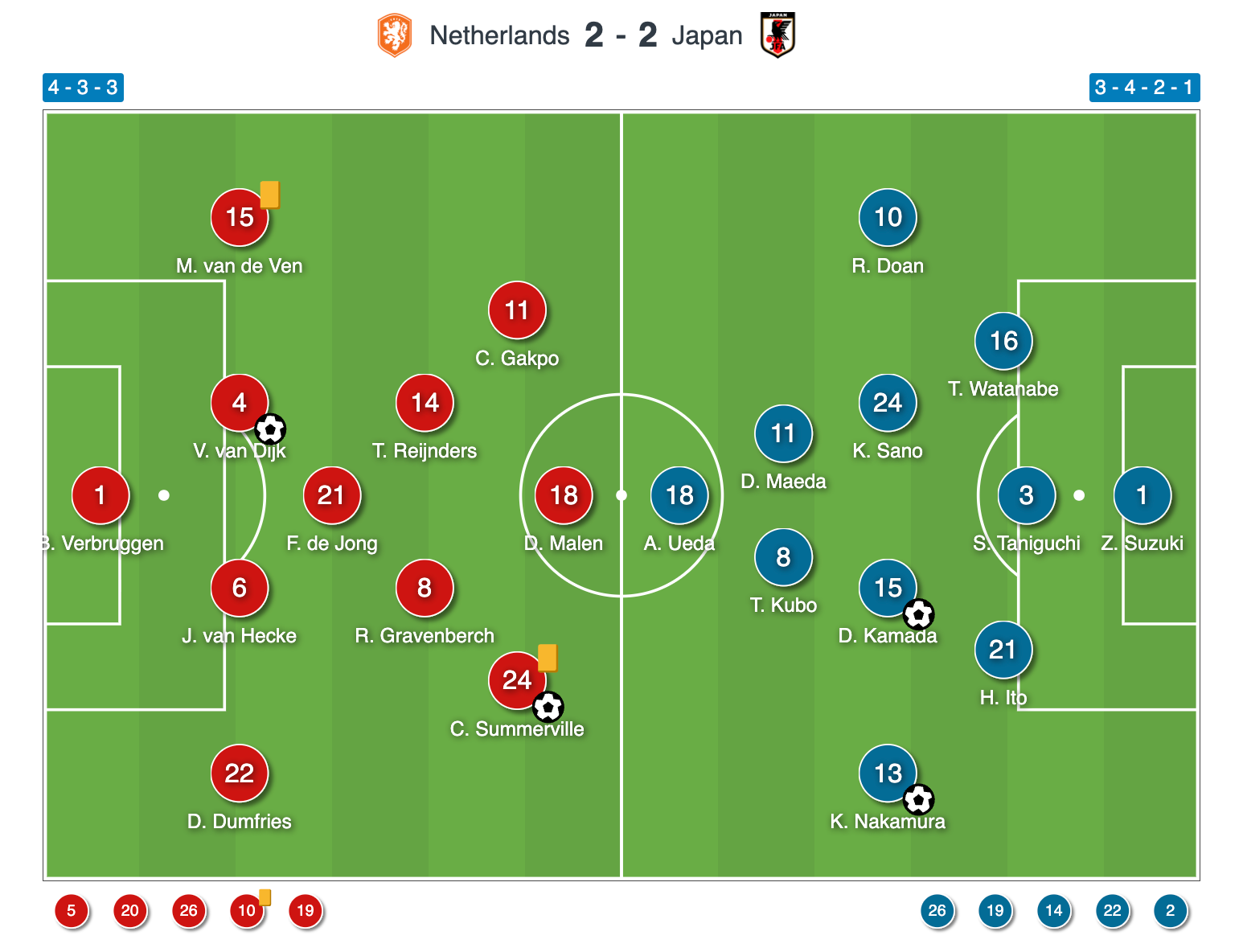
Netherlands Lineup Vs Japan
Ronald Koeman tactics structured the Netherlands in a base 4-1-2-3 formation, which fluidly shifted into a 4-1-5 or 3-2-5 structure during consolidated possession phases.
Bart Verbruggen started in goal, protected by a central defensive pairing of Jan Paul van Hecke and captain Virgil van Dijk.
Denzel Dumfries occupied his standard right-back berth, operating with high-volume linear verticality, while Micky van de Ven was deployed at left-back to mitigate counterattacking threats with his elite recovery pace.
In the engine room, Frenkie de Jong functioned as the single, deep-lying orchestrator tasked with dropping deep to construct a temporary three-man line.
Ahead of him, Ryan Gravenberch and Tijjani Reijnders operated as advanced eights exploiting the half-spaces, while Crysencio Summerville and Cody Gakpo provided wide danger flanking Donyell Malen, who led the line as a dynamic, dropping centre-forward.
Japan Lineup Vs Netherlands
Hajime Moriyasu tactics countered this system by deploying Japan in a highly disciplined 3-4-3 base alignment, which converted into a compact 5-2-3 mid-block out of possession.
Zion Suzuki started between the posts, shielded by a back three of Tsuyoshi Watanabe, Shogo Taniguchi, and Hiroki Ito.
Ritsu Doan operated as an offensive wing-back on the right side, while Keito Nakamura patrolled the left flank to provide natural width.
The central midfield double pivot comprised Kaishu Sano, who provided defensive coverage and ground-level duel efficiency, and Daichi Kamada, who acted as the deep playmaker.
Upfront, Japan utilised an extremely fluid, narrow attacking trident featuring Takefusa Kubo in the right interior channel, Daizen Maeda operating from the left, and Ayase Ueda acting as the central focal point executing tireless structural pressing runs.
Japan 5-2-3 Mid-Block Vs Dutch 4-1-5 Build-Up
The defining tactical narrative of the first half was the absolute structural gridlock engineered by Japan's defensive architecture.
Out of possession, Moriyasu's side did not engage in a hyper-aggressive, high-territory press; instead, they established a textbook 5-2-3 mid-block designed to eliminate central passing lanes and force the Netherlands into slow, lateral horseshoe circulation around the perimeter of the defensive block.
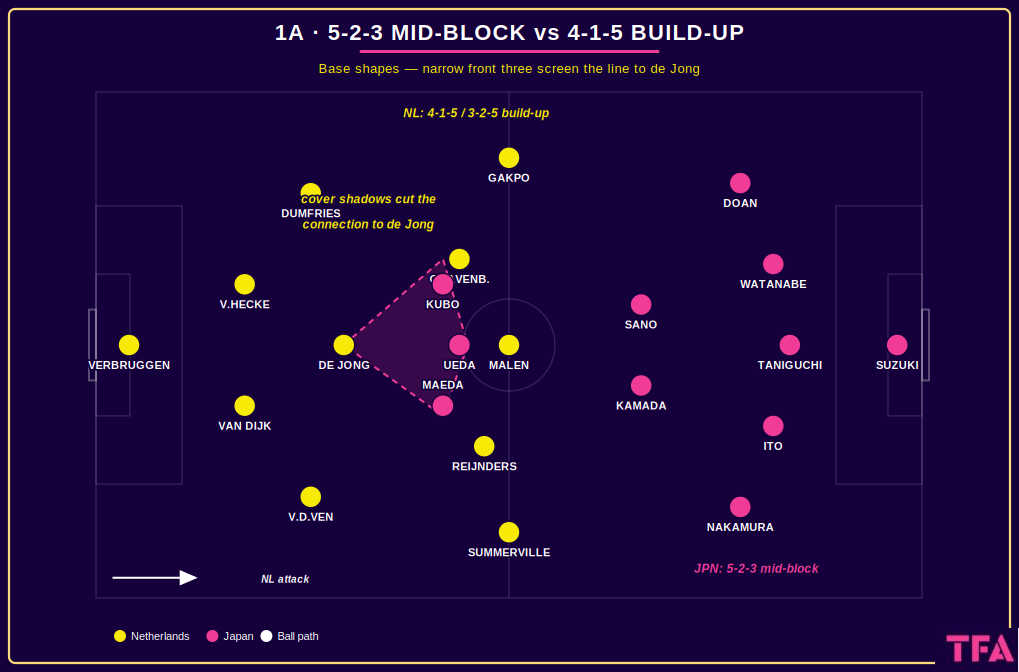
When Jan Paul van Hecke and Virgil van Dijk held possession, Japan's front three of Maeda, Ueda, and Kubo formed a narrow defensive screen.
Their primary objective was not to apply direct, high-speed pressure to the Dutch centre-backs, but rather to use their cover shadows to sever the connection to Frenkie de Jong completely.
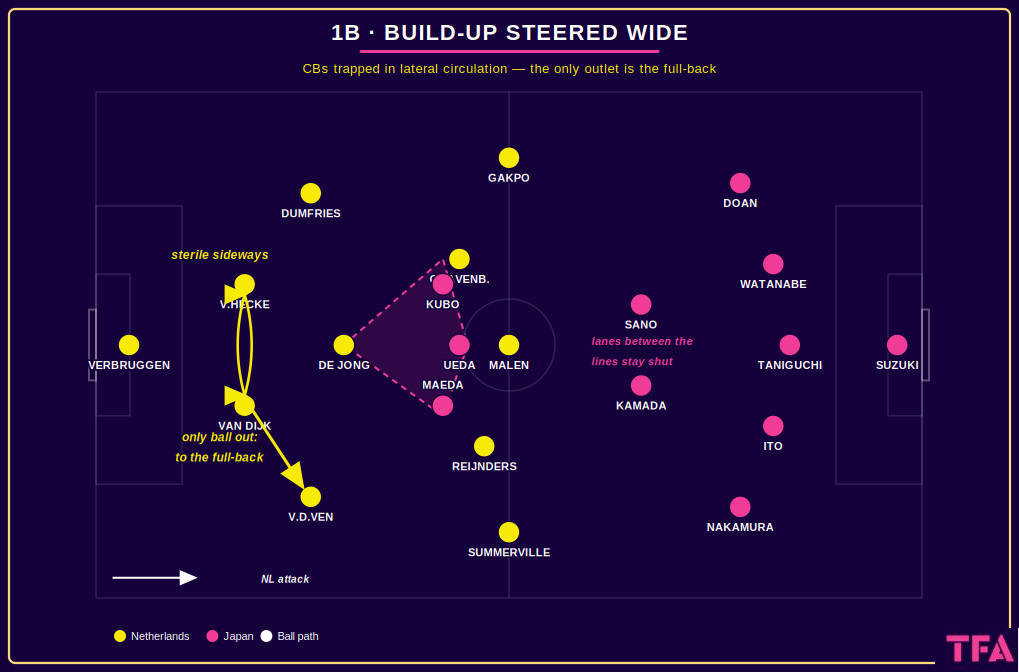
By positioning themselves narrowly, the Japanese forward line forced the Dutch build-up wide into the full-back zones.
Koeman attempted to combat this by instructing his full-backs, Dumfries and Van de Ven, to remain initially deeper and narrower in their nominal full-back positions, thereby establishing a temporary 4-1-5 or 4-1-2-3 structure.
The intent was to draw out Japan's wing-backs, Nakamura and Doan, thereby creating vertical space behind them for Gakpo and Summerville to isolate the Japanese wide centre-backs in 1v1 situations.
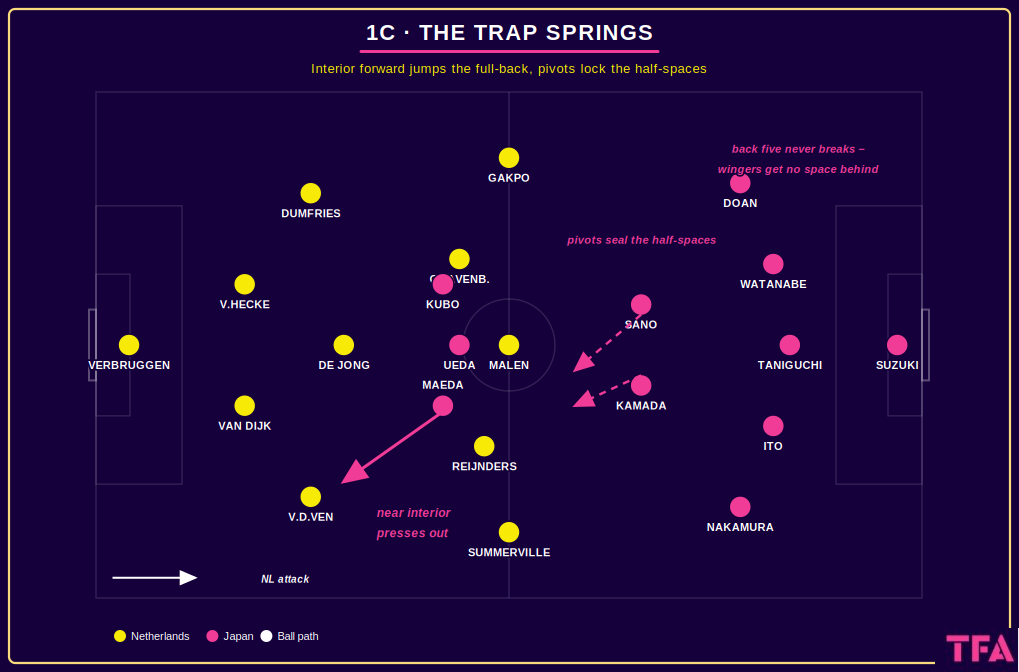
However, Japan's defensive discipline completely nullified this intention.
When the ball was circulated to Van de Ven or Dumfries, Japan's wing-backs did not break defensive ranks to press high up the pitch.
Instead, the near-side interior forward (either Kubo or Maeda) would slide horizontally to apply angled pressure on the Dutch full-back, cutting off the vertical passing lane down the line.
Simultaneously, Kaishu Sano and Daichi Kamada would shift across to lock down the central half-spaces, ensuring that neither Gravenberch nor Reijnders could receive the ball between the lines on the half-turn.
This defensive coordination meant that the Netherlands were continuously trapped in a state of stagnant possession.
The Dutch centre-backs spent large portions of the first half exchanging lateral passes, unable to penetrate the central block.
When Frenkie de Jong attempted to drop deeper to create a 3v3 overload against Japan's first line of pressure, it simply meant the Netherlands had one fewer body in the middle third of the pitch, allowing Sano and Kamada to easily control Gravenberch and Reijnders in a 2v2 underload.
The only semi-consistent outlet for the Oranje came through direct vertical directness toward Donyell Malen, who would drop deep at times from his centre-forward role to try and drag Shogo Taniguchi out of the back three.
While Malen's physical profile allowed him to hold off initial challenges, Japan's back three maintained impeccable vertical compactness.
The moment Malen touched the ball, either Ito or Watanabe would instantly slide inside to provide aggressive cover, choking the space and forcing Malen into backward or horizontal layoffs, allowing Japan to reset their block.
The efficiency of Japan's 5-2-3 structure was reflected in the complete containment of Cody Gakpo and Crysencio Summerville during the first 45 minutes.
With Nakamura and Doan remaining deep to form a rigid five-man defensive line, the Dutch wingers could not find opportunities to exploit the space behind the defence.
Every time Gakpo attempted to cut inside from the right, he was immediately met by a wall of three defenders: the left centre-back Hiroki Ito, the wing-back Nakamura, and the tracking central midfielder Sano.
This defensive density restricted the Netherlands to low-value, speculative crosses from deep areas, which Taniguchi and Watanabe cleared with minimal mechanical distress.
There were a couple of decent opportunities on both sides, because both teams did rather well on the ball, but none of those chances posed a real danger.
The Half-Space Conundrum & Dutch Structural Instability
As the match entered the second half, the tactical paradigm shifted dramatically.
Ronald Koeman recognised that the lateral, predictable circulation of the first half was playing directly into Japan's hands.
To break the structural rigidity of the Japanese mid-block, the Netherlands committed more bodies forward, looking to overload the final third and stretch Japan's back three.
The tactical payoff for this increased attacking volume arrived in the 51st minute when Ryan Gravenberch found himself with time and space on the right wing following a rapid horizontal switch after De Jong won a second ball of a set-piece.
Gravenberch whipped an exceptional, high-velocity cross toward the far post, where Virgil van Dijk utilised his superior aerial ability to rise above Tsuyoshi Watanabe and power home a header to break the deadlock.
However, this aggressive offensive expansion came at a profound structural cost, exposing a massive defensive vulnerability in the centre of the pitch.
As the Dutch full-backs and advanced midfielders pushed higher to sustain the attack, a critical disconnect emerged between the Netherlands frontline and their defensive base.
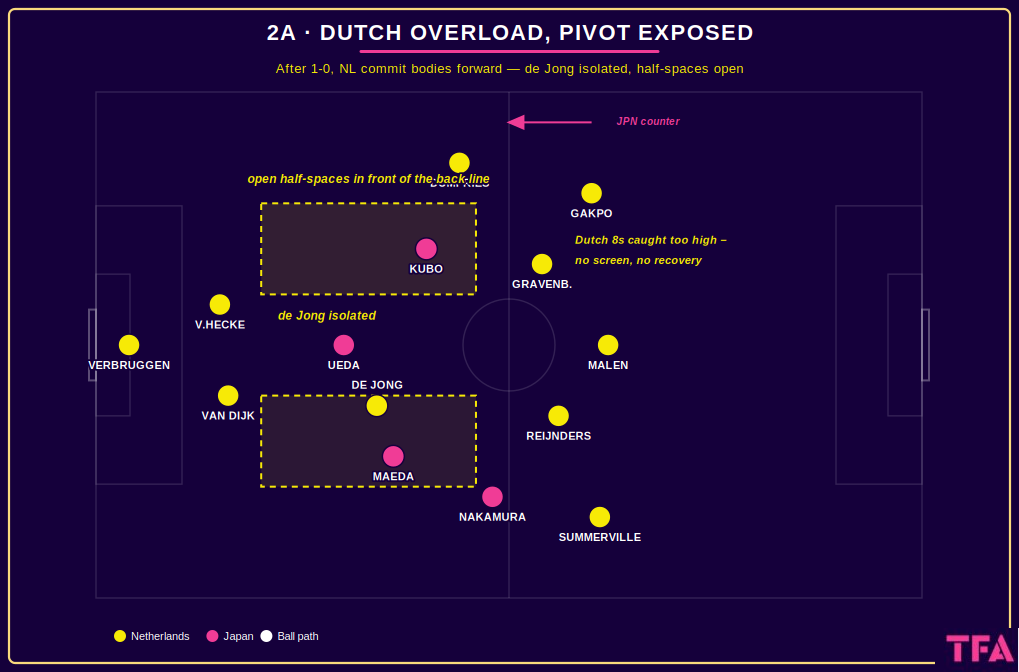
The primary issue stemmed from an inability to control the vital space immediately in front of their own backline.
![Real Sociedad Vs Bournemouth [1-2] Europa League 2026/2027: How Do Marco Rose Pressing Tactics Work? - Tactical Analysis](https://cdn.mymidnight.blog/77f959f119f4fb2321e9ce801e2f5163/size/w600/2026/09/Real-Sociedad-Vs-Bournemouth-20262027---Tactical-Analysis-1.png)
![AC Milan Vs Benfica [0-2] Europa League 2026/2027: How Marco Silva Tactics Exposed Rúben Amorim Defensive Problems - Tactical Analysis](https://cdn.mymidnight.blog/77f959f119f4fb2321e9ce801e2f5163/size/w600/2026/09/AC-Milan-Vs-Benfica-20262027---Tactical-Analysis.png)
![Sunderland Vs AZ Alkmaar [1-0] Europa League 2026/2027: Why The Black Cats Make Better Underdogs - Tactical Analysis](https://cdn.mymidnight.blog/77f959f119f4fb2321e9ce801e2f5163/size/w600/2026/09/Sunderland-Vs-AZ-Alkmaar-20262027---Tactical-Analysis.png)
![Leeds United Vs Newcastle United [4-1] Premier League 2026/2027: Why Did Daniel Farke Tactics Dominate The Magpies? - Tactical Analysis](https://cdn.mymidnight.blog/77f959f119f4fb2321e9ce801e2f5163/size/w600/2026/09/Leeds-United-Vs-Newcastle-2026_2027---Tactical-Analysis.png)
![Real Sociedad Vs Atlético Madrid [0-3] La Liga 2026/2027: How Diego Simeone Tactical Precision Rescued A Late Victory - Tactical Analysis](https://cdn.mymidnight.blog/77f959f119f4fb2321e9ce801e2f5163/size/w600/2026/09/Real-Sociedad-Vs-Atl--tico-Madrid-20262027---Tactical-Analysis-1.png)
![Manchester United Vs Manchester City [0-1] Premier League 2026/2027: How Enzo Maresca Tactics Secured Victory With 10 Men - Tactical Analysis](https://cdn.mymidnight.blog/77f959f119f4fb2321e9ce801e2f5163/size/w600/2026/09/Manchester-United-Vs-Manchester-City--20262027---Tactical-Analysis.png)
![Tottenham Hotspur Vs Everton [0-0] Premier League 2026/2027: Why Can't Spurs Score? - Tactical Analysis](https://cdn.mymidnight.blog/77f959f119f4fb2321e9ce801e2f5163/size/w600/2026/09/Tottenham---Vs-Everton-20262027---Tactical-Analysis.png)
![West Ham United Vs Wrexham [6-0] EFL Championship 2026/2027: The Cost Of Passive Defending Against Smart Movement - Tactical Analysis](https://cdn.mymidnight.blog/77f959f119f4fb2321e9ce801e2f5163/size/w600/2026/09/West-Ham-United-Vs-Wrexham-2026_2027---Tactical-Analysis.png)