FIFA World Cup 2026: Can An African Nation Win The World Cup? – Data Analysis

African football enters the 2026 FIFA World Cup carrying greater expectations than ever before.
The expansion to 48 teams has increased the continent’s representation, while recent international tournaments have demonstrated that African nations are no longer merely capable of isolated upsets; they are increasingly able to compete consistently with the world’s top sides.
The benchmark was established by Morocco’s historic semi-final run in Qatar 2022, a campaign that fundamentally altered perceptions of African football on the global stage.
Since then, several nations have strengthened their squads, improved their tactical structures, and developed greater depth across key positions.
Among Africa’s representatives this time around, Morocco, Egypt, Algeria, Senegal and Côte d’Ivoire stand out as the continent’s strongest contenders.
Morocco arrive with proven tournament pedigree, Senegal continue to combine athleticism with elite-level experience, while Algeria have enjoyed a significant resurgence under Vladimir Petković.
Egypt remain driven by the influence of Mohamed Salah and Omar Marmoush, while Ivory Coast enter the competition as one of Africa’s most balanced and complete sides.
In this World Cup data analysis, we examine the tactical identities, statistical profiles, squad strengths and weaknesses of Morocco, Egypt, Algeria, Senegal and Côte d’Ivoire, before assessing how far each nation can realistically progress at the 2026 FIFA World Cup.
To make cross-team comparisons fairer, given that teams have played different numbers of matches over the last 12 months, all data has been normalised in the visualisations.
Côte d’Ivoire Lead Africa’s Dribbling Revolution
Among Africa’s teams with realistic ambitions of reaching the latter stages of the 2026 FIFA World Cup, no side relies more on individual attacking quality than Côte d’Ivoire.
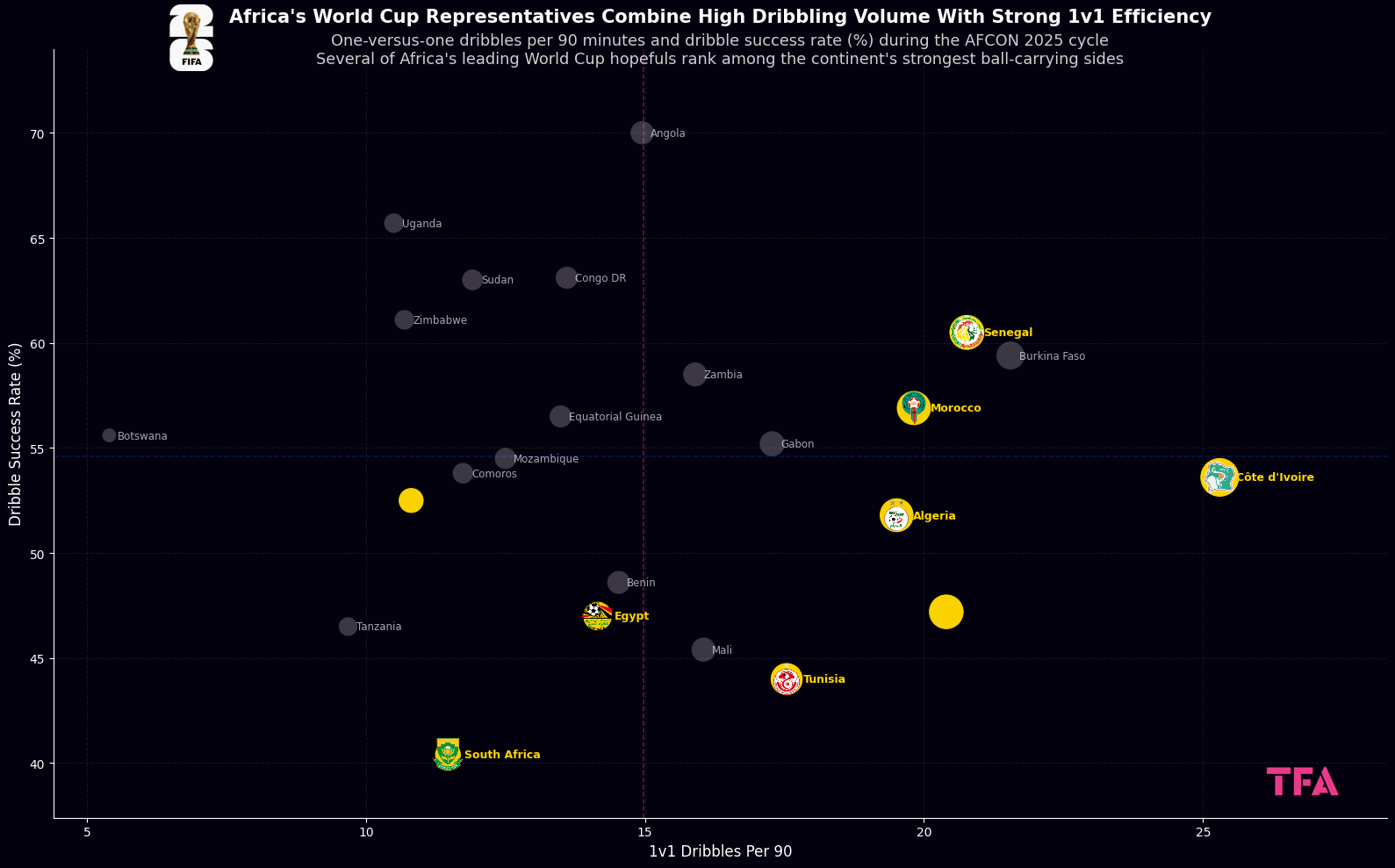
The Elephants lead the continent in 1v1 dribbles, averaging 25.3 per 90 minutes throughout the 2026 World Cup qualifying campaign, a figure that comfortably surpasses every other African nation in the dataset.
Africa World Cup Representatives Combine High Dribbling Volume With Strong 1v1 Efficiency
More importantly, this is not merely a stylistic preference; it reflects the exceptional pool of talent available within one of Africa’s most dynamic attacking squads.
The emergence of young wide players such as Yan Diomandé has added another dimension to Côte d’Ivoire’s attack.
Diomandé has quickly established himself as one of the most aggressive and effective dribblers of his generation, consistently seeking to isolate defenders and progress attacks through direct ball-carrying.
Alongside him, Amad Diallo provides creativity, acceleration and unpredictability in possession, giving Côte d’Ivoire multiple outlets capable of deciding matches through individual moments of quality.
This concentration of dribbling talent helps explain why Côte d’Ivoire continue to post such extraordinary numbers.
Rather than relying exclusively on lengthy possession sequences, they frequently seek to create advantages through direct confrontations, forcing opponents into defensive duels that favour the technical quality and athleticism of their attackers.
It is a profile particularly well suited to tournament football, where organised defensive structures often restrict the space available for more elaborate attacking patterns.
Among Africa’s leading World Cup representatives, Senegal, Morocco and Algeria also rank near the top for dribbling volume.
Senegal combine high dribble frequency with an impressive 60.5% success rate, suggesting a side capable of progressing attacks through both collective organisation and individual quality.
Morocco and Algeria similarly possess numerous players comfortable receiving under pressure and advancing play through direct ball carrying, an increasingly valuable trait against elite opposition.
Interestingly, some of Africa’s strongest dribbling teams are not necessarily the most possession-dominant sides.
Instead, these nations often use individual ball progression as a mechanism to accelerate attacks and bypass opposition pressure.
As the 2026 World Cup approaches, the ability to consistently win 1v1 duels could prove decisive for African teams hoping to challenge the tournament’s traditional powers and progress into the latter stages of the competition.
Africa’s Attacking Efficiency Suggests Genuine Upset Potential
One of the most encouraging indicators for Africa’s leading World Cup representatives is not simply the volume of chances they create, but the efficiency with which they convert them.
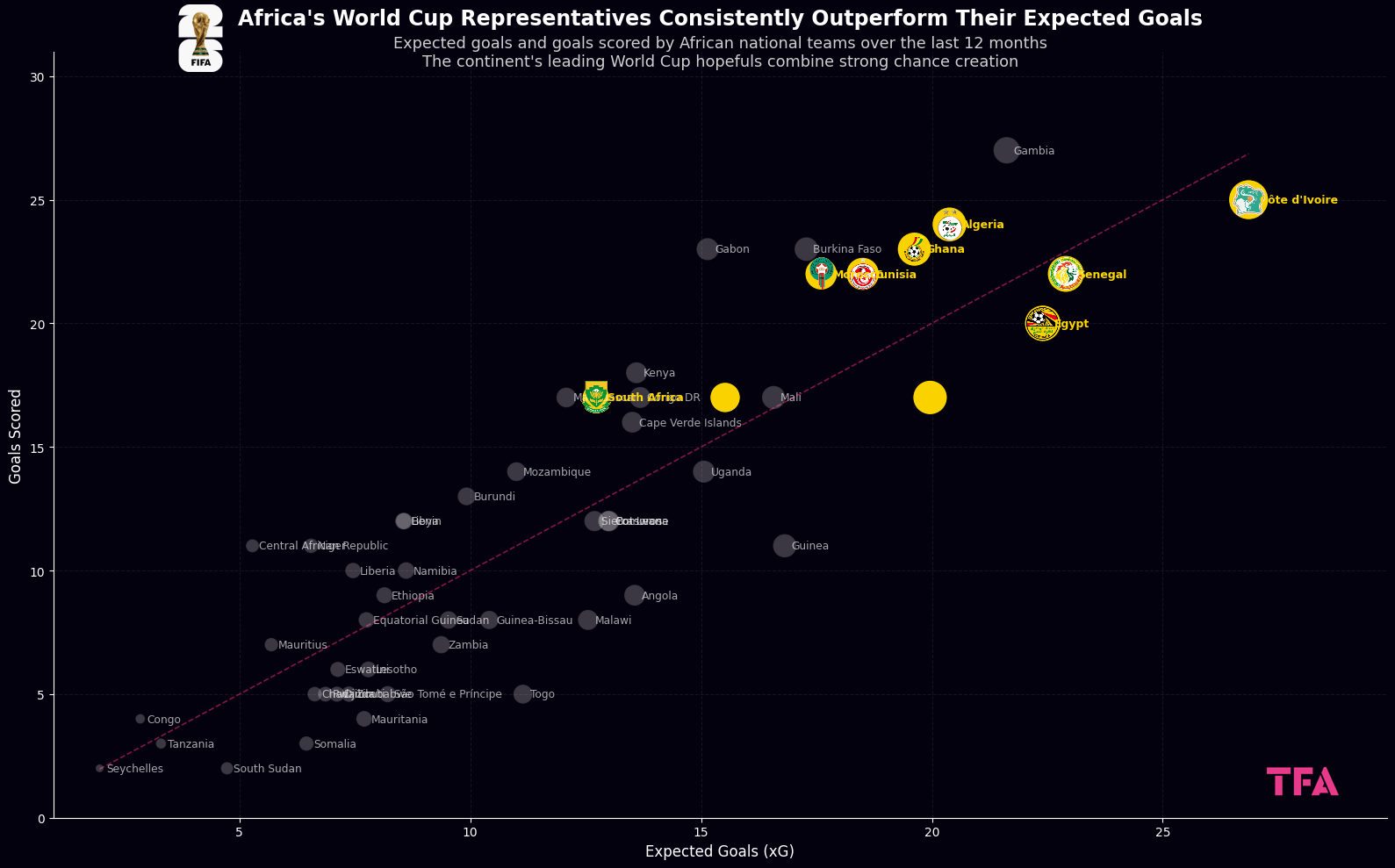
Over the last 12 months, several of the continent’s strongest nations have consistently outperformed their expected goal totals, suggesting a combination of clinical finishing, effective attacking structures, and high-level individual talent.
Côte d’Ivoire, Algeria and Ghana have all converted chances at rates significantly above expectation, while Egypt and Senegal continue to combine strong underlying chance creation with proven goalscoring quality.
Africa World Cup Representatives Consistently Outperform Their Expected Goals
This trend is particularly important in tournament football, where margins are often extremely small, and knockout matches can be decided by a single decisive moment.
African sides have historically been capable of matching elite opponents physically and athletically, but the recent data suggests they are becoming increasingly efficient in possession as well.
Egypt’s attacking output continues to benefit from the creativity and finishing quality of Mohamed Salah and Omar Marmoush, while Algeria’s resurgence under Vladimir Petković has produced a more balanced side capable of controlling matches rather than merely reacting to them.
Côte d’Ivoire, meanwhile have emerged as one of Africa’s most complete teams, combining defensive stability with the ability to generate high-quality chances through multiple attacking routes.
Morocco present perhaps the most fascinating tactical case.
Despite being regarded as Africa’s strongest tournament side, the Atlas Lions ranked among the lowest teams in this sample for expected goals generation over the past year, reflecting the pragmatic and defence-first principles that defined much of Walid Regragui’s tenure.
Morocco’s success under Regragui was built on defensive organisation, compactness and transitional efficiency, with chance prevention often prioritised over sustained attacking pressure.
However, the arrival of Mohamed Ouahbi appears to signal a notable tactical shift.
Morocco’s World Cup opener against Brazil offered an early glimpse of a more proactive approach, with the Atlas Lions pressing higher, committing greater numbers forward and creating dangerous attacking sequences against one of the tournament favourites.
If Ouahbi can retain the defensive solidity that carried Morocco to the 2022 semi-finals while increasing their attacking output, the Atlas Lions may possess a higher ceiling than any African nation has previously taken into a World Cup.
Possession Dominance Is No Longer A Prerequisite For African Success
One of the most interesting tactical trends among Africa’s leading World Cup representatives is the contrast in how they approach possession.
While several of the continent’s strongest teams continue to prioritise territorial control and extended periods on the ball, others have achieved comparable success through far more direct and transitional styles.
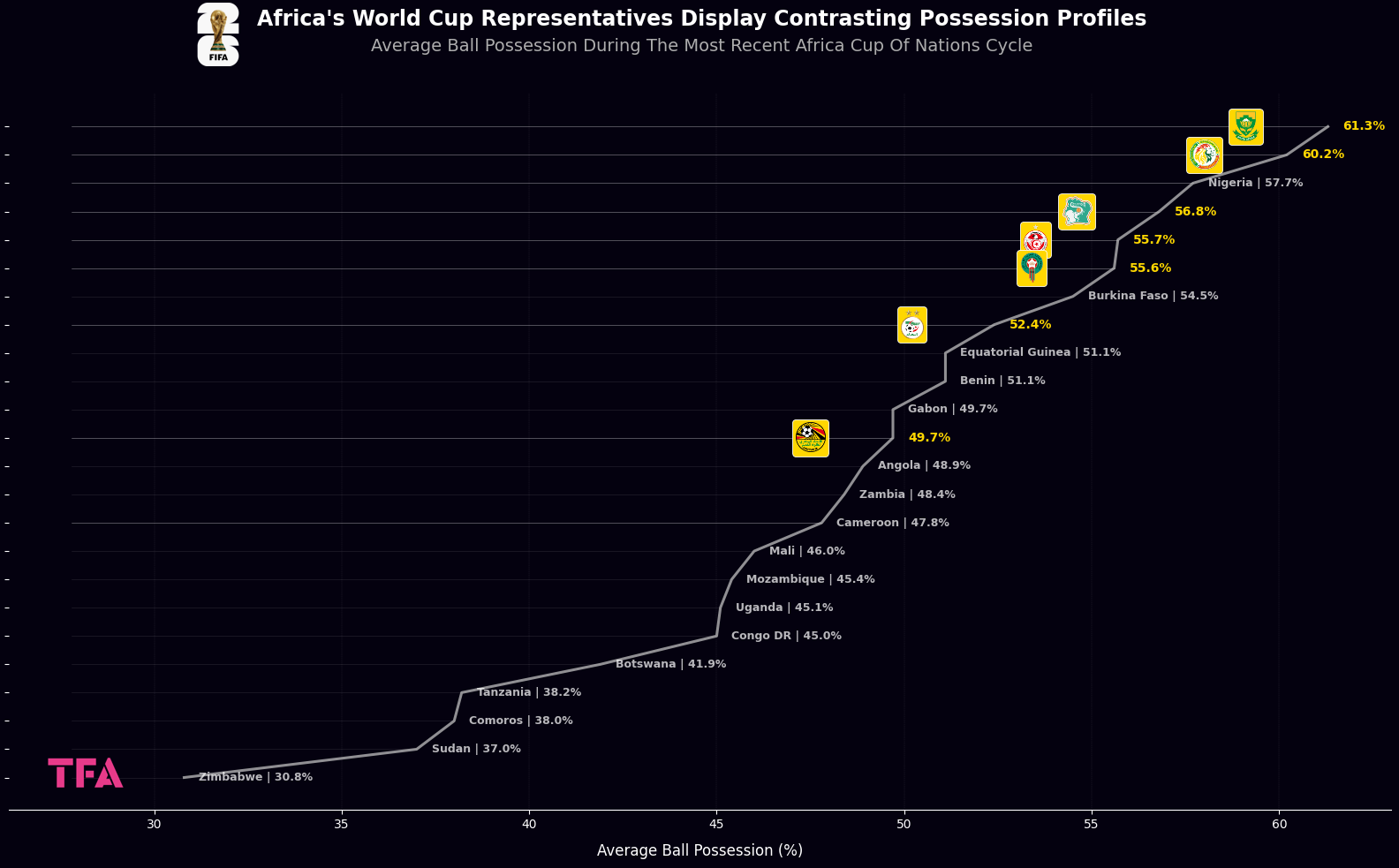
South Africa and Senegal stand out as the most possession-oriented sides in the data, averaging over 60% possession during the most recent Africa Cup of Nations cycle.
Both teams are comfortable building attacks patiently, progressing through structured possession phases and controlling matches through sustained territorial dominance.
Côte d’Ivoire and Tunisia also rank among the continent’s stronger possession teams, reflecting a broader shift towards more proactive football among Africa’s elite nations.
Africa World Cup Representatives Display Contrasting Possession Profiles
At the opposite end of the spectrum, Egypt provide a fascinating tactical contrast.
Despite possessing two of Africa’s most dangerous attacking players in Mohamed Salah and Omar Marmoush, Egypt averaged just 49.7% possession, placing them firmly in the middle of the continental rankings.
Rather than seeking to dominate the ball, Egypt often prioritise vertical progression, quick transitions and direct access into attacking areas.
Their approach is built around efficiency rather than control, allowing them to remain competitive without monopolising possession.
This distinction is particularly important in tournament football.
The strongest teams are not necessarily those that see the most of the ball, but those capable of adapting their game model to different opponents.
Senegal and South Africa appear most comfortable dictating matches through possession, while Egypt represent a reminder that effective tournament football can be achieved through compact defensive structures, rapid transitions and clinical execution rather than territorial dominance alone.
Progressive Football Is Driving Africa’s Most Dangerous Attacks
Progressive play remains one of the clearest indicators of a team's ability to advance possession into threatening areas, and the World Cup qualifying data reveals several distinct tactical approaches among Africa’s leading nations.
The most striking case is the Democratic Republic of Congo, who lead the continent in progressive passes with 795.