![Fulham Vs Chelsea [2-3] Premier League 2026/2027: How Does Xabi Alonso's New Front Three Work? – Tactical Analysis](https://cdn.mymidnight.blog/77f959f119f4fb2321e9ce801e2f5163/size/w1000/2026/08/Fulham-Vs-Chelsea-2026-27---Tactical-Analysis.png)
Fulham Vs Chelsea [2-3] Premier League 2026/2027: How Does Xabi Alonso's New Front Three Work? – Tactical Analysis
Chelsea’s new front three of Cole Palmer, Morgan Rogers and João Pedro starred in Xabi Alonso’s first Premier League win. This tactical analysis examines their complementary roles, pressing and attacking threat against Fulham.

The final match of the opening gameweek of the 2026/2027 Premier League season saw ex-teammates at Liverpool, Real Madrid and Spain face off in the dugouts of Craven Cottage, as new Chelsea manager Xabi Alonso began his tenure as Blues boss against a familiar face in new Fulham chief Álvaro Arbeloa.
The contest produced end-to-end action that resulted in a five-goal thriller that fell Chelsea’s way.
Both teams leave with some serious defensive issues to address.
However, the majority of Chelsea fans and neutrals will have left Monday’s match with the stellar performance of Alonso’s new front three firmly in the front of their minds.
The contrasting and complementary profiles, all of whom displayed exactly the type of positivity, confidence and intent to solve problems that you want to see from your attackers, posed a constant threat to the Fulham backline from the first whistle (literally, with Chelsea’s opener coming in the very first minute).
This Fulham versus Chelsea tactical analysis details how Alonso’s front three functioned in and out of possession in gameweek one.
Fulham Vs Chelsea Lineups & Formations
Fulham Lineup Vs Chelsea
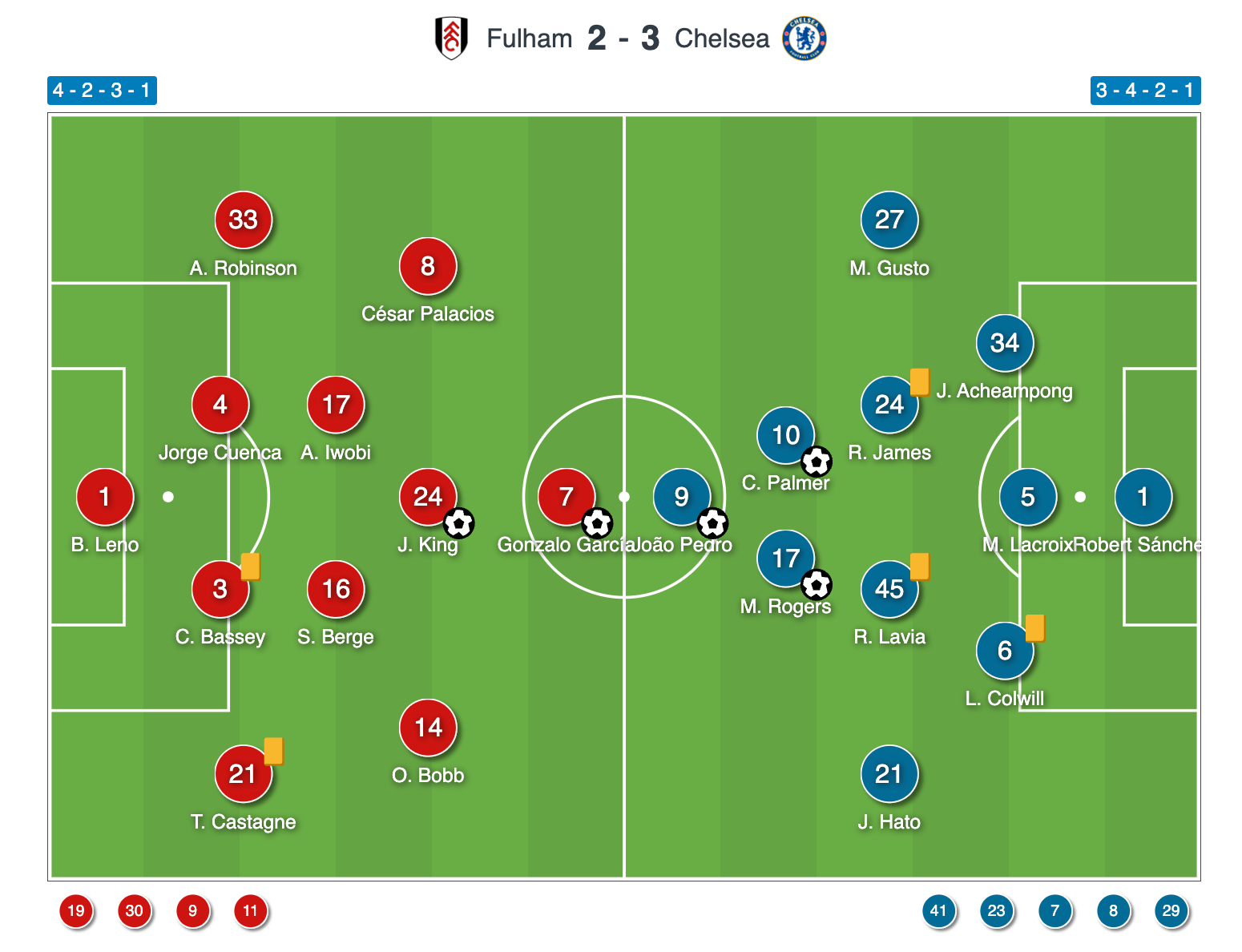
The hosts lined up in a 4-2-3-1 shape with Bernd Leno in goal behind a back four of Timothy Castagne, Calvin Bassey, Jorge Cuenca and Antonee Robinson, from right to left.
Sander Berge and Alex Iwobi started in midfield, behind a creative attacking trio of Oscar Bobb, Josh King and César Palacios, with Gonzalo García leading the line.
Arbeloa made four changes to his starting XI during the match, the first of which saw Shea Charles replace Bobb in the 67th minute.
A double change followed six minutes later, when Kevin and Ryan Sessegnon replaced Palacios and Berge.
Then, in the 82nd minute, another forward, Rodrigo Muniz, was introduced for left-back Robinson.
Chelsea Lineup Vs Fulham
Meanwhile, the visitors set up in a 3-4-2-1 shape with Robert Sánchez in goal behind a back three of Josh Acheampong, Maxence Lacroix and Levi Colwill.
Malo Gusto and Jorrel Hato started as the wing-backs, while Reece James and Roméo Lavia played in central midfield.
Chelsea’s attacking trio was Cole Palmer, Morgan Rogers and João Pedro.
Alonso made five changes to his starting XI over the course of the match.
In the 65th minute, he introduced Enzo Fernández and Pep Chavarría for Lavia and Hato.
Then, 11 minutes later, Pedro Neto was introduced for Malo Gusto.
Lastly, in the 82nd minute, Geovany Quenda and Estêvão came on for Palmer and Rogers.
Fulham Vs Chelsea Stats
While Fulham finished the game on top in the possession department (averaging 60.5% vs Chelsea’s 39.5%), Chelsea were ultimately more efficient, which is what allowed them to leave Craven Cottage with all three points.
The Blues generated more shots (17 to Fulham’s 14) and a slightly higher xG (2.48 vs Fulham’s 2.01), but that was enough given the quality in their forward line to make the most of the opportunities.
Fulham favoured longer periods of possession, averaging 6.29 passes per possession to Chelsea’s 4.37, while the Cottagers also had a far lower PPDA of 9.88 to Chelsea’s 17.46.
The home side sought to play out from the back and build through the thirds patiently, while Chelsea set up to get the ball into their front three early and aggressively to let their quality on the ball do the work.
There weren’t any players in Chelsea’s starting XI you’d really expect to see setting the world alight on the ball outside of that front three, and that showed in how Chelsea played.
They looked to find those difference makers all the time, and thanks to some intelligent movement and good progressive passing, they were able to do so often enough to put three past Fulham, while also exploiting Fulham’s possession-based approach with intelligent pressing from the front on the other side of the ball.
Chelsea Pass Map & Average Positions Vs Fulham
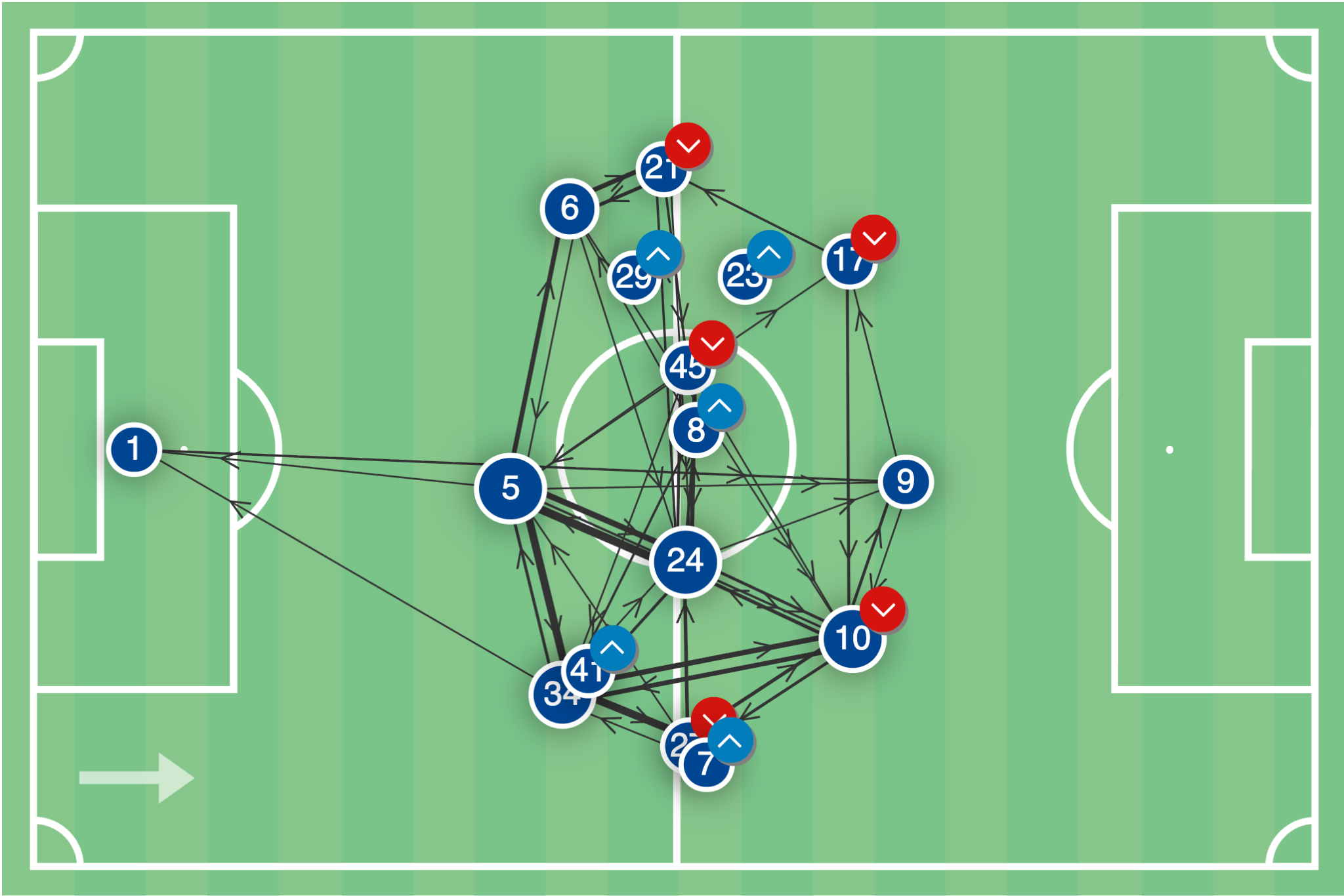
Chelsea’s compact, vertically oriented structure in Figure 2 highlights how their progression had a strong bias towards the right-hand side, particularly running through Reece James (24) in central midfield and Palmer (10), who acted as the key connection into the final third.
Though Palmer and Rogers (17) almost mirrored one another on paper, their roles contrasted heavily in practice.
From his right-sided position, Palmer assumed the responsibilities associated with a traditional No. 10 far more effectively, acting as the central hub around which Chelsea’s attacks revolved.
Rogers was less involved in circulation and played a more dynamic role.
An excellent complement to Palmer, Rogers played higher rather than constantly looking to receive and dictate the play like Palmer.
He drifted into the half-space and threatened with runs in behind the Fulham backline, resembling more of a second-striker than a traditional No. 10.
Chelsea’s Front Three Out Of Possession
Chelsea’s out-of-possession strategy required intensity and positional intelligence from their front three, in particular, during all defensive phases, especially the high press.
From the first kick of the ball on Monday evening, Chelsea’s front three had clear instructions during the high press:
1. Protect the passing lanes into midfield via their cover shadows.
2. Apply pressure on Fulham’s goalkeeper and centre-backs when receiving on the back foot or in limited space.
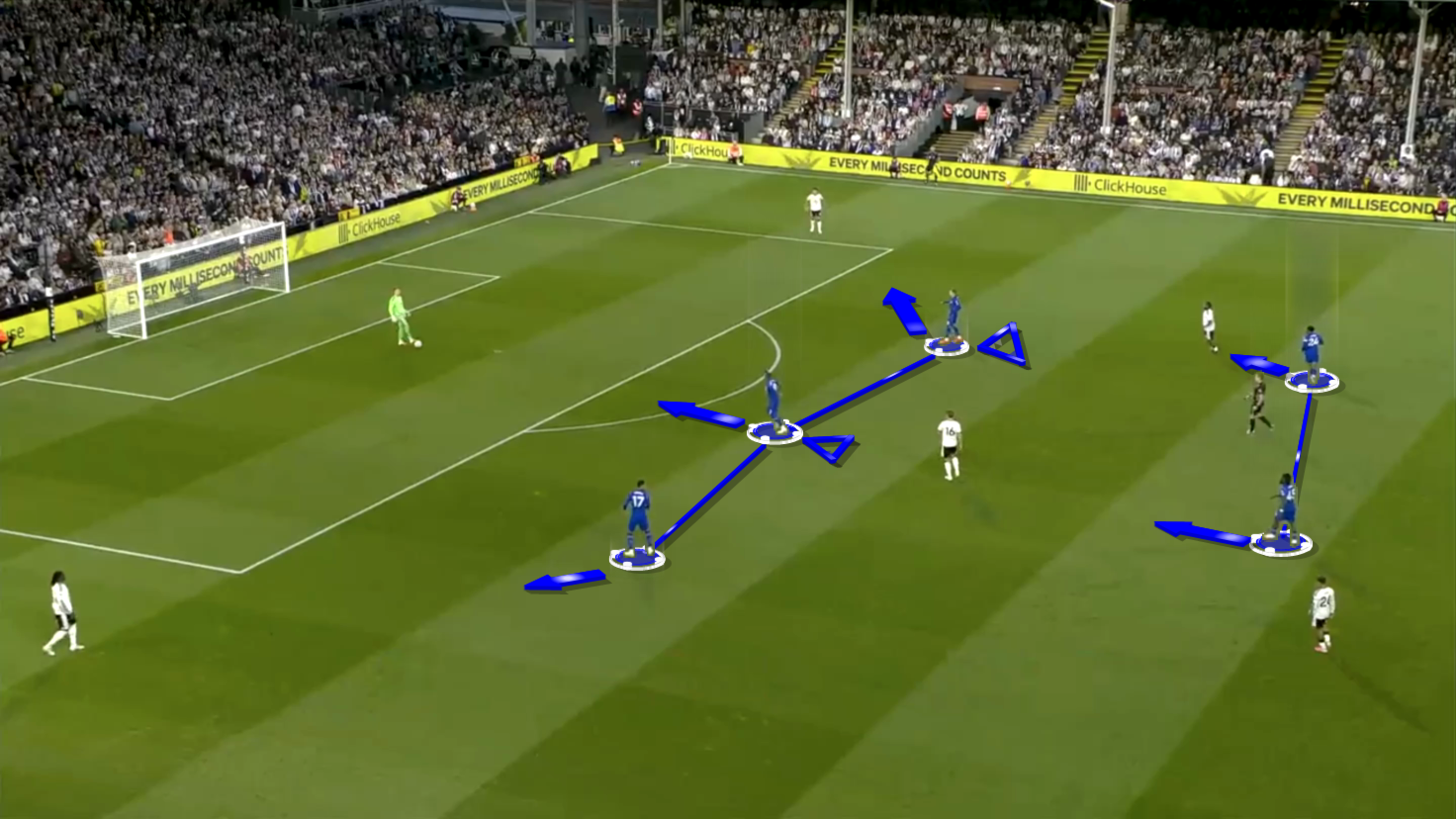
Figures 3-4 show these pressing tactics in action.
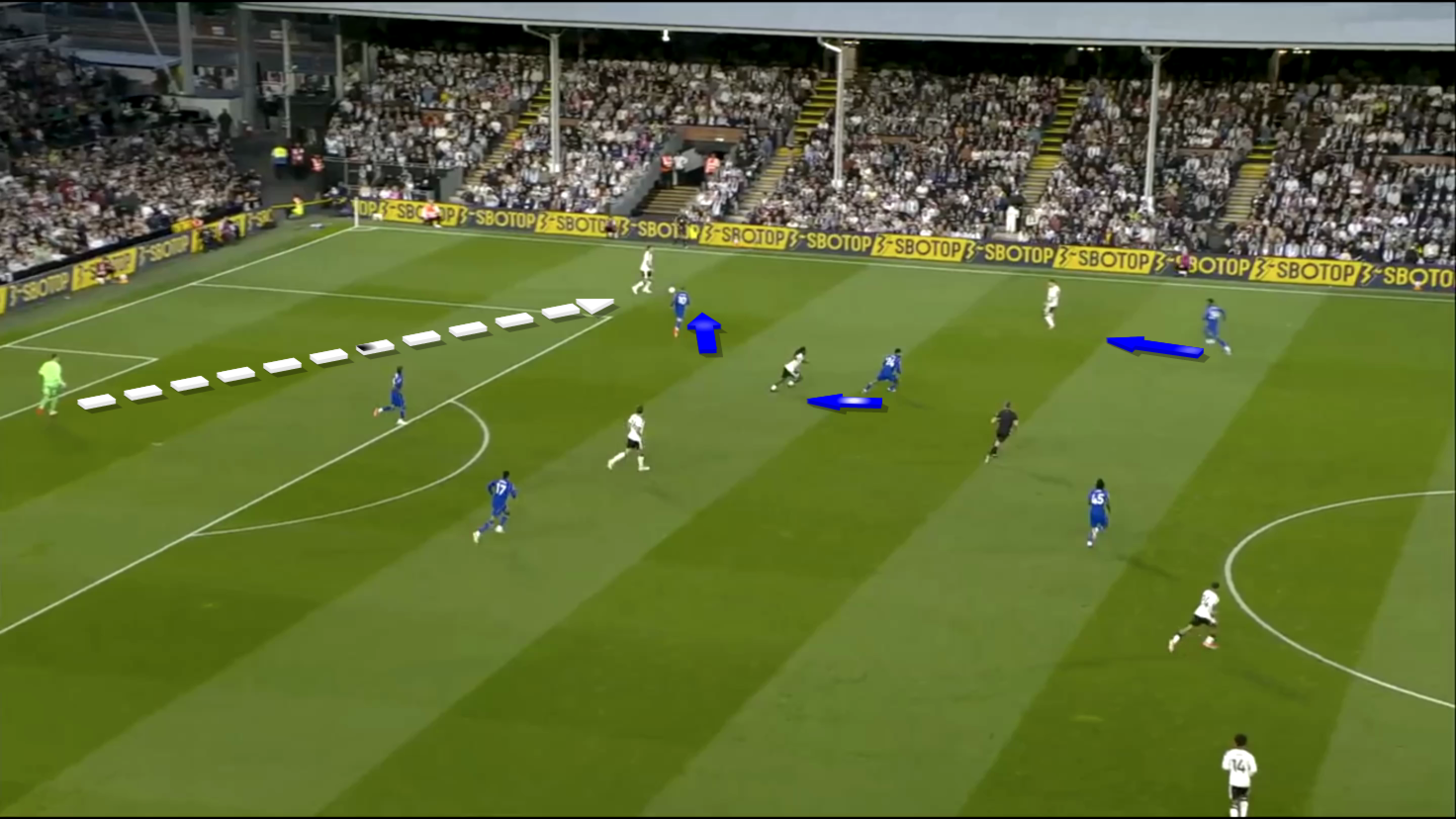
The ball makes its way from Leno to Cuenca, with the centre-back positioned very wide.
This opens the door for Palmer to close the receiver down and contain him out wide by pressing, with the route to midfield kept in his cover shadow.
Chelsea’s midfield and wing-backs, crucially, push up in support of Palmer to prevent Cuenca from escaping via short passing options, which forces the Fulham defender into the long ball, which Chelsea are well placed to deal with thanks to having three centre-backs on the pitch.
The resulting recovery led to the opening goal of the game inside the first minute, as Palmer received the ball in space behind Fulham’s midfield line, which had been looking to advance and apply pressure on the second ball following Cuenca’s long pass.
Palmer took advantage of this space to receive and turn, while taking advantage of the massive gap that still existed between Fulham’s centre-backs to play João Pedro through to score.
This shows how Chelsea’s pressing helped them to take advantage of Fulham’s in-possession tactics throughout the match.
Fulham were not set up to go long, quite the opposite, but Chelsea’s coordinated pressing forced them into long balls at times, which created turnovers and opportunities for Alonso’s side to quickly find their front three in transition.
This was a recurring sequence throughout the match, with the exact same passage of play that led to the goal recurring just a couple of minutes later, as shown in Figures 5-6.
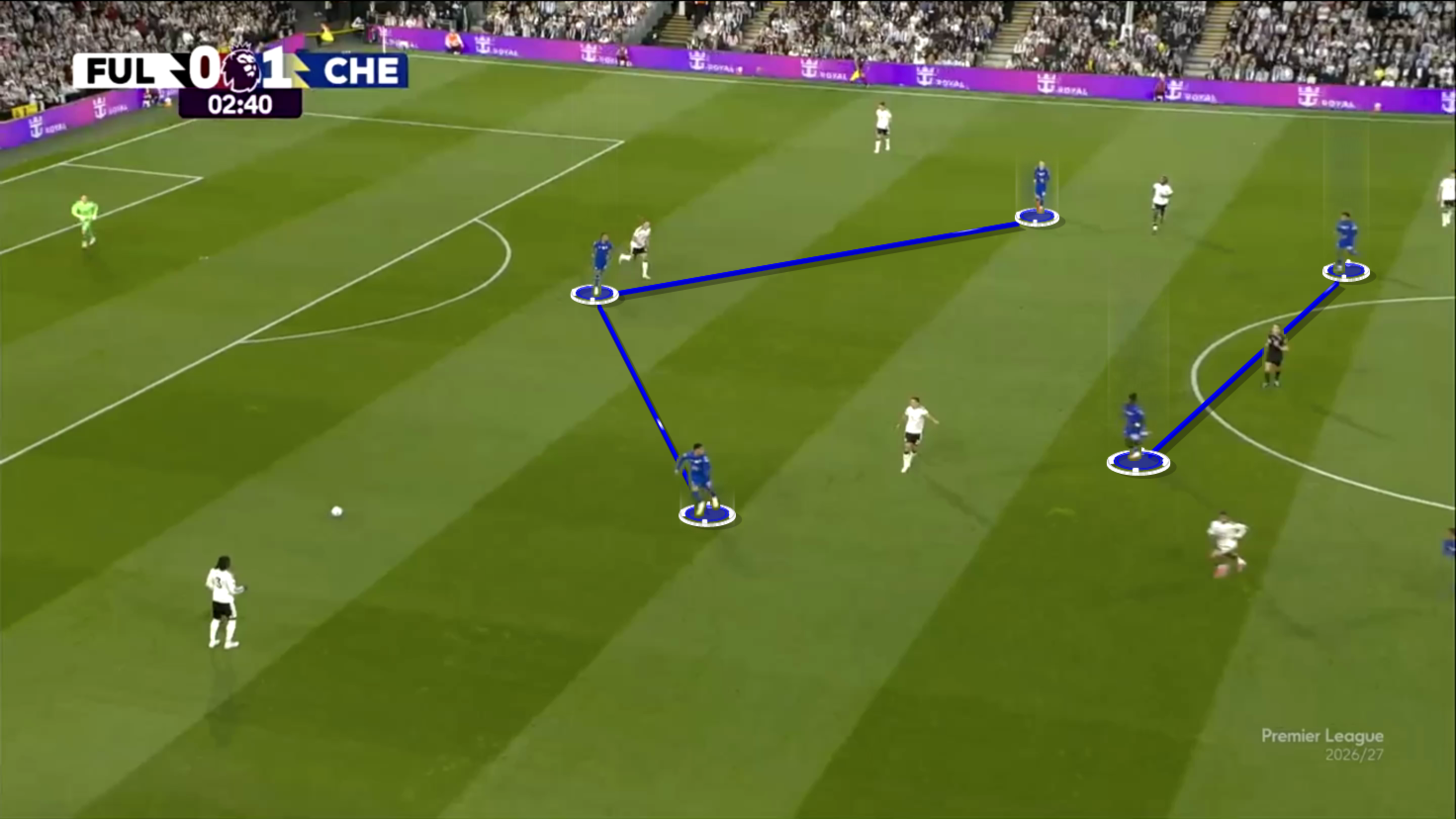
Initially, Chelsea’s front three guard the passing lanes into the centre.
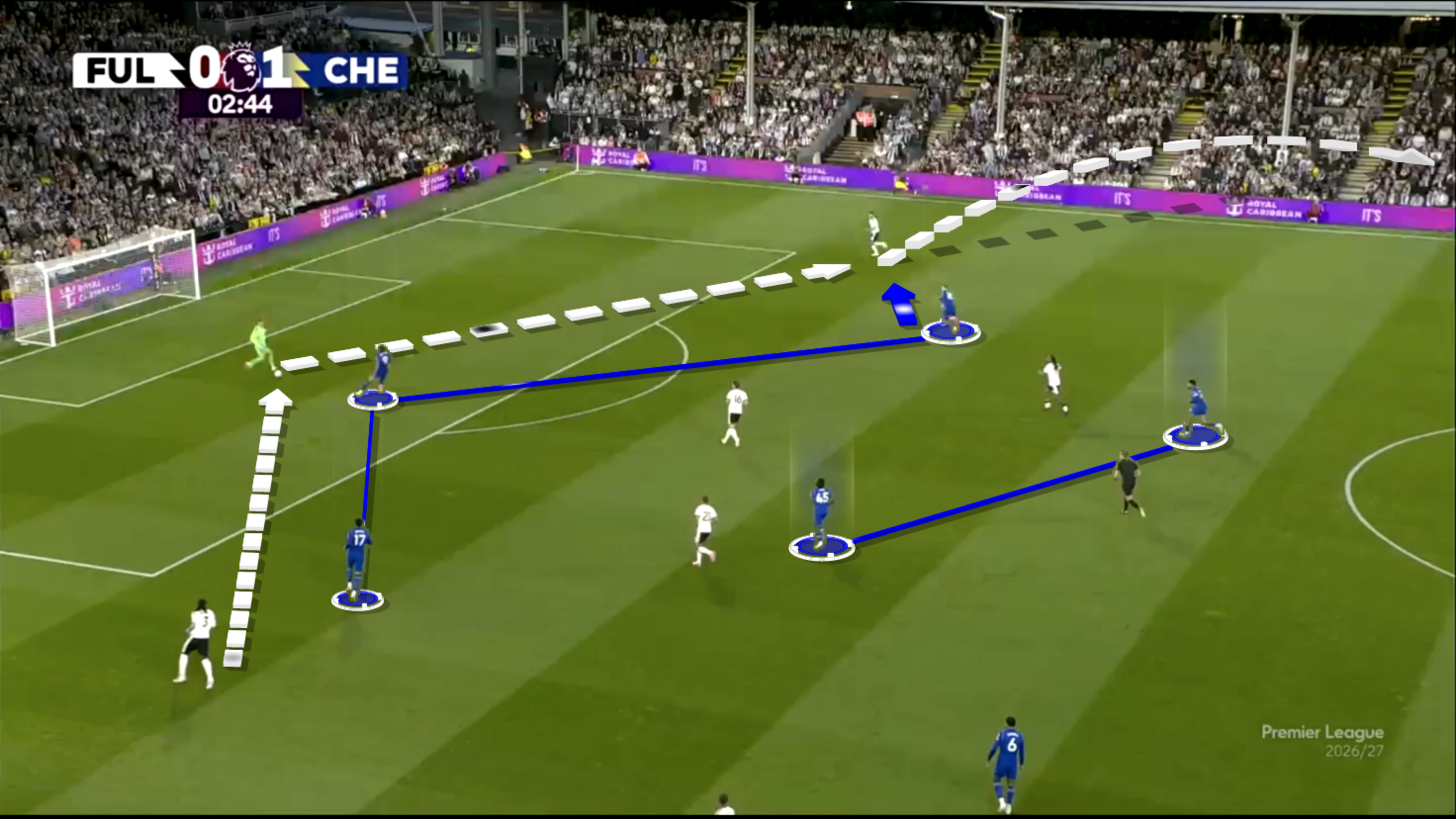
When the ball goes back to Leno, João Pedro pounces while keeping the midfielder behind him in his cover shadow.
This forces Leno to Cuenca again; Palmer presses while keeping the midfielder behind him in his cover shadow too, leading to the centre-back sending the ball long.
Just like the start of the first half, the sequence repeated at the beginning of the second half.
![Borussia Dortmund Vs Werder Bremen [2-2] Bundesliga 2026/2027: How Daniel Thioune Tactics Earned A Late Comeback With 29% Possession - Tactical Analysis](https://cdn.mymidnight.blog/77f959f119f4fb2321e9ce801e2f5163/size/w600/2026/10/Borussia-Dortmund-vs-Werder-Bremen---Tactical-Analysis.png)




![Scotland Vs Switzerland [0-3] UEFA Nations League 2026/2027: How Aggressive Pressing Backfired & Murat Yakin Took Advantage - Tactical Analysis](https://cdn.mymidnight.blog/77f959f119f4fb2321e9ce801e2f5163/size/w600/2026/10/Scotland-Vs-Switzerland-20262027---Tactical-Analysis.png)