FIFA World Cup 2026: Comparing Europe's Top 5 Teams & Tactical Systems – Data Analysis

With the 2026 FIFA World Cup rapidly approaching, attention is increasingly shifting away from qualification campaigns and towards a more important question: who will win the World Cup?
Europe once again arrives with several of the tournament’s strongest contenders.
Spain, France, England, Portugal and Germany all possess elite-level talent, tactical sophistication and the depth required to navigate a month-long international competition.
World Cups are rarely decided by reputation alone.
Recent international tournaments have repeatedly demonstrated that success is often determined by the balance among tactical structure, squad depth, defensive stability, and the ability to adapt under pressure, rather than simply by individual quality.
Each of Europe’s leading challengers enters the tournament with a distinct footballing identity.
In terms of 2026 World Cup predictions, Spain have emerged as the benchmark for positional control and collective organisation; France remain the competition’s most physically dominant transition side; England are undergoing a significant tactical evolution under Thomas Tuchel; whilst Portugal and Germany continue to develop increasingly refined and dangerous systems.
This 2026 FIFA World Cup data analysis examines the leading European World Cup contenders, exploring their tactical profiles, underlying statistical strengths, and potential weaknesses that could ultimately determine whether they become world champions or fall short in decisive moments.
Why Europe’s Leading Contenders Are Built Around Territory Rather Than Defensive Volume
One of the most striking patterns among Europe’s leading World Cup contenders is their remarkably low defensive activity compared to the rest of the continent.
England, France, Germany, Portugal and Spain all rank towards the lower end of the spectrum for both defensive duels and interceptions, suggesting that their defensive strength is not built on constant defending but rather on preventing opponents from attacking in the first place.
Europe World Cup Contenders Rank Among The Least Defensively Active Sides
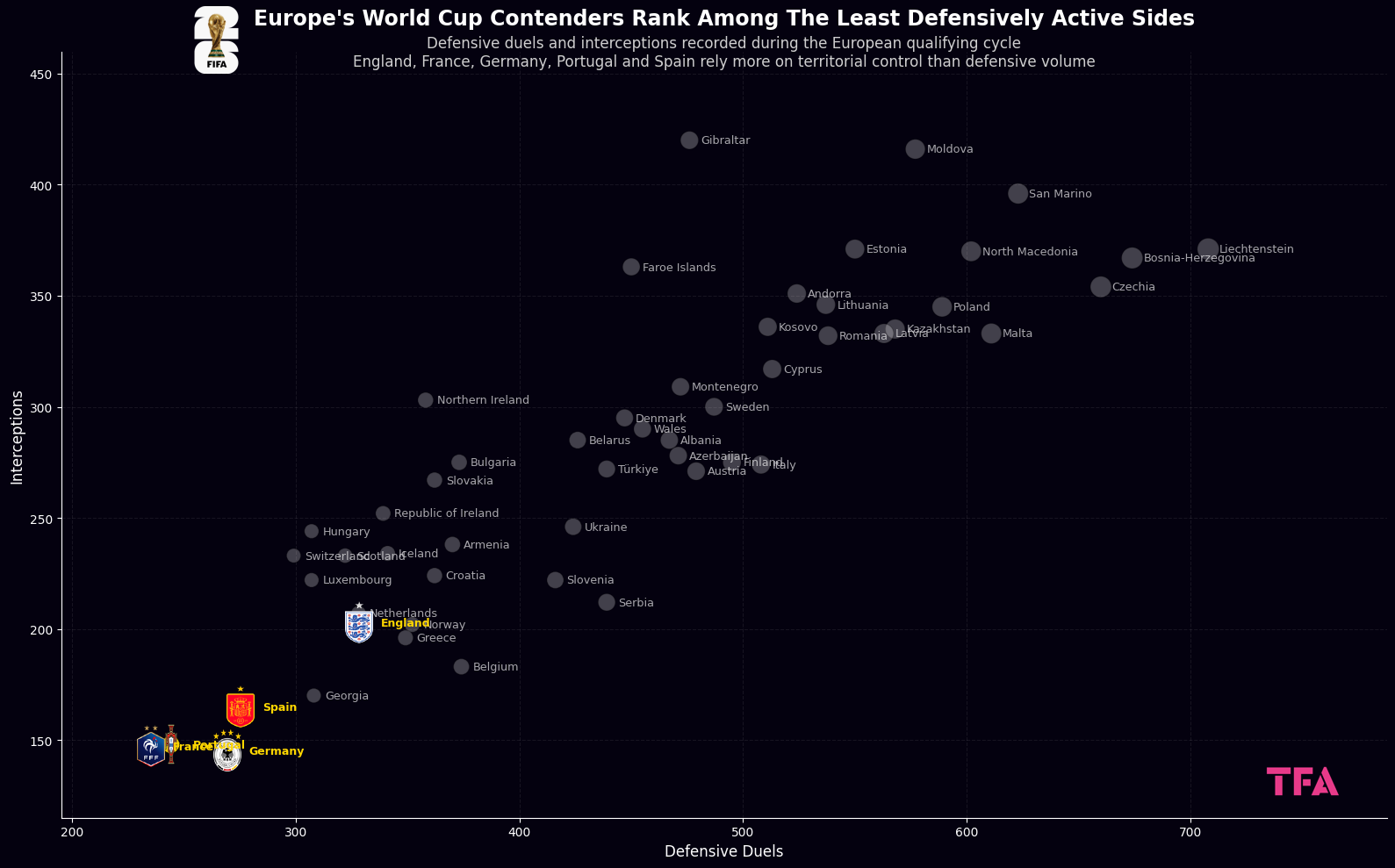
France recorded just 235 defensive duels and 147 interceptions, while Portugal registered 244 and 148, respectively.
Germany and Spain produced similarly low figures, with England only marginally higher.
In contrast, many of Europe’s smaller nations were forced into significantly greater defensive workloads, often recording more than double the number of defensive actions.
This trend reflects the tactical philosophies of their respective coaches.
Luis de la Fuente’s Spain seek to dominate possession, compress space through aggressive counterpressing and recover the ball immediately after losing it rather than defending prolonged phases without possession.
Didier Deschamps’ France remain more pragmatic.
Their compact structure and devastating transitional threat often allow them to defend fewer situations overall while remaining highly effective.
Thomas Tuchel’s England have increasingly prioritised territorial control, positional discipline and structured possession, reducing the need for high defensive volumes through greater collective organisation.
England Lead The Pressing Race As Spain Show Signs Of Tactical Moderation
Among Europe’s leading World Cup contenders, England emerge as the most aggressive pressing side in the data, posting a PPDA of just 6.72.
Under Thomas Tuchel tactics, the Three Lions appear to be moving towards a more proactive and territorially dominant model, built around compact distances, coordinated pressing triggers and rapid ball recoveries rather than passive defensive security.
Tuchel has repeatedly emphasised collective cohesion over individual talent, and England’s pressing numbers suggest a team increasingly designed to control matches without the ball as much as with it.
Germany (7.77), France (8.15) and Portugal (8.24) remain close behind, reinforcing a broader trend among Europe’s strongest nations, defending higher, compressing space and using pressure as a primary mechanism of control rather than retreating into deeper blocks.
Europe World Cup Contenders Are Among The Continent Most Aggressive Pressing Sides
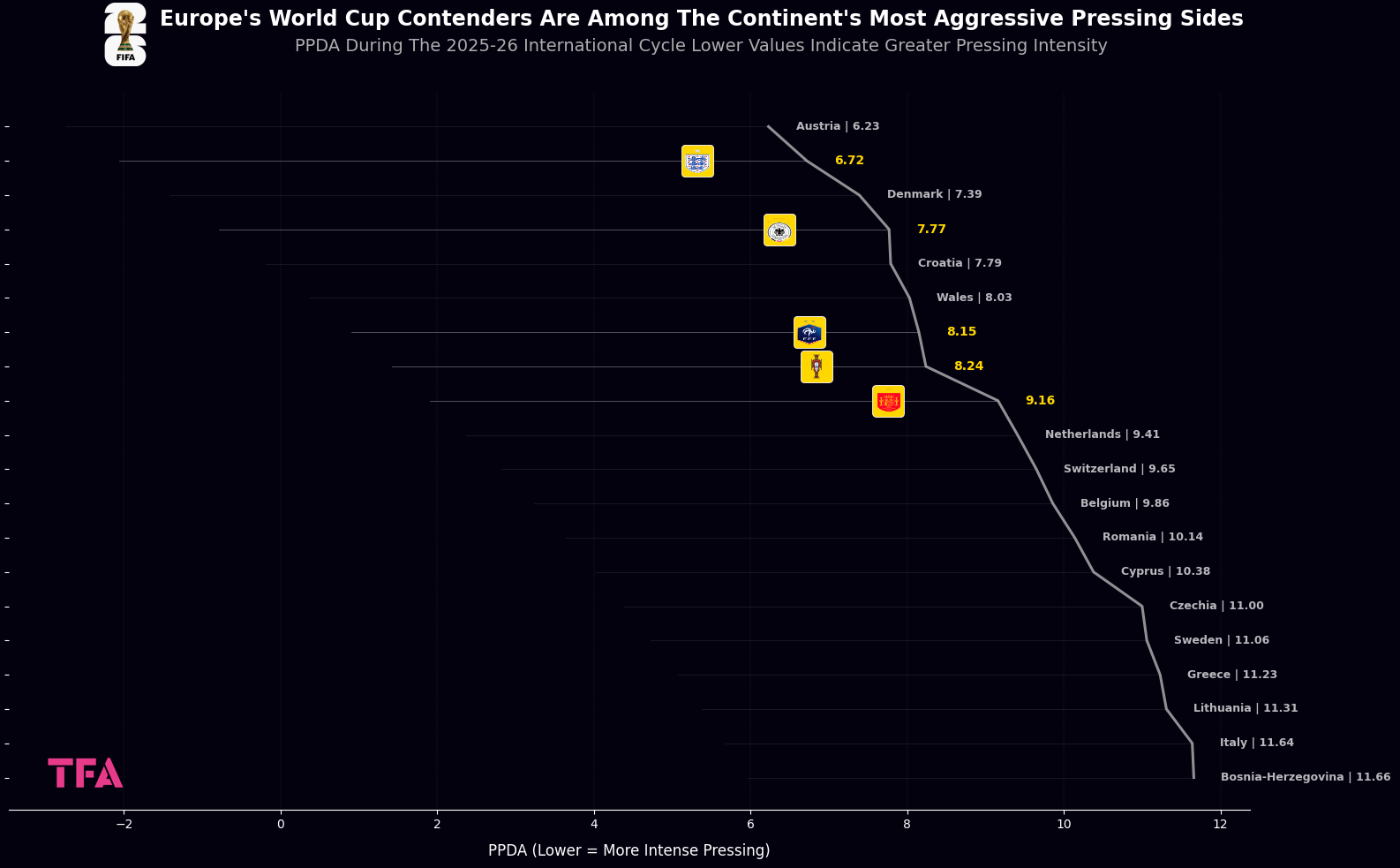
Perhaps the most intriguing figure belongs to Spain.
Despite remaining among Europe’s elite, La Roja rank behind several direct rivals with a PPDA of 9.16.
That does not indicate a weak pressing structure, but it does suggest a more measured approach compared to the relentless intensity displayed by England, Germany or France.
Under Luis de la Fuente, Spain have increasingly prioritised possession control, positional stability and structured circulation, reducing the need for constant high-intensity defensive actions.
From a tournament perspective, the numbers may also hint at a subtle shift.
Spain’s recent success has been built upon technical superiority and ball retention, but their lower pressing intensity relative to fellow contenders could indicate a side becoming slightly less physically aggressive out of possession.
In contrast, England’s position at the top of the pressing rankings reflects a squad attempting to blend elite technical quality with the athletic intensity increasingly associated with modern World Cup winners.
The data therefore suggests that while Spain remain one of the favourites, England currently set the benchmark among Europe’s contenders when it comes to defensive aggression and off-the-ball intensity.
Spain’s Exciting Generation Meets Its Greatest Tactical Test
Spain arrive at the 2026 World Cup, a reflection of both squad quality and the remarkable consistency established under Luis de la Fuente.
With a core built around Lamine Yamal, Pedri, Rodri, Nico Williams and Mikel Oyarzabal, Spain arguably possess the most balanced blend of technical quality, creativity and tactical cohesion in the tournament.
Their Euro 2024 triumph, dominant qualification campaign and exceptional positional structure have established La Roja as the benchmark for territorial control in international football.
Yet beneath the dominance lies a potential vulnerability that could become decisive against elite opposition.
Spain consistently generate high volumes of positional attacks, but they also allow opponents to construct more sustained attacking phases than many other leading contenders.
Spain Consistently Allow Opponents To Generate Significant Volumes Of Positional Attacks
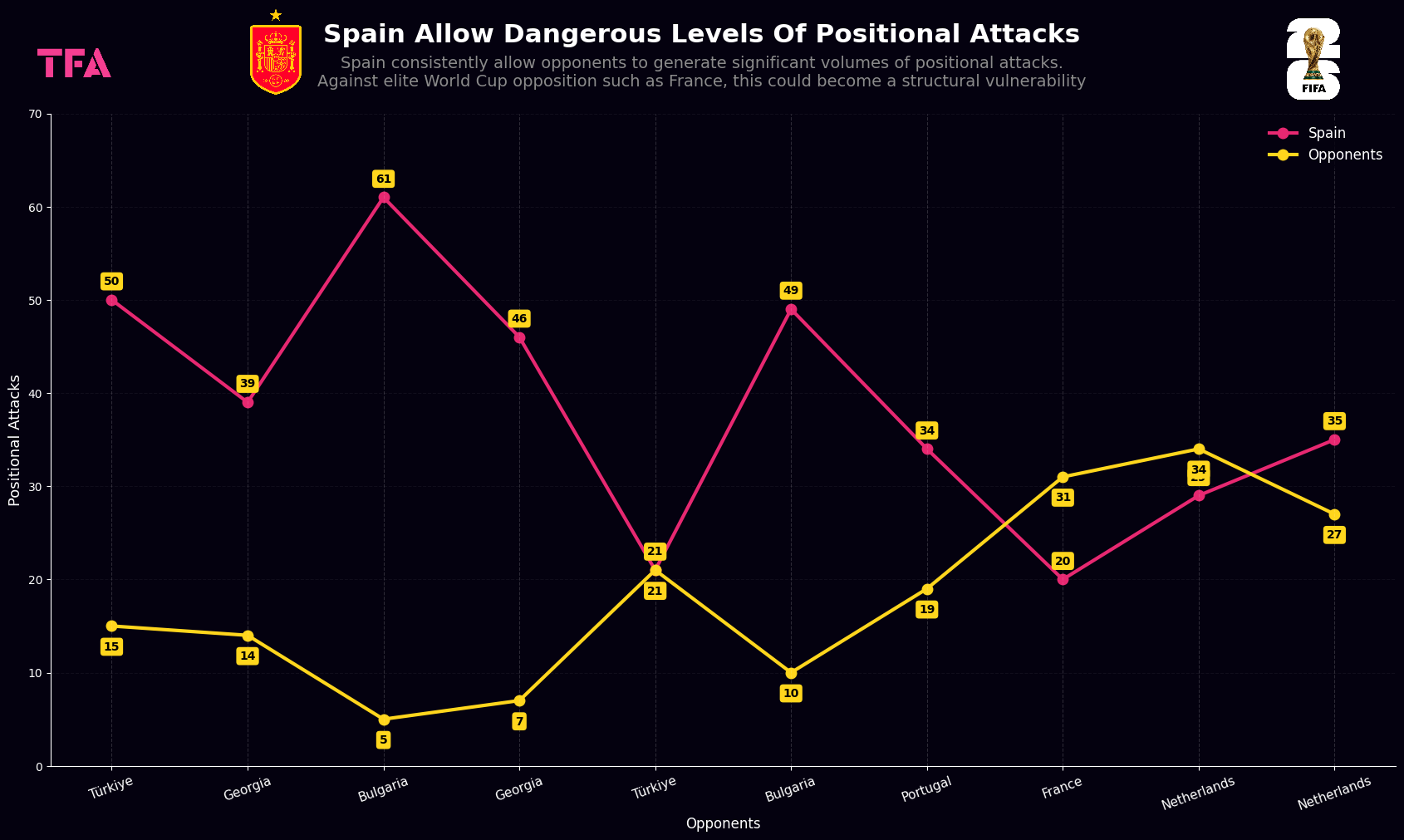
The concern becomes particularly visible against stronger nations.
France produced 31 positional attacks compared to Spain’s 20, while the Netherlands generated 34 and 27 across their two meetings, and even Türkiye recorded 21 positional attacks.
Although Spain usually compensate through possession control and superior chance creation, knockout football often punishes structural weaknesses more ruthlessly.
Against opponents capable of matching their technical level and exploiting transitions, the volume of positional attacks conceded may expose defensive spaces that lesser sides fail to exploit.
If Spain are to justify their status as tournament favourites, reducing these recurring defensive openings could prove just as important as their outstanding attacking quality.
France’s Firepower Makes Them Contenders, But Defensive Fragility Remains A Concern
France enter the 2026 World Cup as one of the tournament’s leading contenders, and it is not difficult to understand why.
Didier Deschamps possesses arguably the deepest attacking pool in international football, with Kylian Mbappé, Ousmane Dembélé, Michael Olise, Désiré Doué and Rayan Cherki offering a blend of pace, creativity, 1v1 ability and elite finishing that few nations can match.
The sheer volume of attacking talent available to Les Bleus gives them the capacity to overwhelm opponents in multiple ways, whether through direct transitions, wide overloads or individual brilliance in decisive moments.
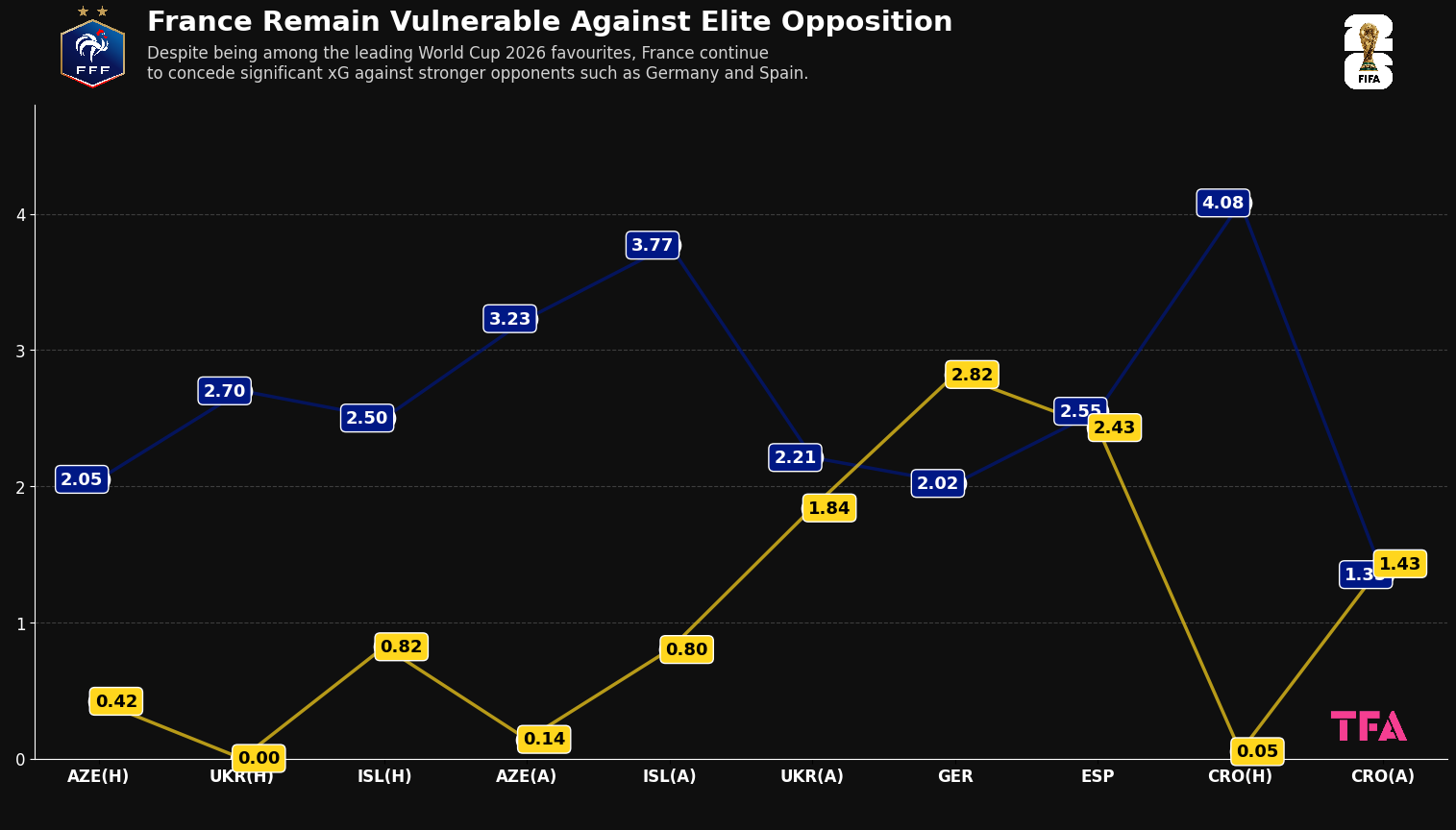
However, there is a vulnerability that could define their tournament, while France continue to generate strong attacking numbers, the data suggests they remain susceptible against elite opposition.
France Remain Vulnerable Against Elite Opposition