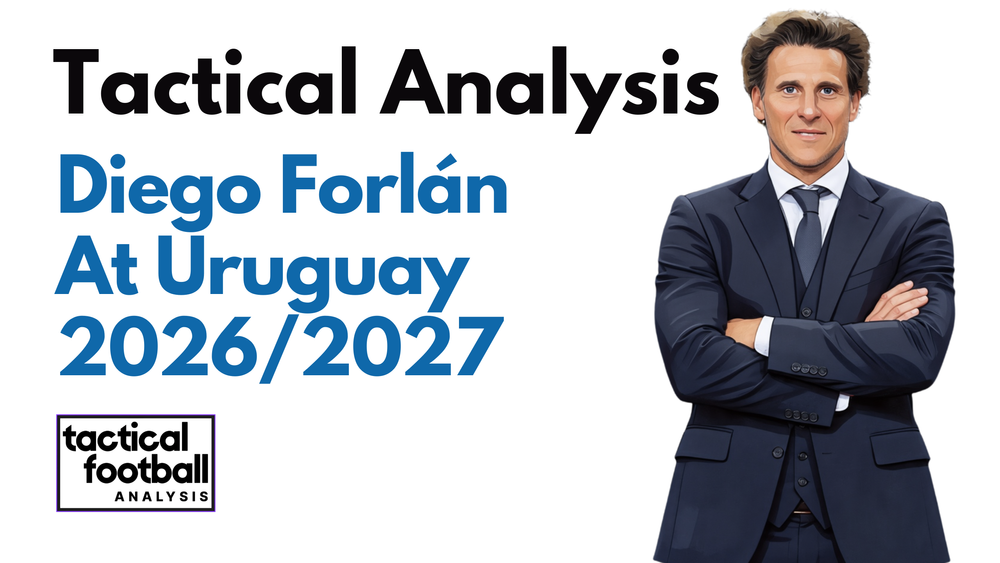
Diego Forlán Tactics At Uruguay 2026: Pressing, Attacking Rotations & The Argentina Challenge - Tactical Analysis
How is Uruguay changing under Diego Forlán? This tactical analysis examines their high man-oriented press, pragmatic attacking approach and asymmetrical rotations before assessing how Argentina could exploit the system.

Uruguay play their first match on South American soil under new manager Diego Forlán this Friday.
La Celeste face Argentina at La Bombonera, a tough task against the reigning Copa América champions.
This Uruguay tactical analysis examines what the national team have looked like under Forlán thus far, including their pressing and attacking rotations.
This analysis will also preview Uruguay’s potential systematic struggles against an Argentina side unbeaten in 17 of their last 18 matches.
Diego Forlán Pressing Methodology & Tactical Pragmatism
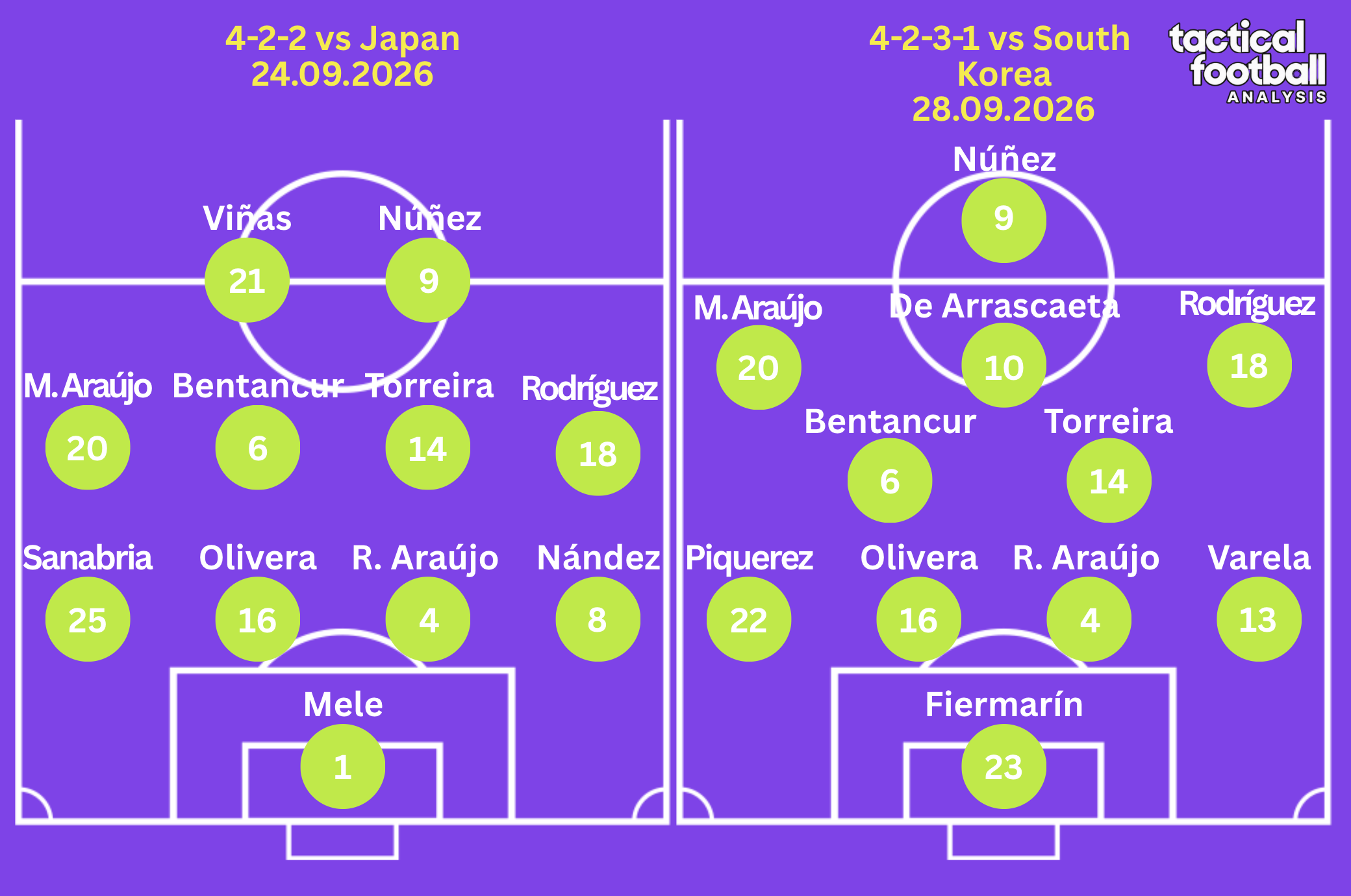
Diego Forlán’s pressing methodology does not stray significantly from Marcelo Bielsa’s tenure.
Uruguay’s press remains high with the intention of attacking quickly from transition.
In practice against Japan and South Korea, Forlán pressed with two players in the first line, rather than Bielsa’s World Cup preference for one.
Against Japan, Darwin Núñez paired with Federico Viñas as a front two both in possession and in the first line of pressure.
Although Giorgian de Arrascaeta played in a deeper attacking role against South Korea, Uruguay still pressed with Núñez and De Arrascaeta up top.
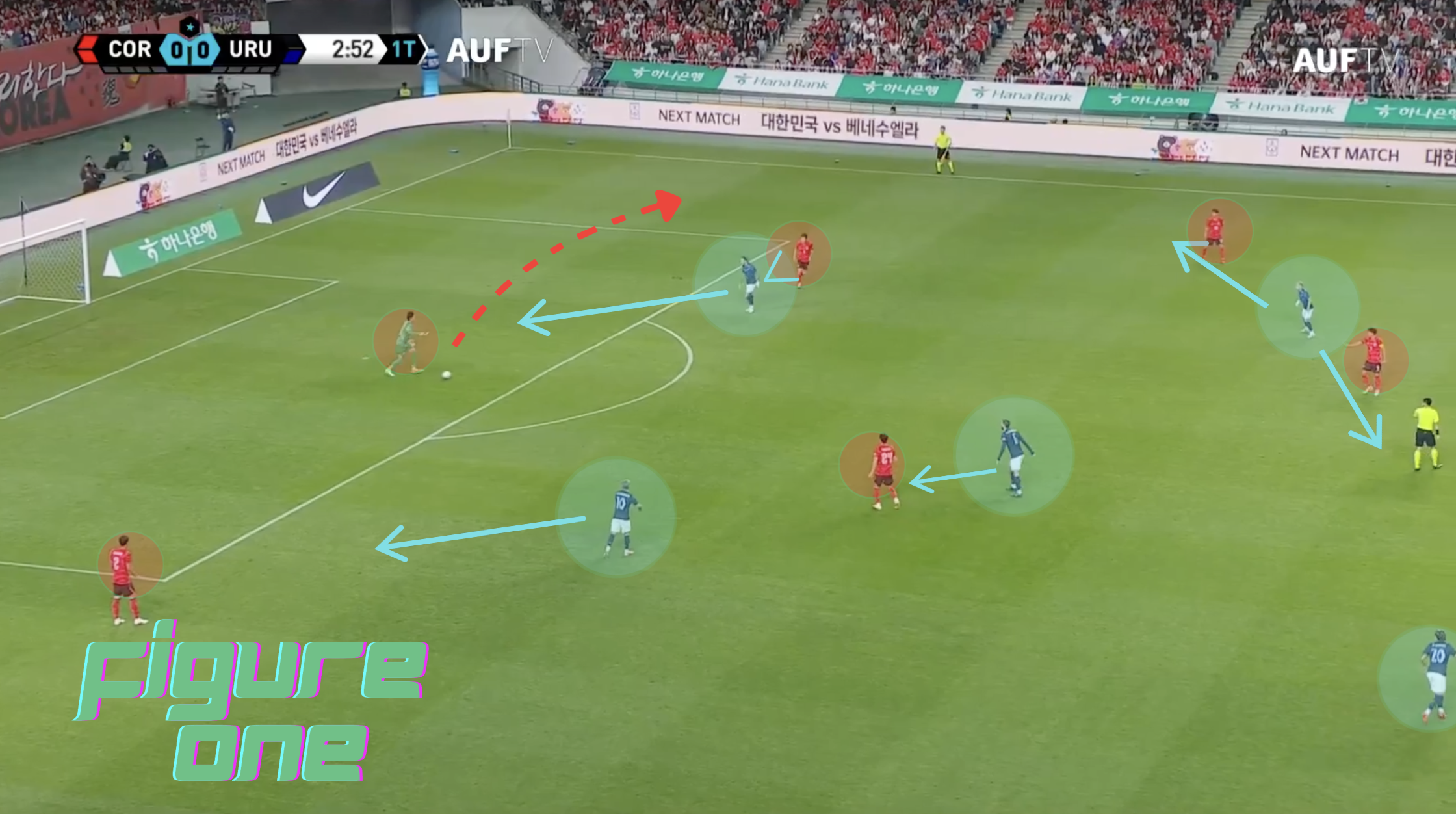
The player not immediately pressing the possessor marked the weak-sided centre-back, while Rodrigo Bentancur man-marked the opposing defensive midfielder.
As shown in Figure 1, centre-back Kim Min-jae, under pressure from Núñez, plays to his goalkeeper.
Núñez repeatedly checks his shoulder to ensure that he is effectively cutting off the pass to the centre-back he is marking while pressing the goalkeeper.
De Arrascaeta marks the other centre-back.
In midfield, Rodrigo Bentancur tightly man-marks Kim Bong-soo.
This forces South Korea to play long, out of bounds.
Forlán’s press was effective insofar as it produced high turnovers or helped Uruguay regain possession in the opposition’s defensive third.
Núñez, in particular, was highly effective off the ball in the opposition’s defensive third.
His physicality, speed, and positioning consistently put Japan and South Korea under pressure and enabled his teammates to capitalise on Uruguay’s quick transition.
Nevertheless, this press caused issues against both Japan and South Korea centrally because of Uruguay’s man-oriented system out of possession.
Because Viñas or De Arrascaeta played alongside Núñez in the first line of pressure, Uruguay had one fewer body in midfield.
As seen above in Figure 1, Lucas Torreira becomes responsible for the opposition full-back as well as the central midfielder against South Korea.
Instead of marking the right-back, Brian Rodríguez marks the ball-side wide midfielder.
Maximiliano Araújo tucks in on the weak side to add an additional central body.
Rodríguez’s positioning behind Torreira (not pictured) showcases Uruguay’s aim to entrap opposition by removing possible outlets during build-up.
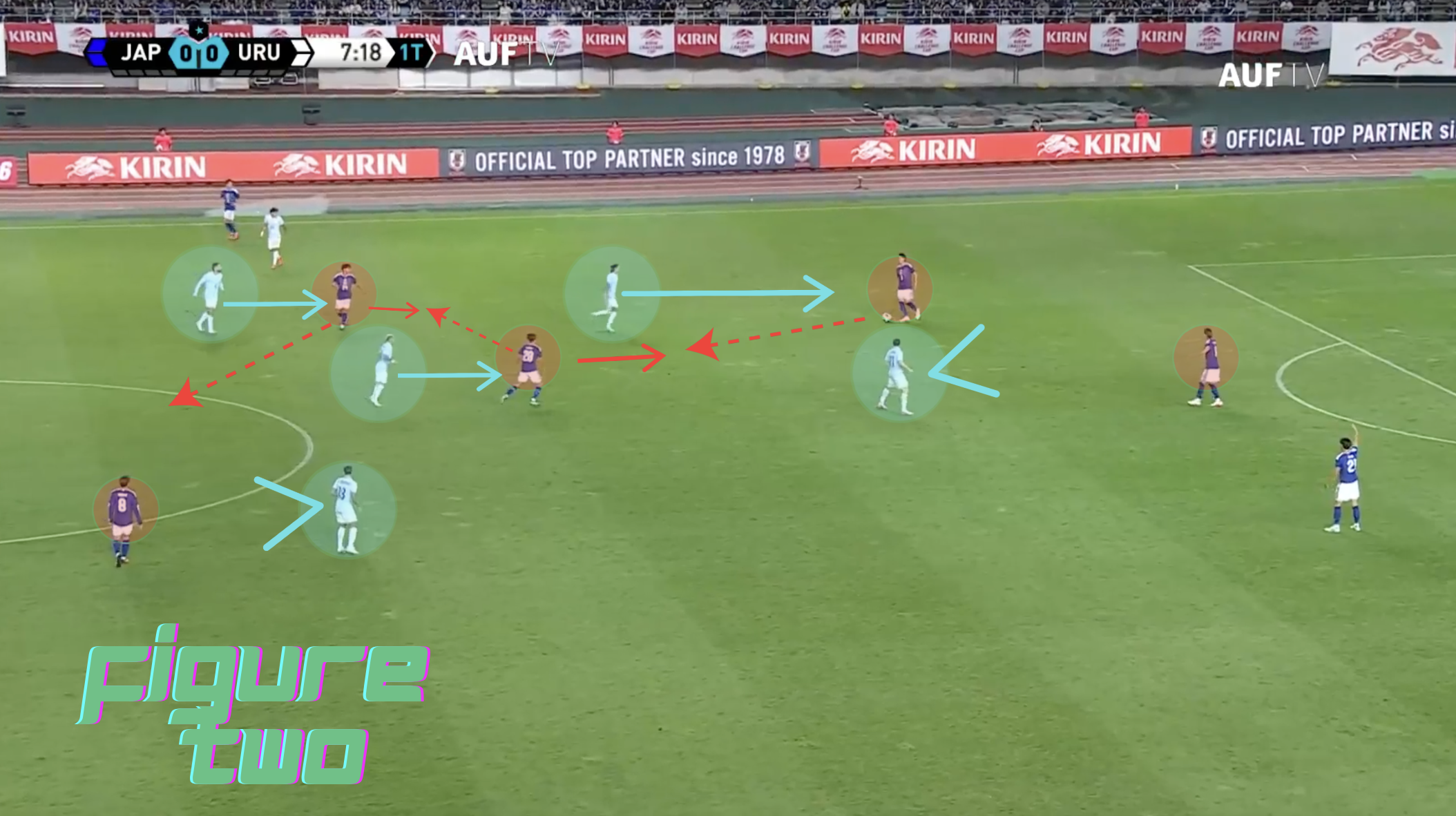
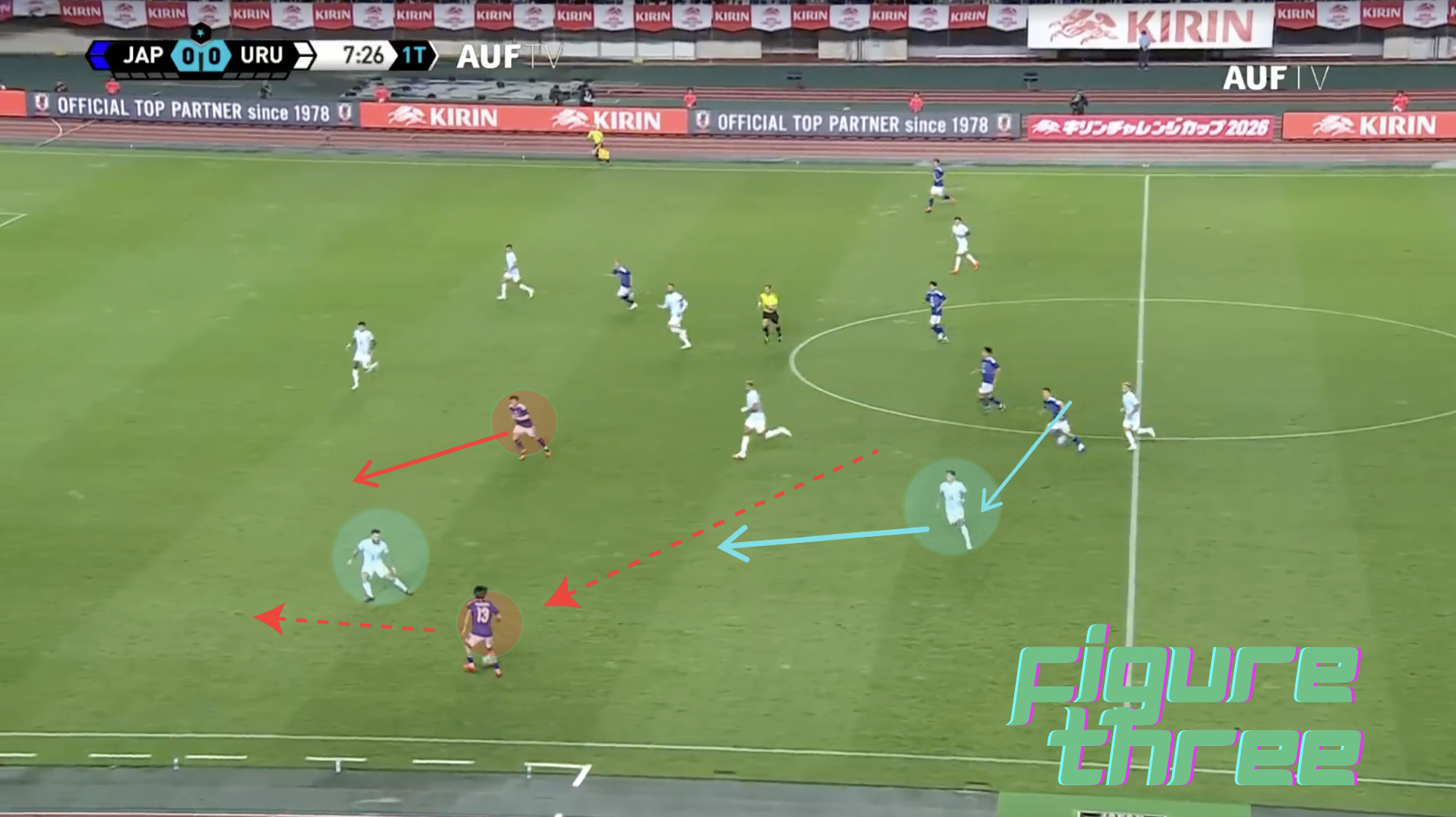
Figures 2 and 3, taken from the match against Japan, address a weaker execution of Forlán’s press.
Japan, unlike South Korea, have an overload in midfield.
To make their man-to-man press function against the home side, Uruguay need to pull another body into midfield.
Similarly to Figure 1, Núñez presses the centre-back on the ball while Viñas marks the weak-side centre-back.
Torreira and Bentancur man-mark Japan’s double pivot.
Rodríguez comes across from the weak side to mark Japan’s attacking midfielder and contend with the overload.
Crucially, this means the only player occupying Uruguay’s right flank is Nahitan Nández.
Japan’s defensive midfielder drops to receive the ball, dragging Torreira with him.
Bentancur is also dragged forward by his mark, who plays into the space behind Bentancur.
Japan’s striker collects the ball and plays it backwards to his right-winger, who has come central.
The ball is then switched to the left wing, where Nández is left isolated to defend a 2v1.
Only then does Rodríguez track back, as shown in Figure 3.
Like Bielsa's, Forlán’s press is not merely a method for winning possession.
The press itself is integral to Uruguay’s attack and a foundation for Forlán’s methodology of play.
Uruguay’s possession remained below 50% in both matches.
Against South Korea, Uruguay had less possession, fewer total shots, fewer shots on target, and just three big chances created to South Korea’s two.
Yet, Uruguay won 4-1.
Several factors contributed to this disparity.
Nonetheless, part of the answer lies in Forlán’s tactical pragmatism.
Forlán is not merely asking what his players can do within his system, but how his system can complement the players he has.
In his first official press conference as national team head coach, Diego Forlán stated that “[He] would love to dictate every match, but one who has played many different sides knows that sometimes it is not about what you want to do but what you can do.”
Forlán appears to be focusing on maximising the attributes of his most imposing player profiles to convert chances.
Núñez, Bentancur, and Maximiliano Araújo were the only players to start all three matches in the September-October international window.
Each possesses a distinct set of attributes that shape Uruguay's style of play and inform the roles of those around them.
Uruguay Asymmetrical Attacking Rotations
Uruguay’s base attacking formation against South Korea was a 4-2-3-1.
The formation remained largely unchanged from the match against Japan.
The only notable difference was Giorgian de Arrascaeta operating deeper behind Darwin Núñez, rather than alongside him as Federico Viñas had done as a second striker.
This additional body in midfield allowed Uruguay to exert more creative control in attacking zones and to manage better the relational rotations Forlán intended to exploit.
In Uruguay’s third match against India, Viñas once more started alongside Núñez, but took up De Arrascaeta’s deeper positioning.
Uruguay played an asymmetrical attack, overloading the right side of the field.
As is shown below in Figure 4, Brian Rodríguez has positioned himself as the wide outlet.
In this sequence, he can combine with an overlapping Guillermo Varela or play centrally.
Varela’s movement draws the attention of the South Korean full-back, leaving a gap in their backline.
This gap is exploited by Maximiliano Araújo, who has made his run from the left flank.
In response, De Arrascaeta shifts to occupy the left half-space.
Núñez holds his wide positioning on the left flank after initially winning the ball at the start of the possession sequence.
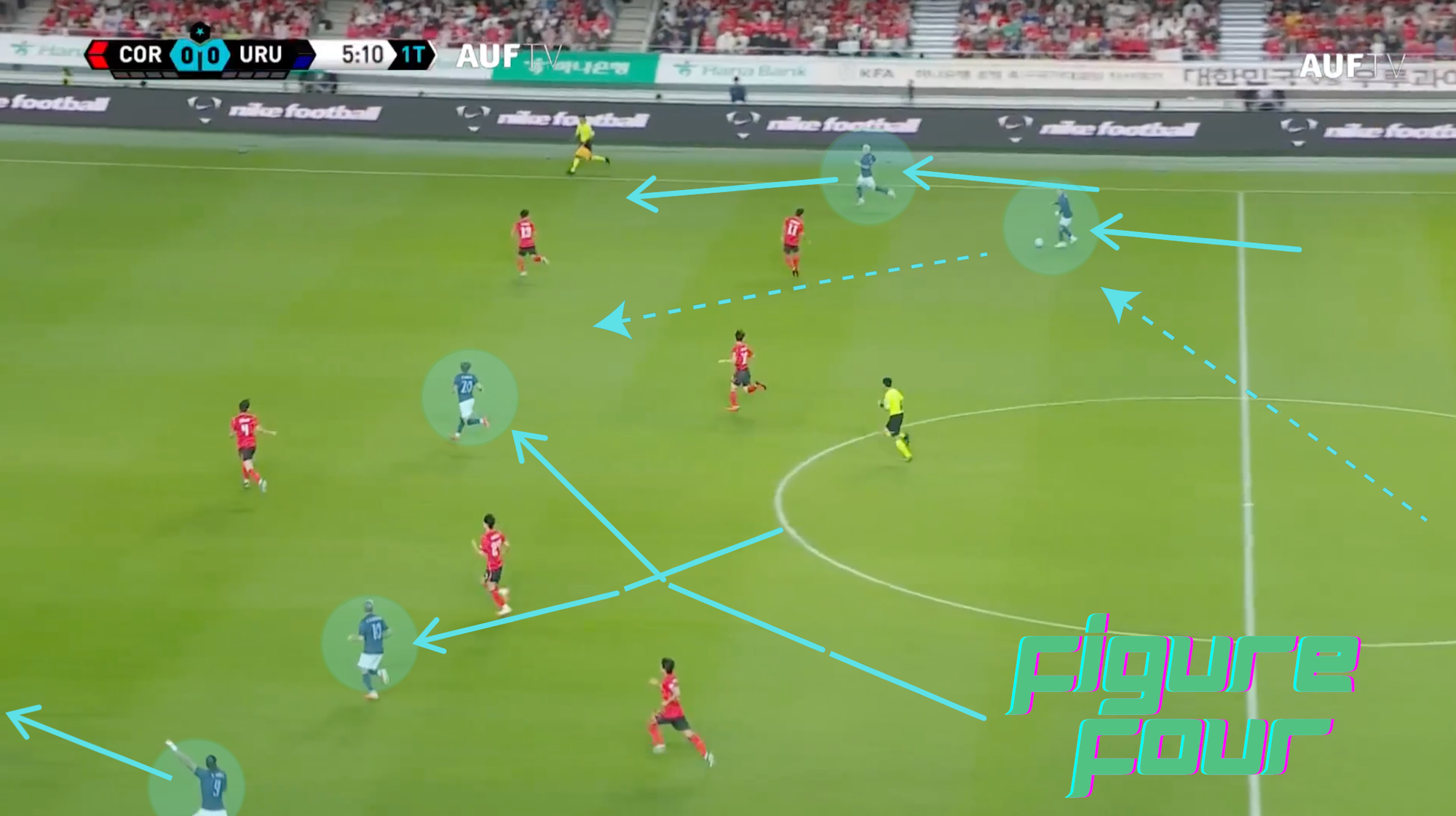
Maximiliano Araújo's movement further contributes to Uruguay’s right-sided overload and disrupts South Korea’s defensive organisation as he arrives from the opposite flank.
His movement also draws defenders centrally, creating space for Núñez to make an unmarked run from the left.
Although the ball does not ultimately reach Núñez, this sequence showcases how Uruguay’s asymmetrical attacking structure generates opportunities to exploit gaps in the South Korea backline.
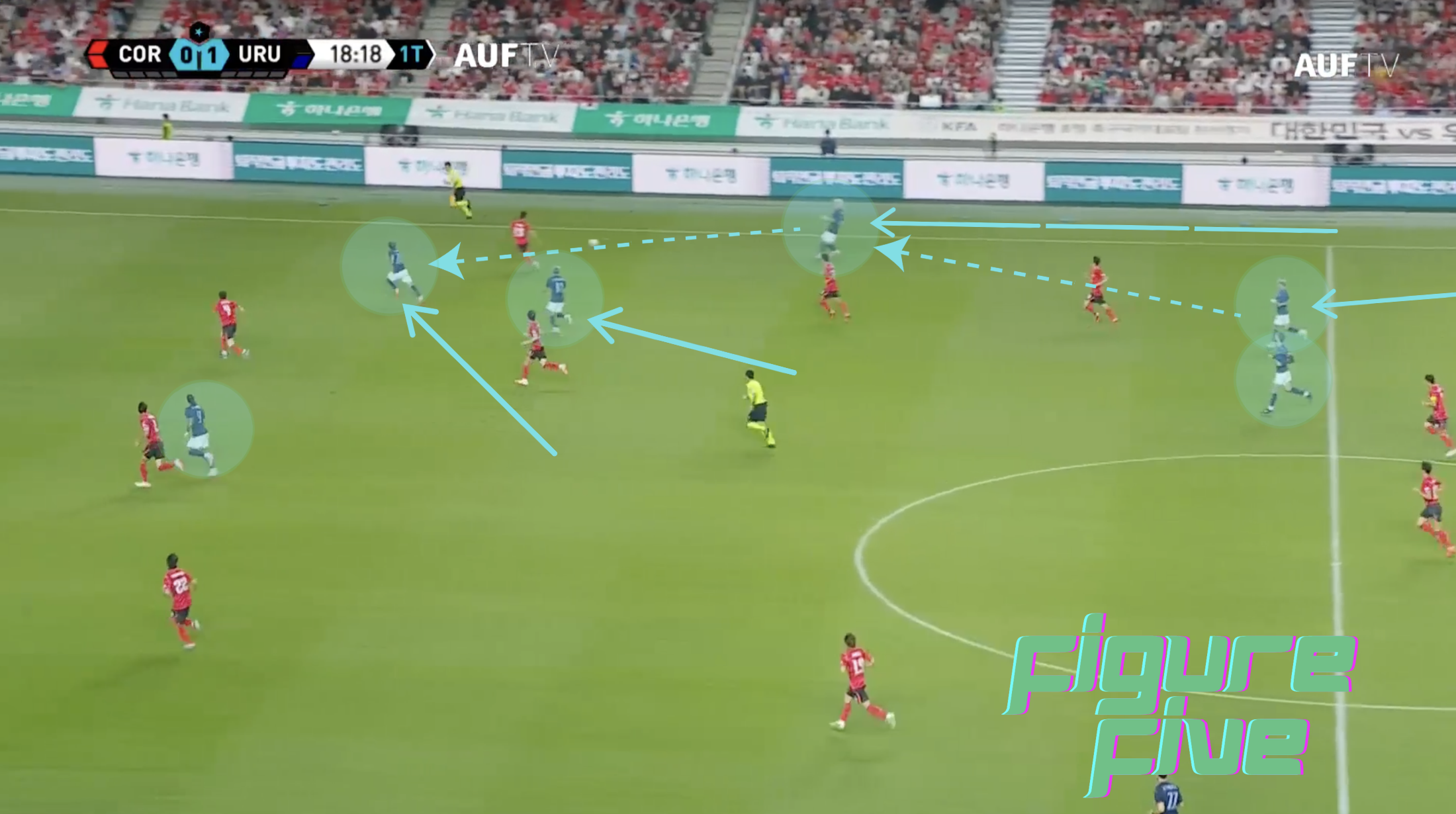
Figure 5, shown above, provides a similar attacking opportunity.
Maximiliano Araújo makes a diagonal run across the field to receive the ball from Varela on the right touchline.
In this sequence, however, Lucas Torreira drops into the defensive line, allowing Varela to advance.
After receiving the ball from Torreira, Varela continues his forward movement before finding Maximiliano Araújo.
De Arrascaeta maintains his central position, while Brian Rodríguez, positioned off-screen to the left, has exchanged wings with Maximiliano Araújo.
Rodríguez and Maximiliano Araújo interchanged flanks throughout the match, solidifying Uruguay’s right-sided overload while varying who makes the late weak-side run.
These rotations complicate South Korea’s defensive positioning as either winger can become a significant central threat.