
Hajime Moriyasu Tactics At Japan 2026: One Of The World Cup's Best Coached Collectives – Tactical Analysis
You can recognise aspects of whether a team is well-drilled or not extremely quickly.
Even if a team is not well-equipped with the best players, what they are trying to do on a football pitch, even if they can’t execute it perfectly as a team, can be seen as admirable or bold.
For instance, Vincent Kompany was brought in as Bayern Munich manager because of the way he set his Burnley team up.
Watching Japan over some matches, particularly the England and Scotland games, live, I was mightily impressed.
The World Cup is the biggest tournament in world football, and now more teams have been invited to the party to participate.
Though they do not have the easiest group with the Netherlands, Sweden and Tunisia to keep them company, the manner in which they play and have been managed by the same man, Hajime Moriyasu, for eight years is refreshing.
In this tactical analysis, we dive into Japan tactics, advantages and why they threaten to go further than many might expect in the World Cup.
Japan In Possession: Pulling Opposing Players Out Of Position
One of the best tools used by some of the world's elite teams is to drop a forward, thereby pulling a defender out of the backline.
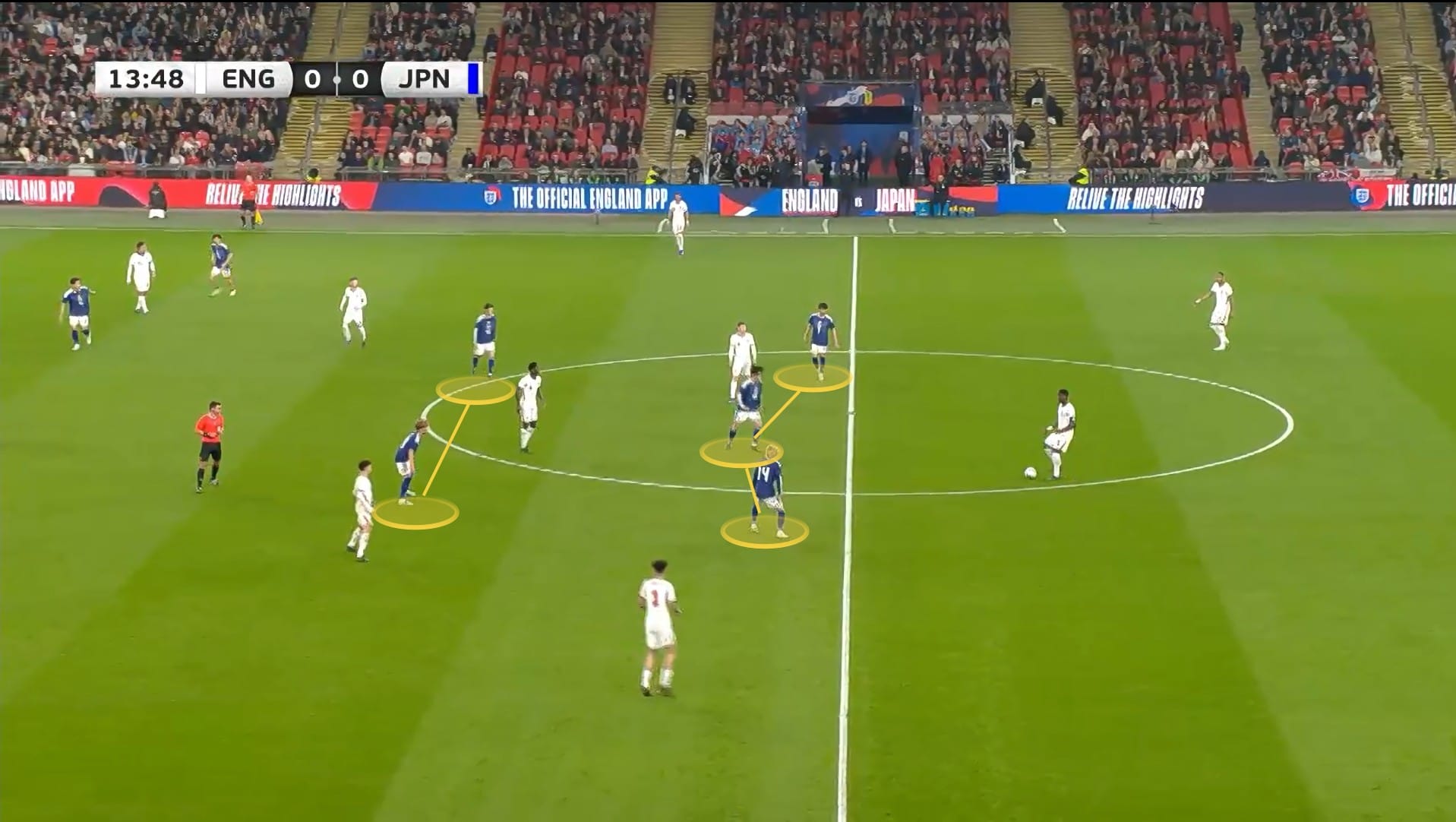
For Japan, it isn’t always the front three creating space to receive from the defence; it tends to be the two dropping midfielders, Ao Tanaka of Leeds United and Joel Chima Fujita of FC St. Pauli, pulling opposing midfielders further upfield.
It can also be Daichi Kamada of Crystal Palace, Kaishu Sano of 1. FSV Mainz 05 or even Wataru Endō of Liverpool.
Hajime Moriyasu has many options in this position, but he tends to go for the industrious and threatening Tanaka when he wants to go for a more attacking approach, and it’s something to look at with the World Cup coming up.
What this does is allow Japan to find gaps in an opponent's midfield as the attack is caught up the pitch, pressing.
By using two midfielders or one of the strikers to do this, it means there are players still up the pitch should the midfielders receive the ball on the half turn.
What I was mightily impressed with was the manner in which the Blue Samurai progress the ball up the pitch using these dropping midfielders or a midfield pivot.
With the back three close together or wide, as the ball reaches Fujita from the defence, one of the attackers who supports the forward in Sano is just ahead of him in close proximity, waiting for the ball to be played.
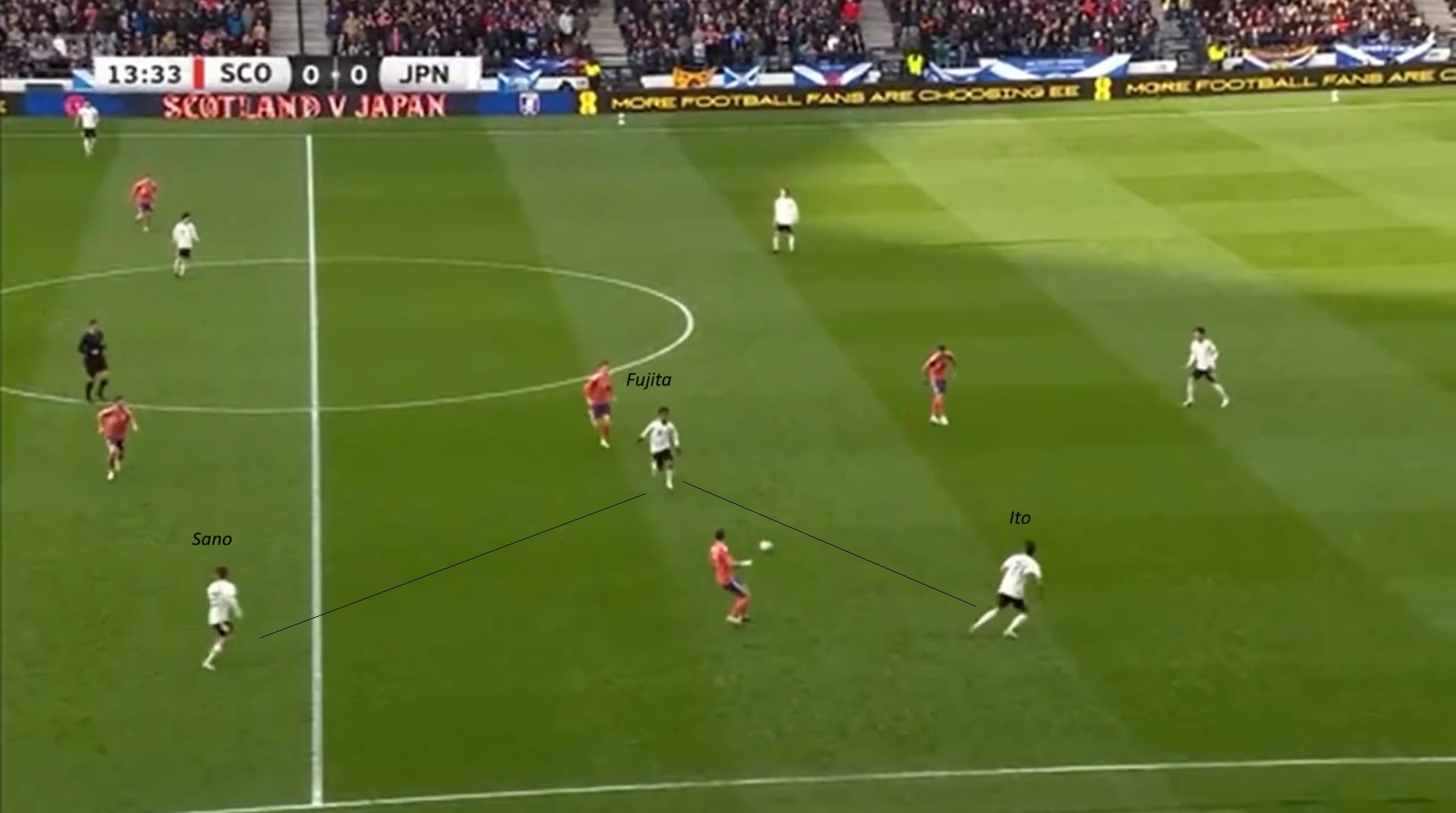
Sano drops; Fujita plays it into him, and there are still two Japanese attackers up the pitch to funnel the ball into.
In the meantime, it has sucked in players in one zone and up the pitch as they attempt to press Japan.
Progression up the pitch without sacrificing too many forwards, so you still have the advantage of pushing the opposition back and trying to have target men to reach after you progress the ball.
What tends to happen for some teams, and even elite teams (Manchester United), is that they lose players who drop off as attackers because they are busy trying to progress the ball.
Because Japan use one midfielder in the pivot, with one attacker from the three dropping and pushing up two full-backs to hold width, this isn’t the case.
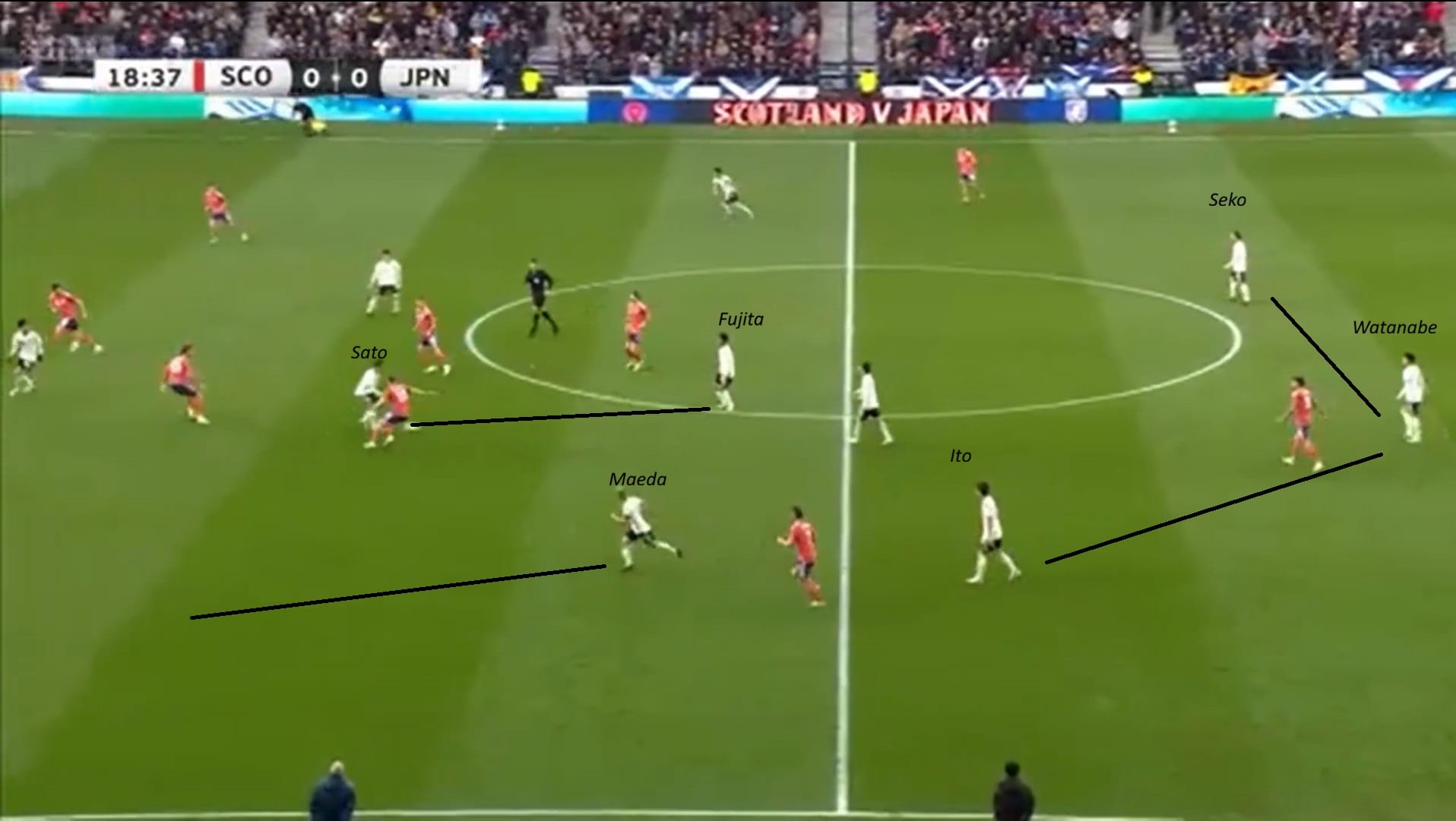
It’s a 3-2-1 build-up, but it works because the 1 comes close to one of the two midfielders dropping.
What's important to note is the dynamic solutions and versatility it gives Japan in attack.
From the shot above, you can see Fujita feed the ball into Sato, but beyond him, you can also see on the left-hand side of the screen, Daizen Maeda makes a darting run up the pitch.
What’s interesting to note is the movement from the players who aren’t involved in the move but know where to be and how to move to fool the defence.
Next to Sato is another number 10, and on the opposite wing to Maeda is another player making a darting run.
It’s remarkable to see this from an international team, but at the same time, when you think of how long Japan have been together as a team under this coach, perhaps it isn’t.
Practised automatisms are a thing of beauty, and even more so in Japan, who take every game as an opportunity to learn and showcase their ability and tenacity.
The reason they progress the ball through the middle with a dropping attacker makes sense: they don’t have to worry about depth because of how they encourage their wing-backs to push up the pitch.
A compact middle of three centre-backs, two midfielders, and an attacking '10' dropping in close proximity, manages to funnel the ball through whilst baiting the opposition in, with the full-backs providing width.
Japan Out-Of-Possession Tactics
So we’ve established Japan’s 3-4-2-1 in possession, but what do they do without the ball?
To compact the centre of the pitch, Japan like to press in a 2-3 shape centrally and aggressively.
When they did this against England, it meant that whenever the defence got it into Kobbie Mainoo or Elliot Anderson in the middle of the pitch, Japan’s midfield would swarm them.