
![Germany Vs Côte d'Ivoire [2–1] – FIFA World Cup 2026: Julian Nagelsmann Second-Half Changes Earn Three Points – Tactical Analysis](https://cdn.mymidnight.blog/77f959f119f4fb2321e9ce801e2f5163/size/w1000/2026/06/Germany-Vs-Co--te-d---Ivoire-World-Cup-2026.png)
Germany Vs Côte d'Ivoire [2–1] – FIFA World Cup 2026: Julian Nagelsmann Second-Half Changes Earn Three Points – Tactical Analysis

The intense crucible of the World Cup group stage consistently demands that elite international managers balance structural rigidity with innovative attacking fluidity.
The highly anticipated Group E clash between Julian Nagelsmann's Germany and Emerse Faé's Côte d'Ivoire at the Toronto Stadium offered a masterclass in dynamic modern game models, structural adjustments, and individual spatial intelligence.
With both sides seeking to secure early qualification for the knockout rounds following successful opening fixtures, this encounter promised a clash of contrasting tactical philosophies: Germany's possession-oriented, intricate positional play juxtaposed against the explosive, direct transitional mechanics and structural discipline of the West African heavyweight.
What unfolded in Toronto was a complex tactical narrative that developed over two distinct phases, ultimately decided by the structural impact of in-game managerial interventions.
The first half was largely dominated by Côte d'Ivoire's defensive discipline and clinical vertical counters, which exposed Germany's high defensive line and rest defence vulnerabilities, establishing a well-deserved lead through captain Franck Kessié.
However, the second period witnessed a profound tactical shift as Nagelsmann tactics executed a series of crucial personnel changes and positional reorientations, introducing structural alterations that exploited the half-spaces and shifted the offensive weight of the match.
Spearheaded by the introduction of Deniz Undav, whose exceptional spatial awareness and predatory movement dismantled Ivory Coast's low block, Germany engineered a dramatic late comeback victory.
This World Cup tactical analysis decompiles the core tactical dimensions that defined this captivating match, exploring the asymmetric positional overloads, wide wing rotations, and subtle off-the-ball movements that dictated the final outcome.
Germany Vs Côte d'Ivoire Lineups & Formations
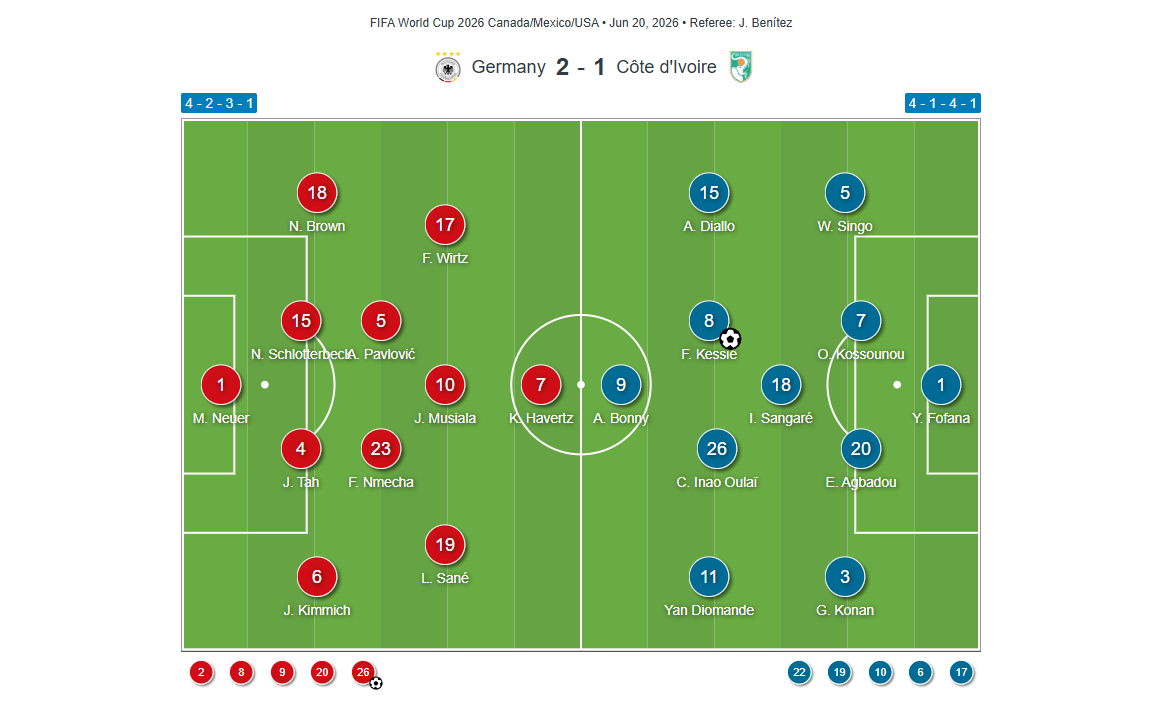
Germany Lineup Vs Côte d'Ivoire
Julian Nagelsmann deployed Germany in an asymmetric 4-2-3-1 base alignment designed to convert into a highly expansive 3-2-5 positional structure during sustained possession phases.
Manuel Neuer started between the posts, achieving a historic milestone as the goalkeeper with the most appearances in World Cup history.
The three-man defensive line featured Joshua Kimmich operating as a hybrid right centre-back, flanked by central anchor Jonathan Tah and left-sided defender Nico Schlotterbeck.
The central midfield double pivot was comprised of the young Aleksandar Pavlović and the energetic Felix Nmecha, who were tasked with dictating tempo and providing central structural security.
Out wide, Nathaniel Brown provided natural width on the left flank as a highly advanced wing-back, while Leroy Sané occupied the right wing, frequently tucking inside to create interior overloads.
The attacking trio was completed by the positional fluidity of Florian Wirtz operating as a free-roaming playmaker across the entire frontline and Jamal Musiala operating as a '10' profile in the right half-space, supporting the central forward Kai Havertz, who served as a mobile target man.
Côte d'Ivoire Lineup Vs Germany
Emerse Faé tactics countered Germany's system by structuring Côte d'Ivoire in a balanced, compact 4-3-3 shape.
Yahia Fofana guarded the Ivorian goal, protected by a traditional four-man backline consisting of the athletic Wilfried Singo at right-back, a central defensive partnership of Odilon Kossounou and Emmanuel Agbadou, and the experienced Ghislain Konan at left-back.
The midfield trio formed a balanced engine room, where Christ Inao Oulaï anchored the base as the primary defensive destroyer, flanked by the box-to-box energy of Ibrahim Sangaré and the technical leadership of captain Franck Kessié.
In the attacking line, the Elephants utilised an incredibly direct, explosive wing pairing, with the highly technical Yan Diomande starting as the left winger on the left flank, with Amad Diallo occupying the right wing, both flanking the central presence of forward Ange-Yoan Bonny, who worked tirelessly to pin the German centre-backs and act as a transitional outlet.
Germany Asymmetric Right-Side Overloads & Half-Space Penetration
The core pillar of Julian Nagelsmann's attacking strategy centred around the deliberate, highly structured creation of numerical and qualitative overloads along the right flank.
Recognising that Côte d'Ivoire's left-back Ghislain Konan was prone to tracking wide wingers aggressively, thereby opening up internal gaps within the defensive line, Germany consistently slanted their possession mechanics toward the right side of the pitch during build-up phases.
![Olympique De Marseille Vs PSG [1-2] Ligue 1 2026/2027: How Bruno Génésio Transitions Troubled PSG - Tactical Analysis](https://cdn.mymidnight.blog/77f959f119f4fb2321e9ce801e2f5163/size/w600/2026/09/Marseille-Vs-PSG-2026_2027---Tactical-Analysis.png)
![Fulham Vs Manchester United [1-1] Premier League 2026/2027: How Álvaro Arbeloa Tactics Exposed The Red Devils' Problems - Tactical Analysis](https://cdn.mymidnight.blog/77f959f119f4fb2321e9ce801e2f5163/size/w600/2026/09/Fulham-FC-Vs-Man-United-2026_2027---Tactical-Analysis.png)
![AS Roma Vs Inter Milan [2-2] Serie A 2026/2027: When Undefeated Giallorossi Attack Met Nerazzurri Comeback Resilience - Tactical Analysis](https://cdn.mymidnight.blog/77f959f119f4fb2321e9ce801e2f5163/size/w600/2026/09/AS-Roma-Vs-Inter-Milan-2026_2027---Tactical-Analysis.png)
![Real Sociedad Vs Bournemouth [1-2] Europa League 2026/2027: How Do Marco Rose Pressing Tactics Work? - Tactical Analysis](https://cdn.mymidnight.blog/77f959f119f4fb2321e9ce801e2f5163/size/w600/2026/09/Real-Sociedad-Vs-Bournemouth-20262027---Tactical-Analysis-1.png)
![AC Milan Vs Benfica [0-2] Europa League 2026/2027: How Marco Silva Tactics Exposed Rúben Amorim Defensive Problems - Tactical Analysis](https://cdn.mymidnight.blog/77f959f119f4fb2321e9ce801e2f5163/size/w600/2026/09/AC-Milan-Vs-Benfica-20262027---Tactical-Analysis.png)
![Sunderland Vs AZ Alkmaar [1-0] Europa League 2026/2027: Why The Black Cats Make Better Underdogs - Tactical Analysis](https://cdn.mymidnight.blog/77f959f119f4fb2321e9ce801e2f5163/size/w600/2026/09/Sunderland-Vs-AZ-Alkmaar-20262027---Tactical-Analysis.png)
![Leeds United Vs Newcastle United [4-1] Premier League 2026/2027: Why Did Daniel Farke Tactics Dominate The Magpies? - Tactical Analysis](https://cdn.mymidnight.blog/77f959f119f4fb2321e9ce801e2f5163/size/w600/2026/09/Leeds-United-Vs-Newcastle-2026_2027---Tactical-Analysis.png)
![Real Sociedad Vs Atlético Madrid [0-3] La Liga 2026/2027: How Diego Simeone Tactical Precision Rescued A Late Victory - Tactical Analysis](https://cdn.mymidnight.blog/77f959f119f4fb2321e9ce801e2f5163/size/w600/2026/09/Real-Sociedad-Vs-Atl--tico-Madrid-20262027---Tactical-Analysis-1.png)