
![Spain Vs Cape Verde [0–0] – World Cup 2026: How The Blue Sharks Frustrated The European Champions – Tactical Analysis](https://cdn.mymidnight.blog/77f959f119f4fb2321e9ce801e2f5163/size/w1000/2026/06/Spain-Vs-Cabo-Verde-World-Cup-2026-1.png)
Spain Vs Cape Verde [0–0] – World Cup 2026: How The Blue Sharks Frustrated The European Champions – Tactical Analysis

Nobody gave Cape Verde, the island nation of 530,000 people, a chance.
One of the smallest nations in World Cup history, in terms of both territory and population, was making its tournament debut against the reigning European champions and a favourite to lift the trophy.
Before kick-off, the World Cup prediction markets were not betting whether Spain would win, but by how many goals.
Instead, on Monday, Cape Verde made history by holding Spain to a goalless draw.
Far from simply defending deep and hoping to survive, the Blue Sharks delivered a disciplined and courageous performance, combining defensive organisation with ambition in possession.
In this tactical analysis, we will examine how Spain attacked and how Cape Verde defended, as well as how Cape Verde built their attacks and how Spain tried to stop them.
We will analyse the key tactical aspects of both teams and the factors that led to this historic goalless draw.
Spain Vs Cape Verde Lineups & Formations
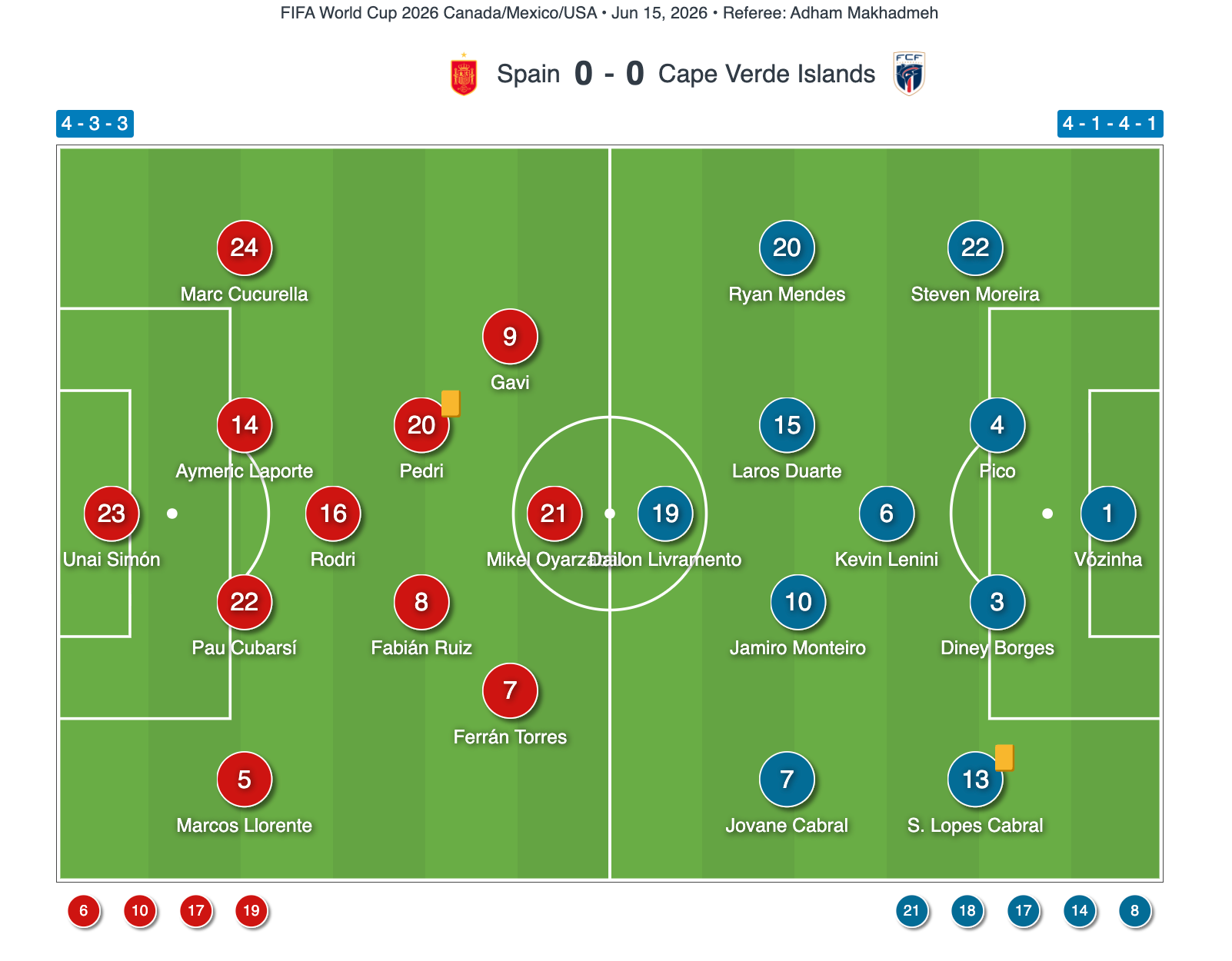
Cape Verde Lineup Vs Spain
Cape Verde coach Bubista set his team up in a 4-1-4-1 formation.
Vózinha started in goal, with Steven Moreira at right-back, Pico Lopes at right centre-back, Diney Borges at left centre-back, and Sidny Lopes Cabral at left-back.
Kevin Lenini started in the holding midfield position, with Laros Duarte and Jamiro Monteiro alongside him in the middle of the park.
Ryan Mendes (right) and Jovane Cabral (left) occupied the wide areas for Cape Verde, while Dailon Livramento led the forward line.
During the match, Cape Verde made five changes to try to maintain their intensity and defensive organisation while refreshing the team for the final stages of the match.
In the 61st minute, Jovane Cabral, Laros Duarte, and Dailon Livramento were withdrawn for Willy Semedo, Deroy Duarte, and Nuno da Costa.
15 minutes after that, João Paulo came off the bench to replace Sidny Lopes Cabral, and Cape Verde's final substitution in the 79th minute saw Telmo Arcanjo introduced for Jamiro Monteiro.
Spain Lineup Vs Cape Verde
Meanwhile, Luis de la Fuente tactics opted for Spain's usual 4-3-3 structure.
Unai Simón started in goal, behind a back four consisting of Marcos Llorente, Pau Cubarsí, Aymeric Laporte and Marc Cucurella (from right to left).
Rodri played at the base of Spain's midfield alongside Fabián Ruiz and Pedri.
Ferran Torres and Gavi lined up on the wings, either side of Mikel Oyarzabal up top.
Spain made four substitutions during the match as they searched for the winner.
In the 71st minute, they introduced players such as Mikel Merino and Lamine Yamal in place of Fabián Ruiz and Gavi.
Dani Olmo came on for Ferrán Torres in the 81st minute, while Nico Williams, who can't yet play a full game due to injury, was introduced for Rodri as a final throw of the dice in the 87th minute.
Spain Style Of Play In Possession
When Spain had possession, their structure was clearly organised into three lines.
The first line consisted of the two centre-backs, who were responsible for initiating the build-up.
Ahead of them, the full-backs positioned themselves alongside Rodri, creating the second line and providing support during ball circulation.
The third line was formed by the advanced midfielders, who occupied the half-spaces, the striker in the central corridor, and the wingers holding the width.
This positioning allowed Spain to stretch Cape Verde both horizontally and vertically while creating multiple passing options between the lines.
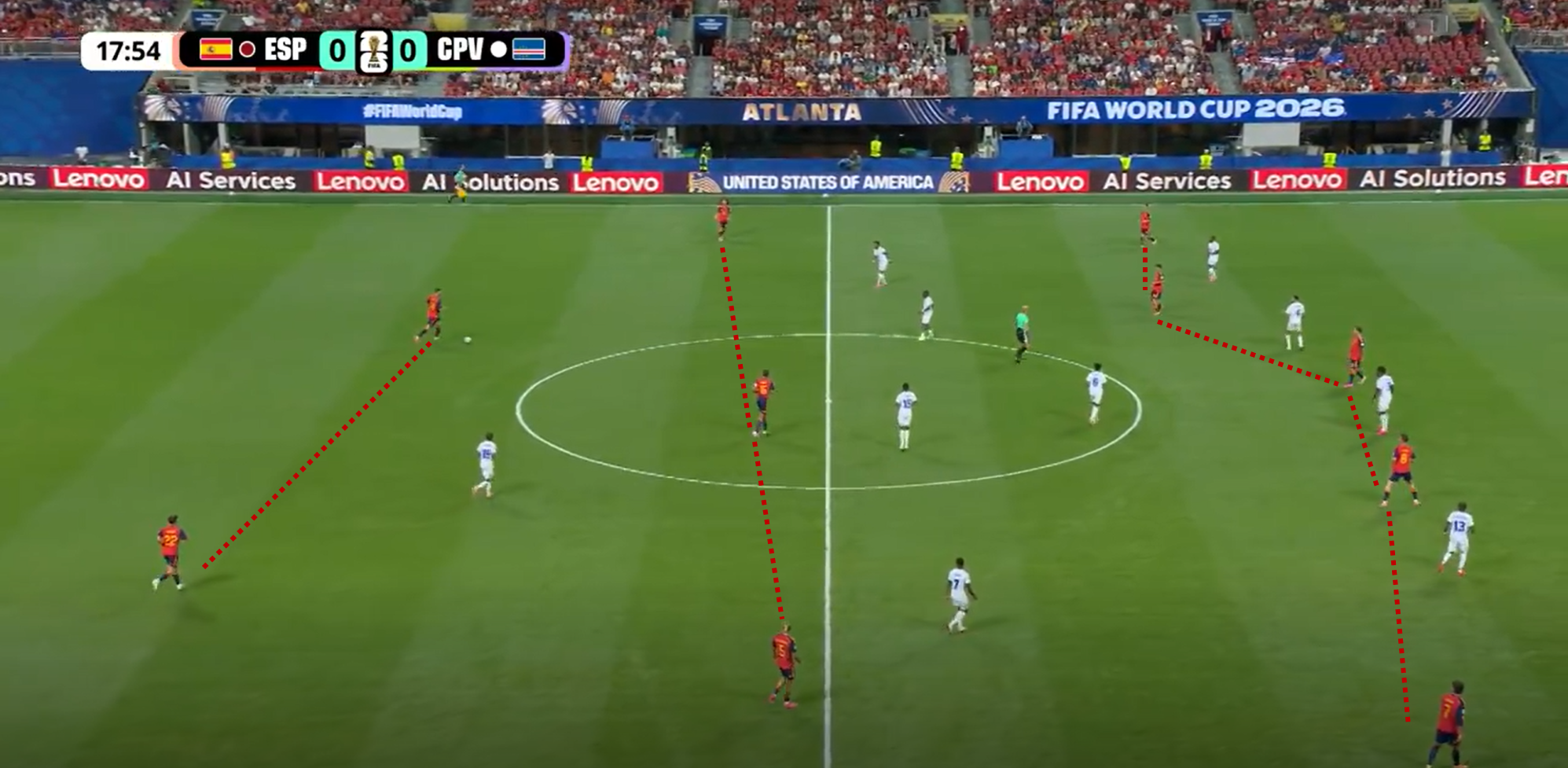
Higher upfield, Spain adjusted their positioning to create better attacking connections.
The full-backs pushed forward and provided width, while the wingers moved inside into the half-spaces.
At the same time, the attacking midfielders often dropped into central areas to offer additional passing options between the lines.
To maintain balance and provide protection against transitions, one midfielder would typically drop alongside the centre-backs, creating a back three during the attacking phase.
This role was most commonly performed by Rodri, although Fabián Ruiz also occupied this position on several occasions.
This structure allowed Spain to sustain attacks while remaining protected against potential counterattacks.
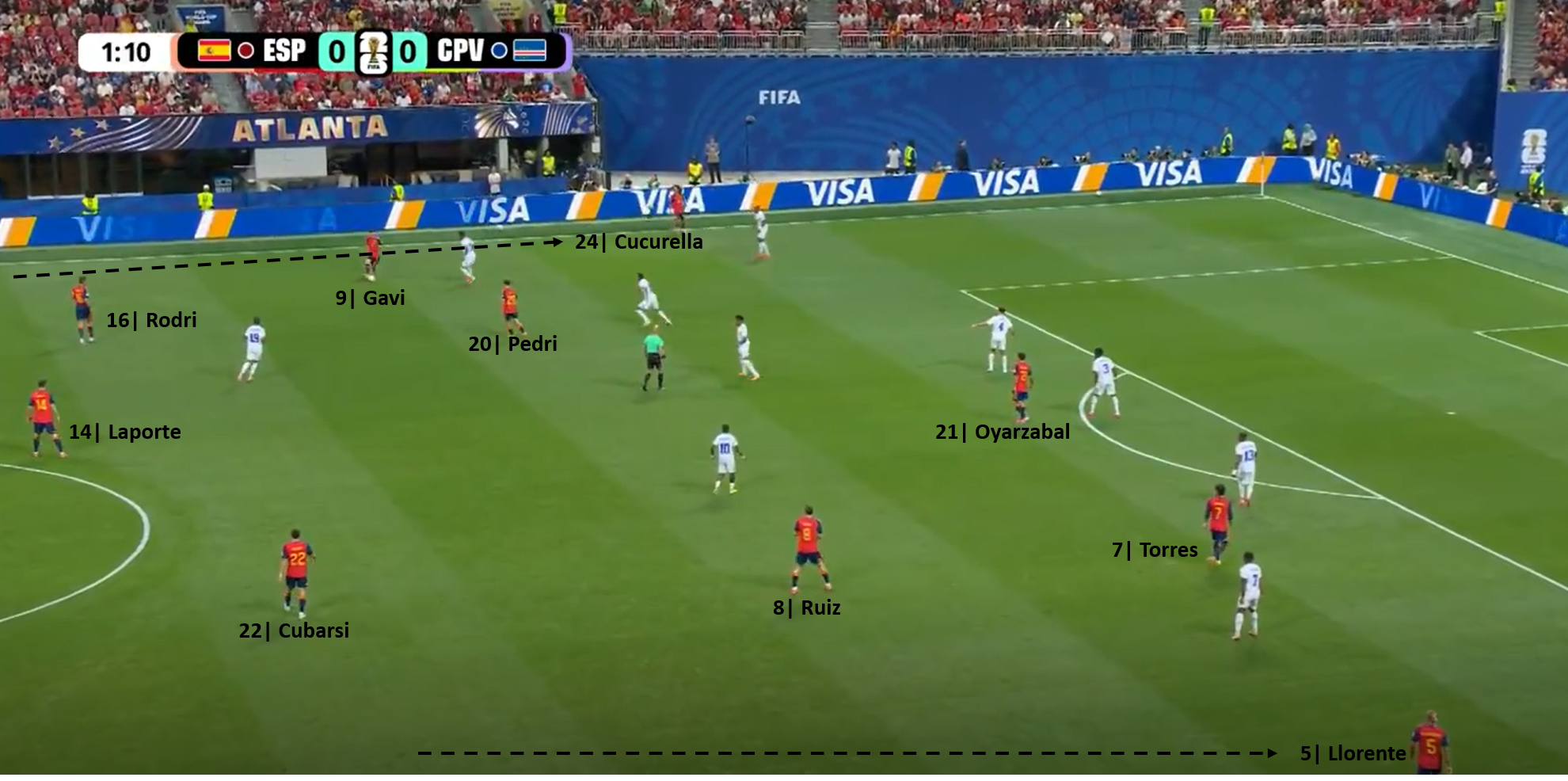
In the final third, Spain repeatedly looked to exploit the space behind Cape Verde's defensive line through Marc Cucurella.
The new Real Madrid signing received more than any other Spaniard between the opponent's midfield and defensive lines.
This was a clear attacking pattern throughout the match, with the left-back making forward runs beyond the defence to receive passes in advanced areas.
![Real Sociedad Vs Bournemouth [1-2] Europa League 2026/2027: How Do Marco Rose Pressing Tactics Work? - Tactical Analysis](https://cdn.mymidnight.blog/77f959f119f4fb2321e9ce801e2f5163/size/w600/2026/09/Real-Sociedad-Vs-Bournemouth-20262027---Tactical-Analysis-1.png)
![AC Milan Vs Benfica [0-2] Europa League 2026/2027: How Marco Silva Tactics Exposed Rúben Amorim Defensive Problems - Tactical Analysis](https://cdn.mymidnight.blog/77f959f119f4fb2321e9ce801e2f5163/size/w600/2026/09/AC-Milan-Vs-Benfica-20262027---Tactical-Analysis.png)
![Sunderland Vs AZ Alkmaar [1-0] Europa League 2026/2027: Why The Black Cats Make Better Underdogs - Tactical Analysis](https://cdn.mymidnight.blog/77f959f119f4fb2321e9ce801e2f5163/size/w600/2026/09/Sunderland-Vs-AZ-Alkmaar-20262027---Tactical-Analysis.png)
![Leeds United Vs Newcastle United [4-1] Premier League 2026/2027: Why Did Daniel Farke Tactics Dominate The Magpies? - Tactical Analysis](https://cdn.mymidnight.blog/77f959f119f4fb2321e9ce801e2f5163/size/w600/2026/09/Leeds-United-Vs-Newcastle-2026_2027---Tactical-Analysis.png)
![Real Sociedad Vs Atlético Madrid [0-3] La Liga 2026/2027: How Diego Simeone Tactical Precision Rescued A Late Victory - Tactical Analysis](https://cdn.mymidnight.blog/77f959f119f4fb2321e9ce801e2f5163/size/w600/2026/09/Real-Sociedad-Vs-Atl--tico-Madrid-20262027---Tactical-Analysis-1.png)
![Manchester United Vs Manchester City [0-1] Premier League 2026/2027: How Enzo Maresca Tactics Secured Victory With 10 Men - Tactical Analysis](https://cdn.mymidnight.blog/77f959f119f4fb2321e9ce801e2f5163/size/w600/2026/09/Manchester-United-Vs-Manchester-City--20262027---Tactical-Analysis.png)
![Tottenham Hotspur Vs Everton [0-0] Premier League 2026/2027: Why Can't Spurs Score? - Tactical Analysis](https://cdn.mymidnight.blog/77f959f119f4fb2321e9ce801e2f5163/size/w600/2026/09/Tottenham---Vs-Everton-20262027---Tactical-Analysis.png)