
Ronald Koeman Tactics At Netherlands 2026: Can Oranje End Decades Of World Cup Heartbreak? – Tactical Analysis

Netherlands are in their final phase of preparation ahead of the 2026 FIFA World Cup.
The hope of the nation is to lift a trophy that they have been chasing since 1934, the date of their first-ever participation in the FIFA World Cup.
In that time, the Dutch have finished as runners-up three times: 1974, 1978, and, most recently, 2010.
The Total Football pioneers will be hoping to reach the final once again and lift the trophy this time, despite knowing the mission will not be easy, with several teams having strong enough squads to challenge them in the knockout phase.
That said, it is no secret to anyone that the Netherlands also have a very powerful squad made up of some of the European leagues’ best players in their positions.
That alone should be a huge boost for Ronald Koeman and his team during the tournament.
It is also important to note that the Netherlands reached the quarter-finals in the latest World Cup edition in 2022, topping Group A with Qatar, Senegal, and Ecuador, and eliminating the United States in the Round of 16 before being knocked out by eventual winners Argentina in the quarter-finals.
This time, the Netherlands’ mission will be more difficult early on in a tricky Group F, with Sweden, Austria, and Tunisia all complicated teams to face and beat.
Furthermore, the Netherlands’ latest friendly game against Algeria ended in a 0-1 loss, suggesting that the Netherlands’ group-stage journey may not be as easy as some might think.
This Netherlands tactical analysis explores the Netherlands’ squad depth, expected Dutch tactics and formations at the World Cup, their attacking strengths/weaknesses, areas for defensive improvement, and provides a tournament prediction.
Netherlands Squad Depth, Predicted Starting XI & Formations
As mentioned, the Netherlands are known for having a world-class squad, with numerous players in the Premier League and other top leagues.
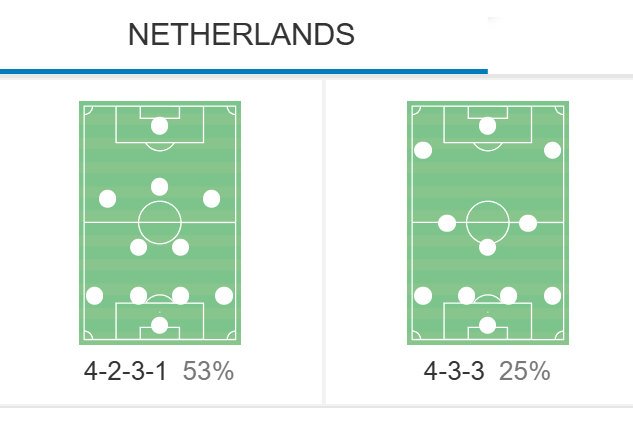
Koeman is known for using the 4-3-3 formation first and foremost, with the 4-2-3-1 formation as plan B.
Roland Koeman In-Game Formation Changes
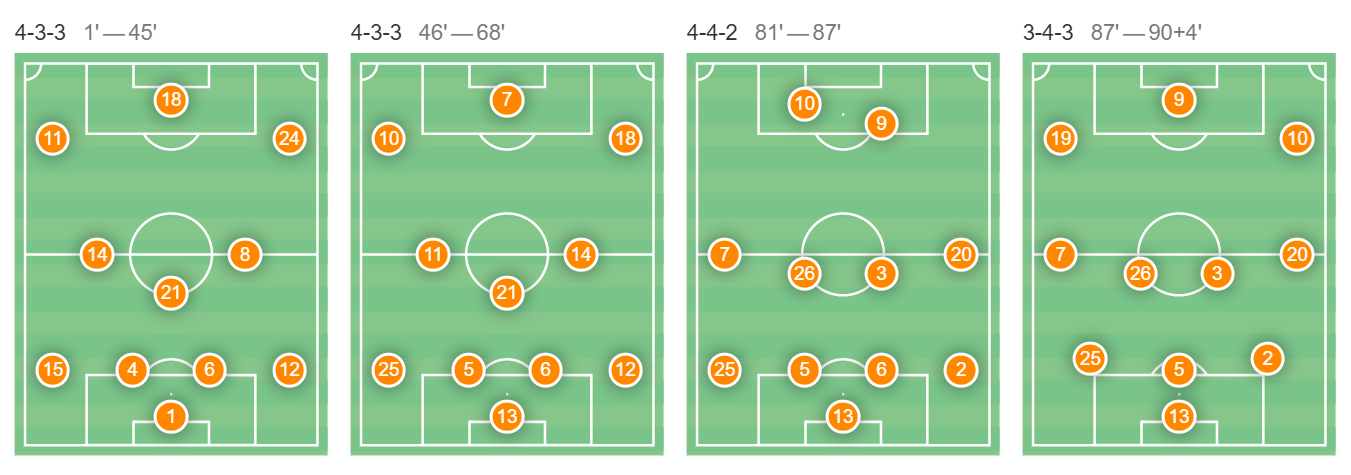
In the World Cup, Koeman is expected to continue using these two formations, with a slight possibility of reverting to a 4-4-2 when needed, as he did against Spain in the UEFA Nations League in 2025.
Moreover, we might see Koeman make other changes to his formation depending on how the game unfolds.
He showed remarkable tactical fluidity recently and a tendency to change his formations, especially when falling behind and needing to score goals urgently.
Against Algeria, Koeman switched to the 4-4-2 formation and then to the 3-4-3 formation to have more players in attack and midfield.
This might be reused in the World Cup when the team needs to score goals quickly or against teams that defend well and do not allow much space in behind.
Against Sweden and Tunisia, the Netherlands might find themselves in situations similar to those against Algeria: having to attack and find solutions against compact defences with low blocks, while putting their defence at risk in case of counterattacks.
Therefore, it will be important for Koeman to get his players used to such scenarios and adopt the best possible organisation for them, rather than switching formations repeatedly in a short time.
Predicted Netherlands Lineup
In terms of the team’s lineup, it is fair to say that Koeman’s mission will not be easy in this regard, as he has a lot of solid options regarding each position.
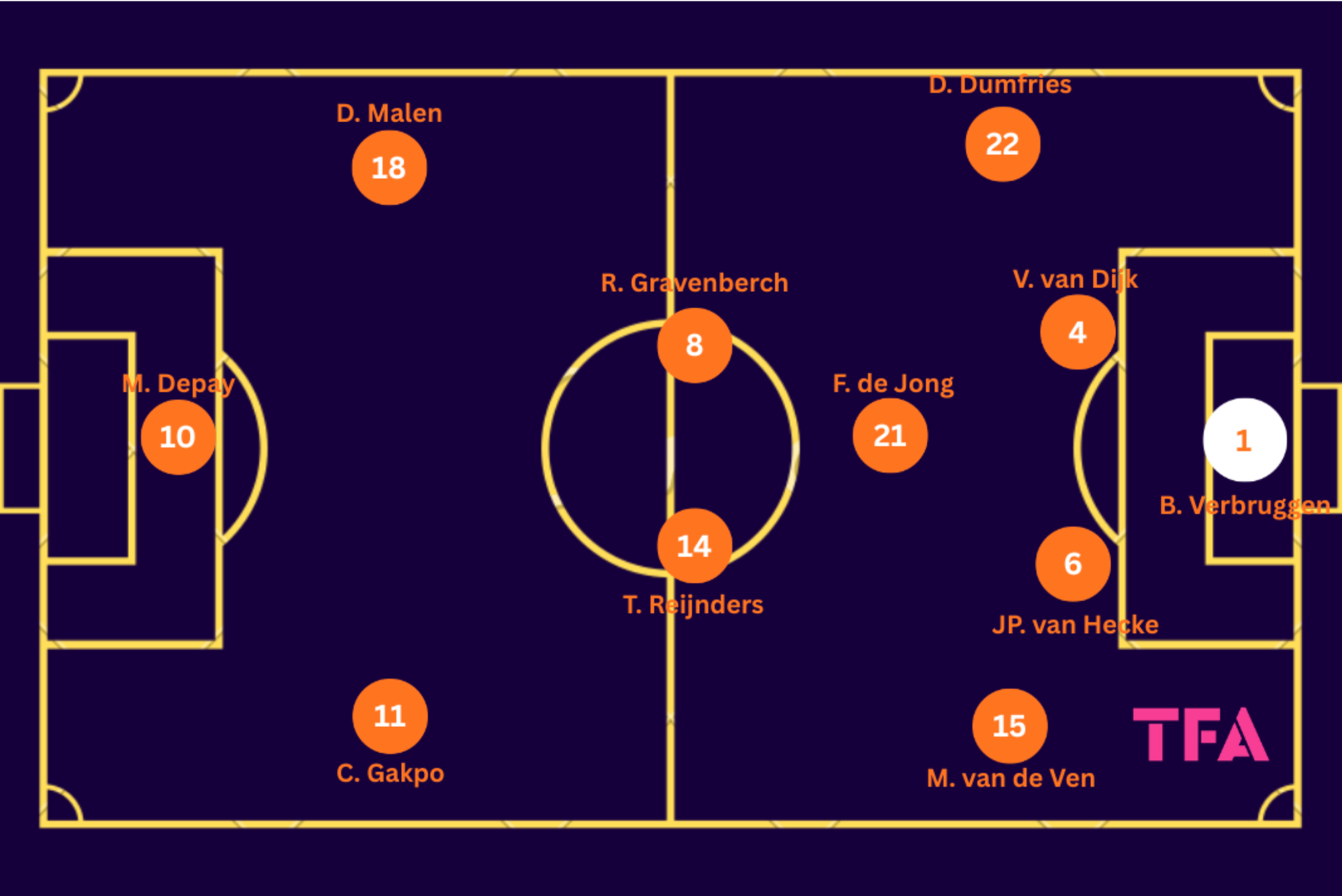
For the goalkeeper position, Bart Verbruggen will be the first-choice goalkeeper during the World Cup if no surprises happen, with Mark Flekken and Robin Roefs as backup options.
In defence, Koeman’s preferences are overall obvious: Relying mainly on a back-four formation and resorting to a back-three only in emergency cases.
For the defensive duo, Virgil van Dijk and Jan Paul van Hecke have the advantage over the rest of the centre-backs, knowing that Koeman have been using this duo frequently, which created more chemistry between the two.
The backup options will be Nathan Aké and Jorrel Hato, knowing that both players can also be backup options for the left-back role.
Jurriën Timber and Mats Wieffer will also be backup options for the right-back role, given that the first-choice for Koeman remains Denzel Dumfries on that right flank.
On the left side, Micky van de Ven is Koeman’s best option for the left-back role, while Hato and Aké remain second options for that position.
In midfield, Koeman has some of the most powerful players in their positions.
He is more likely to rely on both Ryan Gravenberch and Frenkie de Jong as the main central midfield players.
If he were to rely on a 4-3-3 formation, Tijjani Reijnders would be the best fit for the third midfield role, with De Jong as the defensive midfielder and both Gravenberch and Reijnders as the two central midfielders.
If Koeman switches to the 4-2-3-1 formation, Gravenberch and De Jong would remain as central midfielders, and Reijnders would advance to the advanced playmaker role.
Alternatively, Koeman might just sub out Reijnders and replace him with Justin Kluivert for that advanced playmaker role.
These are the best starting solutions for Koeman in midfield, with Marten de Roon, Teun Koopmeiners, Guus Til, and Quinten Timber as plan B options.
In attack, Koeman will be relying on Cody Gakpo as the first choice on the left wing, with Kluivert as a possible backup and Noa Lang as a reliable alternative.
On the right, Koeman is more likely to rely on Donyell Malen even though he is a striker.
Given Malen’s excellent run of form this season, Koeman is convinced that playing him even on the wing and not inside the box can be fruitful, whether in terms of penetrations or goalscoring.
The second option would be Crysencio Summerville.
For the striker role, Memphis Depay still has the advantage over the rest, with Malen as a very good alternative, and Wout Weghorst and Brian Brobbey as backup options.
Netherlands Attacking Strengths & Areas Of Improvement
Attacking-wise, it is impossible to think that the Netherlands lack quality, whether in playmaking or finishing.
Koeman’s side relies on progressive football, based mainly on short and through passes, with intelligent forward movements from midfielders like Reijnders to support attacks and provide key passing options.
Having two powerful and dynamic wingers, in addition to a striker who retreats to contribute to playmaking, makes the Netherlands capable of finding solutions with relative ease, even when facing teams that use a low defensive block.
The latest friendly game against Algeria showed us that the Netherlands had no issues reaching their opponent’s goal.
On the contrary, the Netherlands were capable of shooting 16 times, launching 37 attacks, and making 12 high recoveries.
The high recoveries, in particular, helped the Netherlands a lot in creating numerical superiority, thanks mainly to the quick advances to reach the box in such situations.
The Netherlands High Pressing Resistance & Efficient Build-Up From The Back
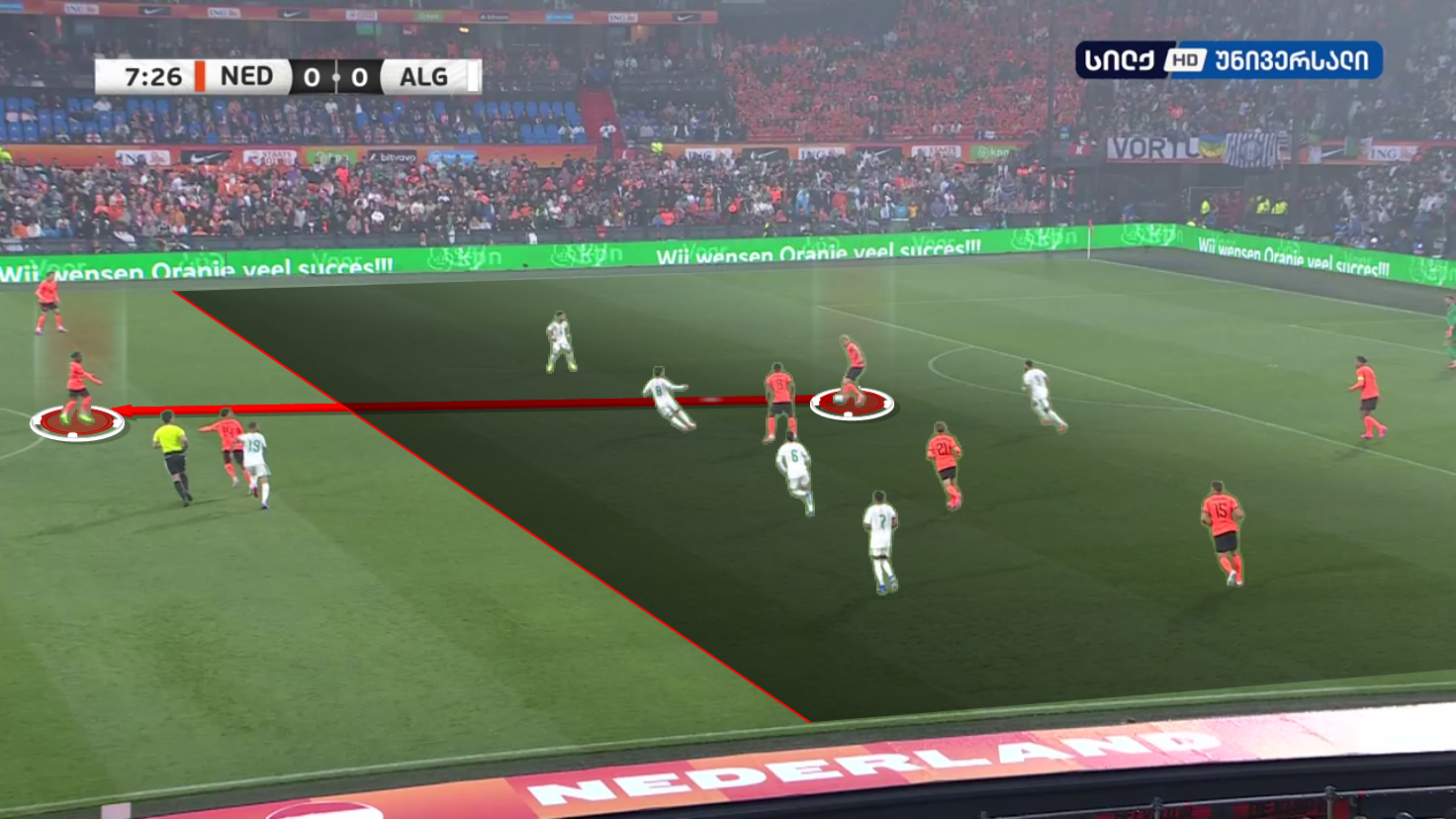
Another important aspect that helped the Netherlands reach the opponent’s box despite numerical superiority is their ability to easily break down high pressure, thanks to their impressive build-up play and the impressive qualities of their players.
The chemistry between the defensive and midfield players, along with their passing accuracy and intelligent movement, helps the Netherlands overcome any team’s high-pressing efforts.
That not only helps them surpass the opponent’s high press but also puts them in favourable conditions to continue their attacking transitions in numerical superiority by overcoming the numerous players applying the press.
In this example, the Netherlands beat five Algerian players thanks to their accurate vertical passing and ability to find passing opportunities at the right time.